
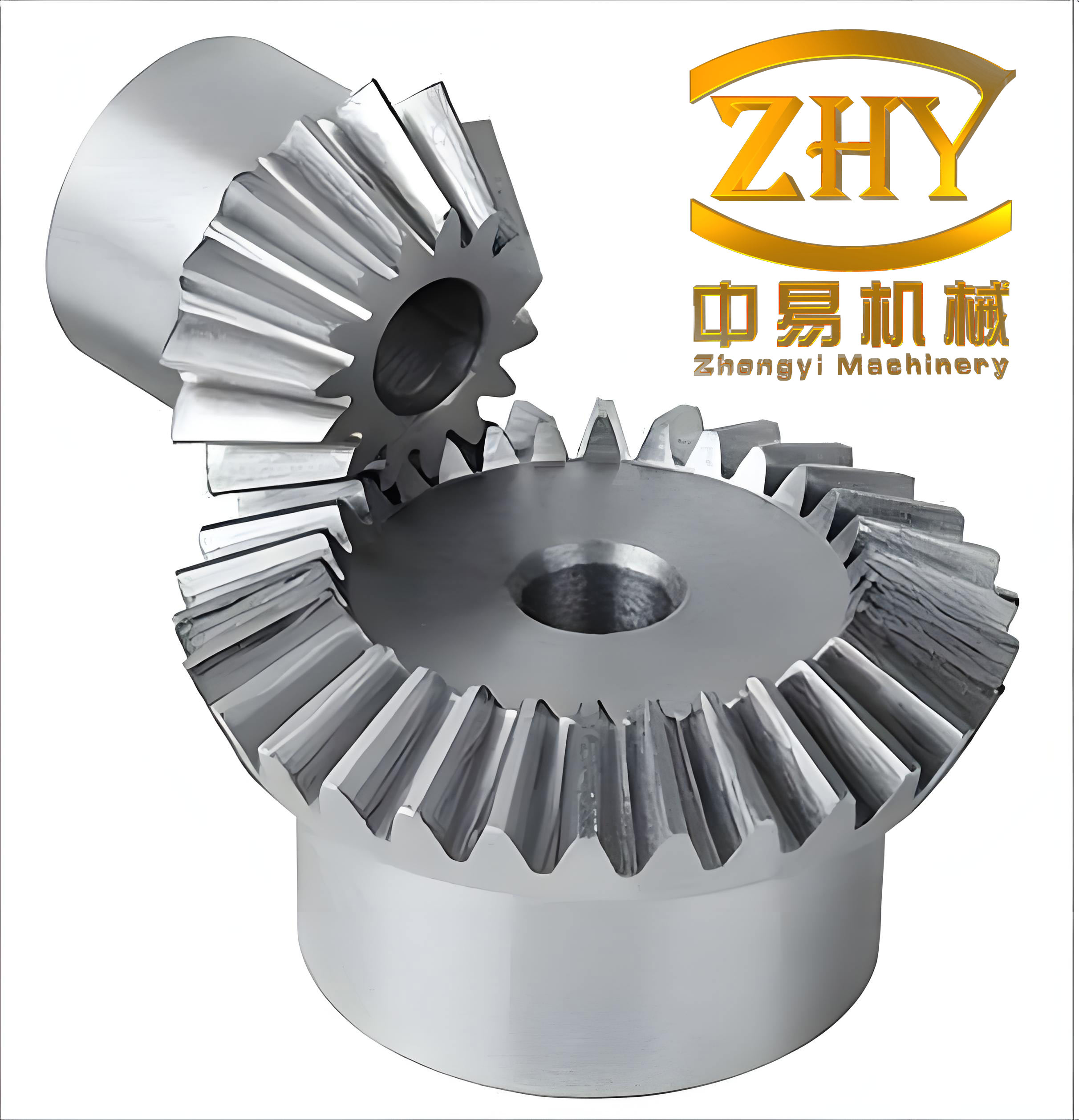
In this study, we investigate the complex nonlinear dynamics of straight bevel gear systems, focusing on bifurcation behaviors, tooth surface impacts, non-meshing phenomena, and dynamic load characteristics. Straight bevel gears are widely used in various industrial applications, such as automotive transmissions and aerospace systems, due to their ability to transmit power between intersecting shafts. However, the presence of backlash and time-varying meshing stiffness introduces significant nonlinearities, leading to undesirable vibrations, noise, and potential failures. Understanding the coupling between periodic motions, bifurcations, and dynamic responses is crucial for optimizing the design and performance of straight bevel gear systems. We employ an improved Continuous-Poincaré-Newton-Floquet (CPNF) method combined with cell mapping theory to analyze the solution domain structures in a two-parameter plane defined by the time-varying meshing stiffness coefficient and frequency ratio. This approach allows us to efficiently trace periodic solutions, identify bifurcation boundaries, and quantify dynamic characteristics such as non-meshing duty cycles and dynamic load coefficients. Our results reveal rich bifurcation modes, including saddle-node, Hopf, period-doubling, and period-3 bifurcations, coexisting with various tooth impact states. The insights gained from this analysis provide a foundation for mitigating vibrations and enhancing the reliability of straight bevel gear systems.
The dynamic behavior of straight bevel gear systems is governed by nonlinear equations that account for factors like backlash, time-varying stiffness, and damping. We develop a 7-degree-of-freedom model to capture the essential dynamics, including translational and rotational motions of the gears. The equations of motion are derived based on Newton’s second law, and dimensionless parameters are introduced to generalize the analysis. Key variables include the dynamic transmission error, meshing force, and stiffness variations. The dimensionless equations are expressed as follows:
$$ \begin{aligned}
&\ddot{x}_1 + 2\xi_{x1}\dot{x}_1 + 2a_4\xi_{h1}\dot{\lambda} + k_{x1}x_1 + a_4k_{h1}f(\lambda) = 0, \\
&\ddot{y}_1 + 2\xi_{y1}\dot{y}_1 – 2a_5\xi_{h1}\dot{\lambda} + k_{y1}y_1 – a_5k_{h1}f(\lambda) = 0, \\
&\ddot{z}_1 + 2\xi_{z1}\dot{z}_1 – 2a_3\xi_{h1}\dot{\lambda} + k_{z1}z_1 – a_3k_{h1}f(\lambda) = 0, \\
&\ddot{x}_2 + 2\xi_{x2}\dot{x}_2 – 2a_4\xi_{h2}\dot{\lambda} + k_{x2}x_2 – a_4k_{h2}f(\lambda) = 0, \\
&\ddot{y}_2 + 2\xi_{y2}\dot{y}_2 + 2a_5\xi_{h2}\dot{\lambda} + k_{y2}y_2 + a_5k_{h2}f(\lambda) = 0, \\
&\ddot{z}_2 + 2\xi_{z2}\dot{z}_2 + 2a_3\xi_{h2}\dot{\lambda} + k_{z2}z_2 + a_3k_{h2}f(\lambda) = 0, \\
&-a_1\ddot{x}_1 + a_2\ddot{y}_1 + a_3\ddot{z}_1 + a_1\ddot{x}_2 – a_2\ddot{y}_2 – a_3\ddot{z}_2 + \ddot{\lambda} + 2a_3\xi_h\dot{\lambda} + a_3k_h f(\lambda) = f_{pm} + f_{pv} + f_e\Omega^2 \cos(\Omega\tau),
\end{aligned} $$
where \( x_j, y_j, z_j \) are dimensionless displacements, \( \lambda \) is the dynamic transmission error, \( \xi \) terms represent damping ratios, \( k \) terms denote stiffness coefficients, and \( f(\lambda) \) is the backlash function defined as:
$$ f(\lambda, b) = \begin{cases}
\lambda – b, & \lambda > b, \\
0, & |\lambda| \leq b, \\
\lambda + b, & \lambda < -b.
\end{cases} $$
The time-varying meshing stiffness \( k_h(\tau) \) is approximated by a Fourier series:
$$ k_h(\tau) = 1 + \alpha \cos(\Omega\tau + \Phi_k), $$
where \( \alpha \) is the stiffness variation coefficient and \( \Omega \) is the frequency ratio. This model captures the essential nonlinearities in straight bevel gear systems, enabling a detailed analysis of dynamic responses.
To analyze the dynamic characteristics, we define several key metrics. The non-meshing duty cycle (δ_NMDC) and back-meshing duty cycle (δ_BMDC) quantify the extent of tooth separation and back-side contact, respectively:
$$ \delta_{\text{NMDC}} = \frac{t_1}{T}, \quad \delta_{\text{BMDC}} = \frac{t_2}{T}, $$
where \( t_1 \) and \( t_2 \) are the times spent in non-meshing and back-meshing states during one period \( T \). The dynamic load coefficient (δ_DLC) measures the amplification of dynamic loads:
$$ \delta_{\text{DLC}} = \frac{ |k(\tau) f(\lambda, b) + 2\xi_h \dot{\lambda}|_{\text{max}} }{f_{pm}}. $$
These metrics help evaluate the severity of impacts and loads in straight bevel gear systems under various operating conditions.
We employ the cell mapping principle to discretize the parameter plane into cells, each representing a combination of the stiffness coefficient \( \alpha \) and frequency ratio \( \Omega \). The CPNF method is used to solve for periodic orbits and track their stability across the parameter domain. The Jacobian matrix of the system is computed numerically to handle discontinuities at \( \lambda = \pm b \). The continuation algorithm predicts new periodic solutions using Euler integration, enabling efficient tracing of bifurcation boundaries. The Floquet multipliers are analyzed to determine stability, with \( |\lambda|_{\text{max}} > 1 \) indicating instability and bifurcation.
The parameter domain is set as \( \Omega \times \alpha \in [1.2, 1.7] \times [0.05, 0.55] \), discretized into 501×501 cells. We compute the periodicity, impact states, and dynamic metrics for each cell, resulting in comprehensive solution domain structures. The bifurcation types are classified as saddle-node (SN), period-doubling (PD), Hopf (HP), and period-3 (3T) bifurcations, among others. The impact states are denoted as I/P, where I represents the impact type (0 for no impact, 1 for unilateral impact, 2 for bilateral impact) and P is the period number.
Our simulations reveal intricate solution domain structures for straight bevel gear systems. The I/P bifurcation diagram shows that period-1 motion dominates the parameter space, but higher-period orbits, quasi-periodic, and chaotic motions also occur. Three types of tooth impacts coexist, with unilateral impacts being most common. As the stiffness coefficient \( \alpha \) increases, impact severity and chaotic behavior intensify. Bifurcation boundaries correspond to sudden changes in dynamic metrics, highlighting the coupling between periodic motions and tooth impacts.
The table below summarizes the dynamic characteristics in different parameter regions for straight bevel gear systems:
| Parameter Region | Dominant Motion | Impact Type | δ_NMDC Range | δ_BMDC Range | δ_DLC Range |
|---|---|---|---|---|---|
| α < 0.15, Ω < 1.25 | Period-1 | 0 and 1 | 0.1–0.3 | 0.0–0.1 | 1.2–1.8 |
| 0.15 < α < 0.3, 1.25 < Ω < 1.5 | Period-1 and Chaos | 1 and 2 | 0.2–0.5 | 0.1–0.3 | 1.5–2.5 |
| α > 0.3, Ω > 1.5 | Period-3 and Chaos | 2 | 0.3–0.55 | 0.2–0.38 | 2.0–2.8 |
The non-meshing duty cycle δ_NMDC exhibits jumps at bifurcation points, reaching up to 0.55 in regions with grazing bifurcations. In period-1 domains, δ_NMDC decreases with increasing Ω but increases with α. The back-meshing duty cycle δ_BMDC is most severe in bilateral impact regions, peaking around 0.38. The dynamic load coefficient δ_DLC shows mutations at impact transitions, with values ranging from 1.2 in no-impact zones to 2.8 in bilateral impact zones. These results underscore the sensitivity of straight bevel gear dynamics to parameter variations.
To validate the CPNF method, we compare the solution domain structures with numerical bifurcation diagrams obtained using the Runge-Kutta method. The three-dimensional I/P bifurcation diagram confirms the presence of SN, 3T, HP, and crisis bifurcations, aligning with the CPNF results. For instance, at α = 0.20, the system undergoes a sequence of bifurcations: from period-1 to period-3 via 3T bifurcation, then to quasi-periodic and chaotic motions via Hopf bifurcation. Poincaré maps and phase portraits illustrate these transitions, such as the emergence of three foci and invariant circles. Similarly, at α = 0.40, period-3 bifurcations lead to chaotic attractors, demonstrating the robustness of the CPNF approach for straight bevel gear analysis.
The dynamic metrics δ_NMDC, δ_BMDC, and δ_DLC are plotted against Ω for fixed α values, revealing how tooth impacts and bifurcations influence these parameters. In unilateral impact regions, δ_DLC decreases with Ω, whereas in bilateral impact regions, it increases with Ω. This behavior highlights the trade-offs in operating conditions for straight bevel gear systems. Engineers can use these insights to select parameters that minimize impacts and loads, such as avoiding high α values near resonance frequencies.
In conclusion, the parameter solution domain structures provide a comprehensive view of the nonlinear dynamics in straight bevel gear systems. The CPNF method efficiently captures bifurcation boundaries and dynamic characteristics, revealing that stiffness variations and frequency ratios critically affect periodicity, impacts, and loads. Designers should prioritize parameter regions with low δ_NMDC and δ_DLC, such as those with minimal backlash and controlled stiffness, to enhance the durability and performance of straight bevel gear systems. Future work could extend this approach to include additional parameters, such as lubrication effects or manufacturing errors, for a more holistic analysis.