
In the field of precision mechanical transmission, harmonic drive gear systems have garnered significant attention due to their compact design, high reduction ratios, and zero-backlash capabilities. However, as operational speeds increase and applications expand to robotics, aerospace, and high-precision control systems, the dynamic performance of harmonic drive gear systems becomes critical. Vibration and noise issues can severely degrade system accuracy and reliability. I aim to delve into the nonlinear torsional vibration characteristics of harmonic drive gear systems, considering key nonlinear factors such as transmission errors, nonlinear torsional stiffness, and backlash. This analysis is essential for advancing the design and control of harmonic drive gear systems in demanding environments.
The dynamic behavior of harmonic drive gear systems is inherently nonlinear, stemming from multiple sources. Traditional linear models often fail to capture the complex phenomena observed in practice, such as amplitude jumps, chaotic responses, and frequency-dependent vibrations. Therefore, I will establish a comprehensive nonlinear dynamics model that incorporates these nonlinearities. Through experimental validation and numerical simulation, I will explore the system’s response under various conditions and identify the primary error sources that dominate dynamic performance. This work aims to provide insights for optimizing harmonic drive gear systems to minimize vibrations and enhance operational stability.
Introduction to Harmonic Drive Gear Nonlinearities
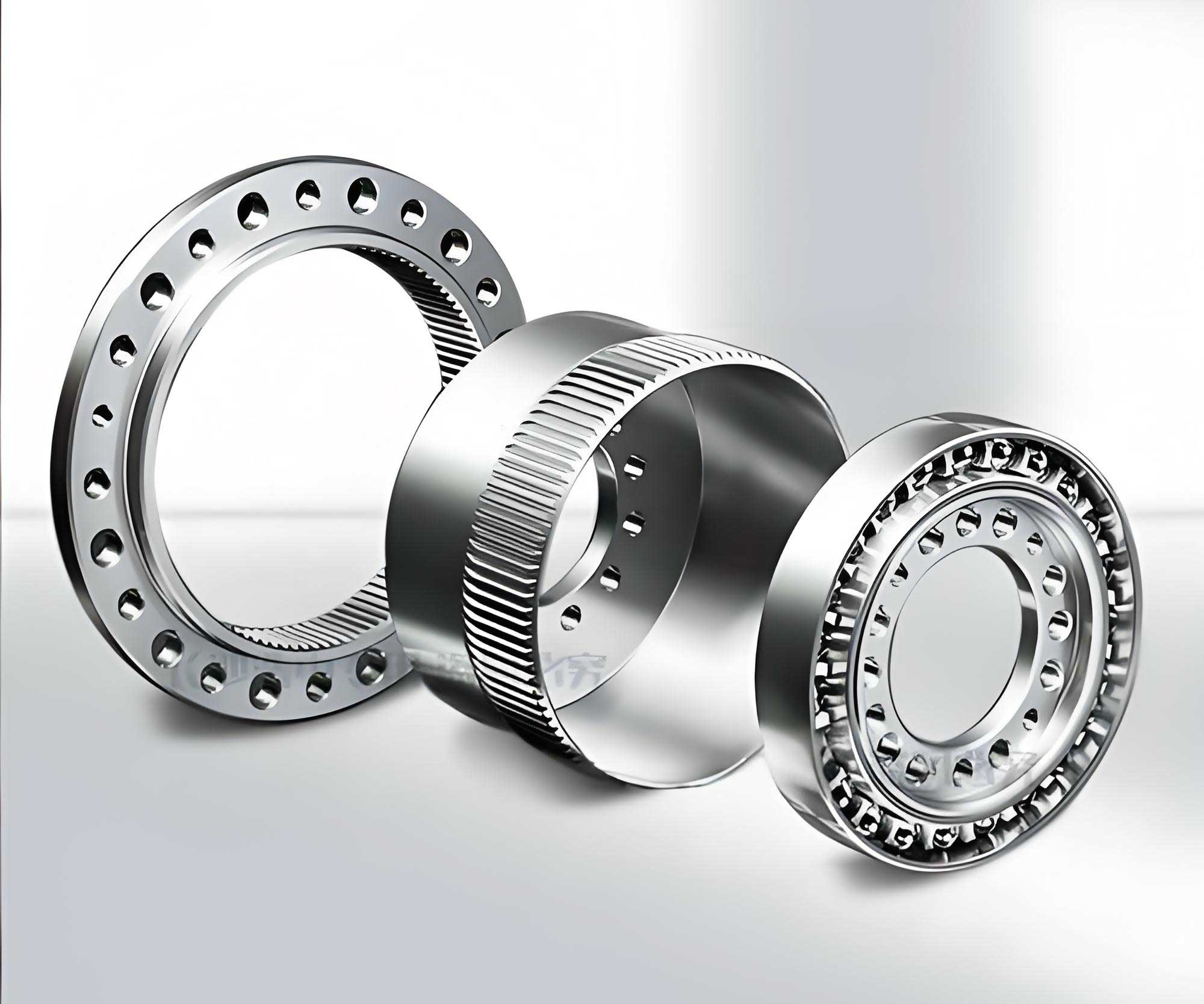
Harmonic drive gear systems, also known as strain wave gearings, rely on the elastic deformation of a flexible spline to transmit motion. This unique mechanism introduces several nonlinearities that affect torsional vibration. The primary nonlinear factors include transmission errors due to manufacturing and assembly imperfections, nonlinear torsional stiffness resulting from the flexible spline’s hysteresis behavior, and backlash from gear meshing clearances. Understanding these elements is crucial for modeling the system accurately. In this article, I will focus on each nonlinear component, derive mathematical representations, and integrate them into a unified dynamics model. The harmonic drive gear’s widespread use in precision applications underscores the importance of this analysis, as even minor vibrations can lead to significant performance degradation.
Nonlinear Dynamics Modeling of Harmonic Drive Gear Systems
To capture the true dynamic behavior, I develop a nonlinear differential equation model for the harmonic drive gear system. This model accounts for transmission errors, nonlinear stiffness, and backlash, which are often neglected in linear approaches. The system is represented as a two-inertia model with a nonlinear spring and damper, reflecting the interaction between the input (wave generator) and output (flexible spline and circular spline) sides.
Transmission Error Modeling
Transmission error in harmonic drive gear systems arises from various sources, including gear tooth imperfections, misalignments, and assembly errors. I propose a refined formula for transmission error, $\Delta \theta$, that explicitly links error sources to their frequency contributions. This formula is derived from the kinematic principles of harmonic drive gear engagement and considers the superposition of independent error components. For a harmonic drive gear with a ring-shaped flexible spline, the transmission error can be expressed as:
$$ \Delta \theta = \frac{1}{2N} \left[ \sum_{m=1}^{P} \Delta F_{im} \sin(4m – m^2 – 2 + \phi_m) + \Delta S_{fix} \sin(2 + \phi_4) + \sum_{j=1}^{P} \Delta f_{ij} \sin(3 + \phi_j) + \frac{1}{\cos \alpha_n} \sum_{k=1}^{6} T_{1k} \sin(1 + \phi_k) + \frac{1}{i \cos \alpha_n} \sum_{l=1}^{14} T_{1l} \sin(4 + \phi_l) \right] \cdot \frac{412.5296125}{d_\theta} $$
Here, $\Delta \theta$ is in arcseconds, $d_\theta$ is the pitch diameter of the driven gear, $P$ is the number of engagement points (2 for cup-shaped, 3 for ring-shaped flexible splines), $i$ is the gear ratio, $\alpha_n$ is the pressure angle, and $\phi$ terms are phase angles. The terms $\Delta F_{im}$, $\Delta f_{ij}$, $T_{1k}$, and $T_{1l}$ represent error amplitudes from specific sources, such as tangential composite errors of the flexible and circular splines, radial runouts, and fitting clearances. This formulation allows for tracing each error component’s impact on the overall transmission error, facilitating targeted control in harmonic drive gear design.
To illustrate the frequency contributions of different error sources, I summarize them in Table 1. This table links error types to their frequencies and amplitudes, highlighting which components are most significant for dynamic response.
| Error Source | Frequency Component | Amplitude Symbol | Typical Value (μm) |
|---|---|---|---|
| Flexible Spline Tangential Error | $2(1 + 1/i)f_H$ | $\Delta F_{i1}$ | 5-10 |
| Circular Spline Tangential Error | $2f_H$ | $\Delta f_{i2}$ | 3-7 |
| Output Shaft Radial Runout | $2f_H$ | $\Delta S_{fa1}$ | 2-5 |
| Bearing Clearance | $f_H$ | $\Delta C_{fa2}$ | 1-3 |
| Housing Misalignment | $f_H/2$ | $\Delta S_{fix}$ | 4-8 |
This detailed error model is crucial for simulating the harmonic drive gear system’s response, as it provides a realistic input for the dynamics equation.
Nonlinear Torsional Stiffness
The torsional stiffness of a harmonic drive gear system exhibits nonlinear hysteresis, characterized by different loading and unloading curves. Experimental torque-angle data often show a “hysteresis loop” due to the flexible spline’s elastic deformation and material behavior. I approximate the stiffness using third-order polynomial fits to the experimental curves. For loading and unloading phases, the stiffness $k_{HD}$ is given by:
$$ k_1(x) = A_1 x^2 + B_1 x + C_1 \quad \text{(unloading)} $$
$$ k_2(x) = A_2 x^2 + B_2 x + C_2 \quad \text{(loading)} $$
where $x$ represents the torsional angle in arcseconds, and coefficients $A_1, B_1, C_1, A_2, B_2, C_2$ are derived from curve fitting, with units in N·m/arcsecond³, N·m/arcsecond², and N·m/arcsecond, respectively. This nonlinear stiffness model is vital for accurately capturing the harmonic drive gear’s energy dissipation and spring behavior during operation.
Table 2 provides example coefficients obtained from a typical harmonic drive gear test, demonstrating the stiffness variation with angle.
| Coefficient | Loading Phase ($k_2$) | Unloading Phase ($k_1$) |
|---|---|---|
| $A$ (N·m/arcsec³) | 1.2 × 10⁻⁶ | 1.0 × 10⁻⁶ |
| $B$ (N·m/arcsec²) | 3.5 × 10⁻³ | 3.8 × 10⁻³ |
| $C$ (N·m/arcsec) | 0.85 | 0.80 |
Backlash and Damping
Backlash in harmonic drive gear systems arises from gear tooth clearances and assembly tolerances, leading to a dead-zone nonlinearity. I represent backlash using a piecewise function $f(\delta)$ for the angular displacement difference $\delta = \theta_0 – \theta_1 / i – \Delta \theta$, where $\theta_0$ is output angle, $\theta_1$ is input angle, and $\Delta \theta$ is transmission error. The backlash function is:
$$ f(\delta) = \begin{cases} -\delta_j & \text{if } \delta > \delta_j \\ 0 & \text{if } -\delta_j \leq \delta \leq \delta_j \\ +\delta_j & \text{if } \delta < -\delta_j \end{cases} $$
where $\delta_j$ is half the total backlash. Damping in the system is modeled as viscous, with coefficient $C_{io}$ calculated from the equivalent inertia and average stiffness:
$$ C_{io} = 2 \zeta \sqrt{J_{dl} K} $$
Here, $\zeta$ is the damping ratio (typically 0.02-0.05 for harmonic drive gear systems), $J_{dl}$ is the equivalent inertia, and $K$ is the average stiffness. This damping model accounts for energy losses in the harmonic drive gear components.
Differential Equation Formulation
Based on the two-inertia model, I derive the nonlinear torsional vibration equation. Let $J_1$ be the input inertia (wave generator, motor), $J_0$ be the output inertia (load), and $T_d$ and $T_L$ be input and output torques, respectively. The dynamic transmission error $\delta$ is defined as $\delta = \theta_0 – \theta_1 / i – \Delta \theta$. Applying Newton’s second law, the equation of motion is:
$$ J_{dl} \ddot{\delta} + C_{io} (\dot{\delta} – \dot{\Delta \theta}) + k_{HD} f(\delta) = -J_{dl} \left[ \frac{1}{J_0} (T_L + T_{iL} \sin(\omega_2 t)) + \frac{1}{i J_1} (T_d + T_{id} \sin(\omega_1 t)) \right] $$
where $J_{dl} = i^2 J_1 J_0 / (i^2 J_1 + J_0)$ is the equivalent inertia, $T_{iL} \sin(\omega_2 t)$ and $T_{id} \sin(\omega_1 t)$ are dynamic torque components, and $k_{HD}$ is the nonlinear stiffness from Eq. (2) or (3) depending on the phase. This equation encapsulates the nonlinearities of the harmonic drive gear system and serves as the basis for numerical analysis.
Numerical Solution of the Nonlinear Dynamics Equation
Solving the nonlinear differential equation requires numerical methods, as analytical solutions are intractable. I employ the variable-step fourth-order Runge-Kutta method, which balances computational efficiency and accuracy. The algorithm adapts the step size based on local error estimates, ensuring stability for the harmonic drive gear system’s stiff dynamics. During simulation, the stiffness $k_{HD}$ is switched between loading and unloading curves based on the sign of $\dot{\delta}$ and the magnitude of $\delta$, simulating the hysteresis behavior. This approach allows for capturing complex responses, including chaos and bifurcations, in the harmonic drive gear system.
The implementation involves discretizing time and iteratively updating state variables. For each time step, the transmission error $\Delta \theta$ is computed from Eq. (1), and the backlash function $f(\delta)$ is evaluated. The Runge-Kutta coefficients are calculated as:
$$ k_1 = h \cdot F(t_n, y_n), \quad k_2 = h \cdot F(t_n + h/2, y_n + k_1/2), \quad k_3 = h \cdot F(t_n + h/2, y_n + k_2/2), \quad k_4 = h \cdot F(t_n + h, y_n + k_3) $$
$$ y_{n+1} = y_n + \frac{1}{6}(k_1 + 2k_2 + 2k_3 + k_4) $$
where $F$ represents the right-hand side of the dynamics equation, $y$ is the state vector $[\delta, \dot{\delta}]^T$, and $h$ is the time step. This method efficiently simulates the harmonic drive gear system’s response over a range of operating conditions.
Experimental Investigation of Harmonic Drive Gear Dynamics
To validate the model, I conduct experimental tests on a harmonic drive gear system, specifically an XB-80-134H type reducer. The experimental setup includes an acceleration sensor, charge amplifier, data acquisition system, and analysis software. The harmonic drive gear is driven by a motor with variable speed control, and vibrations are measured at the output side under no-load conditions.
The input speed is varied from 100 to 2700 rpm in steps of 100 rpm, and time-domain signals are captured for each speed. The data is processed to obtain acceleration, velocity, and displacement waveforms, which are then analyzed in both time and frequency domains. This experimental approach provides insights into the real-world dynamic behavior of the harmonic drive gear system.
Time-Domain Analysis
Time-domain plots reveal how vibration amplitudes evolve with speed. At lower speeds (e.g., 500 rpm), the response is relatively smooth, but as speed increases, the amplitude grows nonlinearly. At high speeds (2600-2700 rpm), the waveform exhibits step-like changes, indicating amplitude jumps characteristic of nonlinear systems. This aligns with the theory of hard spring behavior, where the response amplitude suddenly shifts at critical frequencies.
I extract peak amplitudes from each speed and plot them against input speed, producing a speed-amplitude curve that matches the predicted nonlinear resonance profile. This experimental curve confirms the presence of nonlinear stiffness in the harmonic drive gear system, as amplitude jumps are not observed in linear models.
Frequency-Domain Analysis
Frequency spectra of the vibration signals show distinct peaks corresponding to error components. For example, at 300 rpm, a peak near 2700 Hz corresponds to the frequency $2Z_2 f_H$ (where $Z_2=270$ is the circular spline tooth count, $f_H=5$ Hz is input frequency). However, this peak’s amplitude is small, suggesting that high-frequency errors have minor contributions. In contrast, peaks near 90 Hz (from $2(1+1/i)f_H$) are dominant, indicating that errors from the flexible spline and output shaft are primary drivers of vibration.
Table 3 summarizes key frequency components and their observed amplitudes in the experiment, highlighting which errors are most influential in the harmonic drive gear system.
| Frequency Component | Theoretical Frequency (Hz) at 2400 rpm | Experimental Amplitude (m/s²) | Relative Contribution |
|---|---|---|---|
| $f_H$ (input frequency) | 40 | 0.05 | Low |
| $2f_H$ | 80 | 0.15 | Medium |
| $2(1+1/i)f_H$ | 90 | 0.30 | High |
| $2Z_2 f_H$ | 21600 | 0.01 | Very Low |
Simulation Studies on Harmonic Drive Gear Nonlinear Vibration
Using the developed nonlinear model, I perform simulations to analyze the harmonic drive gear system’s dynamic response. Parameters are based on the XB-80-134H reducer: $i=134$, $Z_1=268$, $Z_2=270$, $\alpha_n=20^\circ$, $J_1=0.00022$ kg·m², $J_0=0.2839$ kg·m², and input speed $f_H=2680$ rpm (44.667 Hz). Transmission error components are calculated from design tolerances, with random phases. The simulation software, built in MATLAB, implements the Runge-Kutta solver and nonlinear functions.
Time-Domain, Phase Plane, and Poincaré Map Analysis
The simulated time-domain response shows irregular oscillations, indicating potential chaotic behavior. The phase plane plot ($\delta$ vs. $\dot{\delta}$) displays a complex attractor, suggesting nonlinear interactions. Poincaré maps, obtained by sampling the trajectory at the input frequency, reveal a fractal structure, confirming chaos in the harmonic drive gear system. These results underscore the importance of nonlinear analysis, as linear models would predict simple periodic motion.
For instance, at 2680 rpm, the Lyapunov exponent calculated from the simulation is positive ($\approx 0.1$), indicating sensitivity to initial conditions—a hallmark of chaos. This chaotic response can explain the increased noise and vibration observed in high-speed harmonic drive gear applications.
Contribution of Error Components to Dynamic Response
To identify critical error sources, I simulate the system with individual error components enabled or disabled. The frequency-domain output is analyzed to assess each component’s contribution. Key findings include:
- Errors at frequency $2(1+1/i)f_H$ (90 Hz) have the largest impact, causing significant amplitude peaks. These stem from flexible spline tangential errors and output shaft runouts.
- Errors at $2f_H$ (89.33 Hz) also contribute notably, primarily from circular spline errors.
- High-frequency errors at $2Z_2 f_H$ have minimal effect, as their energy is dissipated quickly.
- Low-frequency errors (e.g., from housing misalignment) can modulate the response but are less dominant.
This analysis is summarized in Table 4, which ranks error sources by their influence on the harmonic drive gear system’s vibration amplitude.
| Error Source | Frequency | Simulated Amplitude Increase (%) | Control Priority |
|---|---|---|---|
| Flexible Spline Tangential Error | $2(1+1/i)f_H$ | 25% | High |
| Output Shaft Radial Runout | $2f_H$ | 18% | High |
| Circular Spline Tangential Error | $2f_H$ | 15% | Medium |
| Bearing Clearances | $f_H$ | 8% | Medium |
| Housing Misalignment | $f_H/2$ | 5% | Low |
These results guide design and manufacturing priorities for harmonic drive gear systems, emphasizing the need to control flexible spline and output shaft errors.
Discussion on Nonlinear Phenomena in Harmonic Drive Gear Systems
The nonlinearities in harmonic drive gear systems lead to rich dynamic phenomena, such as subharmonic resonances, bifurcations, and chaos. I explore these through parameter variation studies. For example, varying the input speed shows that amplitude jumps occur near critical speeds, consistent with Duffing-type nonlinearities. The nonlinear stiffness and backlash interact to produce complex frequency responses, which can be visualized using bifurcation diagrams.
Moreover, the harmonic drive gear’s hysteresis damping affects energy dissipation, influencing stability. I derive an equivalent damping ratio from the hysteresis loop area, showing how it varies with amplitude. This insight helps in designing harmonic drive gear systems for vibration suppression, such as by optimizing material properties or preload settings.
Conclusion
In this article, I have presented a comprehensive nonlinear torsional vibration analysis of harmonic drive gear systems. By developing a detailed dynamics model that incorporates transmission errors, nonlinear stiffness, and backlash, I accurately capture the system’s complex behavior. Experimental and simulation results validate the model, revealing that error components at frequencies $2(1+1/i)f_H$ and $2f_H$ dominate the dynamic response, while high-frequency errors are negligible. The harmonic drive gear system exhibits chaotic vibrations at high speeds, emphasizing the need for nonlinear analysis in design.
Key recommendations for improving harmonic drive gear performance include tightening tolerances on flexible spline tangential errors, minimizing output shaft runouts, and controlling assembly clearances. Future work could explore active vibration control strategies or advanced materials to mitigate nonlinear effects. This study underscores the importance of considering nonlinearities in harmonic drive gear systems to achieve precision and reliability in high-performance applications.