
In the development of pure electric vehicles, the two-speed automated mechanical transmission (AMT) without a clutch or synchronizer is a critical component for optimizing powertrain efficiency and performance. Within such transmissions, helical gears are extensively employed due to their superior load-bearing capacity, smooth engagement, and reduced noise compared to spur gears. However, the nonlinear vibration characteristics of helical gear systems can significantly impact transmission stability, shift comfort, and noise generation. As an engineer focused on powertrain dynamics, I have investigated the bending-torsion-axis coupled nonlinear vibration behavior of helical gears in a two-speed AMT. This analysis considers factors such as time-varying mesh stiffness, gear backlash, static transmission error, and bearing support stiffness, aiming to provide insights for structural design and shift strategy optimization.
The importance of helical gears in automotive transmissions cannot be overstated. Their angled teeth allow for gradual engagement, which minimizes impact loads and reduces vibration. Nevertheless, under operational conditions, internal excitations like mesh stiffness variations and external excitations from motor torque fluctuations induce nonlinear dynamics. These dynamics can lead to phenomena such as bifurcation and chaos, affecting the overall system reliability. In this article, I will explore the coupled vibration model, analyze the response under varying speeds, and discuss how parameters like damping ratio and mesh stiffness influence the system. The goal is to enhance the design of helical gear systems for improved NVH (noise, vibration, and harshness) performance in electric vehicles.
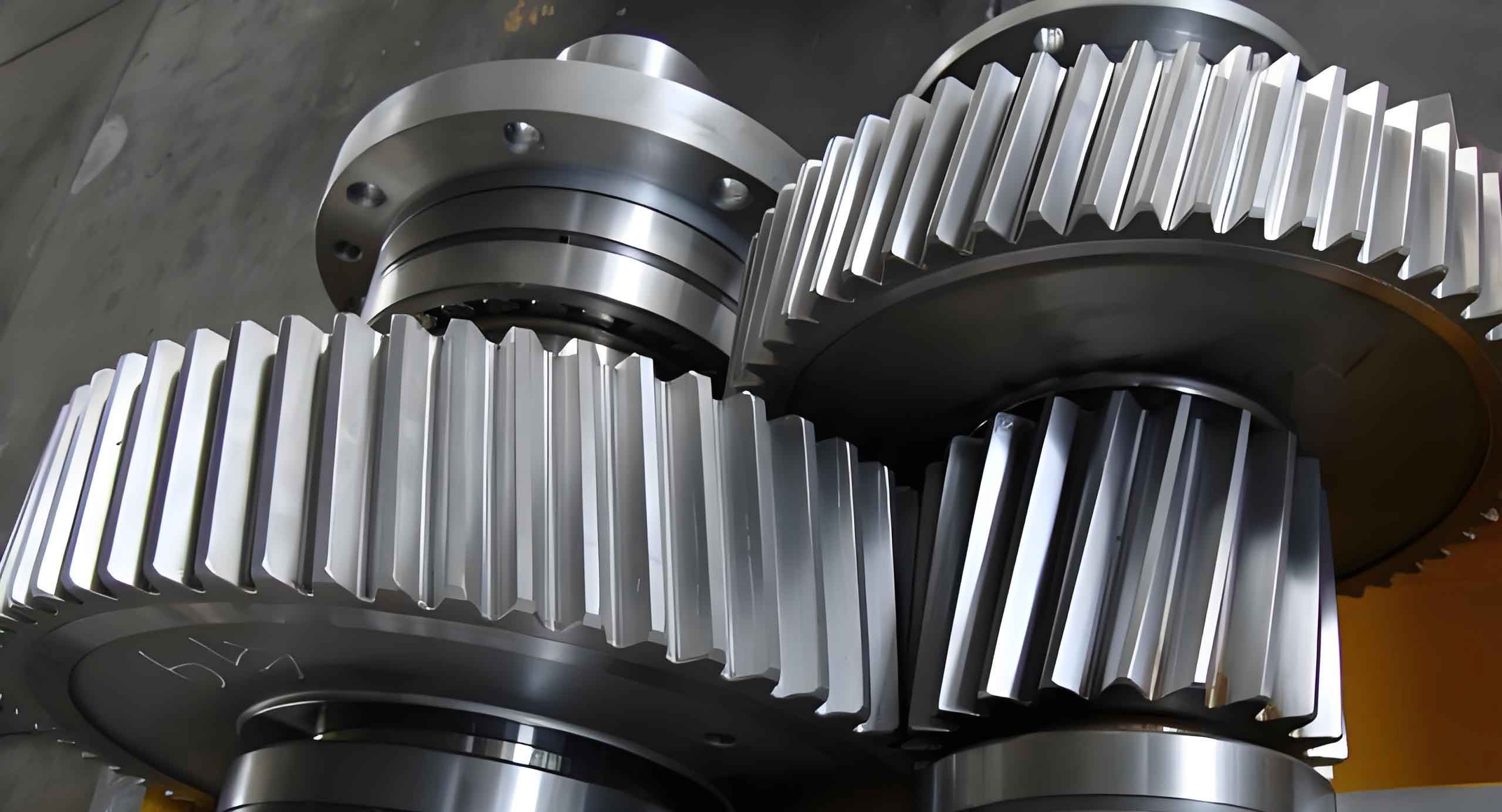
To understand the vibration behavior, I developed a nonlinear dynamic model for the two-speed AMT helical gear system. The transmission configuration includes an input shaft directly connected to the drive motor, with two helical gear pairs arranged for different gear ratios. When the first gear is engaged, the second gear pair remains unloaded but still participates in the dynamics due to coupling effects. The model accounts for 11 degrees of freedom, incorporating translational motions in axial and transverse directions, as well as rotational motions. The generalized coordinates are defined as follows:
$$ q = \{ x_1, y_1, x_2, y_2, \theta_m, x_3, y_3, \theta_3, x_4, y_4, \theta_4 \}^T $$
where \( x_i \) and \( y_i \) represent the axial and transverse displacements of gear \( i \), respectively, \( \theta_m \) is the rotational angle of the motor-input shaft assembly, and \( \theta_3 \) and \( \theta_4 \) are the rotational angles of gears 3 and 4. The internal excitations include time-varying mesh stiffness, mesh damping, and static transmission error. For helical gears, the mesh stiffness varies periodically and can be expressed as a Fourier series. For simplification, I consider only the first harmonic:
$$ k_h(t) = k_0 + \sum_{j=1}^{n} k_j \cos(j \omega_h t + \phi_j) $$
In practice, for helical gears, the average mesh stiffness \( k_0 \) and the harmonic amplitude \( k_1 \) are derived from gear geometry and material properties. The mesh damping is estimated using an empirical formula:
$$ c_h(t) = 2\xi \sqrt{\frac{k_0 I_p I_q}{r_p^2 I_q + r_q^2 I_p}} $$
where \( \xi \) is the damping ratio (typically 0.03–0.17), \( r_p \) and \( r_q \) are the base circle radii, and \( I_p \) and \( I_q \) are the moments of inertia. The static transmission error, resulting from manufacturing imperfections, is modeled as:
$$ e(t) = e \sin(\omega_h t) $$
Gear backlash introduces nonlinearity, described by piecewise functions for the axial and transverse dynamic mesh errors. For the first helical gear pair, the errors are:
$$ \delta_{x1} = x_1 – x_4 – \tan(\beta_{b1})(r_1 \theta_m + y_1 – r_4 \theta_4 – y_4) – e_1(t) \sin(\beta_{b1}) $$
$$ \delta_{y1} = r_1 \theta_m + y_1 – r_4 \theta_4 – y_4 – e_1(t) \cos(\beta_{b1}) $$
Similarly, for the second helical gear pair, the errors are defined. The mesh forces in axial and transverse directions are then derived using these errors and the stiffness and damping terms. The backlash function \( f(\delta) \) is given by:
$$ f(\delta) = \begin{cases}
\delta + b \sin \beta_b, & \delta < -b \sin \beta_b \\
0, & -b \sin \beta_b \leq \delta \leq b \sin \beta_b \\
\delta – b \sin \beta_b, & \delta > b \sin \beta_b
\end{cases} $$
External excitations include bearing support stiffness and load torques. The shafts are modeled as simply supported beams, and coupling between gear pairs on the same shaft is considered through displacement ratios \( \chi_x \) and \( \chi_y \), which depend on the shaft length and gear positions. The equations of motion are derived using Newton’s second law, resulting in a set of nonlinear differential equations. For brevity, the dimensionless form of these equations is presented below, where \( \omega_0 \) is the natural frequency, \( \tau \) is dimensionless time, and variables are normalized:
$$ \dot{X}_i = X_{i+11} \quad (i=1,2,\ldots,11) $$
with subsequent equations for accelerations involving stiffness, damping, and force terms. The system parameters for the helical gears are summarized in the table below.
| Parameter | Gear 1 | Gear 4 | Gear 2 | Gear 3 |
|---|---|---|---|---|
| Number of Teeth | 17 | 48 | 23 | 42 |
| Module (mm) | 2.5 | 2.5 | 2.5 | 2.5 |
| Helix Direction | Right | Left | Right | Left |
| Helix Angle (°) | 17.08 | 17.08 | 17.08 | 17.08 |
| Base Circle Radius (m) | 20.89e-3 | 58.98e-3 | 28.26e-3 | 51.53e-3 |
| Mass (kg) | — | 1.98 | — | 1.49 |
| Moment of Inertia (kg·m²) | — | 55.67e-4 | — | 25.41e-4 |
| Average Mesh Stiffness (N/m) | 2.229e8 | 2.246e8 | ||
| Mesh Stiffness Amplitude (N/m) | 0.82e8 | 0.8e8 | ||
| Half Backlash (m) | 1e-5 | |||
| Static Error Amplitude (m) | 5e-6 | |||
| Bearing Axial Stiffness (N/m) | 6.708e8 | |||
| Bearing Radial Stiffness (N/m) | 4.884e8 | |||
| Needle Bearing Stiffness (N/m) | 3.207e9 | |||
| Axial Contact Stiffness (N/m) | 2.06e8 | |||
| Motor-Input Shaft Inertia (kg·m²) | 0.0482 | |||
| Input Shaft Mass (kg) | 0.84 | |||
| Output Shaft Mass (kg) | 2.79 | |||
| Output Shaft Inertia (kg·m²) | 2e-3 | |||
The dimensionless equations are solved numerically using the fourth-order Runge-Kutta method to analyze the vibration characteristics. The dimensionless mesh frequency \( \omega \) is related to the motor speed \( \omega_m \) by \( \omega = \omega_m z_1 / \omega_0 \), where \( z_1 \) is the number of teeth on gear 1. For electric vehicles, the motor speed can vary widely, and the load torque changes with speed due to aerodynamic and rolling resistances, given by:
$$ T_f = \left( mgf + \frac{C_D A}{21.15} \left( \frac{\omega_m r_w}{3.6 i_{g1} i_0} \right)^2 \right) \frac{r_w}{\eta_t i_0} $$
where \( m \) is vehicle mass, \( f \) is rolling resistance coefficient, \( C_D \) is drag coefficient, \( A \) is frontal area, \( r_w \) is tire radius, \( \eta_t \) is transmission efficiency, \( i_{g1} \) is first gear ratio, and \( i_0 \) is final drive ratio. The motor torque is \( T_m = T_f / (i_{g1} i_0) \). This coupling between speed and load adds complexity to the dynamics of helical gears.
In the vibration analysis, I focused on the first gear pair under load, as it directly affects vehicle stability and shift smoothness. The transverse dynamic mesh error \( U_{y1} \) is used to represent torsional vibration. The bifurcation diagram of \( U_{y1} \) with respect to \( \omega \) reveals rich nonlinear behavior. For low dimensionless frequencies (\( \omega < 0.09 \)), the system exhibits single-period motion, indicating stable operation of the helical gears. As \( \omega \) increases to 0.09–0.1654, periodic motions alternate, but the system remains generally stable. A critical transition occurs at \( \omega = 0.1654 \) to 0.1673, where a grazing bifurcation leads to discontinuous periodic or chaotic motions. This bifurcation is caused by impacts between gear teeth, as the mesh error crosses the backlash boundaries, resulting in bilateral impacts. For example, at \( \omega = 0.1654 \), the phase diagram shows a single closed orbit, and the Poincaré map has a unique point set, confirming single-period motion. The time history and FFT spectrum indicate periodic vibration with a dominant frequency. In contrast, at \( \omega = 0.1673 \), the phase diagram becomes chaotic with multiple irregular loops, the Poincaré map shows a continuous set of points, and the FFT spectrum contains broadband frequencies, signifying chaos. This chaotic state can lead to increased noise and instability in helical gear transmissions.
Further analysis shows that at higher frequencies, such as \( \omega = 0.2528 \), the system reaches a maximum vibration displacement, followed by chaotic regions. Around \( \omega = 0.76–0.78 \), a pitchfork bifurcation occurs, where single-period motion bifurcates into double-period or multi-period motions. For \( \omega > 0.8 \), the system returns to single-period motion, suggesting that helical gears can stabilize at very high speeds. The bifurcation diagram highlights three peak vibration points at approximately \( \frac{1}{4}\omega_0 \), \( \frac{1}{2}\omega_0 \), and \( \frac{2}{3}\omega_0 \), corresponding to low, medium, and high-speed regions, respectively. These peaks represent critical speeds where torsional vibrations are amplified, necessitating careful design considerations for helical gears in AMTs.
The unloaded second helical gear pair also exhibits significant vibration due to coupling with the loaded pair. When the first gear pair is in single-period motion, the second gear pair’s torsional vibration, represented by \( U_{y2} \), increases with speed. For instance, at \( \omega = 0.04, 0.08, \) and \( 0.158 \), \( U_{y2} \) shows single-period motion with maximum displacements of 0.5182, 0.6458, and 0.7931, respectively. The time history plots confirm that higher speeds lead to larger vibration amplitudes, even in unloaded helical gears. This phenomenon contributes to gear rattling noise in transmissions, impacting driving comfort. Therefore, understanding the coupled dynamics of both loaded and unloaded helical gears is essential for comprehensive NVH optimization.
To mitigate excessive vibrations, I investigated the effects of system parameters on the nonlinear response of helical gears. The damping ratio \( \xi \) and mesh stiffness \( k_0 \) are key factors. For the maximum vibration point at \( \omega = 0.2528 \), varying \( \xi \) from 0.03 to 0.17 shows that higher damping ratios (\( \xi > 0.085 \)) significantly reduce the maximum displacement of \( U_{y1} \). For example, at \( \xi = 0.12 \), the bifurcation diagram indicates lower vibration amplitudes across most frequencies, but chaos persists at high speeds. The table below summarizes the impact of parameter changes on the peak vibration points.
| System Parameters | Frequency Point \( \omega \) | Maximum \( U_{y1} \) Displacement |
|---|---|---|
| \( \xi = 0.08 \), \( k_{01} = 2.229 \times 10^8 \, \text{N/m} \) | 0.2528 | 4.41 |
| \( \xi = 0.08 \), \( k_{01} = 2.229 \times 10^8 \, \text{N/m} \) | 0.4646 | 3.26 |
| \( \xi = 0.08 \), \( k_{01} = 2.229 \times 10^8 \, \text{N/m} \) | 0.6653 | 3.14 |
| \( \xi = 0.12 \), \( k_{01} = 2.229 \times 10^8 \, \text{N/m} \) | 0.2620 | 2.02 |
| \( \xi = 0.12 \), \( k_{01} = 2.229 \times 10^8 \, \text{N/m} \) | 0.5055 | 2.35 |
| \( \xi = 0.12 \), \( k_{01} = 2.229 \times 10^8 \, \text{N/m} \) | 0.6932 | 1.83 |
| \( \xi = 0.08 \), \( k_{01} = 4 \times 10^8 \, \text{N/m} \) | 0.2713 | 2.91 |
| \( \xi = 0.08 \), \( k_{01} = 4 \times 10^8 \, \text{N/m} \) | 0.4962 | 3.34 |
| \( \xi = 0.08 \), \( k_{01} = 4 \times 10^8 \, \text{N/m} \) | 0.7025 | 2.21 |
Increasing the average mesh stiffness \( k_{01} \) also reduces vibration amplitudes, particularly at low and high speeds. For \( k_{01} = 4 \times 10^8 \, \text{N/m} \), the bifurcation diagram shows that the system maintains quasi-single-period motion at low frequencies and exhibits pitchfork bifurcation at high frequencies. In general, higher stiffness and damping help suppress torsional vibrations in helical gears, but they may alter the bifurcation patterns. For instance, with increased stiffness, the medium-speed peak displacement slightly rises, highlighting the need for balanced parameter selection. These findings emphasize that optimizing helical gear design involves not only geometric parameters but also material properties and damping treatments to achieve desired dynamic performance.
The nonlinear dynamics of helical gears in two-speed AMTs are further influenced by coupling between bending, torsion, and axial vibrations. The dimensionless equations account for this coupling through terms involving \( \chi_x \) and \( \chi_y \), which represent displacement transfer between gear pairs on the same shaft. For example, the axial vibration of the first helical gear pair affects the second pair via shaft deformation, leading to coupled responses. This coupling explains why unloaded gears exhibit significant vibration even under no load. The equations of motion include cross-terms that link different degrees of freedom, making the system highly interactive. Solving these equations requires careful numerical integration, and I used time-step adjustments to ensure accuracy during impact events, such as when gear teeth disengage and re-engage due to backlash.
In practical applications, the results suggest several design strategies for helical gears in electric vehicle transmissions. First, avoiding operational speeds near critical frequencies where bifurcation or chaos occurs can reduce vibration and noise. For instance, if the motor speed range corresponds to \( \omega \) around 0.25, shifting to a different gear ratio might mitigate excessive torsional vibrations. Second, increasing the damping ratio through materials or lubrication can dampen nonlinear oscillations. Helical gears with optimized tooth profiles and surface treatments may exhibit higher effective damping. Third, enhancing mesh stiffness via material selection or heat treatment can improve stability, though trade-offs with weight and cost must be considered. Additionally, controlling backlash within tighter tolerances may reduce impact severity, but manufacturing constraints must be accounted for.
From a broader perspective, the study underscores the importance of holistic modeling in powertrain design. Traditional linear analyses often overlook nonlinear phenomena like bifurcation and chaos, which are critical for helical gears in high-performance applications. By incorporating time-varying stiffness, backlash, and coupling effects, engineers can better predict NVH characteristics and develop robust transmissions. Future work could explore advanced control strategies, such as active damping or shift timing optimization, to further enhance the performance of helical gear systems in AMTs. Moreover, experimental validation using dynamometer tests would help correlate the model with real-world behavior, ensuring practical relevance.
In conclusion, my analysis of the bending-torsion-axis coupled nonlinear vibration in two-speed AMT helical gear systems reveals complex dynamics driven by internal and external excitations. The helical gears exhibit periodic, chaotic, and bifurcation behaviors depending on operational speed, with critical points identified through bifurcation diagrams. The unloaded gear pair also shows significant vibration due to coupling, impacting overall transmission noise. Parameter studies indicate that higher damping ratios and mesh stiffness can reduce vibration amplitudes, aiding in design optimization. These insights contribute to the development of quieter, more efficient electric vehicle transmissions, highlighting the pivotal role of helical gears in advancing automotive technology. As the industry moves toward electrification, understanding and mitigating nonlinear vibrations in helical gear systems will remain a key focus for engineers aiming to improve driving comfort and vehicle reliability.