
In the field of gear design and manufacturing, straight bevel gears play a crucial role in transmitting motion and power between intersecting shafts, particularly in perpendicular arrangements. Their compact size, high transmission ratios, and robust load-bearing capacity make them indispensable in various mechanical systems. Traditional design approaches for straight bevel gears predominantly rely on spherical involute surfaces, which are challenging to manufacture precisely and often result in approximated tooth profiles. This paper introduces a novel methodology based on the tooth surface normal vector to directly solve for ruled tooth surfaces of straight bevel gears and analyze their geometric properties. By leveraging vector analysis and gear meshing principles, I derive the normal vector of the tooth surface, including its direction angles and length, which subsequently enables the direct determination of conjugate ruled surfaces and their characteristics such as principal curvatures, sliding coefficients, and conditions for singular points or undercutting. This approach simplifies the design process, eliminates the need for complex coordinate transformations, and provides a foundation for innovative design and optimization of straight bevel gears.
The foundation of this methodology lies in the precise definition of the tooth surface normal vector. Consider a point M on the tooth surface of a straight bevel gear, where the normal vector at this point is denoted as l. The magnitude of this vector, l = |l|, represents the length from the pitch circle intersection point Op to M. To facilitate analysis, I establish a Cartesian coordinate system Sp with origin at Op, where the yp-axis is tangent to the pitch circle, and the zp-axis is parallel to the gear axis. The direction angles of the normal vector l—α, β, and γ—define its orientation in this coordinate system. The relationships between these angles are given by:
$$ \cos\alpha = \sin\beta \cos\lambda $$
$$ \cos\gamma = -\sin\beta \sin\lambda $$
Here, λ is an auxiliary angle that relates to the gear’s geometry. The unit normal vector n(p) in the Sp coordinate system can be expressed as:
$$ n^{(p)} = \begin{bmatrix} \sin\beta \cos\lambda \\ \cos\beta \\ -\sin\beta \sin\lambda \end{bmatrix} $$
Consequently, the normal vector l(p) is written as l(p) = l n(p). This formulation allows for a direct link between the normal vector and the tooth surface parameters, serving as the basis for subsequent derivations. The key insight is that by defining the normal vector in terms of its direction angles and length, I can bypass traditional methods that require predefined tooth profiles or generating gear surfaces.
To derive the tooth surface equation, I consider two fixed coordinate systems, S and St, attached to the gear. The position vector of point M in system S is composed of three components: the axial displacement vector u, the radial position vector r, and the normal vector l. Thus, the tooth surface vector equation is:
$$ \mathbf{R}(u, v) = \mathbf{u} + \mathbf{r} + \mathbf{l} $$
where u = (0, 0, u)^T, r = (r sin v, r cos v, 0)^T, and l = l n. The parameter u represents the axial position, v is the angular position, and r is the pitch circle radius. The unit normal vector n in system S is obtained through a coordinate transformation from Sp to S, given by the transformation matrix Msp. Applying gear meshing theory, the conditions for conjugate surfaces are enforced through the dot products of partial derivatives of R with the normal vector:
$$ \frac{\partial \mathbf{R}}{\partial v} \cdot \mathbf{n} = 0 $$
$$ \frac{\partial \mathbf{R}}{\partial u} \cdot \mathbf{n} = 0 $$
Solving these equations yields differential relationships for the normal vector length l with respect to u and v. For a ruled surface, the unit normal vector n is independent of the axial position u, meaning that the direction angles β and λ are functions only of v. This leads to the following expressions:
$$ \frac{dl}{dv} = r \cos\beta = u \tan\delta \cos\beta $$
$$ \frac{dl}{du} = \frac{\sin\beta}{\cos\delta} \sin(\lambda – \delta) $$
Integrating these, I obtain the normal vector length as a function of u and v:
$$ l = u \frac{\sin\beta}{\cos\delta} \sin(\lambda – \delta) $$
$$ l = u \tan\delta \int \cos\beta \, dv $$
Equating these expressions provides a relation for the angle λ:
$$ \sin(\lambda – \delta) = \frac{\sin\delta}{\sin\beta} \int \cos\beta \, dv $$
By selecting the angular function β(v), such as a constant or polynomial, I can directly compute the tooth surface using the vector equation R(u, v). This approach enables the generation of various ruled surfaces for straight bevel gears without iterative solutions. The u-curves represent straight lines (generators) on the surface, which coincide with the instantaneous contact lines of meshing gears, while the v-curves depict the contact paths. This property is instrumental in analyzing meshing behavior and designing gears for specific applications.
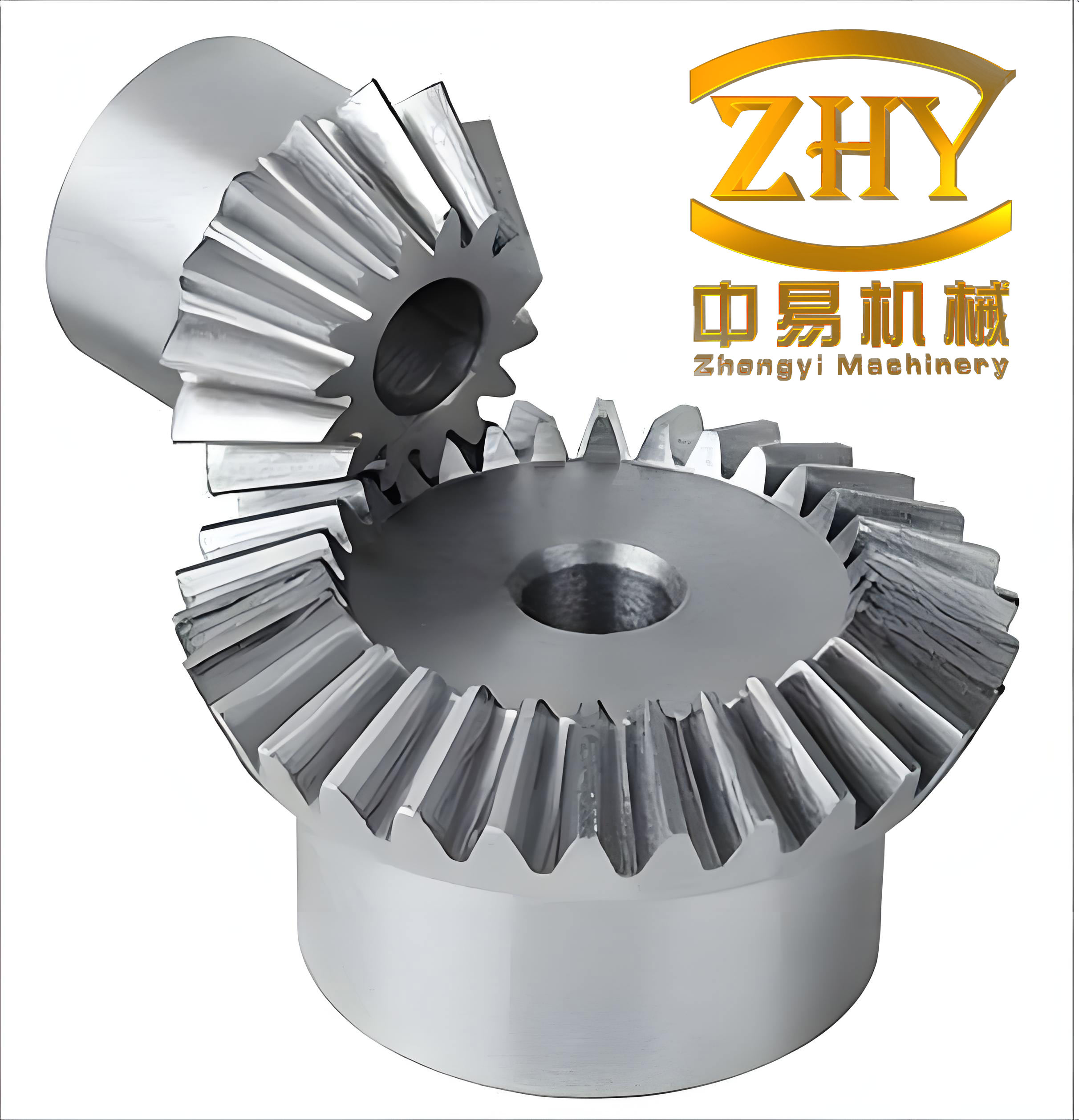
The geometric properties of the tooth surface, such as curvature and sliding coefficients, are critical for assessing performance and durability. For a ruled surface, the minimum principal curvature k2 is zero along the u-curves (generators). The maximum principal curvature k1 is derived from the fundamental forms of the surface. The first fundamental form coefficients E, F, and G are computed as:
$$ E = \frac{\partial \mathbf{R}}{\partial v} \cdot \frac{\partial \mathbf{R}}{\partial v}, \quad F = \frac{\partial \mathbf{R}}{\partial u} \cdot \frac{\partial \mathbf{R}}{\partial v}, \quad G = \frac{\partial \mathbf{R}}{\partial u} \cdot \frac{\partial \mathbf{R}}{\partial u} $$
And the second fundamental form coefficient L is:
$$ L = -\frac{\partial \mathbf{R}}{\partial v} \cdot \frac{\partial \mathbf{n}}{\partial v} $$
Since M and N (other second fundamental form coefficients) are zero for ruled surfaces, the maximum curvature simplifies to:
$$ k_1 = \frac{G L}{E G – F^2} $$
The condition for singular points (e.g., sharp edges or undercutting) occurs when the denominator vanishes:
$$ E G – F^2 = 0 $$
This equation defines the boundaries where the tooth surface may exhibit undesirable features, allowing designers to avoid them by adjusting parameters. Furthermore, the normal curvature in any direction θ is given by Euler’s formula:
$$ k_n(\theta) = k_1 \cos^2\theta $$
Sliding coefficients, which quantify relative motion between meshing surfaces, are essential for evaluating wear and efficiency. The sliding coefficients Sc1 and Sc2 for two conjugate surfaces are defined as:
$$ Sc_1 = \frac{\mathbf{V}_r \cdot \mathbf{V}_r}{\mathbf{v}_1 \cdot \mathbf{V}_r}, \quad Sc_2 = \frac{Sc_1}{Sc_1 – 1} $$
Here, Vr is the relative sliding velocity, and v1 is the sliding velocity of the contact point on the first tooth surface. In the Sp coordinate system, these velocities are computed as:
$$ \mathbf{v}_1 = \omega_1 \left( \frac{dl}{dv} \mathbf{n}^{(p)} + l \frac{d\mathbf{n}^{(p)}}{dv} \right) + (\mathbf{r}^{(p)} + \mathbf{l}^{(p)}) \times \boldsymbol{\omega}_1^{(p)} $$
$$ \mathbf{V}_r = (\boldsymbol{\omega}_1^{(p)} – \boldsymbol{\omega}_2^{(p)}) \times \mathbf{l}^{(p)} $$
where ω1 and ω2 are the angular velocities of the gears. By substituting these into the sliding coefficient formulas, I can directly assess the meshing performance without explicitly solving for the tooth surface geometry. The contact limit curve, where v1 = 0, indicates the boundaries of effective meshing and is derived from the equation:
$$ \omega_1 \left( \frac{dl}{dv} \mathbf{n}^{(p)} + l \frac{d\mathbf{n}^{(p)}}{dv} \right) + (\mathbf{r}^{(p)} + \mathbf{l}^{(p)}) \times \boldsymbol{\omega}_1^{(p)} = 0 $$
To demonstrate the applicability of this methodology, I consider examples of straight bevel gears with different angular functions β(v). First, for a spherical involute straight bevel gear, the base cone and pitch cone angles are δb and δ, respectively. The normal vector length is given by:
$$ l = u \frac{\cos\delta}{\sin(v \sin\delta_b)} $$
Substituting into the differential equations yields:
$$ \cos\beta = \frac{\sin\delta_b}{\sin\delta} \cos(v \sin\delta_b) $$
$$ \sin(\lambda – \delta) = \frac{\sin(v \sin\delta_b)}{\sin\beta} $$
For a constant direction angle function, β is constant (e.g., β = 0.349 rad), and for a linear function, β = a0 + a1 v (e.g., a0 = 0.349, a1 = 0.3). The geometric properties for these cases are summarized in the table below, assuming a pressure angle α0 = π/9, pitch cone angle δ = 5π/36, tooth count z = 18, and initial axial position u0 = 30.
| Type of Straight Bevel Gear | Angular Function β(v) | Maximum Curvature k1 | Sliding Coefficient Sc1 | Condition for Singular Points |
|---|---|---|---|---|
| Spherical Involute | Derived from involute geometry | High, varies with v | Moderate to high | EG – F² = 0 at specific v |
| Constant Direction Angle | β = 0.349 rad | Lower than involute | Reduced compared to involute | Depends on β and δ |
| Linear Direction Angle | β = 0.349 + 0.3v | Variable, controllable | Further reduced | Adjustable via coefficients |
The results indicate that non-involute angular functions can yield superior performance in terms of sliding coefficients and curvature management. For instance, the constant and linear direction angle straight bevel gears exhibit lower sliding coefficients, potentially reducing wear and improving efficiency. The maximum curvature k1 is also more manageable, minimizing stress concentrations. Moreover, the condition for singular points can be tailored by selecting appropriate β(v) functions, thereby avoiding undercutting and enhancing gear longevity.
In practical applications, this normal vector-based approach facilitates the direct generation of 3D models for straight bevel gears, which can be utilized in CNC machining or additive manufacturing. The ruled surface nature simplifies toolpath generation, as the u-curves are straight lines. Additionally, the methodology supports the design of custom tooth profiles for specific operational requirements, such as high-speed or high-load environments. By integrating this with modern CAD software, designers can rapidly prototype and optimize straight bevel gears without relying on traditional approximations.
In conclusion, I have presented a comprehensive methodology for solving ruled tooth surfaces of straight bevel gears based on the normal vector. This approach simplifies the design process by directly deriving tooth surfaces and their geometric properties from the normal vector definition. The ability to control parameters such as direction angles and normal vector length enables the creation of optimized gears with improved performance characteristics. Future work could explore the integration of this method with advanced manufacturing techniques and the extension to other gear types, further expanding its applicability in mechanical engineering.