
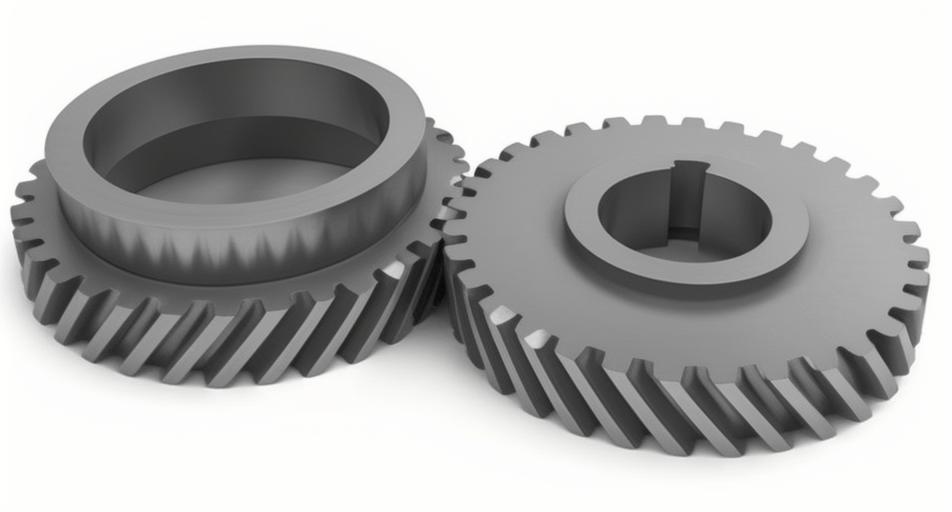
In the field of power transmission, helical gears are pivotal components renowned for their superior performance over spur gears. The inherent helix angle allows for a smoother and more gradual engagement of tooth pairs, leading to a higher contact ratio. This characteristic directly translates to enhanced load-carrying capacity, reduced noise generation, and greater operational平稳ity under heavy loads. Consequently, helical gears are extensively deployed in demanding applications across aerospace, maritime, wind turbine, and various heavy industrial sectors. However, when operating under high-speed and high-torque conditions, these gears can still exhibit significant vibration and acoustic emissions. Gear modification, or flank modification, has emerged as a highly effective engineering strategy to mitigate these dynamic issues by optimizing the tooth contact pattern and minimizing excitation sources.
Recent years have witnessed substantial research efforts directed towards understanding and applying modification techniques for helical gears. Scholars have employed diverse methodologies, including finite element analysis (FEA), to investigate the effects of modifications. Studies often focus on predicting quasi-static transmission error (QSTE), load distribution along the tooth face, and root bending stresses. While these static or quasi-static analyses provide valuable insights into contact mechanics and stress states, they frequently overlook the dynamic interactions inherent in a running gear pair, especially at elevated speeds. Furthermore, many established dynamic models simplify the system by considering only bending-torsional vibrations, neglecting the coupled effects of axial vibrations which are significant in helical gears due to the helix-induced axial force component. Additionally, experimental validation of dynamic parameters, such as vibration acceleration specifically in the line of action at high operational speeds, remains challenging due to measurement limitations.
To address these gaps, this work presents a comprehensive study that integrates a refined dynamic model with experimental validation. The primary objectives are: 1) To develop a coupled bending-torsion-axial vibration model for a helical gear pair that explicitly incorporates parameters for both profile and lead (longitudinal) modifications. 2) To numerically determine the vibration acceleration in the line of action using this model for both unmodified and modified gear sets. 3) To manufacture corresponding gear specimens and establish a power-circulating-type test rig capable of accurately measuring this dynamic parameter at high speeds. 4) To compare the numerical predictions with experimental results, thereby validating the model and quantifying the vibration reduction achieved through modification.
Development of the Coupled Bending-Torsion-Axial Vibration Model
The dynamic model considers a pair of meshing helical gears. The coordinate system is defined with the y-axis along the line of action direction at the pitch point, the z-axis along the gear axial direction, and the x-axis completing the right-handed system (primarily associated with rotation). The helix angle is denoted by $\beta$. A critical kinematic relationship links the transverse and axial displacements at the mesh point due to the helix:
$$ z = y \tan \beta $$
Ignoring tooth friction, the generalized displacement vector for the system is defined as:
$$ \{\delta\} = \{ y_p, z_p, \theta_p, y_g, z_g, \theta_g \}^T $$
where $y_i$, $z_i$, and $\theta_i$ (with $i = p, g$ for pinion and gear respectively) represent the translational vibrations in the y and z directions and the rotational vibration of the gear body centers.
Applying Newton’s second law, the equations of motion for the pinion and gear are derived separately. For the pinion:
$$
\begin{aligned}
m_p \ddot{y}_p + c_{py} \dot{y}_p + k_{py} y_p &= -F_y, \\
m_p \ddot{z}_p + c_{pz} \dot{z}_p + k_{pz} z_p &= -F_z, \\
I_p \ddot{\theta}_p &= -F_y \cdot R_p + T_p.
\end{aligned}
$$
For the gear:
$$
\begin{aligned}
m_g \ddot{y}_g + c_{gy} \dot{y}_g + k_{gy} y_g &= F_y, \\
m_g \ddot{z}_g + c_{gz} \dot{z}_g + k_{gz} z_g &= F_z, \\
I_g \ddot{\theta}_g &= F_y \cdot R_g – T_g.
\end{aligned}
$$
Here, $m_i$ is mass, $I_i$ is mass moment of inertia, $R_i$ is pitch radius, and $T_i$ is the transmitted torque. The damping and stiffness coefficients $c_{iy}, c_{iz}, k_{iy}, k_{iz}$ represent the effective support properties from shafts and bearings in the transverse (y) and axial (z) directions. $F_y$ and $F_z$ are the dynamic mesh forces in the y (transverse/longitudinal) and z (axial) directions, respectively.
These mesh forces are expressed in terms of the mesh stiffness $k_m(t)$, mesh damping $c_m$, and the total dynamic transmission error along the line of action, which includes the static transmission error $e(t)$ and geometric modifications $\Delta_{mod}$. The force can be expressed as:
$$ F_{mesh} = k_m(t) (\delta_{dte}) + c_m (\dot{\delta}_{dte}) $$
where $\delta_{dte} = (y_p – y_g + q) \cos \beta + (z_p – z_g) \sin \beta – e(t) – \Delta_{mod}(t)$.
The parameter $q$ is introduced to eliminate rigid body rotation and is defined as:
$$ q = R_p \theta_p – R_g \theta_g $$
By substituting the kinematic relation $z = y \tan \beta$ and combining the equations of motion, a 5-degree-of-freedom system is obtained with the displacement vector $\{\delta\} = \{ y_p, z_p, y_g, z_g, q \}^T$. The final coupled matrix form of the equations of motion is:
$$
\mathbf{M} \ddot{\mathbf{\delta}} + \mathbf{C} \dot{\mathbf{\delta}} + \mathbf{K} \mathbf{\delta} = \mathbf{F_{ext}} + \mathbf{F_{mesh}}(\delta, \dot{\delta}, t)
$$
Where $\mathbf{M}$, $\mathbf{C}$, and $\mathbf{K}$ are the mass, damping, and stiffness matrices, respectively. $\mathbf{F_{ext}}$ is the external torque vector. The mesh force vector $\mathbf{F_{mesh}}$ is a nonlinear function due to the time-varying mesh stiffness $k_m(t)$ and the modification function $\Delta_{mod}(t)$, making the system a set of nonlinear ordinary differential equations (ODEs). The modification function typically combines profile relief (parabolic or linear) and lead crowning.
$$
\Delta_{mod}(t) = \Delta_{profile}(s) + \Delta_{lead}(u)
$$
Here, $s$ is the roll distance along the profile, and $u$ is the coordinate along the tooth face width.
| Parameter | Symbol | Description |
|---|---|---|
| Pinion/Gear Mass | $m_p, m_g$ | Gear body mass |
| Transverse Support Stiffness | $k_{py}, k_{gy}$ | Bearing/shaft stiffness in line-of-action direction |
| Axial Support Stiffness | $k_{pz}, k_{gz}$ | Bearing/shaft stiffness in axial direction |
| Time-Varying Mesh Stiffness | $k_m(t)$ | Periodic function representing changing contact conditions |
| Mesh Damping | $c_m$ | Often taken as a percentage of critical damping |
| Static Transmission Error | $e(t)$ | Kinematic error due to manufacturing deviations |
| Helix Angle | $\beta$ | Key parameter coupling transverse and axial motions |
Numerical Simulation Case Study
To demonstrate the application of the developed model, a case study involving two sets of helical gears was conducted: one unmodified set and one modified set. The basic geometric parameters for the unmodified helical gears are listed in the table below. The nominal operating condition for simulation was set at a pinion speed of 1000 rpm and a gear torque of 865 Nm.
| Gear Parameter | Pinion | Gear |
|---|---|---|
| Number of Teeth, Z | 47 | 19 |
| Module, mn (mm) | 6 | 6 |
| Normal Pressure Angle, αn (°) | 20 | 20 |
| Helix Angle, β (°) | 9.91 | 9.91 |
| Face Width, b (mm) | 75 | 75 |
| Transmission Ratio | 2.47 | |
The modified gear set shared all basic parameters with the unmodified set. The modification applied was a combination of profile relief and lead crowning. The specific modification parameters are summarized as follows:
| Profile Modification Parameters | Lead (Longitudinal) Modification Parameters | |||
|---|---|---|---|---|
| Symbol | Value | Symbol | Value | Description |
| Amount at Tip/Start | 12 µm | Crowning Amount (Center) | 10 µm | Parabolic crowning amplitude |
| Relief Length | 1.6 mm | Crowning Length/Zone | 35 mm | Effective crowning zone width |
| Amount at Root/End | 10 µm | Linear End Relief | 10 µm | Additional relief at tooth ends |
| Active Profile Length | 3.2 mm | – | – | – |
The system of nonlinear ODEs was solved using a numerical integration technique, such as the Runge-Kutta method. The time-varying mesh stiffness $k_m(t)$ was calculated prior to dynamic analysis based on the potential energy method or ISO standards, considering the contact lines of the helical gears. The output of primary interest was the relative vibration acceleration along the line of action, derived from the second derivative of the dynamic transmission error:
$$ \ddot{\delta}_{LOA} = \ddot{y}_p – \ddot{y}_g + \ddot{q} $$
The simulation results for both gear sets are presented conceptually. The unmodified helical gears exhibited a vibration acceleration signal with pronounced fluctuations and higher amplitude modulation, corresponding to significant excitation at the mesh frequency and its harmonics. The calculated Root Mean Square (RMS) value for the unmodified case was found to be 4.46 m/s². In contrast, the signal for the modified helical gears showed markedly reduced fluctuation amplitude and a smoother waveform. The RMS value for the modified case decreased to approximately 2.09 m/s², representing a reduction of 53.2% compared to the unmodified gears. This substantial decrease highlights the effectiveness of the applied profile and lead modifications in mitigating dynamic mesh forces and, consequently, vibration levels in helical gears.
Experimental Setup and Validation
To validate the numerical model, an experimental investigation was conducted. A power-circulating (or back-to-back) gear test rig was designed and constructed. This type of rig is ideal for testing gears under high load without requiring massive input power, as the torque is recirculated within a closed loop. The major components included a test gearbox housing the specimen helical gear pair, a slave gearbox, a connecting shaft, and a hydraulic or mechanical torque actuator to apply and maintain the static load in the loop.
The core of the measurement system involved two high-precision rotary encoders (e.g., Heidenhain ROD 280 series) mounted directly on the pinion and gear shafts. These encoders measure angular position with extremely high resolution and accuracy (±5 arcseconds). The analog sinusoidal signals from the encoders were acquired simultaneously by a high-speed data acquisition card (e.g., PCI 8502H with 40 MHz clock) to ensure precise timing correlation. The sampling frequency was set sufficiently high to capture the high-frequency content of the angular vibration.
Before dynamic testing, a contact pattern check was performed using gear marking compound (blue) to verify proper alignment and contact of the helical gear teeth. Both the unmodified and modified gear pairs showed clear, well-centered contact patterns across the tooth face, confirming correct installation and the absence of major misalignment, which could otherwise skew vibration results.
The principle for obtaining the line-of-action vibration acceleration from the measured angular data is as follows. The angular acceleration of each shaft, $\ddot{\varphi}_p$ and $\ddot{\varphi}_g$, is derived by double differentiation of the acquired angular position signals (using appropriate digital filtering to manage noise amplification). The relative vibration acceleration along the line of action, $\Delta \ddot{x}$, is then calculated using the base circle radii:
$$ \Delta \ddot{x} = \ddot{x}_p – \ddot{x}_g = \ddot{\varphi}_p R_{bp} – \ddot{\varphi}_g R_{bg} $$
where $R_{bp}$ and $R_{bg}$ are the base circle radii of the pinion and gear, respectively.
The tests were performed under the same nominal operating conditions as the simulation: a pinion speed of 1000 rpm and a gear static torque of 865 Nm. The measured vibration acceleration signals for both gear sets were processed. The experimental data for the unmodified helical gears confirmed the numerical prediction, displaying large-amplitude fluctuations. The RMS value calculated from the experimental data was 15.96 m/s². For the modified helical gears, the experimental signal showed a dramatic reduction in amplitude and a much smoother characteristic. The experimental RMS value dropped to 7.13 m/s², which corresponds to a reduction of 55.3%.
The comparison between numerical and experimental results yields crucial insights. First and foremost, the trend is in excellent agreement: both methods conclusively demonstrate that the applied flank modification leads to a significant reduction (approximately 53-55%) in the RMS level of vibration acceleration for these helical gears. This validates the fundamental predictive capability of the coupled bending-torsion-axial vibration model regarding the effect of modifications.
However, a notable difference exists in the absolute magnitude of the RMS values. The experimental values (15.96 and 7.13 m/s²) are higher than the simulated values (4.46 and 2.09 m/s²). This discrepancy is expected and can be attributed to several real-world factors not fully captured in the idealized numerical model:
- Manufacturing and Assembly Errors: Real gears have deviations in tooth profile, pitch, and lead that contribute to additional excitation (composite transmission error) beyond the idealized modification.
- System Damping and Stiffness: The model uses estimated values for support damping and stiffness. Actual bearing clearances, housing flexibility, and shaft dynamics can differ.
- Lubrication and Friction: The model neglects tooth friction. In reality, friction in the contact and from seals can add damping and potentially slight excitation.
- Measurement System Noise: Although high-precision encoders were used, some electrical and mechanical noise is inevitable in the experimental data.
Thus, while the model accurately predicts the relative improvement due to modification, it predicts vibration levels for an ideal, perfectly manufactured and aligned system. The experimental results reflect the behavior of the physical system with all its inherent imperfections.
Conclusion
This integrated numerical and experimental study has successfully investigated the dynamic behavior of modified helical gears. A sophisticated coupled bending-torsion-axial vibration model was developed, explicitly incorporating the effects of combined profile and lead modifications. Numerical simulations performed using this model predicted a substantial reduction (53.2%) in the RMS value of vibration acceleration along the line of action for the modified gear pair compared to its unmodified counterpart.
To validate these findings, a power-circulating test rig was established, employing high-resolution rotary encoders to directly measure the relative angular vibration from which line-of-action acceleration was derived. Experimental tests on manufactured gear sets confirmed the model’s predictions. The modification led to a 55.3% reduction in the measured vibration acceleration RMS value, a result that aligns remarkably well with the simulation trend.
The research underscores several key points. Firstly, the developed dynamic model, which accounts for the axial coupling inherent in helical gears, is a valid and effective tool for predicting the qualitative and quantitative benefits of flank modifications on gear dynamics. Secondly, the combination of profile relief and lead crowning is a highly effective strategy for reducing vibration excitation in helical gears operating under significant load and speed. The reduction of over 55% in vibration level represents a major improvement for noise and durability. Finally, the study bridges the gap between theoretical modeling and practical validation, providing a reliable methodology for designing quieter and more reliable helical gear transmissions for advanced engineering applications.