
In the field of mechanical manufacturing, the production of straight bevel gears is critical for various applications in automotive, agricultural machinery, and industrial equipment. As a researcher involved in machine tool innovation, I have focused on enhancing the performance of gear machining equipment through numerical control (NC) technology. The straight bevel gear, known for its conical shape and straight teeth, requires precise manufacturing to ensure efficient power transmission and longevity. Traditional machines, such as the Y2726-type double cradle straight bevel gear milling machine, rely on mechanical systems that involve complex adjustments and custom gear changes for different gear pairs. This not only increases production time but also limits flexibility. In this article, I will detail the comprehensive NC-based innovation of such a machine, emphasizing how it improves accuracy, efficiency, and adaptability for straight bevel gear production. By integrating servo motors and a modern CNC system, we have transformed the machine into a high-performance tool capable of handling diverse gear specifications without mechanical modifications.
The original Y2726 straight bevel gear milling machine employs a generating motion method to produce barrel-type teeth on straight bevel gears. This process involves a simulated engagement between the cutting tool and the workpiece, where the tool represents a theoretical crown gear, and the workpiece rotates in a coordinated manner to form the gear teeth. The machine consists of two independent machining heads, each with a cradle and workpiece spindle, allowing simultaneous or sequential processing of gear pairs. Key components include the cutter head, cradle assembly, workpiece head, hydraulic slides, and an electrical control system. The generating motion is achieved through a mechanical transmission chain that connects the cradle rotation to the workpiece rotation via change gears. These change gears, denoted as z1, z2, z3, and z4 in the传动 diagram, must be replaced and recalibrated for each new gear set, leading to significant downtime and increased inventory costs. For instance, when switching from a gear pair with a specific ratio to another, operators need to calculate and install the appropriate gears, which is error-prone and time-consuming. This limitation becomes more pronounced in small-batch production, where frequent changeovers are required.
To address these issues, we embarked on a数控化改造 project that replaces the mechanical transmission with a digitally controlled system. The core of this innovation lies in using four servo motors—two for each machining head—to drive the cradle and workpiece rotations independently. This eliminates the need for change gears and simplifies the machine structure. The generating motion, which is essential for accurate straight bevel gear formation, is now achieved through electronic interpolation between the servo motors. Specifically, for a given gear pair with pinion teeth z1 and gear teeth z2, the relationship between the cradle angle θ1 and the workpiece angle θ2 during generating motion is defined by the following equations:
$$ \theta_2 = \frac{z_1}{\sqrt{z_1^2 + z_2^2}} \theta_1 \quad \text{(for pinion machining)} $$
$$ \theta_2 = \frac{z_2}{\sqrt{z_1^2 + z_2^2}} \theta_1 \quad \text{(for gear machining)} $$
During indexing, where the workpiece is rotated to the next tooth position, the cradle remains stationary, and the workpiece motor executes a precise rotation:
$$ \theta_2 = \frac{360}{z_1} \quad \text{(for pinion indexing)} $$
$$ \theta_2 = \frac{360}{z_2} \quad \text{(for gear indexing)} $$
These equations are programmed into the CNC system, allowing for seamless adjustments without physical components. The servo motors are coupled with high-precision worm gear reducers to ensure sufficient torque and positional accuracy, critical for maintaining the integrity of the straight bevel gear profile. The removal of mechanical linkages reduces backlash and wear, leading to improved long-term reliability. Below is a table summarizing the key parameters of the NC-driven generating motion compared to the traditional mechanical system:
| Parameter | Traditional Mechanical System | NC-Driven System |
|---|---|---|
| Generating Motion Control | Change gears and mechanical linkages | Servo motor interpolation via CNC |
| Adjustment Time for New Gear Set | Several hours (including gear calculation and installation) | Minutes (parameter input in CNC program) |
| Backlash and Error Sources | High due to mechanical wear and tolerance stack-up | Low, with electronic compensation |
| Flexibility for Different Straight Bevel Gears | Limited by available change gears | High, adaptable to any tooth count and ratio |
The electrical control system is centered around a Siemens 802C CNC unit, chosen for its cost-effectiveness and capability to handle multi-axis coordination. This system manages the four servo motors (two for cradles and two for workpiece heads) as well as auxiliary functions like the cutter head motor and hydraulic slides. The CNC is configured to operate in a 4-axis, two-axis interpolation mode, where each pair of cradle and workpiece motors can be synchronized for generating motions. The programmable logic controller (PLC) functionality within the 802C handles the sequential control of non-cutting movements, such as approach and retract cycles. For example, during machining, the hydraulic slides position the workpiece under the cutter head, and the CNC coordinates the servo motions to execute roughing and finishing passes. This integration not only automates the process but also allows for real-time monitoring and error correction, which is vital for achieving high-precision straight bevel gears.
In terms of software and operation, the NC program is designed to be user-friendly, with gear parameters stored as R-parameters in the system. Operators simply input values such as tooth numbers, module, entry angle, exit angle, and cutting speeds, and the CNC generates the appropriate motion trajectories. The machining sequence involves several phases: approach, generating cut, retract, and indexing. For a typical straight bevel gear, the process begins with the cutter head engaging the workpiece at a predefined entry angle, followed by a coordinated motion between cradle and workpiece to form the tooth flank. The use of variable feed rates during roughing and finishing enhances surface quality and tool life. Below is a simplified representation of the NC program structure for machining a straight bevel gear pair:
| Step | Action | CNC Code Snippet (Simplified) |
|---|---|---|
| 1 | Initialize parameters (e.g., z1, z2, module) | R1=20 (pinion teeth); R2=40 (gear teeth); R3=5 (module) |
| 2 | Position workpiece via hydraulic slide | M10 (activate slide); G01 X100 F500 |
| 3 | Start generating motion for pinion | G02 Aθ1 Bθ2 I J F (interpolated path) |
| 4 | Execute indexing | G00 B(360/R1) (rapid rotation to next tooth) |
| 5 | Repeat for gear machining | Similar steps with adjusted parameters |
The benefits of this NC innovation are substantial. Machining efficiency has increased by over 50%, primarily due to reduced setup times and faster cycle times. For example, a batch of straight bevel gears that previously required hours of adjustment can now be processed continuously with minimal intervention. Accuracy has also improved, with gear quality consistently reaching AGMA class 7 or better, as verified through coordinate measuring machine (CMM) inspections. This level of precision is crucial for applications in high-speed transmissions, where slight deviations can lead to noise and failure. Moreover, the simplified mechanical structure lowers maintenance costs and enhances machine longevity. The following equation illustrates the theoretical improvement in positioning accuracy, where Δθ represents the angular error reduction due to electronic control:
$$ \Delta \theta_{\text{total}} = \sqrt{ \left( \frac{\Delta \theta_{\text{mech}}}{\text{gear ratio}} \right)^2 + \left( \Delta \theta_{\text{servo}} \right)^2 } $$
In the traditional system, Δθ_mech accumulates from gear tolerances, whereas in the NC system, Δθ_servo is minimized through encoder feedback, resulting in a smaller overall error. This directly translates to better tooth profile accuracy for straight bevel gears.
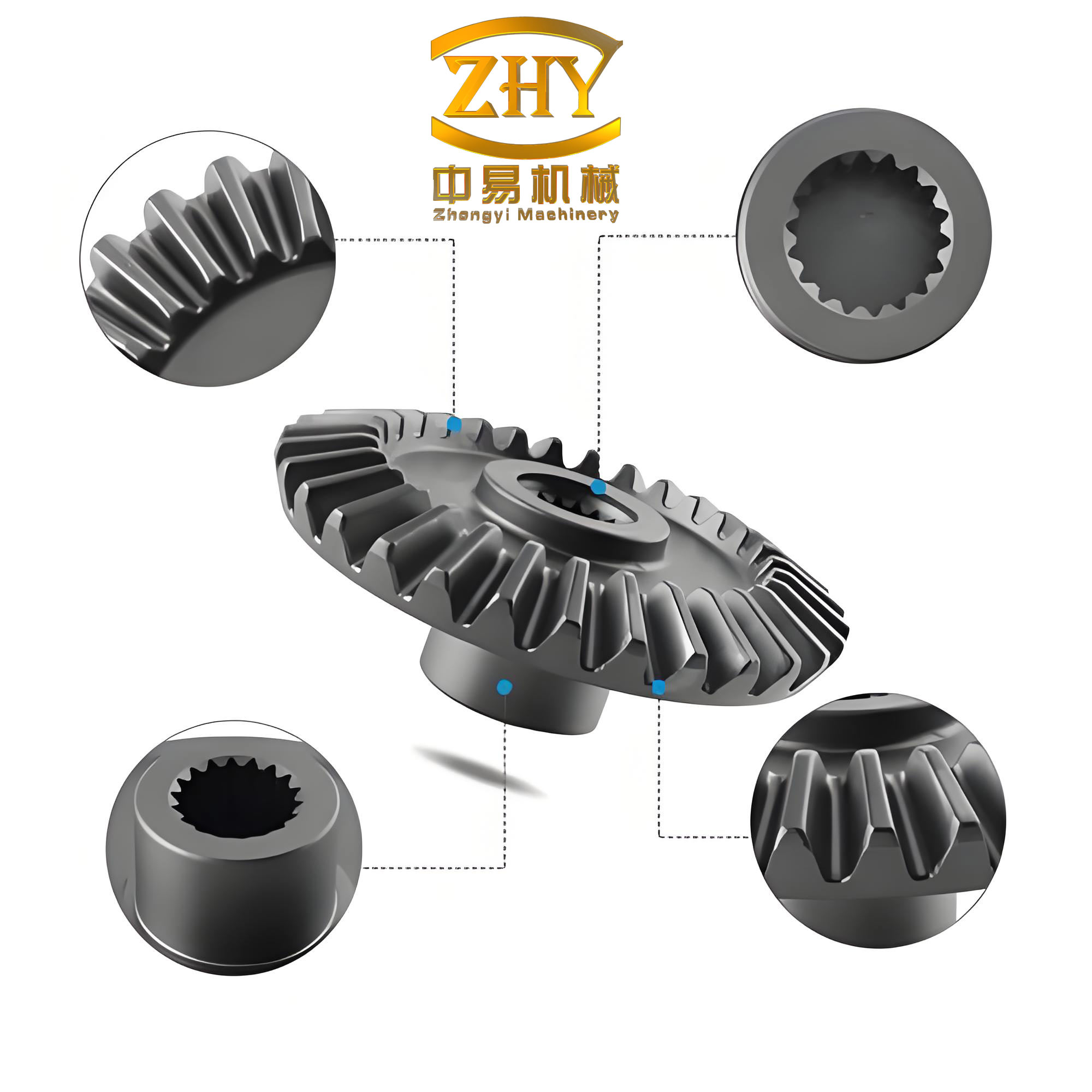
In conclusion, the数控化改造 of the double cradle straight bevel gear milling machine represents a significant advancement in gear manufacturing technology. By leveraging NC systems and servo drives, we have created a flexible, high-precision solution that meets the demands of modern industry. The ability to quickly adapt to different straight bevel gear designs without mechanical changes not only boosts productivity but also supports customization and innovation in product development. Future work could explore the integration of adaptive control and real-time monitoring for further optimization. As straight bevel gears continue to be integral in various mechanical systems, this NC-enhanced machine sets a new standard for efficiency and accuracy in their production.