
In modern mechanical transmission systems, straight bevel gears play a critical role due to their ability to transmit power between intersecting shafts efficiently. As a researcher involved in advancing gear manufacturing technologies, I have focused on enhancing the performance of traditional straight bevel gear milling machines through numerical control (NC) innovations. The conventional Y2726-type double-cradle straight bevel gear milling machine, while widely used, relies on mechanical change gears and complex传动 chains, leading to prolonged setup times and limited flexibility. This paper details a comprehensive NC transformation project that replaces mechanical components with servo motors and CNC systems, significantly improving machining efficiency, accuracy, and adaptability for straight bevel gear production. By integrating advanced motion control and programming, we have achieved a 50% increase in productivity and elevated gear accuracy to grade 7, making the process more sustainable and cost-effective.
The fundamental working principle of the original straight bevel gear milling machine involves the generating motion method, where a virtual crown gear meshes with the workpiece to form tooth profiles. This requires precise coordination between the cradle rotation and the work head rotation, facilitated by mechanical传动 chains that include change gears. For different straight bevel gear pairs, these change gears must be recalculated and replaced, which not only consumes time but also introduces potential errors. The machine’s structure comprises two independent work heads, each with a cutter盘, cradle, and work head, allowing sequential machining of pinion and gear pairs. However, the reliance on mechanical linkages limits the machine’s ability to handle varying gear parameters swiftly. Our NC innovation addresses these shortcomings by leveraging digital control technologies, which streamline the process and enhance the machine’s capability to produce high-quality straight bevel gears consistently.
To illustrate the advantages of the NC-transformed machine, the following table compares key aspects of the original and upgraded systems:
| Feature | Original Mechanical Machine | NC-Transformed Machine |
|---|---|---|
| Transmission Mechanism | Complex mechanical chains with change gears | Servo motors controlled by CNC system |
| Setup Time for Different Gears | High (requires manual gear changes and adjustments) | Low (parameters input via CNC program) |
| Machining Accuracy | Standard grade (e.g., grade 8-9) | Improved to grade 7 for straight bevel gears |
| Production Efficiency | Baseline reference | Increased by 50% |
| Flexibility in Gear Design | Limited by physical gear availability | High (easily adaptable through software) |
The core of the NC transformation lies in redesigning the mechanical传动 system to eliminate most mechanical components. Instead of using change gears and mechanical linkages, we implemented four servo motors—two for driving the cradles and two for the work heads. This approach allows independent control of each axis, enabling precise interpolation for generating motions. The motion relationships for machining straight bevel gears are derived from the fundamental principles of gear generation. For a gear pair with pinion teeth数 z₁ and gear teeth数 z₂, the cradle angle θ₁ and work head angle θ₂ must satisfy specific equations during generating motion. When machining the pinion of a straight bevel gear pair, the relationship is given by:
$$ \theta_2 = \frac{z_1}{\sqrt{z_1^2 + z_2^2}} \theta_1 $$
Similarly, for machining the gear:
$$ \theta_2 = \frac{z_2}{\sqrt{z_1^2 + z_2^2}} \theta_1 $$
During indexing, which positions the workpiece for the next tooth cut, the work head rotates by a fixed angle based on the number of teeth. For the pinion:
$$ \theta_2 = \frac{360}{z_1} $$
And for the gear:
$$ \theta_2 = \frac{360}{z_2} $$
These formulas are embedded in the CNC system, allowing real-time computation and control without physical adjustments. The use of servo motors coupled with precision worm gear reducers ensures high torque transmission and minimal backlash, critical for maintaining the accuracy of straight bevel gears. This design not only simplifies the machine structure but also reduces wear and maintenance requirements, contributing to longer service life.
In terms of the control system, we selected the Siemens 802C CNC system for its robustness and ability to handle multiple axes. The system is configured to manage four servo axes—two for the cradles and two for the work heads—enabling synchronized motion for generating cycles and individual control for indexing. The CNC’s programmable logic controller (PLC) functionality handles auxiliary operations, such as cutter spindle activation and hydraulic slide movements for workpiece positioning. This integration ensures seamless coordination between all machine components, enhancing the overall reliability of straight bevel gear machining. The table below summarizes the key parameters and their roles in the NC program for straight bevel gear production:
| Parameter | Symbol | Description | Example Value |
|---|---|---|---|
| Pinion Teeth Number | z₁ | Number of teeth on the small straight bevel gear | 20 |
| Gear Teeth Number | z₂ | Number of teeth on the large straight bevel gear | 40 |
| Module | m | Gear size parameter influencing tooth dimensions | 5 mm |
| Entry Angle | α_e | Angle at which cutter engages workpiece during generating motion | 10° |
| Exit Angle | α_x | Angle at which cutter disengages after tooth cutting | 15° |
| Indexing Angle | θ₂_index | Work head rotation per tooth for indexing | 18° (for z=20) |
The NC programming approach involves storing these parameters as variables within the CNC system, allowing operators to input new values for different straight bevel gear designs without modifying the core program. The machining process is divided into roughing and finishing phases, with optimized feed rates and cutter paths to minimize cycle times and maximize tool life. For instance, during roughing, higher feed rates are used to remove material quickly, while finishing employs slower rates to achieve the desired surface quality and accuracy for straight bevel gears. The program also includes error compensation algorithms to account for mechanical tolerances, further enhancing the consistency of gear profiles.
One of the significant benefits observed after the NC transformation is the reduction in non-productive time. Previously, changing gears and adjusting传动 chains could take hours, but now, switching between different straight bevel gear pairs requires only minutes of parameter input. This flexibility is particularly valuable in job-shop environments where batch sizes vary. Additionally, the ability to simulate and optimize motion paths offline reduces the risk of errors during actual machining. The following equation exemplifies the dynamic control during generating motion, where the instantaneous angular velocities of the cradle and work head are synchronized based on the gear ratio:
$$ \omega_2 = \frac{z}{\sqrt{z_1^2 + z_2^2}} \omega_1 $$
Here, ω₁ and ω₂ represent the angular velocities of the cradle and work head, respectively, ensuring smooth and accurate tooth generation for straight bevel gears.
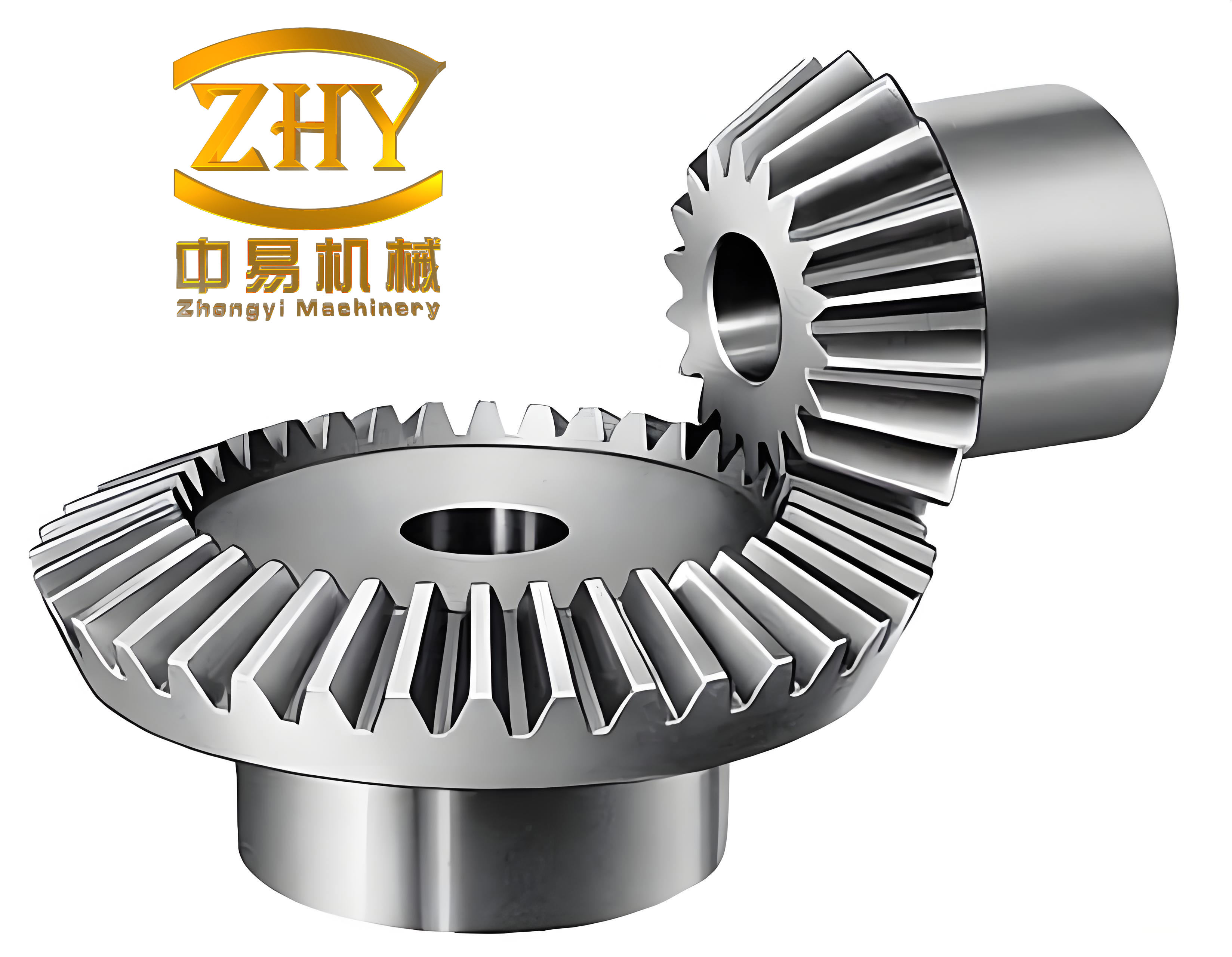
To visualize the outcome of this innovation, consider the following representation of machined straight bevel gears, which demonstrates the precision achieved through NC control:
In conclusion, the NC transformation of the straight bevel gear milling machine has proven to be a groundbreaking advancement in gear manufacturing. By replacing mechanical传动 with servo motors and CNC systems, we have achieved remarkable improvements in efficiency, accuracy, and operational ease. The straight bevel gears produced post-transformation consistently meet grade 7 accuracy standards, with a 50% boost in productivity due to reduced setup times and optimized machining cycles. This approach not only aligns with industry trends toward digitalization but also offers a scalable solution for small to large-scale production of straight bevel gears. Future work may focus on integrating adaptive control and real-time monitoring to further enhance performance and predictive maintenance capabilities.