
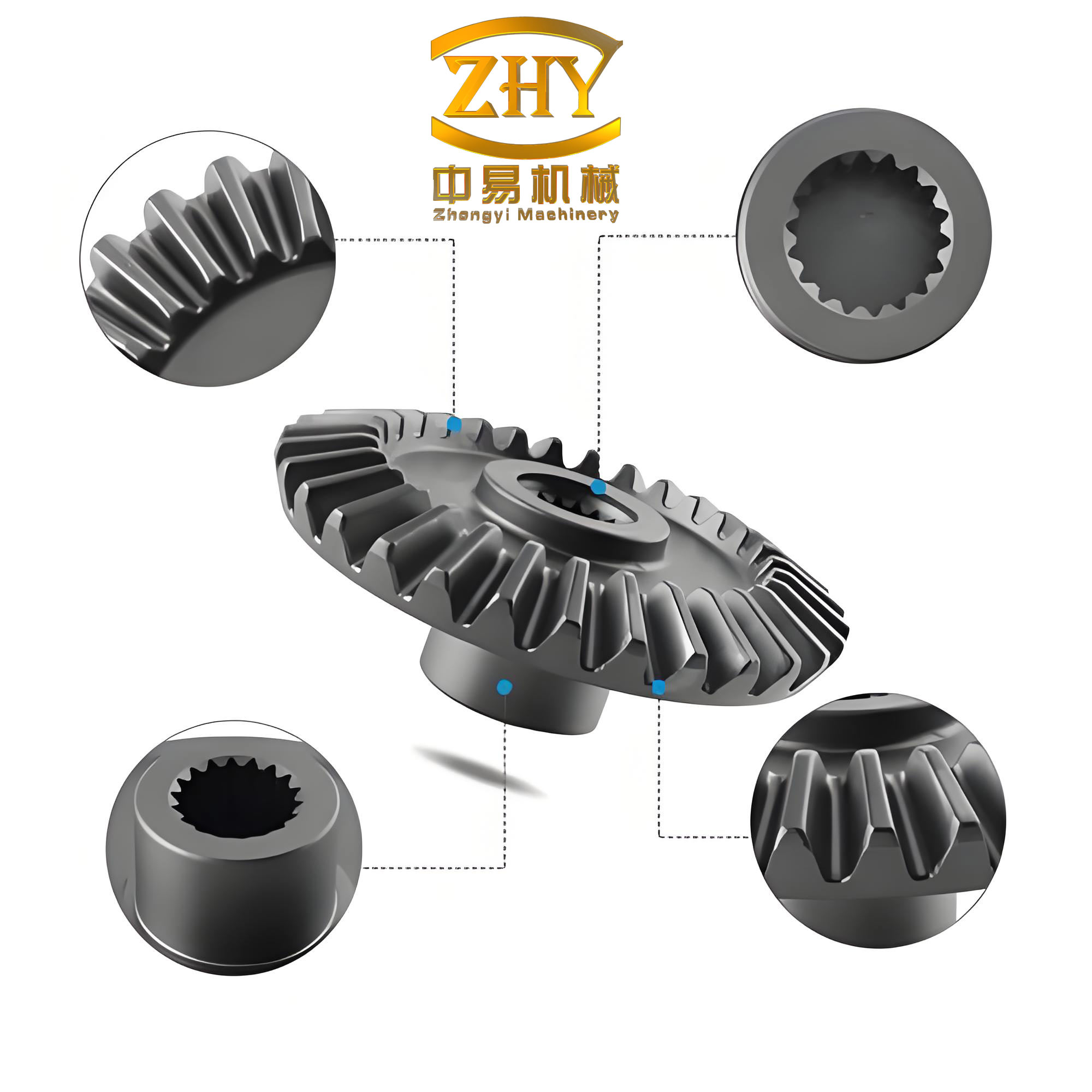
In modern heavy machinery industries, such as mining, shipbuilding, and power generation, large straight bevel gears play a critical role in transmission systems. However, the manufacturing of these gears faces significant challenges due to their substantial dimensions, high equipment dependency, and difficulties in transportation. To address these issues, split straight bevel gears have been developed, allowing for easier handling and assembly. This article explores a novel approach to machining split straight bevel gears using numerical control (NC) methods, specifically focusing on flank milling with cylindrical end mills. The primary goal is to derive and verify the motion trajectories for NC machining, enabling the production of large straight bevel gears on standard five-axis machine tools, thereby reducing costs and improving accessibility.
The machining process for split straight bevel gears involves several stages, including rough slotting and fine finishing of the tooth surfaces. Traditional methods often rely on specialized form cutters or ball-end mills, which can be inefficient or require large-scale machinery. In contrast, the use of general-purpose cylindrical end mills offers advantages in cost, efficiency, and versatility. This study details the coordinate transformation relationships, motion solving algorithms, and experimental validation for flank milling split straight bevel gears. By establishing explicit functions for linear and rotary motions, the NC programming becomes feasible on universal five-axis CNC machines.
The foundation of this approach lies in the coordinate systems used to describe the gear geometry and tool positions. For a split straight bevel gear, multiple coordinate frames are defined to facilitate the transformation from the workpiece to the machine tool. The workpiece coordinate system \( S_o (O_o – X_o Y_o Z_o) \) represents the ideal gear model derived from tooth surface equations. Transitional coordinate systems \( S_i (O_i – X_i Y_i Z_i) \) and \( S_j (O_j – X_j Y_j Z_j) \) are introduced to align the gear model with the machine axes. The installation coordinate system \( S_w (O_w – X_w Y_w Z_w) \) accounts for the offset between the split gear’s mounting center and the overall rotation center. Finally, the machine coordinate system \( S_m (O_m – X_m Y_m Z_m) \) defines the linear and rotary motions for NC programming.
The transformation matrices between these coordinate systems are derived as follows. The transformation from \( S_o \) to \( S_i \) is given by:
$$ M_{io} = \begin{bmatrix}
\cos a & -\sin a & 0 & 0 \\
\sin a & \cos a & 0 & 0 \\
0 & 0 & 1 & 0 \\
0 & 0 & 0 & 1
\end{bmatrix} $$
where \( a \) is the rotation angle about the Z-axis. The transformation from \( S_i \) to \( S_j \) is:
$$ M_{ji} = \begin{bmatrix}
1 & 0 & 0 & 0 \\
0 & \cos c & -\sin c & 0 \\
0 & \sin c & \cos c & 0 \\
0 & 0 & 0 & 1
\end{bmatrix} $$
where \( c \) is the rotation angle about the X-axis. The transformation from \( S_j \) to \( S_w \) involves a translation:
$$ M_{wj} = \begin{bmatrix}
1 & 0 & 0 & a_0 \\
0 & 1 & 0 & b_0 \\
0 & 0 & 1 & c_0 \\
0 & 0 & 0 & 1
\end{bmatrix} $$
where \( a_0, b_0, c_0 \) are the translation offsets. Finally, the transformation from \( S_w \) to \( S_m \) is:
$$ M_{mw} = \begin{bmatrix}
1 & 0 & 0 & a_1 \\
0 & 1 & 0 & b_1 \\
0 & 0 & 1 & c_1 \\
0 & 0 & 0 & 1
\end{bmatrix} $$
where \( a_1, b_1, c_1 \) are additional offsets for machine setup. These matrices enable the conversion of tool positions and orientations from the workpiece to the machine coordinate system.
For linear motion solving, the cutter center coordinates in the workpiece system \( [X’_o, Y’_o, Z’_o] \) are transformed to the machine system \( [X’_m, Y’_m, Z’_m] \) using the composite transformation:
$$ [X’_m, Y’_m, Z’_m] = M_{mw} M_{wj} M_{ji} M_{io} [X’_o, Y’_o, Z’_o] $$
Expanding this yields the explicit functions:
$$ X’_m = X’_o \cos a – Z’_o \sin a + a_0 + a_1 $$
$$ Y’_m = X’_o \sin a \cos c + Y’_o \cos a \cos c – Z’_o \cos c + b_0 + b_1 $$
$$ Z’_m = X’_o \sin a \sin c + Y’_o \cos a \sin c + Z’_o \cos c + c_0 + c_1 $$
Similarly, the cutter axis vector \( \mathbf{p} = [p_X, p_Y, p_Z] \) in the workpiece system is transformed to \( \mathbf{p}_m = [p_{mX}, p_{mY}, p_{mZ}] \) in the machine system by applying the rotational components:
$$ \mathbf{p}_m = M_{mw} M_{wj} \mathbf{p} $$
which simplifies to:
$$ p_{mX} = p_X \cos a – p_Z \sin a $$
$$ p_{mY} = p_X \sin a \cos c + p_Y \cos a \cos c – p_Z \cos c $$
$$ p_{mZ} = p_X \sin a \sin c + p_Y \cos a \sin c + p_Z \cos c $$
For rotary motion solving, a five-axis CNC machine with XYZAB configuration is considered, where A and B represent rotary axes. The tool orientation vector \( \mathbf{p} = (p_X, p_Y, p_Z) \) is used to compute the swing angles A and B. The angle A, representing rotation about the X-axis, is calculated based on the sign of \( p_Y \):
$$ A = \begin{cases}
360^\circ – \arctan \left( \frac{p_Y}{\sqrt{p_X^2 + p_Z^2}} \right) & \text{if } p_Y > 0 \\
0 & \text{if } p_Y = 0 \\
-\arctan \left( \frac{p_Y}{\sqrt{p_X^2 + p_Z^2}} \right) & \text{if } p_Y < 0
\end{cases} $$
The angle B, representing rotation about the Y-axis, depends on the signs of \( p_X \) and \( p_Z \):
$$ B = \begin{cases}
\arctan \left( \frac{p_X}{p_Z} \right) & \text{if } p_X \geq 0, p_Z \geq 0 \\
180^\circ – \arctan \left( \frac{p_X}{p_Z} \right) & \text{if } p_X \geq 0, p_Z \leq 0 \\
180^\circ + \arctan \left( \frac{p_X}{p_Z} \right) & \text{if } p_X \leq 0, p_Z \leq 0 \\
360^\circ – \arctan \left( \frac{p_X}{p_Z} \right) & \text{if } p_X \leq 0, p_Z \geq 0
\end{cases} $$
with \( \arctan(p_X / p_Z) = 90^\circ \) when \( p_Z = 0 \). These equations allow the generation of NC code for the five-axis machine, specifying both linear and rotary motions.
To validate the motion solution, a simulation was conducted using VERICUT software for a split straight bevel gear with the parameters listed in Table 1. The gear was first rough-machined using a form cutter for slotting, followed by fine finishing with a 10 mm diameter cylindrical end mill for flank milling. The machine model in VERICUT was configured to match the derived motion trajectories.
| Parameter | Value |
|---|---|
| Module \( m_n \) (mm) | 20 |
| Number of Teeth \( z \) | 72 |
| Pressure Angle \( \alpha_n \) (°) | 20 |
| Face Width \( b \) (mm) | 100 |
| Profile Shift Coefficient \( x_n \) | 0 |
| Pitch Diameter at Large End \( D \) (mm) | 1440 |
The simulation process involved importing the NC program generated from the motion solutions and running a virtual machining sequence. The results showed that the tooth surfaces were accurately generated, with minor undercuts at the tooth roots and localized overcuts at the large end, primarily due to the lack of fine finishing in the root area. An automatic comparison with the design model, using a tolerance of 0.05 mm for overcut and undercut, confirmed the correctness of the tool paths. This simulation demonstrated the feasibility of using cylindrical end mills for machining split straight bevel gears on five-axis CNC machines.
Following the simulation, an actual machining experiment was performed on a DMU100 five-axis CNC machine. The process mirrored the simulation, with rough slotting using a form cutter and fine finishing with the cylindrical end mill. The machined gear was then measured using a Hexagon coordinate measuring machine to evaluate its geometric accuracy. The measurement results, summarized in Table 2, indicate that the gear met the precision standards specified in GB/T 10095.1-2022, achieving grade 7 for key parameters such as pitch deviation and radial runout.
| Parameter | Value (μm) |
|---|---|
| Single Pitch Deviation \( f_{pt} \) | 25.3 |
| Cumulative Pitch Deviation \( F_p \) | 21.8 |
| Radial Runout \( F_r \) | 38.3 |
| Total Profile Deviation \( F_f \) | 5.6 |
| Profile Form Deviation \( f_f \) | 2.6 |
The successful machining and measurement validate the motion solving approach for split straight bevel gears. The use of cylindrical end mills not only reduces costs but also enhances flexibility, as standard CNC machines can be employed. This method is particularly beneficial for large straight bevel gears, where traditional manufacturing approaches are often constrained by equipment size and cost. The explicit motion functions derived in this study provide a practical foundation for NC programming, enabling efficient production of high-precision split straight bevel gears.
In conclusion, the numerical control machining motion solution for split straight bevel gears has been thoroughly developed and verified. The coordinate transformation matrices and motion equations enable accurate tool path generation for five-axis flank milling. Simulations and experiments confirm that the approach produces gears within acceptable tolerances, demonstrating its practicality for industrial applications. Future work could focus on optimizing tool paths for higher efficiency or extending the method to other gear types, such as spiral bevel gears. Overall, this research contributes to advancing the manufacturing capabilities for large straight bevel gears, supporting the growing demands of heavy machinery sectors.
The integration of these motion solutions into NC systems allows for the machining of split straight bevel gears with improved accuracy and reduced reliance on specialized equipment. By leveraging universal five-axis machines, manufacturers can achieve significant cost savings while maintaining high quality. The derivation of linear and rotary motion trajectories ensures that the tool orientation and position are precisely controlled throughout the machining process. This is critical for achieving the desired tooth geometry in split straight bevel gears, where even minor deviations can affect performance.
Moreover, the use of cylindrical end mills for flank milling offers advantages in terms of tool life and surface finish compared to traditional methods. The simulation in VERICUT provided a robust validation platform, identifying potential issues such as undercuts and overcuts before actual machining. The experimental results further reinforced the reliability of the motion solutions, with the measured deviations falling within standardized limits. This comprehensive approach—from theoretical derivation to practical implementation—highlights the potential for widespread adoption in industries requiring large straight bevel gears.
In summary, the motion solving methodology presented here addresses key challenges in the manufacturing of split straight bevel gears. By providing explicit functions for coordinate transformations and rotary angles, it simplifies the NC programming process and enhances machining efficiency. The success of this approach underscores the importance of advanced numerical control techniques in modern gear production, paving the way for more accessible and cost-effective solutions for large straight bevel gears.