
The reliable operation of high-speed electric multiple units (EMUs) is critically dependent on the performance and longevity of their transmission systems. Within these systems, the gear pair stands as a vital working component. Its dynamic behavior and service life are paramount for ensuring the safety and dependability of the entire train. During high-speed operation, trains frequently encounter complex working conditions such as acceleration, deceleration, and emergency braking. These transient loads can compromise gear reliability and significantly shorten their operational lifespan. Gear failure can lead to service disruption, and catastrophic failures like tooth fracture pose severe safety risks. Since a majority of gear failures are initiated by fatigue, and tooth breakage is particularly hazardous, research into the bending fatigue life of gears provides essential guidance for both design and maintenance practices.
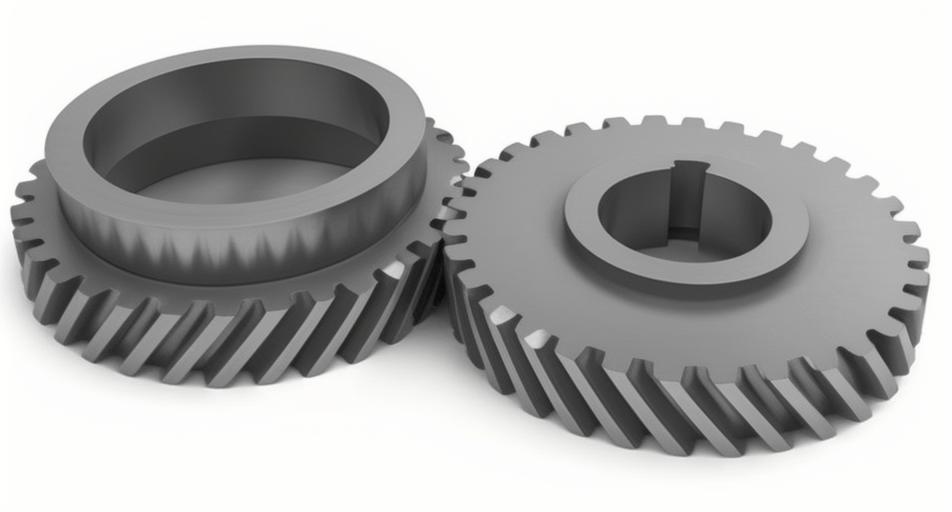
This work focuses on the numerical simulation of crack initiation life at the tooth root of the helical gear pair used in a CRH380A EMU gearbox. Crack initiation life refers to the number of stress cycles required for a microscopic fatigue crack to nucleate at a critical location, which is a crucial phase preceding eventual fracture. The methodology integrates three-dimensional parametric modeling, finite element analysis (FEA) for stress determination, and fatigue life prediction based on cumulative damage theory. A key step involves validating the chosen fatigue damage model by comparing simulation results from two different methods with experimental data from a spur gear test. Once the superior model is identified, it is applied to the helical gear under a realistic operational load spectrum to predict its crack initiation life. Furthermore, a parametric study investigates the influence of critical factors including operating load, surface roughness, residual stress, and tooth profile modification on the predicted fatigue life of the helical gear.
Parametric Modeling and Stress Analysis of the Helical Gear Pair
Accurate geometrical representation is the foundation for precise stress analysis. The basic parameters of the target helical gear pair are listed in the table below.
| Parameter | Symbol | Value |
|---|---|---|
| Gear Ratio | z₁/z₂ | 29 / 69 |
| Normal Module | mₙ | 7 mm |
| Pressure Angle | α | 26° |
| Helix Angle | β | 20° |
| Actual Center Distance | a | 363 mm |
| Face Width | b | 70 mm |
The tooth profile is constructed mathematically. The involute segment of the tooth flank is defined within a manufacturing coordinate system with its origin at the gear center. The equations governing the involute curve coordinates (xK, yK) for any point K are:
$$ x_K = \frac{r_b}{\cos \alpha_K} \sin\left( \frac{S}{2r} + \text{inv} \alpha – \text{inv} \alpha_K \right) $$
$$ y_K = \frac{r_b}{\cos \alpha_K} \cos\left( \frac{S}{2r} + \text{inv} \alpha – \text{inv} \alpha_K \right) $$
where rb is the base radius, αK is the pressure angle at point K, α is the standard pressure angle, S is the arc tooth thickness on the pitch circle, and r is the pitch radius. The term “inv” denotes the involute function (inv φ = tan φ – φ).
The tooth root fillet, or transition curve, is generated by the tool tip during the gear cutting process. Its parametric equations are derived from the relative motion between the tool and the gear blank:
$$ x’ = r’ \sin \varphi – \left( \frac{a – x m_n}{\sin \alpha’} + r_\rho \right) \cos(\alpha’ – \varphi) $$
$$ y’ = r’ \cos \varphi – \left( \frac{a – x m_n}{\sin \alpha’} + r_\rho \right) \sin(\alpha’ – \varphi) $$
$$ \varphi = \frac{1}{r’} \left[ (a – x m_n) \cot \alpha’ + b \right] $$
Here, r’ is the pitch radius of the gear being cut, rρ is the cutting tool tip radius, x is the profile shift coefficient, and a, b, α’ are parameters related to the tool geometry and setup.
Using these equations, a precise three-dimensional model of the helical gear pair was developed in UG software. To perform a static stress analysis, a segment containing five teeth from both the pinion and gear was imported into the ABAQUS finite element software. The model was meshed with C3D8R hexahedral elements, with refinement in the contact zones and at the tooth root fillets to capture stress gradients accurately. The boundary conditions simulated a torque application: the inner ring of the larger gear was fully constrained, while the inner ring of the smaller pinion was only allowed to rotate about its axis, and a nominal torque of 820 N·m was applied to it. The analysis simulated the meshing process to identify the critical loading position.
The total contact ratio for this helical gear pair was calculated to be 2.47, indicating that two or three tooth pairs are in contact simultaneously. The analysis tracked the maximum bending stress at the root of the middle pinion tooth throughout the mesh cycle. The stress was found to peak precisely when the gear pair transitioned from three-pair to two-pair contact. At this critical position, the maximum bending stress on the pinion was 119.6 MPa, compared to 92.76 MPa on the gear. More importantly, the pinion undergoes more load cycles than the gear (a ratio equal to the gear ratio, 69/29 ≈ 2.38). The combination of higher stress and a greater number of cycles means the pinion accumulates fatigue damage faster. Therefore, the pinion is the critical component for bending fatigue analysis, and subsequent life calculations focus on it.
Further investigation along the face width of the pinion tooth revealed that the bending stress varies, reaching its maximum value near the mid-region of the tooth width. The specific node with the highest stress (Node 229149) was identified. During a complete meshing cycle for this tooth, the stress at this critical node cycles from zero to the maximum value and back to zero. This cyclic stress is the driving force for fatigue crack initiation at the root of the helical gear tooth.
Determination of the Fatigue Damage Model
Predicting crack initiation life requires a valid fatigue damage model. To establish the most accurate approach for the gear material (20CrNi2Mo, similar in performance to 20CrMnTi used for validation), a combined experimental and simulation study was conducted on a simpler spur gear specimen.
A high-frequency fatigue test was performed on a standard spur gear made of 20CrMnTi. The test used a resonant fatigue testing machine (GPS100) in a pulsating compression mode (load ratio R = 0.05). The test gear was mounted in a fixture applying a two-tooth loading scheme. The applied load was calculated based on a target nominal tooth root bending stress of 400 MPa, resulting in a maximum force Ft of 81.42 kN. The test was run until complete tooth fracture occurred at 4,511,675 cycles. This experimental result serves as the benchmark for validating simulation methods.
Next, a detailed finite element model of the test setup was created in ABAQUS to replicate the stress state. Applying the same load (81.42 kN) yielded a simulated maximum root stress of 424.6 MPa, which is within a reasonable 6.15% error from the theoretical 400 MPa, confirming the model’s accuracy. This stress result was then imported into the fatigue analysis software FE-SAFE to compute the crack initiation life using two prevalent methods:
- Nominal Stress Method (Principal Stress Algorithm with Goodman mean stress correction): This method uses elastic stresses and S-N (stress-life) data of the material. The calculated life for the test gear was 3,597,493 cycles.
- Local Stress-Strain Method (Brown-Miller Algorithm with Morrow mean stress correction): This method considers elasto-plastic stress-strain behavior at the critical location, using strain-life (ε-N) material properties. It is generally more accurate for low-cycle and notch fatigue. This calculation yielded a life of 4,130,475 cycles.
Comparing these results with the experimental life of 4,511,675 cycles reveals a critical insight. The nominal stress method showed an error of approximately 20%, while the local stress-strain method showed a significantly smaller error of about 8.4%. This closer agreement validates the local stress-strain method as the superior damage model for predicting crack initiation in these gear steels under the given loading conditions. Therefore, this model is adopted for all subsequent fatigue life predictions of the helical gear.
Crack Initiation Life Prediction and Parametric Study for the Helical Gear
With the validated local stress-strain approach, the focus returns to the high-speed EMU helical gear pair. Realistic operation involves varying loads. A load spectrum was constructed based on speed data from a Beijing-Shanghai run, comprising nine distinct torque levels and their corresponding occurrence frequencies per trip.
| Pinion Torque (N·m) | Frequency per Trip (%) | Number of Cycles per Trip |
|---|---|---|
| 1678.66 | 10.33 | 114,663 |
| 1583.23 | 5.72 | 63,492 |
| 1396.97 | 3.69 | 40,959 |
| 1187.43 | 1.29 | 14,319 |
| 1032.54 | 4.61 | 51,171 |
| 913.40 | 2.58 | 28,638 |
| 848.16 | 2.21 | 24,531 |
| 818.91 | 43.36 | 481,296 |
| 791.62 | 26.20 | 290,820 |
Total pinion rotations per trip: ~1.11 × 10⁶ cycles.
The material properties for 20CrNi2Mo were generated within FE-SAFE. The surface roughness was set to a typical manufacturing range (Ra 0.6-1.6 μm), and initial residual stress was assumed to be zero. Applying the Morrow-corrected Brown-Miller algorithm with this load spectrum, the minimum predicted crack initiation life for the pinion was found to be 10,814 trips. Assuming one trip per day, this translates to a service life of approximately 29.63 years before a crack is expected to initiate at the tooth root of the helical gear.
To understand the sensitivity of this life prediction, several key factors were analyzed parametrically by varying their values in the FE-SAFE model.
1. Influence of Load Magnitude
Load has a dramatic, non-linear effect on fatigue life. The entire load spectrum was scaled by factors from 0.8 to 1.2 to simulate milder or harsher operating conditions. The results are summarized by the relationship:
$$ N_f \propto \left( \frac{1}{\sigma} \right)^m $$
where Nf is cycles to failure, σ is stress (proportional to load), and m is a high exponent (material-dependent). The simulation confirmed this stark dependency. At 0.8 times the nominal load spectrum, life skyrocketed to over 666 years. Conversely, at 1.2 times the nominal load, life plummeted to merely 3.17 years. This underscores the critical impact of operational severity on the maintenance schedule for the helical gearbox.
2. Influence of Surface Roughness
Surface finish acts as a stress concentrator, providing nucleation sites for fatigue cracks. Five quality grades corresponding to different manufacturing processes were analyzed.
| Surface Quality Grade | Process | Surface Roughness Ra (μm) | Predicted log(Life) |
|---|---|---|---|
| 1 (Best) | Superfinishing / Lapping | Ra ≤ 0.25 | 4.351 |
| 2 | Grinding / Honing | 0.25 < Ra ≤ 0.6 | 4.168 |
| 3 | Shaving | 0.6 < Ra ≤ 1.6 | 4.034 |
| 4 | Hobbing / Shaping | 1.6 < Ra ≤ 4.0 | 3.663 |
| 5 (Worst) | Milling | 4.0 < Ra ≤ 16.0 | 3.071 |
The analysis shows that improving surface finish from a hobbed state (Grade 4) to a shaved state (Grade 3) offers a significant life extension. Further improvements to ground or super-finished surfaces (Grades 1 & 2) provide additional, though diminishing, returns. From a cost-benefit perspective, shaving presents an optimal balance for enhancing the durability of a helical gear.
3. Influence of Residual Stress
Compressive residual stresses induced by surface hardening processes like shot peening, rolling, or carburizing are highly beneficial. They superimpose on the applied tensile cyclic stresses, effectively lowering the mean stress and retarding crack initiation. The simulation quantified this effect by applying uniform compressive residual stress at the tooth root surface.
| Residual Compressive Stress (MPa) | Predicted Life (Years) | Life Increase vs. 0 MPa |
|---|---|---|
| 0 | 29.63 | Baseline |
| -50 | 38.15 | 28.8% |
| -100 | 49.12 | 65.8% |
| -150 | 59.87 | 102.1% |
| -200 | 70.75 | 138.8% |
The life extension is nearly linear with increasing compressive stress, demonstrating the profound importance of incorporating surface strengthening treatments in the manufacturing process of high-performance helical gears.
4. Influence of Tip Relief (Profile Modification)
Tip relief involves slightly removing material from the tip of the tooth to smooth the engagement and disengagement process, reducing meshing impact and dynamic loads. An arc-shaped tip relief was modeled with varying amounts of maximum modification Δ at the tip.
| Tip Relief Amount Δ (mm) | Predicted Life (Years) | Effect |
|---|---|---|
| 0.00 (No Relief) | 29.63 | Baseline |
| 0.01 | 32.07 | +8.2% |
| 0.02 | 30.45 | +2.8% |
| 0.03 | 27.98 | -5.6% |
| 0.04 | 25.21 | -14.9% |
The results reveal an optimal relief amount. A small relief (0.01 mm) improves life by reducing dynamic stresses. However, excessive relief (≥0.03 mm) shortens life because it reduces the effective contact ratio, increasing the load share on the remaining contacting teeth and consequently raising the root bending stress. Therefore, precise and optimal profile modification is crucial for maximizing the fatigue performance of a helical gear.
Conclusion
This integrated numerical investigation provides a comprehensive framework for assessing the tooth root crack initiation life of high-speed EMU helical gears. The process begins with accurate parametric modeling and finite element stress analysis to identify the critical pinion and the precise crack initiation location. The core of the methodology is the validation and selection of a fatigue damage model; the local stress-strain method (Brown-Miller with Morrow correction) was demonstrated to be significantly more accurate than the nominal stress method for this application through correlation with experimental testing.
Applying this validated model to the helical gear under a realistic operational load spectrum predicted a crack initiation life of approximately 29.6 years. The extensive parametric study yielded crucial engineering insights: the fatigue life of the helical gear is exquisitely sensitive to operational load levels and surface roughness. Implementing surface treatments to induce compressive residual stresses is one of the most effective ways to extend service life. Furthermore, an optimal, small amount of tip relief can enhance life, but over-relief is detrimental.
These findings offer actionable guidance for the design, manufacturing, and maintenance of transmission systems in high-speed trains. They emphasize the importance of controlling operational parameters, selecting appropriate finishing processes like shaving, mandating surface hardening treatments, and applying precise profile modifications to ensure the long-term reliability and safety of helical gear pairs in demanding service conditions.