
In mechanical systems, spur gears are fundamental components for power transmission, often operating under heavy loads and high-speed conditions. However, in scenarios where lubrication is insufficient or absent, dry friction can occur, leading to accelerated wear, temperature rise, and potential failure such as scuffing or plastic deformation. Understanding the wear characteristics of spur gears under dry friction is crucial for improving durability and reliability. This study focuses on numerical simulation and research of dry friction wear in spur gears, combining theoretical analysis with computational tools like MATLAB and ANSYS to explore wear patterns and temperature distributions. The aim is to provide insights into the effects of operational parameters like rotational speed and load on wear behavior, aiding in the design and maintenance of gear systems.
Dry friction in spur gears arises when the lubricant supply in the mating region is inadequate to form an elastohydrodynamic lubrication (EHL) film. Based on lubrication theory, the condition to avoid dry friction can be derived from the oil film thickness criteria. For spur gears, the critical oil film thickness must be maintained to prevent direct metal-to-metal contact. According to Cameron’s theory, the minimum oil film thickness for EHL is given by:
$$ h_{\text{min}} = \frac{2.65 \eta_0^{0.7} U^{0.7} R^{0.43}}{E^{0.03} F_{nc}^{0.13}} $$
where $\eta_0$ is the dynamic viscosity of the lubricant, $U$ is the entrainment velocity, $R$ is the equivalent radius of curvature, $E$ is the combined elastic modulus, and $F_{nc}$ is the normal load. For spur gears, the entrainment velocity varies along the line of action, and the equivalent radius changes with the contact position. The dry friction condition occurs when the actual oil film thickness falls below this critical value. In gear meshing, the oil supply from the driven gear’s tooth surface is key; if the oil volume is insufficient, starvation leads to dry friction. The critical oil volume to sustain EHL can be expressed as:
$$ Q_{\text{crit}} = a \cdot x_1 \cdot B $$
where $a$ is the Hertzian contact half-width, $x_1$ is the starvation boundary, and $B$ is the face width. For spur gears, the condition for oil starvation is:
$$ \Delta A < h_c (h – h_k) \Delta S $$
with $\Delta A$ being the unit oil volume, $h_1$ the film thickness at the meshing point, $h$ the whole tooth height, and $h_c$ the tooth height at the meshing point. These equations help identify when dry friction initiates, guiding the simulation setup for wear analysis.
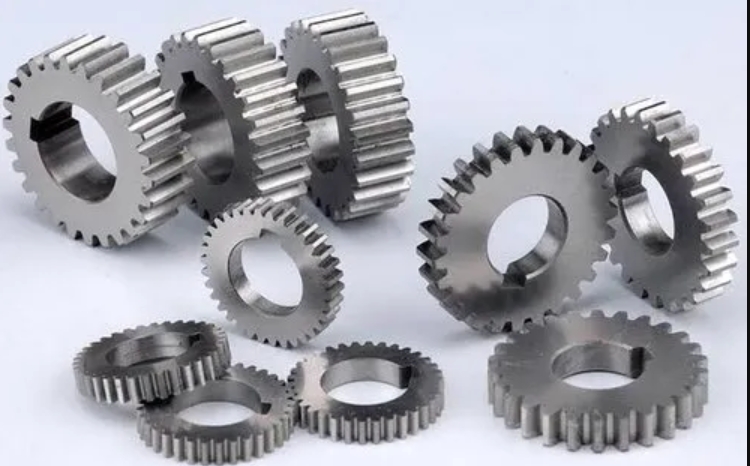
To model wear under dry friction, fatigue wear theory is applied, as it accounts for the cyclic stress experienced by gear teeth during meshing. The small spur gear, due to higher cyclic stress, is more prone to wear, making it a representative case for study. The wear calculation involves analyzing the sliding motion between mating teeth. At any meshing point, the instantaneous velocities of the pinion and gear are:
$$ v_1 = \omega_1 R_{E1}, \quad v_2 = \omega_2 R_{E2} $$
where $\omega_1$ and $\omega_2$ are angular velocities, and $R_{E1}$ and $R_{E2}$ are the radii of curvature. The slide-roll ratio, which influences wear, is defined as:
$$ \xi = \frac{v_1 – v_2}{v_1} $$
Based on fatigue wear models, the wear volume for the small spur gear over time $t$ can be derived as:
$$ V_w = \int_0^t \int_A K_h \cdot \sigma^n \cdot ds \, dt $$
where $K_h$ is a wear coefficient dependent on material properties, $\sigma$ is the contact stress, $n$ is an exponent typically around 3-4 for fatigue wear, and the integration is over the contact area $A$ and path $s$. For spur gears, a simplified form relates wear depth to operating parameters. Assuming a friction coefficient $\mu_f$, the wear depth per cycle can be approximated as:
$$ h_w \propto \mu_f^4 \cdot \frac{F_{nc}^{3/2}}{E^* \sqrt{R}} $$
with $E^*$ being the equivalent elastic modulus. This relationship indicates that wear increases significantly with friction coefficient and load. In dry friction, $\mu_f$ can vary from 0.1 to 0.5 or higher, leading to substantial wear. For numerical simulation, the wear depth along the tooth profile is computed using MATLAB, considering parameters like speed and torque.
The temperature field under dry friction is critical, as frictional heat generation can cause thermal softening or damage. The heat conduction equation for a differential element in a spur gear is given by:
$$ \rho C \frac{\partial T}{\partial t} = k_x \frac{\partial^2 T}{\partial x^2} + k_y \frac{\partial^2 T}{\partial y^2} + k_z \frac{\partial^2 T}{\partial z^2} + q^{\prime\prime\prime} $$
where $\rho$ is density, $C$ is specific heat, $k$ are thermal conductivities, and $q^{\prime\prime\prime}$ is internal heat generation rate. For dry friction, $q^{\prime\prime\prime}$ arises from frictional power dissipation at the contact interface. In steady-state conditions, $\partial T / \partial t = 0$, simplifying to:
$$ \nabla \cdot (k \nabla T) + q^{\prime\prime\prime} = 0 $$
Using finite element methods (FEM), this equation is solved numerically. The variational principle leads to the matrix equation:
$$ \mathbf{K} \mathbf{T} = \mathbf{P} $$
where $\mathbf{K}$ is the conductivity matrix, $\mathbf{T}$ is the temperature vector, and $\mathbf{P}$ is the heat flux vector. ANSYS is employed to simulate both steady-state and transient temperature fields, capturing the effects of load and speed on peak temperatures.
For numerical simulation of wear, MATLAB scripts were developed based on the theoretical models. The spur gear parameters used in the simulation are summarized in the table below:
| Parameter | Symbol | Value | Unit |
|---|---|---|---|
| Module | m | 3 | mm |
| Number of Teeth (Pinion) | z1 | 20 | – |
| Number of Teeth (Gear) | z2 | 40 | – |
| Face Width | B | 20 | mm |
| Pressure Angle | α | 20 | ° |
| Elastic Modulus | E | 210 | GPa |
| Poisson’s Ratio | ν | 0.3 | – |
| Density | ρ | 7850 | kg/m³ |
The simulation considered varying rotational speeds (3000, 6000, and 10000 rpm) and torque loads (150, 250, and 350 N·m) to analyze their effects on friction coefficient and wear depth. The friction coefficient under dry friction was initially set to 0.1, but it can change with operational conditions. The wear depth was calculated along the tooth profile from root to tip, focusing on the pinion due to its higher vulnerability.
The results from MATLAB simulation show distinct trends. For friction coefficient, the distribution along the line of action remains similar across speeds, but the magnitude decreases with increasing speed. This can be attributed to reduced contact time and altered surface interactions at higher speeds. Conversely, higher torque loads increase the friction coefficient due to greater normal forces and enhanced asperity contact. The relationship can be approximated as:
$$ \mu_f \approx \mu_0 + c_1 \cdot F_{nc} – c_2 \cdot \omega $$
where $\mu_0$ is a base friction coefficient, and $c_1$ and $c_2$ are constants. For wear depth, the maximum occurs near the root region where single-to-double tooth meshing transition happens, stress concentration is high. The wear depth decreases with speed but increases significantly with load. This aligns with the fatigue wear theory where wear volume is proportional to load raised to a power. A summary of wear depth at different parameters is shown in the table below:
| Speed (rpm) | Load (N·m) | Max Wear Depth (µm) | Friction Coefficient (avg) |
|---|---|---|---|
| 3000 | 150 | 12.5 | 0.105 |
| 3000 | 250 | 18.7 | 0.115 |
| 3000 | 350 | 25.3 | 0.128 |
| 6000 | 150 | 10.1 | 0.098 |
| 6000 | 250 | 15.4 | 0.108 |
| 6000 | 350 | 20.9 | 0.120 |
| 10000 | 150 | 8.3 | 0.092 |
| 10000 | 250 | 12.8 | 0.102 |
| 10000 | 350 | 17.5 | 0.112 |
These results highlight that load has a more pronounced effect on wear than speed, and dry friction can lead to severe wear under high loads, necessitating careful design considerations for spur gears.
For temperature field analysis, ANSYS finite element simulations were conducted. A 3D model of a spur gear tooth was created, and steady-state thermal analysis was performed under dry friction conditions. The heat flux at the contact interface was calculated from frictional power:
$$ q^{\prime\prime} = \mu_f \cdot F_{nc} \cdot v / A_c $$
where $v$ is sliding velocity and $A_c$ is contact area. The steady-state temperature distribution shows that high temperatures are localized along the meshing line, with the gear bulk remaining cooler due to short friction duration and heat dissipation. The maximum temperature in steady-state ranges from 150°C to 300°C depending on load and speed.
Transient thermal analysis was also carried out to study the effect of torque load on peak temperature. By applying time-varying loads and speeds, the instantaneous temperature rise was captured. The results indicate that peak temperature increases linearly with both speed and load. For example, at a constant speed of 6000 rpm, the peak temperature $T_{\text{max}}$ relates to torque $T_q$ as:
$$ T_{\text{max}} = T_0 + k_T \cdot T_q $$
where $T_0$ is ambient temperature and $k_T$ is a proportionality constant. This linear trend underscores the critical impact of load on thermal limits in spur gears under dry friction. The table below summarizes transient peak temperatures for different loads at 6000 rpm:
| Torque Load (N·m) | Peak Temperature (°C) | Time to Peak (s) |
|---|---|---|
| 150 | 185 | 0.05 |
| 250 | 240 | 0.04 |
| 350 | 295 | 0.03 |
This rapid temperature rise can lead to material degradation, emphasizing the need for thermal management in spur gear systems operating under dry friction.
In conclusion, this study provides a comprehensive numerical analysis of dry friction wear in spur gears. The derivation of dry friction conditions based on lubrication theory helps identify when EHL fails, leading to direct contact. Using fatigue wear theory, wear calculations show that wear depth is sensitive to load and friction coefficient, with maximum wear occurring at the root region due to stress concentration. MATLAB simulations reveal that increasing rotational speed reduces both friction coefficient and wear, while higher torque loads exacerbate them. ANSYS-based temperature field simulations indicate that frictional heat generation causes localized high temperatures along the meshing line, with peak temperatures rising linearly with load in transient conditions. These findings underscore the importance of controlling operational parameters to mitigate wear and thermal damage in spur gears under dry friction. Future work could explore advanced materials or surface treatments to enhance dry friction performance, and real-time monitoring systems to prevent failure. Overall, this research contributes to the understanding of gear tribology and aids in the design of more durable transmission systems.