
In modern mechanical transmission systems, spiral bevel gears play a pivotal role due to their superior load-bearing capacity, smooth operation, and high efficiency. These gears are extensively utilized in automotive differentials, aerospace applications, and heavy machinery. However, traditional manufacturing methods for spiral bevel gears, such as machining from forged blanks using Gleason cutting machines, involve significant material waste, high production costs, and lengthy processing times. To address these limitations, precision plastic forming techniques, particularly cold upsetting-extruding, have emerged as a promising alternative. This process aims to enhance material utilization, improve mechanical properties through work hardening, and achieve near-net-shape production. In this study, we delve into the intricacies of the cold upsetting-extruding process for spiral bevel gears, employing advanced numerical simulation to unravel the metal flow behavior, forming forces, and the impact of process modifications. Our focus remains on optimizing the process parameters to ensure complete die filling and minimize defects, thereby advancing the adoption of this efficient manufacturing method for complex components like spiral bevel gears.
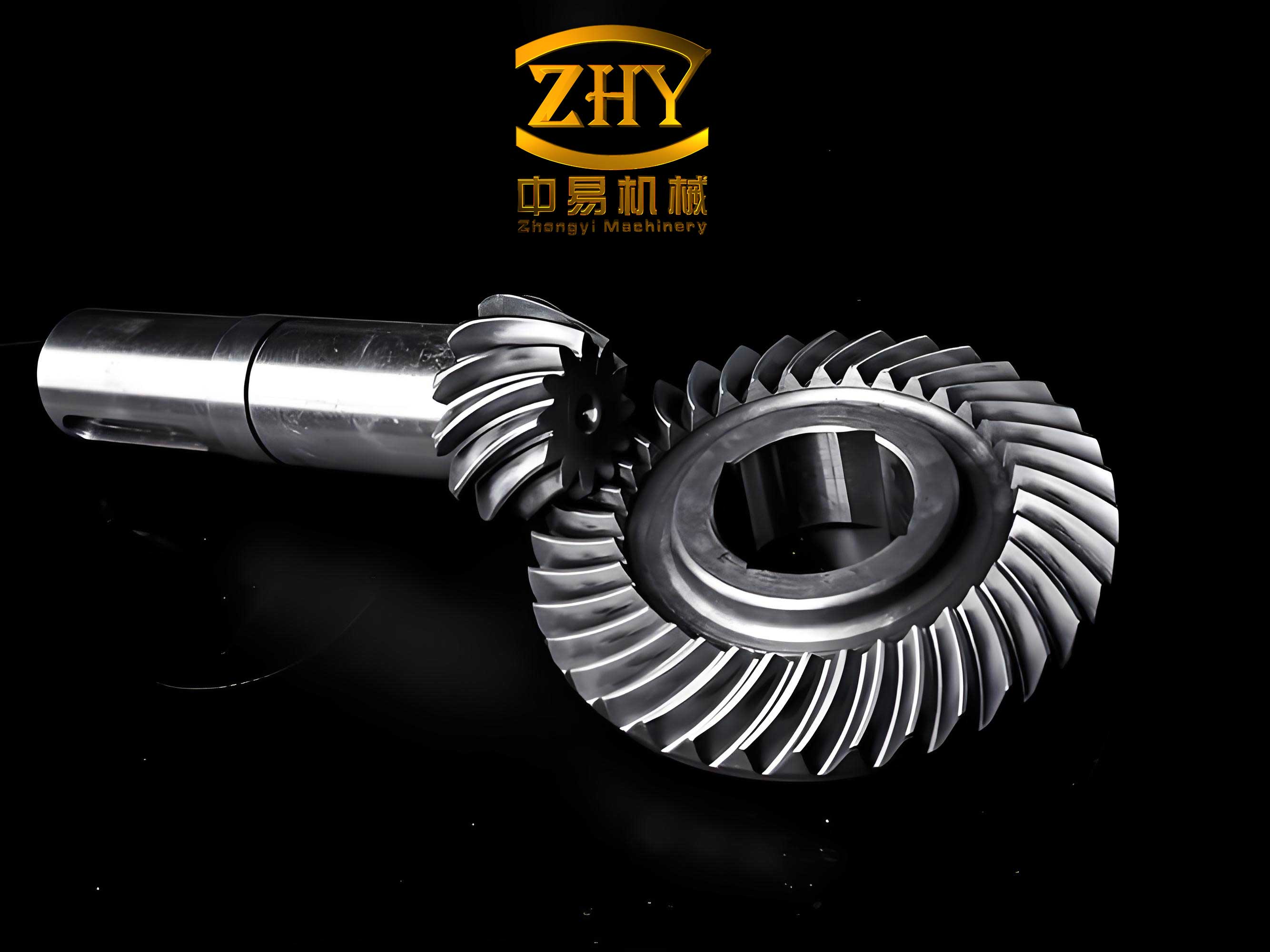
The cold upsetting-extruding process combines the principles of upsetting (forging in the direction of the workpiece axis) and extrusion (forcing metal through a die orifice) to form intricate shapes. For spiral bevel gears, the challenge lies in the three-dimensional, curved tooth profile, which complicates metal flow and increases the risk of incomplete filling or excessive forming loads. The geometry of a spiral bevel gear is defined by parameters such as module, number of teeth, pressure angle, spiral angle, and cone angle. The specific spiral bevel gear investigated here is a critical component in a motorcycle reverse mechanism, with key parameters summarized in Table 1. The material selected is alloy steel 20CrMn, known for its good plasticity and suitability for cold forming operations after proper annealing and surface treatment.
| Parameter | Symbol | Value |
|---|---|---|
| Module | m | 3.5 mm |
| Number of Teeth | z | 16 |
| Pressure Angle | α | 20° |
| Spiral Direction | – | Right-hand |
| Spiral Angle | β | 10° |
| Tangential Shift Coefficient | X_t | 0.08 |
| Normal Shift Coefficient | X_f | 0.14 |
| Pitch Cone Angle | δ | 50.9° |
| Accuracy Grade | – | 7-GB |
Designing the cold upsetting-extruding process for a spiral bevel gear begins with the preparation of a suitable billet. The initial stock is a hot-rolled bar of diameter 28 mm. After spheroidizing annealing to soften the material and phosphating-soaping to reduce friction and prevent galling, the bar is machined into a preform. The shape of this preform is crucial for successful forming. A simple cylindrical billet leads to issues like metal accumulation near the die top, resulting in unfilled teeth and large flash. Conversely, a billet with a small cone angle increases the height-to-diameter ratio, risking buckling and instability during compression. Therefore, we adopted a cylindrical billet with a tapered section, as shown in Figure 3 (preform geometry). This design promotes gradual metal flow into the tooth cavities. The dimensions of the preform were determined through iterative simulation to balance fill quality and forming load. The final cold upsetting-extruding forging drawing, which serves as the target for the simulation, is designed with a parting line at the AA plane. The central hole and certain back-cone features are excluded from the forming operation to simplify die complexity and are intended for subsequent machining, ensuring the precision required for the spiral bevel gear functionality.
To model the plastic deformation during cold upsetting-extruding of the spiral bevel gear, we employed the DEFORM-3D finite element analysis (FEA) software. This software is adept at handling large deformation, nonlinear material behavior, and complex contact conditions inherent in metal forming. The workpiece is treated as a rigid-plastic material, a common assumption for cold forming where elastic strains are negligible compared to plastic strains. The material model for 20CrMn is defined by its flow stress, which is a function of strain, strain rate, and temperature. For cold working, the influence of strain rate and temperature is often simplified. A common constitutive equation used is the power law model:
$$ \sigma = K \epsilon^n $$
where $\sigma$ is the flow stress, $\epsilon$ is the effective plastic strain, $K$ is the strength coefficient, and $n$ is the strain hardening exponent. For 20CrMn, based on experimental data, these parameters can be approximated. However, DEFORM-3D often uses a tabulated stress-strain curve. The key material properties used in our simulation are listed in Table 2.
| Property | Symbol | Value | Unit |
|---|---|---|---|
| Density | ρ | 7.85 | g/cm³ |
| Young’s Modulus | E | 2.05 × 10⁵ | MPa |
| Poisson’s Ratio | ν | 0.3 | – |
| Initial Yield Strength | σ₀ | ~685 (after anneal) | MPa |
| Strain Hardening Exponent | n | 0.15 (estimated) | – |
The friction at the tool-workpiece interface significantly influences metal flow and forming force. We applied the Coulomb friction model:
$$ \tau_f = \mu |\sigma_n| $$
where $\tau_f$ is the frictional shear stress, $\mu$ is the coefficient of friction, and $\sigma_n$ is the normal stress at the interface. A constant friction coefficient of μ = 0.12 was used, typical for cold forging with phosphate-soap lubrication. The tooling (punch and die) was modeled as rigid bodies. The punch moved downward with a constant velocity of 250 mm/s, simulating a press operation. The die cavity contained the negative impression of the spiral bevel gear teeth. Given the non-axisymmetric nature of the spiral bevel gear, the entire billet was meshed with approximately 80,000 tetrahedral elements, with finer mesh on the surface to capture the detailed tooth profile and coarser mesh in the core to reduce computation time. The initial FE model setup is illustrated in Figure 5, showing the punch, billet, and die assembly.
The simulation of the cold upsetting-extruding process for the spiral bevel gear revealed a complex, multi-stage metal flow pattern. Analyzing the velocity vectors of the nodal points (at 1% scale) at different punch strokes provides clear insight into the deformation mechanics. The process can be delineated into four distinct phases:
Phase 1: Initial Cone Engagement and Extrusion. As the punch descends, the tapered section of the preform first contacts the tooth tips at the top of the die cavity. Metal is forced to flow radially outward and axially downward, beginning to fill the tooth spaces near the cone region. The cylindrical portion of the billet undergoes mostly rigid body motion at this stage, with minimal deformation. The metal flow is primarily confined to the conical zone, initiating the formation of the spiral bevel gear teeth profile.
Phase 2: Bottom Contact and Upsetting Initiation. Once the lower end of the billet contacts the bottom of the die cavity, further punch movement induces upsetting. The cylindrical section starts to expand radially (upset) until its outer diameter reaches the inner diameter of the die’s tooth crests. Simultaneously, metal from both the cone and the cylinder continues to extrude into the increasingly constricted tooth cavities. At this point, if the die features a process boss hole (a relief hole at the bottom), metal begins to flow into it, creating a small protrusion. This phase marks the transition where the entire billet volume is actively deforming to conform to the spiral bevel gear shape.
Phase 3: Combined Upsetting, Extrusion, and Flash Formation. With continued punch displacement, the billet experiences significant radial expansion. Metal flows simultaneously into the intricate tooth gaps and the process boss hole (if present). The volume of material that cannot immediately fill the teeth starts to form a flash or overflow in the gap between the punch and die parting line. This flash region acts as a pressure relief zone but also increases the required forming force. The preliminary tooth crests of the spiral bevel gear become defined during this phase.
Phase 4: Final Filling and Flash Thinning. In the final stage, the punch nears the end of its stroke. The flash becomes thinner, significantly increasing its resistance to further flow. This high pressure in the flash region forces the remaining material into the most challenging areas of the die, such as the tooth roots and tips, ensuring complete filling. The spiral bevel gear teeth become fully formed with sharp corners and precise profiles.
To quantify the effect of design modifications, we specifically investigated the role of a process boss hole in the die. Two die configurations were simulated: one with a central relief hole (process boss hole) at the bottom and one without. The forming load versus punch stroke curves for both cases are pivotal for understanding process efficiency. The load-stroke curve for the die without a boss hole shows a steep, almost exponential rise in force as the stroke progresses, culminating in a peak load of approximately 7500 kN. In contrast, the curve for the die with the boss hole exhibits a similar initial trend but a noticeably lower rate of increase in the middle and final stages, reaching a maximum load of about 6500 kN. This represents a reduction of roughly 13.3% in the required forming force. The underlying mechanism is that the boss hole provides an additional, easier path for metal flow, effectively acting as a pressure sink and reducing the hydrostatic stress within the deforming billet. This分流 effect is particularly beneficial for forming complex parts like the spiral bevel gear, where high pressures are needed to fill sharp corners. The comparative data is summarized in Table 3.
| Die Configuration | Maximum Forming Load (kN) | Reduction Compared to No-Hole Case | Observations |
|---|---|---|---|
| Without Process Boss Hole | ~7500 | 0% (Baseline) | Steep load increase, potential for higher die stress |
| With Process Boss Hole | ~6500 | ~13.3% | More gradual load rise, improved metal flow, lower press tonnage requirement |
The effectiveness of the cold upsetting-extruding process for manufacturing spiral bevel gears was validated through physical experiments conducted on a 1000-ton hydraulic press. The experimental setup mirrored the simulation conditions: the same 20CrMn material, identical billet preform geometry, and a fabricated die set with the process boss hole. The die was manufactured from high-strength tool steel and heat-treated for durability. The billet was subjected to the standard softening and lubricating pretreatment. The forming process was carried out at room temperature. The resulting forged spiral bevel gear preform was inspected visually and dimensionally. The experimental part exhibited well-filled teeth, smooth surfaces, distinct edges, and minimal flash, closely matching the simulation prediction. The measured peak forming force during the experiment was approximately 6100 kN, which shows good agreement with the simulated value of 6500 kN, considering practical variables like slight variations in lubrication and material properties. The minor discrepancy can be attributed to the idealized conditions in the FEA model, such as perfectly homogeneous material and constant friction. This correlation between simulation and experiment underscores the reliability of the numerical model for process design and optimization for spiral bevel gear production.
Beyond the basic process analysis, several advanced aspects merit discussion for the cold forming of spiral bevel gears. The selection of the preform geometry is an optimization problem that can be formalized. We can define an objective function $F$ to be minimized, such as the forming energy or the variance of effective strain, subject to constraints like complete die filling and a maximum allowed forming force. Let $V_{fill}$ be the volume of the die cavity and $V_{metal}$ be the volume of metal that has flowed into it at the end of the stroke. The filling constraint can be expressed as:
$$ \frac{V_{metal}}{V_{fill}} \geq 0.999 $$
Another critical factor is the prediction of defects. Incomplete filling is the primary concern, but internal voids or folds can also occur. These can be predicted by analyzing the trace of the strain rate tensor or by monitoring the history of material points. For instance, a folding defect might be indicated by a convergence of flow lines from opposite directions. The simulation software allows tracking of individual elements to identify such potential issues early in the design phase for the spiral bevel gear.
The material’s work hardening behavior during cold upsetting-extruding significantly affects the final properties of the spiral bevel gear. The effective strain distribution within the formed gear is non-uniform, with higher strains typically concentrated in the tooth roots and regions of severe bending. This heterogeneity leads to a gradient in hardness and strength, which can be beneficial for fatigue resistance if managed properly. The relationship between effective strain $\epsilon$ and Vickers hardness $H_v$ can often be approximated by a linear equation for many steels:
$$ H_v = H_{v0} + C \cdot \epsilon $$
where $H_{v0}$ is the initial hardness and $C$ is a material constant. By integrating simulation results with such empirical models, we can predict the performance map of the finished spiral bevel gear component.
Tool design and life are paramount in cold forging. The stresses on the die, especially in the intricate tooth regions, are extreme. Using simulation, we can extract the pressure distribution on the die surface. The maximum pressure $P_{max}$ should be kept below the yield strength of the die material with a safety factor. For a spiral bevel gear die, stress concentrations are expected at the root fillets of the teeth. Finite element analysis of the die itself (elastic analysis) under the loading extracted from the forming simulation can identify critical areas prone to cracking or wear. Optimizing the die profile with appropriate draft angles and generous fillets can enhance its longevity. The economic viability of cold upsetting-extruding for spiral bevel gears heavily depends on achieving sufficient tool life to offset the initial high die manufacturing cost.
Looking forward, the potential for integrating artificial intelligence and machine learning with process simulation for spiral bevel gear manufacturing is vast. Neural networks can be trained on large datasets generated from multiple DEFORM-3D simulations with varying parameters (billet dimensions, friction, die geometry, etc.) to create surrogate models. These models can predict outcomes like forming force and fill percentage almost instantaneously, enabling real-time process optimization and robust design of experiments. Furthermore, multi-objective optimization algorithms can be employed to find the best compromise between conflicting goals, such as minimizing forming load and maximizing die life for the production of spiral bevel gears.
In conclusion, our comprehensive investigation demonstrates that the cold upsetting-extruding process is a viable and efficient method for producing high-quality spiral bevel gear preforms. Through detailed numerical simulation using DEFORM-3D, we have elucidated the complex, multi-stage metal flow involved in forming the intricate teeth of a spiral bevel gear. The simulation accurately predicted the forming stages, from initial extrusion to final flash formation. A key finding is the significant benefit of incorporating a process boss hole in the die, which reduces the maximum forming force by over 13%, thereby lowering press capacity requirements and potentially improving die life. Experimental validation confirmed the simulation results, with the physical forging exhibiting excellent fill and a forming force close to the predicted value. This study provides a solid foundation for the process design and optimization of cold forming for spiral bevel gears. Future work will focus on advanced topics like microstructural prediction, springback analysis after ejection, and the integration of this forming process with subsequent heat treatment and finishing operations to create a complete, cost-effective manufacturing chain for precision spiral bevel gears.