
In the field of mechanical engineering, gear transmission systems are fundamental for motion and power transfer. While cylindrical gears are widely used for constant speed ratio applications, non-circular gears offer unique advantages for variable speed ratio transmissions, such as in printing presses, packaging machinery, and oil pumping units. However, the complexity of non-circular gear design and analysis, particularly regarding transmission error and backlash, has limited their adoption in precision applications. In this article, we explore the numerical modeling and experimental validation of transmission error and backlash in non-circular gears, drawing comparisons with cylindrical gears to highlight key differences and challenges.
Transmission error is a critical factor affecting the performance and accuracy of gear systems. For cylindrical gears, extensive research has established methods for analyzing transmission error using finite element analysis or numerical techniques, focusing on geometric and operational parameters. In contrast, non-circular gears introduce time-varying transmission ratios due to their non-uniform pitch curves, making error modeling more challenging. We aim to address this by developing a comprehensive model based on the meshing line increment method, which accounts for eccentricity errors and enables bidirectional transmission error analysis. This approach allows us to derive backlash indirectly from bidirectional transmission errors, a concept that has been validated for cylindrical gears but requires adaptation for non-circular geometries.
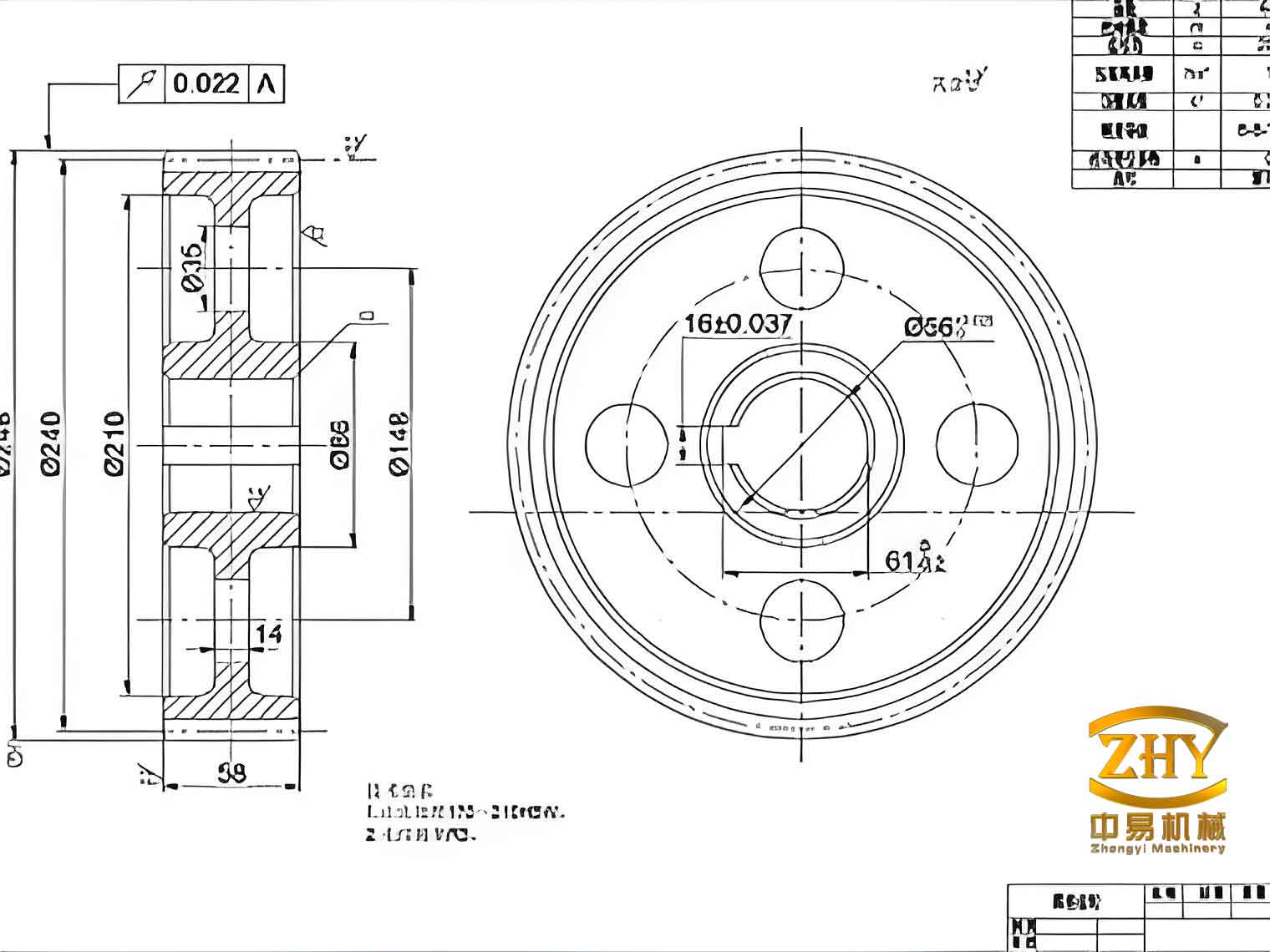
Our work begins with a review of gear transmission principles. Cylindrical gears, with their circular pitch curves, provide a constant transmission ratio, simplifying error analysis. However, non-circular gears, such as elliptic gears, have pitch curves defined by periodic functions like ellipses, leading to varying instantaneous transmission ratios. This variability complicates the prediction of transmission error and backlash, which are essential for minimizing noise, vibration, and wear in high-precision systems. We note that in cylindrical gear systems, backlash is often controlled through manufacturing tolerances and assembly adjustments, but for non-circular gears, dynamic effects due to eccentricities and load variations must be considered.
To model transmission error, we employ the meshing line increment method, which等效izes errors such as eccentricity and center distance variations into increments along the instantaneous meshing line. For a non-circular gear pair, the meshing line increments for the driving and driven gears under bidirectional rotation (clockwise and counterclockwise) are given by:
$$ \Delta L_1 = \pm e_1 \sin(\theta_1 + \phi_1 + \alpha) $$
$$ \Delta L_2 = \pm e_2 \sin(\theta_2 + \phi_2 – \alpha) $$
where \( e_1 \) and \( e_2 \) are the eccentricity errors, \( \theta_1 \) and \( \theta_2 \) are the rotation angles, \( \phi_1 \) and \( \phi_2 \) are the initial phases, and \( \alpha \) is the pressure angle at the pitch point. The signs correspond to the direction of rotation. The initial meshing line increments at time zero are:
$$ \Delta L_{10} = \pm e_1 \sin(\phi_1 + \alpha) $$
$$ \Delta L_{20} = \pm e_2 \sin(\phi_2 – \alpha) $$
From these increments, we derive the transmission errors for counterclockwise (\( \Delta \varphi_n \)) and clockwise (\( \Delta \varphi_s \)) rotations:
$$ \Delta \varphi_n = \frac{180}{\pi r_b} \left[ e_1 \sin(\theta_1 + \phi_1 + \alpha) + e_2 \sin(\theta_2 + \phi_2 – \alpha) – e_1 \sin(\phi_1 + \alpha) – e_2 \sin(\phi_2 – \alpha) \right] $$
$$ \Delta \varphi_s = \frac{180}{\pi r_b} \left[ -e_1 \sin(\theta_1 + \phi_1 + \alpha) – e_2 \sin(\theta_2 + \phi_2 – \alpha) + e_1 \sin(\phi_1 + \alpha) + e_2 \sin(\phi_2 – \alpha) \right] $$
where \( r_b = r \cos \alpha \) is the base radius, and \( r \) is the pitch curve radius. For non-circular gears, \( r \) varies with angle, unlike in cylindrical gears where it is constant. This variation introduces additional complexity in computing \( r_b \) over the rotation cycle.
The backlash, which consists of constant and time-varying components, can be obtained from the bidirectional transmission errors. The time-varying backlash \( b_v \) is approximated as:
$$ b_v = \frac{180 \times 2 \tan \alpha}{\pi r_b} \left[ e_2 \cos(\theta_2 + \phi_2) – e_1 \cos(\theta_1 + \phi_1) \right] $$
This relationship shows that backlash is directly influenced by eccentricity errors and gear geometry, similar to effects observed in cylindrical gears but with angular dependencies due to non-circular pitch curves.
We analyzed the impact of key parameters on transmission error and backlash. First, the eccentricity ratio \( k \), which defines the non-circularity (e.g., for elliptic gears, \( k \) is the ellipse eccentricity), plays a significant role. As \( k \) increases, the amplitude of both counterclockwise and clockwise transmission errors increases, as shown in the table below for a sample non-circular gear pair with parameters: module \( m = 3 \, \text{mm} \), center distance \( a = 150 \, \text{mm} \), and number of teeth \( Z = 47 \).
| Eccentricity Ratio \( k \) | Max \( \Delta \varphi_n \) (degrees) | Max \( \Delta \varphi_s \) (degrees) | Backlash Amplitude \( b_v \) (degrees) |
|---|---|---|---|
| 0.2 | 0.15 | 0.15 | 0.10 |
| 0.4 | 0.25 | 0.25 | 0.18 |
| 0.6 | 0.35 | 0.35 | 0.25 |
This trend indicates that higher non-circularity exacerbates transmission inaccuracies, unlike cylindrical gears where eccentricity errors are independent of gear shape. We attribute this to the varying pitch radius, which amplifies the effects of eccentricity errors over the rotation cycle.
Second, eccentricity errors \( e_1 \) and \( e_2 \), resulting from manufacturing and assembly imperfections, significantly affect transmission error. For a fixed eccentricity ratio \( k = 0.3 \), we observed that increasing eccentricity errors leads to larger transmission error amplitudes, with periodic variations becoming more pronounced. The following table summarizes this relationship:
| Eccentricity Error \( e \) (mm) | Max \( \Delta \varphi_n \) (degrees) | Max \( \Delta \varphi_s \) (degrees) | Backlash Amplitude \( b_v \) (degrees) |
|---|---|---|---|
| 0.01 | 0.10 | 0.10 | 0.05 |
| 0.02 | 0.20 | 0.20 | 0.10 |
| 0.05 | 0.35 | 0.35 | 0.20 |
In cylindrical gears, similar eccentricity errors cause periodic transmission errors, but the constant pitch radius simplifies mitigation through phase optimization. For non-circular gears, however, the time-varying nature complicates compensation strategies.
Third, initial phases \( \phi_1 \) and \( \phi_2 \) influence the transmission error and backlash distributions. By optimizing these phases, we can reduce error amplitudes. For instance, setting \( \phi_1 = \pi – \alpha \) and \( \phi_2 = \alpha \) minimizes backlash fluctuations. The optimization results are summarized below:
| Initial Phase Pair (\( \phi_1, \phi_2 \)) in degrees | Max Backlash \( b_v \) (degrees) Before Optimization | Max Backlash \( b_v \) (degrees) After Optimization |
|---|---|---|
| (10, -10) | 0.15 | 0.05 |
| (30, -30) | 0.20 | 0.08 |
| (60, -60) | 0.25 | 0.10 |
This phase adjustment is analogous to timing adjustments in cylindrical gear systems, where proper phasing can reduce transmission error. However, for non-circular gears, the optimal phases depend on the pitch curve function, requiring detailed analysis.
To validate our model, we conducted transmission experiments using a dedicated test rig. The setup included a horizontal configuration with precision mechanical systems, control units, and measurement instruments such as torque sensors, rotary encoders, and data acquisition cards. We tested non-circular gear pairs under varying loads and speeds, comparing bidirectional transmission errors with model predictions. The experimental results confirmed that backlash can be derived from bidirectional transmission errors, consistent with findings for cylindrical gears. Under a constant speed of 5 rpm and loads ranging from 5 N·m to 15 N·m, we observed that transmission error and backlash increase with load, as summarized below:
| Load (N·m) | Max \( \Delta \varphi_n \) (degrees) Experimental | Max \( \Delta \varphi_s \) (degrees) Experimental | Backlash Amplitude \( b_v \) (degrees) Experimental |
|---|---|---|---|
| 5 | 0.20 | 0.20 | 0.12 |
| 10 | 0.25 | 0.25 | 0.15 |
| 15 | 0.30 | 0.30 | 0.18 |
The experiments also revealed that backlash accumulates over cycles due to tooth deformation, a phenomenon less pronounced in cylindrical gears under similar conditions because of their uniform tooth engagement. This accumulation highlights the need for considering elastic effects in non-circular gear design, much like advanced models for cylindrical gears that incorporate flexibility.
In discussion, we compare our findings with cylindrical gear studies. Cylindrical gears benefit from extensive research on transmission error minimization through profile modifications, lubrication, and precision manufacturing. For non-circular gears, similar strategies can be applied, but the varying geometry demands tailored approaches. For example, the meshing line increment method, commonly used for cylindrical gears, proves effective for non-circular gears when adapted for time-varying parameters. Additionally, the role of eccentricity errors is magnified in non-circular gears due to their inherent asymmetry, whereas in cylindrical gears, eccentricities primarily cause sinusoidal error patterns.
We further explore the implications for practical applications. In systems like oil pumping units, where non-circular gears provide reversing motion, minimizing backlash is crucial to prevent impact and vibration. Our model offers a way to predict and control backlash through phase optimization and error compensation, akin to methods used in high-precision cylindrical gear drives. Future work could integrate finite element analysis to account for tooth deflection and contact dynamics, extending the cylindrical gear methodologies to non-circular geometries.
In conclusion, we have developed a numerical model for transmission error and backlash in non-circular gears based on the meshing line increment method, incorporating eccentricity errors and bidirectional rotation effects. Our analysis shows that transmission error and backlash increase with eccentricity ratio, eccentricity error, and load, and that initial phase optimization can reduce these inaccuracies. Experimental validation confirms the model’s accuracy and the feasibility of deriving backlash from bidirectional transmission errors. These insights contribute to improving the precision of non-circular gear transmissions, bridging gaps between non-circular and cylindrical gear technologies. By leveraging lessons from cylindrical gear research, we can advance non-circular gear applications in precision machinery, ensuring reliable and efficient performance.
Throughout this article, we have emphasized comparisons with cylindrical gears to contextualize our findings. Cylindrical gears serve as a benchmark for understanding transmission error mechanisms, and their well-established principles guide the analysis of non-circular gears. As gear technology evolves, the integration of non-circular and cylindrical gear insights will drive innovations in mechanical transmission systems, enabling more complex and accurate motion control solutions.