
As a fundamental power transmission component in systems like automotive gearboxes, the performance of cylindrical gears is paramount to the overall reliability, efficiency, and noise-vibration-harshness (NVH) characteristics of the drivetrain. Surface failure modes such as wear, pitting, and fatigue cracking are primary life-limiting factors. Carburizing and quenching is a quintessential thermochemical surface hardening process that ingeniously engineers a gradient in material properties. It enriches the surface layer of low-carbon alloy steel gears with carbon, subsequently transforming this case into hard martensite upon rapid cooling, while preserving the tough, ductile core. This “hard shell, tough core” paradigm significantly enhances load-bearing capacity, wear resistance, and contact fatigue life of cylindrical gears.
Traditionally, developing a robust carburizing and quenching process for complex components like cylindrical gears relied heavily on empirical knowledge, rule-of-thumb, and costly trial-and-error experimentation. This approach is not only time-consuming and resource-intensive but also struggles to capture the intricate, interdependent physical phenomena occurring during treatment. The advent of computational numerical simulation, grounded in the theories of metallurgy, heat transfer, and solid mechanics, has revolutionized this domain. It enables a virtual prototyping environment where the coupled effects of carbon diffusion, phase transformation, heat evolution, and stress generation can be predicted and analyzed. This study employs a systematic finite element (FE) based numerical simulation approach to decode the influence of key process parameters on the carburizing outcome and final performance of 20CrMnTi steel cylindrical gears, ultimately guiding an optimization strategy for superior surface integrity.
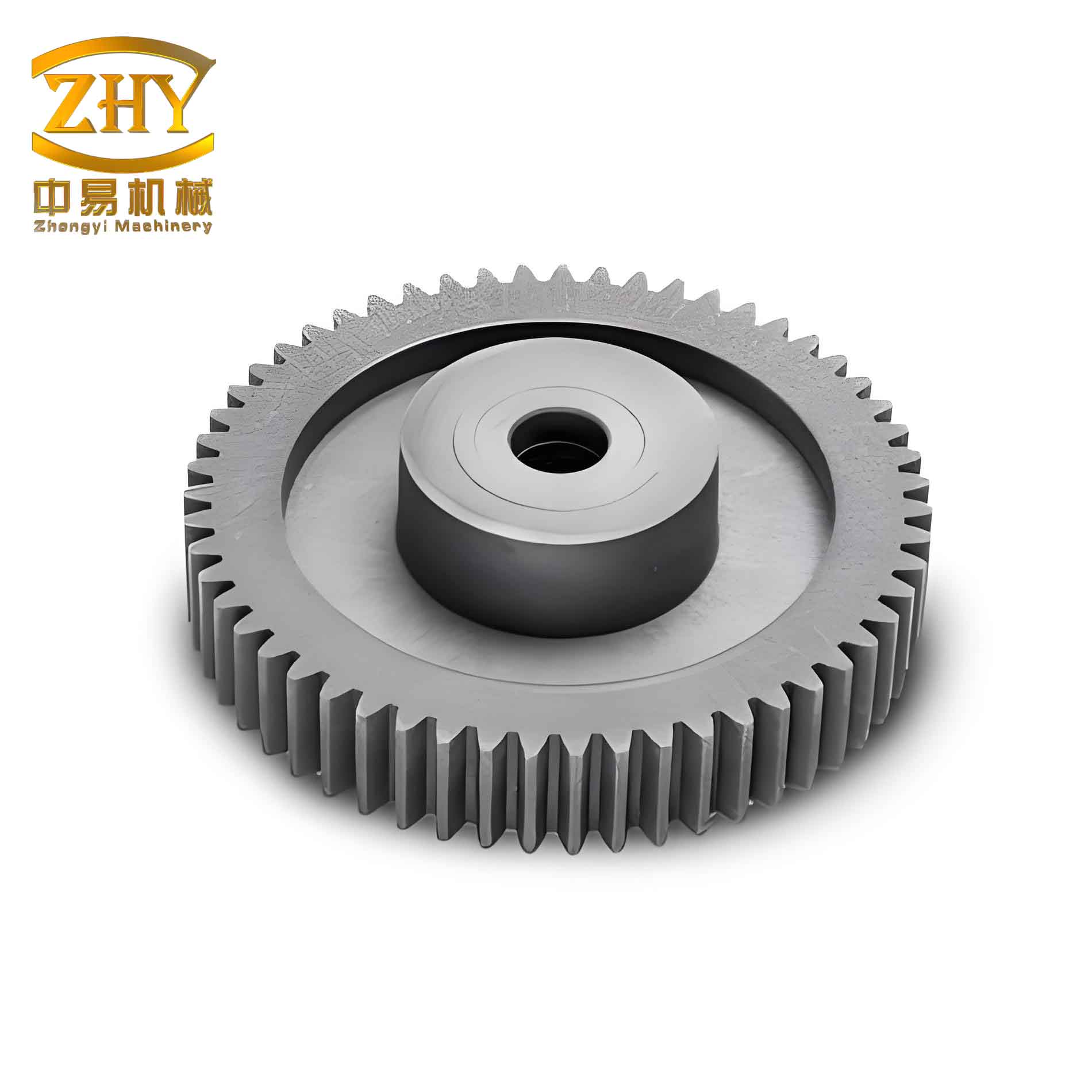
Theoretical Framework for Multi-Physics Simulation
The carburizing and quenching of cylindrical gears is a quintessential multi-physics problem involving strong couplings between diffusion, thermal, metallurgical, and mechanical fields. A reliable simulation must account for these interactions.
1. Carbon Diffusion Field
The ingress and diffusion of carbon atoms into the austenitic steel matrix during carburizing is governed by Fick’s second law, modified to account for concentration-dependent diffusivity and the surface transfer kinetics from the gaseous atmosphere.
$$ \frac{\partial C}{\partial t} = \frac{\partial}{\partial x} \left[ D(C, T) \frac{\partial C}{\partial x} \right] $$
where \( C \) is the carbon concentration (wt%), \( t \) is time (s), \( x \) is the distance from the surface (mm), and \( D(C,T) \) is the temperature and carbon-concentration dependent diffusion coefficient. A widely accepted model for low-alloy steels is:
$$ D(C, T) = D_{0.4} \cdot \exp\left(-\frac{Q}{R T}\right) \cdot \exp\left[B(0.4 – C)\right] $$
Here, \( D_{0.4} \) is the diffusivity at 0.4 wt% C (e.g., 25.5 mm²/s for 20CrMnTi), \( Q \) is the activation energy (e.g., 141 kJ/mol), \( R \) is the universal gas constant, \( T \) is absolute temperature (K), and \( B \) is a material constant (~0.8).
The boundary condition at the gear surface (\( x=0 \)) accounts for the carbon transfer from the atmosphere with carbon potential \( C_p \):
$$ -D \frac{\partial C}{\partial x} \bigg|_{x=0} = \beta(t) \left[ C_p – C(0,t) \right] $$
The transfer coefficient \( \beta(t) \) is temperature-activated: \( \beta(t) = \beta_0 \exp(-E_\beta / (R T)) \).
2. Thermal Field with Phase Transformation Latent Heat
The transient temperature field during heating and quenching obeys the energy conservation law, incorporating latent heat release/absorption (\( Q_{pt} \)) during phase changes.
$$ \rho C_p \frac{\partial T}{\partial t} = \nabla \cdot (\lambda \nabla T) + Q_{pt} $$
where \( \rho \) is density, \( C_p \) is specific heat capacity, and \( \lambda \) is thermal conductivity. For quenching, the convective/radiative boundary condition is critical:
$$ -\lambda \frac{\partial T}{\partial n} = h(T) (T – T_{medium}) + \sigma \epsilon (T^4 – T_{medium}^4) $$
where \( h(T) \) is the temperature-dependent heat transfer coefficient, crucial for modeling oil quenching.
3. Phase Transformation Kinetics
During cooling, austenite decomposes into ferrite, pearlite, bainite, and martensite. Diffusive transformations (ferrite, pearlite, bainite) are modeled using the additivity rule (Scheil’s principle) based on Time-Temperature-Transformation (TTT) diagrams. The transformed fraction \( X \) is computed incrementally.
The martensitic transformation, a diffusionless shear process, is modeled using the Koistinen-Marburger relationship, often modified to account for stress effects:
$$ X_M = 1 – \exp[-\phi(M_s – T)] $$
where \( X_M \) is the martensite volume fraction, \( M_s \) is the martensite start temperature (strongly dependent on carbon content), \( T \) is the current temperature, and \( \phi \) is a material constant. For carburized layers with varying carbon, \( M_s \) is a function of local carbon concentration \( C \): \( M_s(C) = M_s^0 – K C \), where \( M_s^0 \) is the \( M_s \) for pure iron and \( K \) is a constant (~450 °C/wt%C for many steels).
4. Stress-Strain Field
The total strain increment \( d\varepsilon_{total} \) in a material point is decomposed into elastic, plastic, thermal, transformation-induced (dilatational), and transformation-induced plasticity (TRIP) components:
$$ d\varepsilon_{total} = d\varepsilon_{el} + d\varepsilon_{pl} + d\varepsilon_{th} + d\varepsilon_{tr} + d\varepsilon_{tp} $$
- Elastic: \( d\varepsilon_{el} = \mathbf{D}^{-1} d\sigma \), where \( \mathbf{D} \) is the elastic stiffness matrix.
- Plastic: Governed by a yield criterion (e.g., von Mises) and isotropic/kinematic hardening rules.
- Thermal: \( d\varepsilon_{th} = \alpha(T) \cdot dT \cdot \mathbf{I} \), with \( \alpha \) as the coefficient of thermal expansion.
- Transformation Strain: \( d\varepsilon_{tr} = \sum_i \beta_i dX_i \mathbf{I} \), where \( \beta_i \) is the volumetric expansion coefficient for phase \( i \).
- Transformation Plasticity (TRIP): \( d\varepsilon_{tp} = \frac{3}{2} K_{tp} (1-X) dX \cdot \mathbf{s} \), where \( K_{tp} \) is a material parameter and \( \mathbf{s} \) is the deviatoric stress. This term is crucial for accurate residual stress prediction.
5. Hardness Prediction Model
The final hardness in a quenched microstructure is estimated using a linear rule of mixtures based on the predicted phase fractions and their inherent hardness.
$$ HV_{mix} = \sum (V_i \cdot HV_i) $$
where \( V_i \) and \( HV_i \) are the volume fraction and hardness of phase \( i \) (Martensite, Bainite, etc.). The hardness of martensite is primarily a function of its carbon content:
$$ HV_M \approx 1667 C – 926 C^2 + 150 \quad (\text{for } C < 0.6\%) $$
Bainite and ferrite-pearlite hardness depend on composition and cooling rate. The presence of retained austenite (\( V_{RA} \)), common in high-carbon surface layers, softens the matrix. Its effect can be approximated by:
$$ HRC_{corrected} \approx \frac{HRC_{M}}{1 + 0.2 V_{RA}} $$
Finite Element Model Setup for Cylindrical Gears
A 3D model of a representative cylindrical gear was created. Given symmetry, a half-tooth sector model was used for computational efficiency. The mesh comprised approximately 12,800 high-quality tetrahedral elements, with refinement near the tooth surface to capture steep carbon and thermal gradients. The material was 20CrMnTi steel, and its temperature-dependent thermophysical properties (density \( \rho \), conductivity \( \lambda \), specific heat \( C_p \), Young’s modulus \( E \), Poisson’s ratio \( \nu \), CTE \( \alpha \)) and TTT data for different carbon levels were calculated using JMatPro software, as summarized below.
| Property | Temperature Dependence Trend (20CrMnTi) |
|---|---|
| Density (\( \rho \)) | Decreases linearly from ~7850 kg/m³ at 20°C to ~7600 kg/m³ at 900°C. |
| Conductivity (\( \lambda \)) | Decreases from ~42 W/m·K at 20°C to ~28 W/m·K at 800°C, then increases slightly. |
| Specific Heat (\( C_p \)) | Increases gradually, with a peak near the austenitization temperature (~800-900°C). |
| Young’s Modulus (\( E \)) | Decreases monotonically from ~210 GPa at 20°C to ~120 GPa at 900°C. |
| CTE (\( \alpha \)) | Increases with temperature; significant jump during phase change. |
The process boundary conditions were defined: a prescribed carbon potential on all exposed surfaces during carburizing stages, and a temperature-dependent heat transfer coefficient \( h(T) \) representing oil quenching during cooling.
Experimental Validation of the Simulation Model
cylindrical gears made of 20CrMnTi (0.19 wt% C initial) were subjected to a standard industrial gas carburizing and oil quenching cycle: Preheat (820°C, 30 min) → Strong Carburize (905°C, Cp=0.9%, 120 min) → Diffuse (850°C, Cp=0.9%, 60 min) → Quench in 25°C oil. Post-treatment, samples were sectioned for analysis.
Results & Validation:
- Microstructure: The core showed a mix of low-carbon martensite, bainite, and ferrite. The case transitioned from fine plate martensite at intermediate depths to high-carbon plate/needle martensite with interlain retained austenite at the surface. This gradient was correctly predicted by the simulation via the local carbon-dependent \( M_s \) and transformation kinetics.
- Carbon Profile: The measured carbon concentration from the surface to the core at the pitch circle was compared with the simulation. The results showed excellent agreement in trend and magnitude.
| Distance from Surface (mm) | Experimental C (wt%) | Simulated C (wt%) | Relative Error (%) |
|---|---|---|---|
| 0.0 | 0.80 | 0.82 | 2.5 |
| 0.3 | 0.65 | 0.67 | 3.1 |
| 0.6 | 0.48 | 0.50 | 4.2 |
| 0.9 | 0.35 | 0.36 | 2.9 |
| 1.2 | 0.25 | 0.26 | 4.0 |
The effective case depth (to 0.35 wt% C) was ~1.15 mm for both experiment and simulation.
- Hardness Profile: The simulated hardness profile (calculated from phase fractions and carbon content) matched the experimentally measured Vickers hardness trend closely. The surface hardness was slightly lower than the sub-surface maximum due to retained austenite, a feature captured by the model.
This comprehensive validation confirmed the FE model’s reliability for investigating parameter influences and performing virtual optimization for cylindrical gears.
Parametric Study via Numerical Simulation
Using the validated model, a series of simulations were conducted to isolate the effects of four key parameters: Carburizing Temperature, Carburizing Time, Carbon Potential, and Quenching Cooling Rate. The carburizing stage was split into “Boost” (high potential) and “Diffuse” (lower potential) phases, reflecting industrial practice.
1. Influence of Carburizing Temperature
Temperature primarily affects carbon diffusivity \( D(T) \propto \exp(-Q/RT) \). Simulations varied Boost temperature (895-925°C) and Diffuse temperature (840-870°C).
Finding: Increasing Boost temperature significantly increased the depth of the carbon penetration and the core carbon level, while the surface carbon was stabilized by the boundary condition. Increasing Diffuse temperature promoted further inward diffusion, slightly lowering surface carbon but increasing case depth. The effect on final hardness profile was secondary, as the quenching outcome for a given carbon profile was similar. The governing equation for diffusion depth \( d \) illustrates the temperature sensitivity:
$$ d \propto \sqrt{D(T) \cdot t} \approx \sqrt{t \cdot \exp\left(-\frac{Q}{RT}\right)} $$
2. Influence of Carburizing Time
Time is the other direct factor in the diffusion equation \( \partial C/\partial t = D \nabla^2 C \). Boost time (90-180 min) and Diffuse time (45-90 min) were varied.
Finding: Boost time had a profound effect. Doubling boost time from 90 to 180 min increased case depth (to 0.35%C) by approximately 70%. It also raised the core carbon level substantially. Diffuse time had a more subtle effect, primarily smoothing the carbon gradient and slightly reducing surface carbon. The hardness profile directly mirrored the carbon profile: longer times resulted in a thicker high-hardness case and a higher hardness core due to increased hardenability from higher carbon.
3. Influence of Carbon Potential
Carbon potential \( C_p \) sets the driving force for surface ingress, \( \beta (C_p – C_{surface}) \). Boost potential (0.85-0.95%) and Diffuse potential (0.75-0.90%) were varied.
Finding: Boost potential strongly controlled the magnitude of the surface carbon concentration and the gradient steepness near the surface. Higher boost potential led to a higher surface carbon peak. Diffuse potential was the primary knob for setting the final surface carbon content. A lower diffuse potential effectively “decarburizes” the very surface, lowering the peak carbon to avoid excessive retained austenite or brittle carbides. This is critical for cylindrical gears where high surface carbon can compromise bending fatigue strength. An optimal sequence uses high boost potential for speed and high diffuse potential for depth, followed by a lower diffuse potential or temperature to trim the surface carbon.
4. Influence of Quenching Cooling Rate
Modeled by varying the oil quenching heat transfer coefficient \( h(T) \).
Finding: The cooling rate had no effect on the carbon profile, as it is established during the high-temperature carburizing stages. However, it drastically affected the microstructure and hardness. Faster cooling (e.g., more agitated oil) suppressed the formation of soft transformation products like bainite and ferrite-pearlite, especially in the lower-carbon core and case-core transition zone. This resulted in a higher and more uniform hardness throughout the section. For deep-case cylindrical gears, adequate cooling intensity is essential to achieve full martensitic transformation in the core, preventing a soft “under-hardened” region.
The quantitative effects are summarized in the following table ranking the influence on two key outputs:
| Process Parameter | Effect on Case Depth | Effect on Surface Carbon | Effect on Core Hardness |
|---|---|---|---|
| Boost Time | Very Strong (↑) | Moderate (↑) | Strong (↑) |
| Boost Temperature | Strong (↑) | Weak/Stabilized | Moderate (↑) |
| Boost Carbon Potential | Strong (↑) | Strong (↑) | Weak (↑) |
| Diffuse Time | Moderate (↑) | Weak (↓) | Weak (↑) |
| Diffuse Carbon Potential | Weak (↑) | Very Strong (↑) | Very Weak |
| Quenching Rate | None | None | Very Strong (↑) |
Process Optimization for Target Case Properties
For a specific gear application, the target is often a defined surface carbon (e.g., 0.75-0.85% to balance hardness and toughness) and an effective case depth (e.g., 0.9 mm). Using the insights from the parametric study, an optimization workflow was implemented.
1. Orthogonal Experiment Design
A \( L_9(3^4) \) orthogonal array was designed with four factors at three levels: Boost Time (A: 60, 80, 100 min), Diffuse Time (B: 40, 50, 60 min), Boost Carbon Potential (C: 0.85, 0.90, 0.95%), and Diffuse Carbon Potential (D: 0.80, 0.85, 0.90%). The target outputs were Surface Carbon Concentration (\( Y_1 \)) and Case Depth (\( Y_2 \)). Nine simulations were run according to the array.
Analysis of Means (ANOM) & ANOVA: The mean response for each factor level was calculated. The difference between the max and min mean for a factor is its range (R), indicating its influence.
For \( Y_1 \) (Surface Carbon): \( R_D > R_A > R_C > R_B \). Diffuse Carbon Potential (D) was the overwhelmingly dominant factor.
For \( Y_2 \) (Case Depth): \( R_A > R_C > R_B > R_D \). Boost Time (A) was the most significant factor.
Analysis of Variance (ANOVA) confirmed these findings with statistical significance. This clear separation of controlling factors is powerful: to adjust surface carbon, primarily change the diffuse potential; to adjust case depth, primarily change the boost time.
2. Deriving an Optimal Parameter Set
With targets of \( Y_1 \approx 0.80\% \) and \( Y_2 \approx 0.90 \) mm, the optimal level combination was identified as A2B1C2D3:
- Boost Time (A): 80 min (Level 2)
- Diffuse Time (B): 40 min (Level 1)
- Boost Carbon Potential (C): 0.90% (Level 2)
- Diffuse Carbon Potential (D): 0.90% (Level 3)
A confirmatory simulation with this set yielded \( Y_1 = 0.796\% \) and \( Y_2 = 0.903 \) mm, hitting the targets precisely. This represents a 33% reduction in total process time compared to the initial validated cycle (180 min vs. 120 min boost+diffuse) while achieving a more desirable surface carbon level.
3. Development of a PSO-BP Neural Network Prediction Model
To facilitate rapid prediction and inverse design (finding parameters for a desired output), a machine learning model was developed. A Back-Propagation (BP) Neural Network can map the nonlinear relationship between input parameters (A, B, C, D) and outputs (Y1, Y2). However, BP networks are prone to local minima. A Particle Swarm Optimization (PSO) algorithm was used to optimize the initial weights and biases of the BP network, creating a robust PSO-BP model.
PSO Algorithm: Each particle’s position represents a set of neural network weights/biases. The particle swarm searches the space by updating velocity \( v_{id} \) and position \( x_{id} \):
$$ v_{id}^{k+1} = w v_{id}^k + c_1 r_1 (pbest_{id} – x_{id}^k) + c_2 r_2 (gbest_d – x_{id}^k) $$
$$ x_{id}^{k+1} = x_{id}^k + v_{id}^{k+1} $$
where \( w \) is inertia, \( c_1, c_2 \) are learning factors, \( r_1, r_2 \) are random numbers, \( pbest \) is the particle’s best solution, and \( gbest \) is the global best.
The optimized PSO-BP network (4-9-2 architecture) was trained on 25 data points from simulations. It demonstrated superior accuracy compared to a standard BP network, predicting case depth and surface carbon with an average error under 2%. This model serves as an instant digital twin for the carburizing process of these cylindrical gears, enabling fast what-if analysis and process window definition.
Conclusion
This integrated study demonstrates the formidable power of coupled numerical simulation in deconvoluting and optimizing the complex carburizing and quenching process for cylindrical gears. The established thermo-metallurgical-mechanical FE model, validated against experimental data, accurately predicts carbon profiles, microstructure gradients, and hardness distributions. The parametric study elucidated distinct roles of process parameters: Boost time and temperature govern penetration depth, boost potential sets the carbon influx rate, and diffuse potential is the master control for final surface carbon. Quenching rate independently controls the phase transformation and core hardness.
Through designed numerical experiments (Orthogonal Array) and modern optimization (PSO-BP Neural Network), a systematic pathway was established to efficiently identify optimal process parameters (e.g., 80 min boost at 0.9%C, 40 min diffuse at 0.9%C) meeting specific case depth and surface carbon targets. This virtual engineering approach significantly reduces development time, material waste, and energy consumption compared to traditional trial-and-error methods. It provides a foundational framework for achieving tailored case properties in cylindrical gears, ultimately contributing to the manufacture of high-performance, durable, and reliable transmission components. Future work will integrate distortion and residual stress minimization as concurrent optimization objectives.