
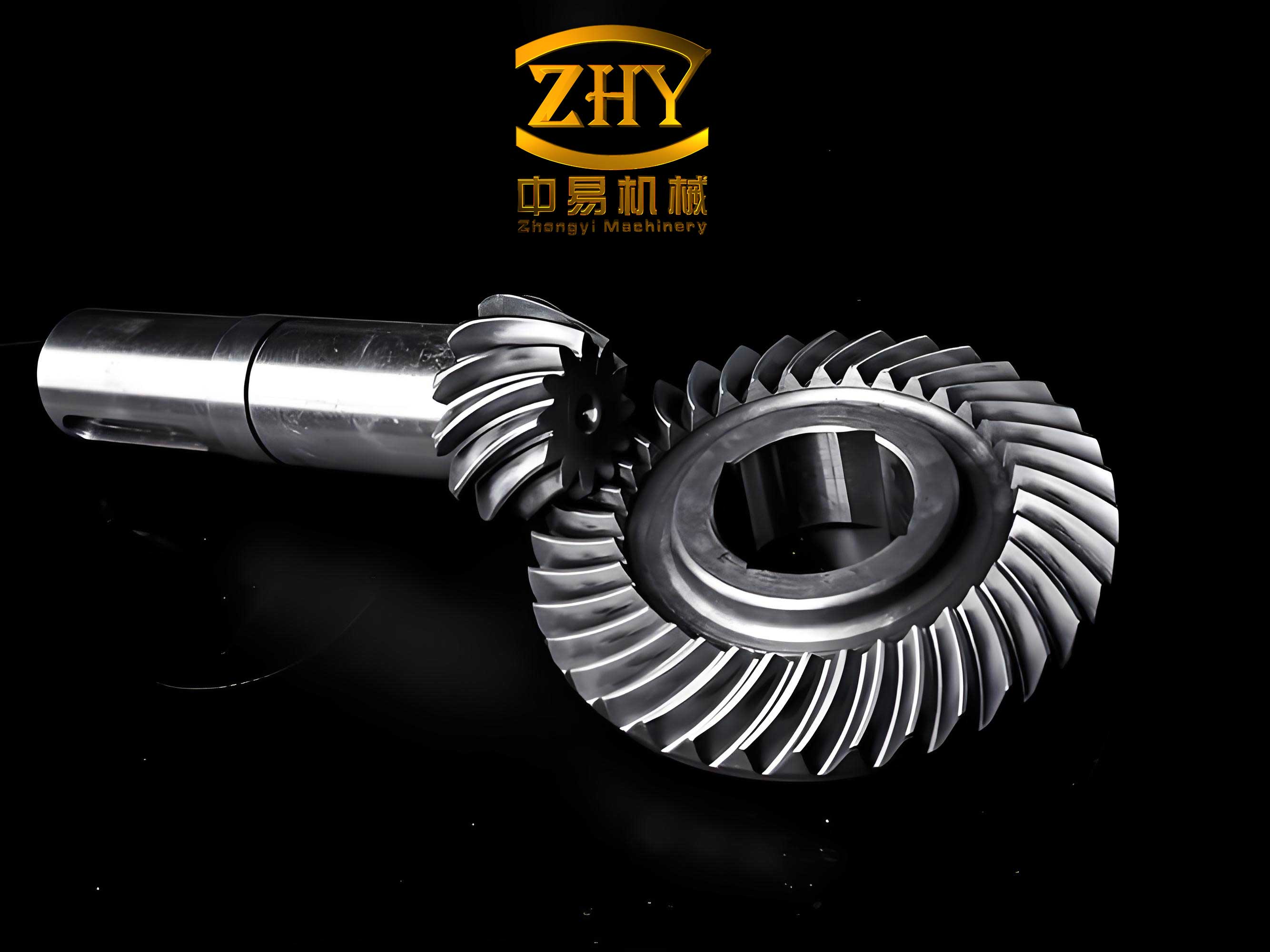
In the realm of aerospace propulsion systems, the performance and reliability of transmission components are paramount. Among these, the spiral bevel gear plays a critical role in power transmission within turboshaft engines. The intricate geometry and high-load demands of spiral bevel gears necessitate precise manufacturing and heat treatment processes to ensure optimal mechanical properties, fatigue resistance, and minimal distortion. Traditional heat treatment methods for spiral bevel gears often involve carburizing followed by quenching. However, uncontrolled distortion during quenching can lead to significant challenges in meeting tight geometric tolerances, affecting gear meshing, noise, and overall system efficiency. To address this, die quenching—or press quenching—has been adopted as a sophisticated technique where the gear is constrained within a die set during cooling to actively control and minimize distortion. The design of the die set, including its dimensions, pressure angles, and alignment, is a complex empirical task. In recent years, numerical simulation has emerged as a powerful tool to model the multi-physics phenomena during heat treatment, enabling virtual prototyping and optimization of die quenching processes for spiral bevel gears before physical trials. This article presents a comprehensive numerical investigation into the die quenching process of a 9310 steel spiral bevel gear, focusing on establishing a coupled thermal-metallurgical-mechanical model, analyzing the effects of die design parameters on distortion, and proposing optimization strategies to achieve distortion control.
The die quenching process for a spiral bevel gear involves heating the gear to an austenitizing temperature, followed by rapid transfer to a press where it is clamped between upper and lower dies and a core rod, then quenched with oil. The complex interaction between thermal gradients, phase transformations, and mechanical constraints from the dies results in a intricate stress-strain evolution. To accurately simulate this, a finite element model incorporating temperature, phase transformation, and stress/strain coupling was developed. The geometry of the spiral bevel gear and the die set was modeled in detail. The spiral bevel gear consisted of the toothed section, a web, and a cylindrical shaft with a flange. The die set comprised an upper die, a lower die, and a core die inserted into the gear’s bore. The key dimensions requiring control post-quenching are the distance from the gear tooth root to the flange (assembly dimension) and the face cone angle of the teeth, both directly influenced by the die design.
The mathematical foundation for the simulation rests on governing equations for heat transfer, phase transformation kinetics, and constitutive material behavior. The transient temperature field within the spiral bevel gear during heating and quenching is governed by the Fourier-Kirchhoff heat conduction equation, which accounts for internal heat generation due to phase transformation latent heat:
$$ \nabla \cdot (\lambda \nabla T) + P_v = \rho c \frac{\partial T}{\partial t} $$
where \( \rho \) is density, \( \lambda \) is thermal conductivity, \( c \) is specific heat, \( T \) is temperature, \( t \) is time, and \( P_v \) represents the volumetric heat source from phase transformations. For the spiral bevel gear material, 9310 steel, the phase transformation during the rapid quench is predominantly martensitic, a diffusionless transformation. The volume fraction of martensite, \( f \), as a function of temperature is described by the Koistinen-Marburger (K-M) equation:
$$ f = 1 – \exp[-\alpha (M_s – T)] $$
where \( \alpha \) is a constant (typically 0.011 for many steels) and \( M_s \) is the martensite start temperature. The total strain \( \varepsilon_{kl} \) in the material is decomposed into elastic, plastic, thermal, transformational, and transformation-induced plastic components:
$$ \varepsilon_{kl} = \varepsilon_{kl}^e + \varepsilon_{kl}^p + \varepsilon_{kl}^{th} + \varepsilon_{kl}^{ph} + \varepsilon_{kl}^{tp} $$
This multi-physics coupling was implemented using finite element software capable of handling thermo-metallurgical-mechanical analysis. The dies were modeled as rigid bodies, while the spiral bevel gear was a deformable body. Boundary conditions included convective heat transfer with a quenchant, whose heat transfer coefficient was derived from cooling curve analysis, and mechanical contact with friction between the gear and dies. A pressure force was applied on the upper die to simulate the press action.
The material properties for 9310 steel are crucial for simulation accuracy. The chemical composition of the spiral bevel gear material is listed in Table 1.
| C | Mn | Si | Cr | Ni | Mo | B | Cu |
|---|---|---|---|---|---|---|---|
| 0.07-0.13 | 0.40-0.70 | 0.15-0.35 | 1.00-1.40 | 3.00-3.50 | 0.08-0.15 | <0.001 | <0.35 |
Critical transformation temperatures and thermal expansion coefficients were determined via dilatometry. A cylindrical specimen was heated to 815°C at 2°C/s, held, and cooled at 10°C/s. The dilatometric curve provided key data: \( A_{c1} = 738°C \), \( A_{c3} = 795°C \), and \( M_s = 431°C \). The coefficient of thermal expansion \( \beta_m(T) \) for different phases was calculated from the slope of the expansion curve, and the transformation strain \( \beta_m(0) \) at 0°C was derived. Other temperature-dependent properties like thermal conductivity, specific heat, Young’s modulus, and yield strength were obtained from material databases and calculations using specialized software. The heat transfer coefficient for the oil quenchant, a critical boundary condition, was modeled as a function of temperature based on inverse analysis of cooling curves, as shown in the following representative equation set fitted to the data:
$$ h(T) = h_0 + a \cdot \exp(-b(T – T_0)^2) $$
where \( h_0 \), \( a \), \( b \), and \( T_0 \) are fitting parameters specific to the quenchant used for the spiral bevel gear.
The simulation of the die quenching process for the spiral bevel gear began with the heating stage. The gear was heated from room temperature to 815°C. The temperature distribution was non-uniform due to varying section thicknesses; thinner sections like the tooth tips and web heated faster than the thicker shaft. The maximum temperature difference during heating reached approximately 85°C. Upon reaching the austenitizing temperature, the gear was fully austenitized, as confirmed by the phase transformation model. The subsequent quenching stage involved transferring the gear to the press and applying the die pressure. The cooling rates varied significantly: the tooth tips cooled at an average rate exceeding 100°C/s down to 300°C, while the thick shaft section cooled at about 11°C/s. This disparity led to a large thermal gradient, with a maximum temperature difference of around 340°C during quenching. The martensitic transformation, as predicted by the K-M equation, initiated first in the fast-cooling thin sections (tooth tips and web) around 3 seconds into the quench and completed within 12 seconds, while transformation in the shaft started later. The sequential transformation and associated volume expansion (martensite has a larger specific volume than austenite) generated significant transformation stresses.
The distortion of the spiral bevel gear after die quenching is a result of the interplay between thermal shrinkage, phase transformation expansion, and the constraining force from the dies. To systematically study the influence of die design, several die assembly configurations were simulated. The two primary die design parameters investigated were the assembly dimension (the combined height of supports on the lower die that determines the distance from tooth root to flange) and the pressure angle of the upper die’s conical surface that contacts the tooth face. Six different assembly methods, combining three assembly dimensions and two pressure angles, were defined, as summarized in Table 2.
| Configuration | Upper Die Pressure Angle | Assembly Dimension (mm) |
|---|---|---|
| 1 | 24°9′ | 14.88 |
| 2 | 24°9′ | 14.95 |
| 3 | 24°9′ | 15.02 |
| 4 | 24°6′ | 14.88 |
| 5 | 24°6′ | 14.95 |
| 6 | 24°6′ | 15.02 |
The contact state between the spiral bevel gear and the dies at different stages critically affects the stress distribution and final distortion. At room temperature, with an assembly dimension of 14.95 mm, both the gear tooth root and the flange were in full contact with the lower die. For dimensions 14.88 mm and 15.02 mm, contact was incomplete—either the flange or the tooth root lost contact. After heating to 815°C, thermal expansion altered the gear dimensions, changing the contact conditions when the press force was applied. For assembly dimensions of 14.88 mm and 14.95 mm, only the flange remained in contact, leaving the tooth section unsupported, while for 15.02 mm, both surfaces contacted. Similarly, the contact area between the upper die and the tooth face varied with the pressure angle and during cooling as the gear material strengthened.
The simulated post-quench distortions for the spiral bevel gear under the six configurations are quantitatively compared in Table 3. The distortion values represent changes from the original room-temperature dimensions before heat treatment. Key metrics are the change in the assembly dimension (tooth root to flange) and the change in the face cone angle.
| Configuration | Change in Assembly Dimension (mm) | Change in Face Cone Angle (minutes of arc) | Overall Axial Shrinkage (mm) | Radial Contraction (mm) |
|---|---|---|---|---|
| 1 | -0.06 | -2.5 | -0.051 | -0.15 |
| 2 | +0.008 | +0.8 | -0.049 | -0.152 |
| 3 | +0.04 | +4.0 | -0.048 | -0.148 |
| 4 | -0.062 | -4.8 | -0.053 | -0.151 |
| 5 | +0.007 | +1.2 | -0.050 | -0.150 |
| 6 | +0.042 | +5.5 | -0.047 | -0.147 |
Analysis of Table 3 reveals that the assembly dimension of the die is the dominant factor controlling the distortion of the critical assembly dimension on the spiral bevel gear. Configurations with an assembly dimension of 14.95 mm (2 and 5) resulted in minimal change (less than ±0.01 mm), whereas deviations from this value led to significant shrinkage or growth. The face cone angle distortion is influenced by both parameters. For a given pressure angle, a larger assembly dimension increases the face cone angle change. For a given assembly dimension, a larger pressure angle (24°9′ vs. 24°6′) generally reduces the face cone angle increase. Configuration 2, with a pressure angle of 24°9′ and assembly dimension of 14.95 mm, offered the best compromise, keeping both key dimensions within acceptable limits. The overall gear exhibited axial and radial shrinkage due to the net volume contraction from martensite formation and thermal contraction, consistent with the dilatometry results. The governing equation for the net volumetric strain can be expressed as a combination of contributions:
$$ \Delta V/V_0 \approx 3\alpha_T \Delta T + \sum_i \beta_i \Delta f_i $$
where \( \alpha_T \) is the linear thermal expansion coefficient, \( \Delta T \) is the temperature drop, \( \beta_i \) is the transformation strain coefficient for phase i, and \( \Delta f_i \) is the change in phase fraction. For the spiral bevel gear, the sum over i primarily involves the martensite transformation.
Another critical aspect in the die quenching of spiral bevel gears is the alignment of the press. In practice, press axes may have misalignment, leading to eccentric loading. This was simulated by introducing lateral offsets of the upper die relative to the lower die and core die. Offsets of 0.05 mm, 0.1 mm, and 0.2 mm were modeled. The results showed that even a small offset of 0.2 mm could cause asymmetric distortion, with one side of the gear tooth face collapsing and the opposite side lifting, creating a face angle error of about 0.1 mm in height difference. The mechanism is that the lateral component of the press force on the inclined tooth face tries to shift the gear radially, but if the core die fits tightly in the bore, this shift is prevented, inducing uneven stress and distortion. The force imbalance can be analyzed by resolving the press force \( F \) into normal and tangential components on the tooth face:
$$ F_t = F \sin(\theta),\quad F_n = F \cos(\theta) $$
where \( \theta \) is the pressure angle. The tangential component \( F_t \) induces a lateral force. If the core die clearance is insufficient, a reaction moment \( M \) develops, causing tilting. To mitigate this, the core die diameter was reduced to provide a radial clearance of 0.2 mm with the gear bore. Subsequent simulation with this modified core die and a 0.2 mm upper die offset showed that the gear could now shift slightly radially, allowing the forces to equilibrate and resulting in a much more uniform tooth face with minimal distortion. This highlights the importance of die design tolerances and clearances in accommodating real-world equipment inaccuracies for spiral bevel gear manufacturing.
The evolution of stress during the die quenching of the spiral bevel gear is complex. Residual stresses arise from thermal gradients and transformation sequences. High compressive stresses often develop on the surface of the teeth due to martensite formation, which is desirable for fatigue resistance. The von Mises stress distribution at the end of quenching for the optimized configuration (Configuration 2) showed maximum stresses in the fillet regions of the teeth and at the junction of the web and shaft, areas prone to stress concentration. The final hardness profile, derived from the martensite fraction, indicated full hardening in the thin sections and possibly some lower hardness in the core of the thick shaft if the cooling rate was insufficient to form 100% martensite. The hardness \( H \) can be estimated from the martensite fraction \( f_m \) using a rule of mixtures:
$$ H = H_m f_m + H_{ra} (1 – f_m) $$
where \( H_m \) is the hardness of full martensite and \( H_{ra} \) is the hardness of retained austenite. For the spiral bevel gear material, a high martensite fraction is typically achieved in all critical regions due to the alloy composition and quench intensity.
Based on the simulation insights, an optimized die set for the spiral bevel gear was designed and manufactured. The key parameters were an assembly dimension of 14.95 mm, an upper die pressure angle of 24°9′, and a core die with a diameter reduced to provide a 0.2 mm radial clearance with the gear bore. This design was validated in actual production trials. The measured distortions on treated spiral bevel gears were within specifications: gear runout less than 0.1 mm, cumulative pitch error less than 0.1 mm, assembly dimension change less than 0.05 mm, and face cone angle change less than 2 minutes of arc. The success of this approach demonstrates the power of numerical simulation in replacing costly trial-and-error methods for complex components like spiral bevel gears.
In conclusion, the die quenching process for a 9310 steel spiral bevel gear was thoroughly investigated through advanced numerical simulation. A fully coupled thermo-metallurgical-mechanical finite element model was developed and validated against material data. The simulations elucidated the critical influence of die design parameters—specifically the assembly dimension and pressure angle—on the final distortion of the spiral bevel gear. An assembly dimension of 14.95 mm was found optimal for controlling the flange-to-tooth root distance, while a pressure angle of 24°9′ helped maintain the face cone angle. Furthermore, the study highlighted the sensitivity of the spiral bevel gear distortion to press misalignment and proposed a design modification for the core die (increased clearance) to mitigate this issue, ensuring robustness against equipment tolerances. The numerical approach enabled a deep understanding of the underlying physics, including temperature gradients, martensite transformation kinetics, and stress evolution during the die quenching of spiral bevel gears. This methodology provides a robust framework for optimizing heat treatment processes for other complex gear geometries, reducing development time and cost while improving product quality and performance in critical applications such as aerospace transmissions.