
In this study, I investigate the isothermal forging process for aluminum alloy straight bevel gears, focusing on numerical simulation and parameter optimization to enhance forming quality and reduce loads. Aluminum alloys, such as 7075 aluminum, offer advantages like lightweight, high strength, and corrosion resistance, making them suitable for replacing steel in gears to reduce weight and energy consumption. The straight bevel gear, a key component in automotive differentials, is analyzed here to address challenges in forging, such as high forming loads and defects like folding. Using finite element analysis (FEA) with Deform-3D software, I simulate the open-die forging process, examine metal flow and forming loads, and optimize critical parameters through orthogonal experiments and single-variable analyses. The goal is to achieve a defect-free straight bevel gear with minimal forming load, providing insights for industrial applications.
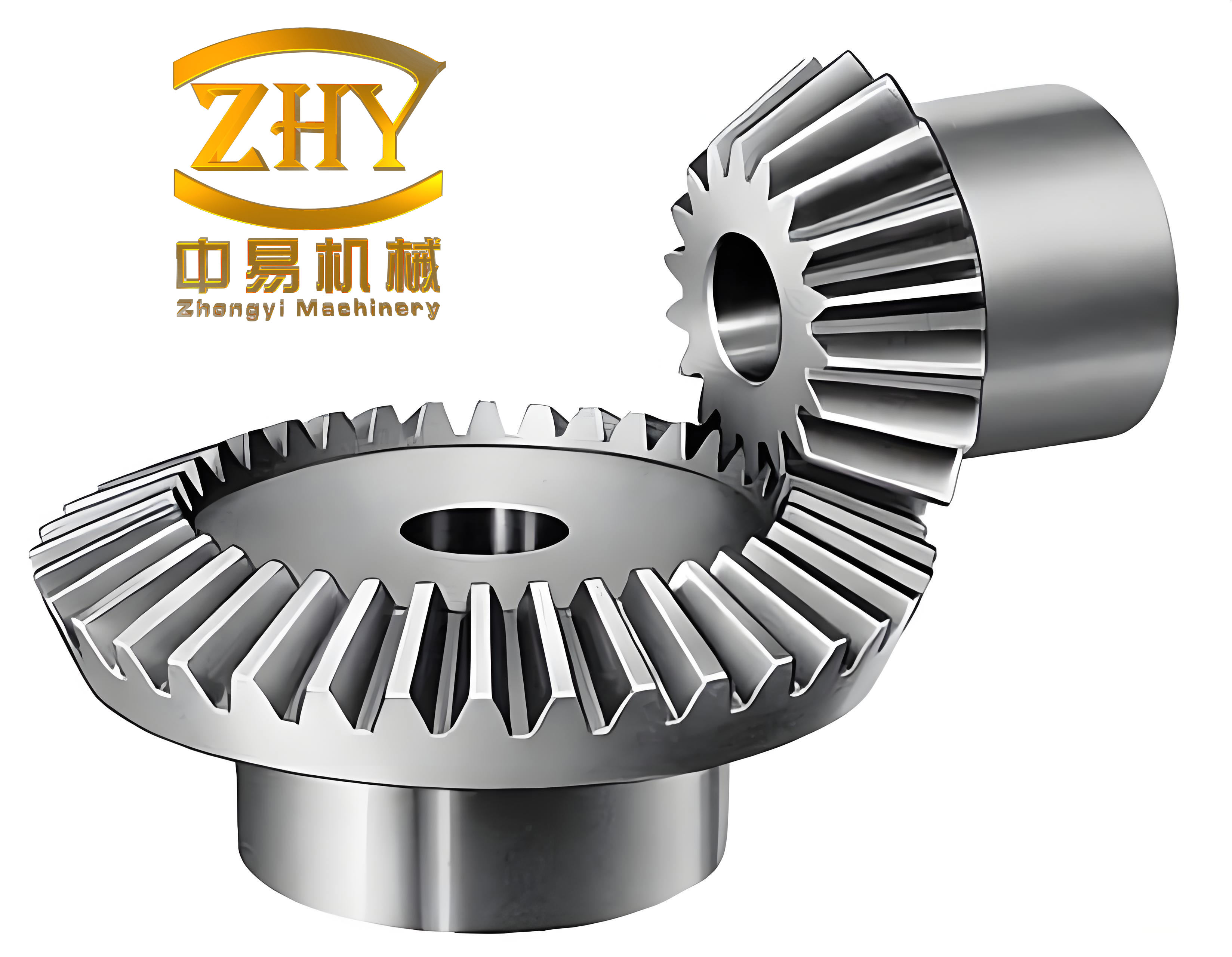
The straight bevel gear under study has specific geometric parameters, as summarized in Table 1. These parameters influence the forging process, and understanding them is crucial for effective simulation. The gear is designed with a module of 7.55, pressure angle of 30 degrees, and 11 teeth, resulting in a pitch diameter of 64.36 mm. For forging, I adopt an open-die approach with a parting surface at the maximum cross-section to ensure the teeth are fully formed in the lower die. This method incorporates a simple flash design to prevent mold contact at the end of forging, reducing loads and improving mold life. The 3D model of the forging, derived from these parameters, serves as the basis for FEA.
| Parameter | Value |
|---|---|
| Number of Teeth | 11 |
| Module | 7.55 |
| Pressure Angle (°) | 30 |
| Pitch Circle Tooth Thickness (mm) | 14.35 |
| Average Module | 5.85 |
| Average Pitch Diameter (mm) | 64.36 |
| Average Cone Length (mm) | 56.80 |
| Addendum Modification | 1.67 |
To establish the finite element model, I use UG software to create the die components, including the tooth-shaped die and back taper die, which are then imported into Deform-3D for assembly. Given the rotational symmetry of the straight bevel gear, I simulate only one tooth segment to save computational time. The assembled model includes the upper punch, lower die, and billet, with the billet modeled as a plastic material and the dies as rigid bodies. The initial parameters for simulation are set as follows: temperature of 475°C, flash thickness of 1.2 mm, web height of 19 mm, web thickness of 8 mm, fillet radius of 3 mm, punch velocity of 0.01 mm/s, and friction coefficient of 0.25. These values are based on preliminary analyses to ensure realistic conditions for the straight bevel gear forging.
The simulation results reveal the metal flow and forming load variations during the isothermal forging of the straight bevel gear. Initially, the billet undergoes upsetting, similar to an H-shaped cross-section deformation. As the process progresses, metal flows into the tooth cavities, and a flash forms at the periphery. The forming load remains relatively low in the early stages but increases significantly upon flash formation, reaching approximately 73 kN. However, folding defects occur, indicating the need for parameter optimization. The metal flow can be described by the continuity equation for incompressible flow: $$ \nabla \cdot \mathbf{v} = 0 $$ where \( \mathbf{v} \) is the velocity vector. Additionally, the effective stress during deformation follows the power law: $$ \sigma = K \epsilon^n $$ where \( \sigma \) is the flow stress, \( \epsilon \) is the strain, \( K \) is the strength coefficient, and \( n \) is the strain-hardening exponent. For 7075 aluminum, typical values are \( K = 500 \) MPa and \( n = 0.15 \) at elevated temperatures, but these are adjusted based on simulation feedback.
To optimize the process, I employ an orthogonal experimental design focusing on five key parameters: temperature (A), web thickness (B), web height (C), fillet radius (D), and flash thickness (E). Each parameter has four levels, as shown in Table 2, and I use an L16 orthogonal array to conduct 16 trials. The response variable is the forming load, with the objective of minimizing it while ensuring complete filling without defects like folding or cracking. The orthogonal array and initial results are presented in Table 3, where I analyze the influence of each parameter on the forming load.
| Parameter | Level 1 | Level 2 | Level 3 | Level 4 |
|---|---|---|---|---|
| A: Temperature (°C) | 400 | 425 | 450 | 475 |
| B: Web Thickness (mm) | 6 | 7 | 8 | 9 |
| C: Web Height (mm) | 19 | 20 | 21 | 22 |
| D: Fillet Radius (mm) | 1 | 2 | 3 | 4 |
| E: Flash Thickness (mm) | 0.6 | 0.8 | 1.0 | 1.2 |
| Trial | A | B | C | D | E | Forming Load (kN) | Filling Condition |
|---|---|---|---|---|---|---|---|
| 1 | 1 | 1 | 1 | 1 | 1 | 21.9 | Folding, filled |
| 2 | 1 | 2 | 2 | 2 | 2 | 159.0 | Folding, filled |
| 3 | 1 | 3 | 3 | 3 | 3 | 140.0 | No folding, filled |
| 4 | 1 | 4 | 4 | 4 | 4 | 126.0 | Folding, filled |
| 5 | 2 | 1 | 2 | 3 | 4 | 84.1 | Folding, filled |
| 6 | 2 | 2 | 1 | 4 | 3 | 122.0 | No folding, filled |
| 7 | 2 | 3 | 4 | 1 | 2 | 138.0 | Folding, filled |
| 8 | 2 | 4 | 3 | 2 | 1 | 100.0 | No folding, filled |
| 9 | 3 | 1 | 3 | 4 | 2 | 107.0 | Folding, filled |
| 10 | 3 | 2 | 4 | 3 | 1 | 123.0 | No folding, filled |
| 11 | 3 | 3 | 1 | 2 | 4 | 57.6 | Folding, filled |
| 12 | 3 | 4 | 2 | 1 | 3 | 101.0 | Folding, filled |
| 13 | 4 | 1 | 4 | 2 | 3 | 77.1 | No folding, cracking, filled |
| 14 | 4 | 2 | 3 | 1 | 4 | 63.2 | No folding, cracking, filled |
| 15 | 4 | 3 | 2 | 4 | 1 | 86.4 | Folding, filled |
| 16 | 4 | 4 | 1 | 3 | 2 | 97.7 | No folding, filled |
From the orthogonal experiments, I calculate the average forming loads for each parameter level and determine the range values to assess the influence degree. The results are summarized in Table 4. The range analysis shows that temperature has the greatest impact on forming load, followed by flash thickness, fillet radius, web height, and web thickness. The optimal parameter combination based on this analysis is A4B3C3D2E4, corresponding to temperature of 475°C, web thickness of 8 mm, web height of 21 mm, fillet radius of 2 mm, and flash thickness of 1.2 mm. However, when I verify this combination through additional simulation, folding defects persist. Therefore, I refine the optimization by conducting single-variable tests, starting from Trial 16 (which has no folding), and sequentially adjusting parameters according to their influence order. The final optimized parameters are A4B4C1D3E4, i.e., temperature of 475°C, web thickness of 9 mm, web height of 19 mm, fillet radius of 3 mm, and flash thickness of 1.2 mm.
| Parameter | K1 | K2 | K3 | K4 | Range | Influence Order |
|---|---|---|---|---|---|---|
| A: Temperature | 161.0 | 111.0 | 97.2 | 81.1 | 79.9 | 1 |
| E: Flash Thickness | 132.0 | 125.0 | 114.0 | 82.7 | 49.3 | 2 |
| D: Fillet Radius | 130.0 | 98.4 | 111.0 | 110.0 | 31.6 | 3 |
| C: Web Height | 124.0 | 107.6 | 102.6 | 116.0 | 21.4 | 4 |
| B: Web Thickness | 122.0 | 116.0 | 105.0 | 106.0 | 17.0 | 5 |
Further optimization involves single-variable analyses for punch velocity and friction coefficient, as these parameters significantly affect metal flow and forming loads in straight bevel gear forging. I vary punch velocity from 0.005 to 0.015 mm/s and friction coefficient from 0.15 to 0.35, while keeping other parameters constant at the optimized values. The results indicate that a punch velocity of 0.01 mm/s and friction coefficient of 0.15 yield the lowest forming load without defects. The relationship between forming load and these parameters can be approximated by a linear model: $$ L = L_0 + \alpha v + \beta \mu $$ where \( L \) is the forming load, \( L_0 \) is the base load, \( v \) is punch velocity, \( \mu \) is friction coefficient, and \( \alpha \) and \( \beta \) are coefficients derived from regression analysis. For instance, with the optimized parameters, \( \alpha \approx 500 \) kN·s/mm and \( \beta \approx 200 \) kN, but these values are context-dependent.
The optimized process for the straight bevel gear results in a forming load of 56 kN, reduced by approximately 30% compared to the initial 73 kN, and the gear is fully filled without folding or cracking. The metal flow during forging follows a predictable pattern, with minimal flash and uniform deformation. The effectiveness of the optimization is evident in the improved quality of the straight bevel gear, demonstrating the importance of parameter tuning in isothermal forging. This approach can be extended to other gear types, but the specific parameters may vary based on geometry and material properties.
In conclusion, this study successfully optimizes the isothermal forging process for aluminum alloy straight bevel gears through numerical simulation and orthogonal experiments. The key findings are: (1) Temperature has the greatest influence on forming load, followed by flash thickness, fillet radius, web height, and web thickness. (2) The optimal parameters for defect-free forging are temperature of 475°C, web thickness of 9 mm, web height of 19 mm, fillet radius of 3 mm, flash thickness of 1.2 mm, punch velocity of 0.01 mm/s, and friction coefficient of 0.15. (3) The forming load is reduced to 56 kN, ensuring efficient production and longer mold life. Future work could explore other aluminum alloys or complex gear geometries to further enhance the applicability of straight bevel gears in lightweight automotive systems.