
Spiral bevel gears are critical components in automotive transmission systems, characterized by high load capacity, smooth operation, and low noise. This study investigates the warm forging process of spiral bevel gears using finite element analysis to optimize forming parameters and improve manufacturing efficiency.
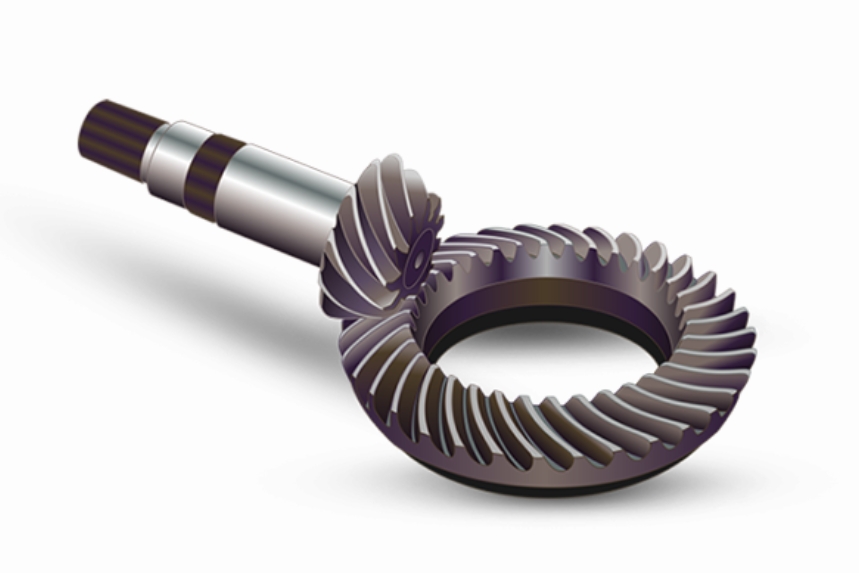
Material Properties and Geometric Modeling
The X38CrMoV5-3 alloy steel was selected for its excellent mechanical properties:
| Elastic Modulus (GPa) | Poisson’s Ratio | Yield Strength (MPa) | Thermal Expansion (K-1) |
|---|---|---|---|
| 215 | 0.28 | 1800 | 1.1×10⁻⁵ |
The geometric parameters of spiral bevel gears were calculated using Gleason’s formulas:
$$h_k = 1.70m$$
$$h_t = 1.888m$$
$$X_e = R_e\cos\delta – h_{ae}\sin\delta$$
| Parameter | Pinion | Gear |
|---|---|---|
| Module (mm) | 2.54 | 2.54 |
| Number of Teeth | 20 | 40 |
| Working Depth (mm) | 1.778 | 2.540 |
Warm Forging Process Optimization
The orthogonal experimental design considered two key factors:
$$T_{forge} = [550, 600, 650, 700]^\circ C$$
$$F_{punch} = [1000, 2000, 3000, 4000] N$$
| Case | Temperature (°C) | Load (N) | Max Stress (MPa) | Displacement (mm) |
|---|---|---|---|---|
| L8 | 600 | 4000 | 1548 | 0.2499 |
| L16 | 700 | 4000 | 1785 | 0.2545 |
The contact stress analysis confirmed the forged gears’ reliability:
$$\sigma_H = Z_E\sqrt{\frac{2000T_1}{bd_{e1}^2}\cdot\frac{Z_I}{K_A K_V K_{H\beta}}}$$
$$\sigma_{HP} = \frac{\sigma_{Hlim}Z_{NT}Z_W}{S_H K_\theta Z_Z}$$
| Parameter | Value |
|---|---|
| Elastic Coefficient (ZE) | 173.8 MPa0.5 |
| Dynamic Factor (KV) | 1.0 |
| Hardness Ratio (ZW) | 1.0 |
Thermal-Mechanical Analysis
The temperature distribution during warm forging significantly affects material flow:
$$\nabla \cdot (k\nabla T) = \rho C_p\frac{\partial T}{\partial t} + \dot{q}_{plastic}$$
Where plastic heat generation is calculated as:
$$\dot{q}_{plastic} = \eta\sigma_{eff}\dot{\varepsilon}_{eff}$$
Conclusion
Optimal parameters for spiral bevel gear warm forging were identified as 600°C and 4000N punch load, achieving 1548MPa stress and 0.2499mm displacement. The numerical model demonstrated effective prediction of forming behavior and contact stress distribution, providing valuable guidance for industrial production.