
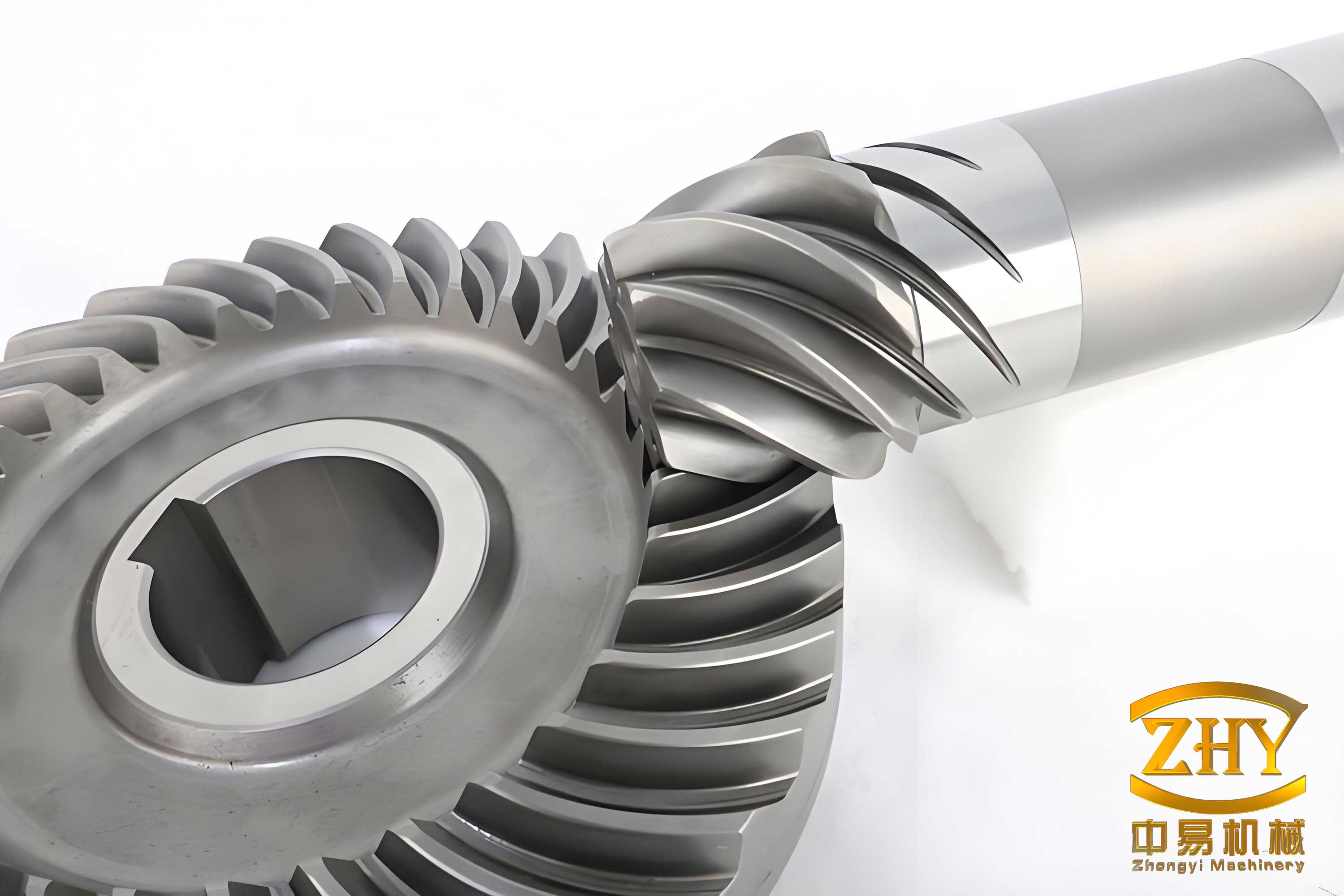
In this article, I explore the rolling forming process of spiral bevel gears using finite element analysis (FEA). The spiral bevel gear is a critical component in power transmission systems, especially in automotive and aerospace applications, due to its ability to transmit motion between non-parallel shafts efficiently. Traditional manufacturing methods like cutting often lead to material waste and reduced mechanical properties. In contrast, rolling forming—a combination of forging and rolling—offers advantages such as material savings, high production efficiency, improved grain flow, and enhanced mechanical performance. Here, I focus on simulating the rolling process to understand material flow, deformation patterns, and process optimization. The study is based on a detailed FEA model, analyzing stages like billet occlusion, gear-splitting, continuous rolling, and shaping. Through this, I aim to provide insights for designing efficient rolling processes for spiral bevel gears.
The rolling forming of spiral bevel gears involves complex motions where multiple rolling wheels rotate and radially feed into a billet, causing plastic deformation to form the desired gear teeth. This process is not yet fully mature, partly due to the intricate kinematics: the rotational motions of the rolling wheels and billet are not co-planar, with a 90° spatial relationship, and involve interrelated movements that change as the gear teeth form. Material deformation zones, including positive, pending, completed, and undeformed areas, interact dynamically, making it challenging to predict outcomes. Thus, numerical simulation becomes essential to visualize and analyze these phenomena. In this work, I employ Deform-3D software to simulate the rolling forming of a spiral bevel gear, examining factors like initial occlusion depth, stress-strain distribution, and forming loads. The goal is to identify optimal parameters and avoid defects such as misalignment or incomplete filling.
To set up the FEA model, I define the key dimensions based on gear meshing relationships. The target spiral bevel gear and rolling wheel parameters are summarized in Table 1. These include module, pressure angle, spiral angle, shaft angle, number of teeth, cone angles, and modification coefficients. Ensuring accurate geometry is crucial for simulating realistic deformation. The billet size is determined using volume constancy principles, adding a slight allowance to the target gear’s pitch circle. The initial billet is conical, with a large-end diameter of 70 mm and a small-end diameter of 53.5 mm, to account for plastic flow and flash formation during rolling.
| Parameter | Target Gear | Rolling Wheel |
|---|---|---|
| Module m (mm) | 6 | 6 |
| Pressure Angle α (°) | 20 | 20 |
| Spiral Angle β (°) | 35 | 35 |
| Shaft Angle Σ (°) | 90 | 90 |
| Number of Teeth Z | 11 | 33 |
| Pitch Cone Angle δ (°) | 18.4394 | 71.6261 |
| Root Cone Angle δ_f (°) | 16.1694 | 67.0000 |
| Profile Shift Coefficient X | +0.35 | -0.35 |
| Tangential Shift Coefficient X_t | +0.115 | -0.115 |
The material selected for the billet is AISI 8620 steel, commonly used in gear manufacturing due to its good hardenability and toughness. The initial forming temperature is set to 950°C to simulate hot rolling conditions, which reduce flow stress and enhance ductility. The rolling wheels and billet shaft are treated as rigid bodies to simplify computation, while the billet is meshed with approximately 100,000 tetrahedral elements to capture deformation accurately. The contact between the rolling wheels, shaft, and billet is defined with a shear friction model, coefficient 0.25, to account for interfacial resistance. Motion settings include a rolling wheel angular velocity of ω₁ = π/3 rad/s and a billet shaft angular velocity of ω₂ = π rad/s, maintaining a gear ratio relationship to prevent slippage. Feed velocities vary across stages, as detailed later.
The rolling forming process is divided into four stages: occlusion, gear-splitting, continuous rolling, and shaping. Each stage involves specific motions and deformations that collectively shape the spiral bevel gear. In the occlusion stage, the rolling wheels only move radially inward to initially bite into the billet. I analyze different initial occlusion depths—0.3 mm, 0.7 mm, and 1.0 mm—to assess their impact on subsequent stages. For a depth of 0.3 mm, the contact is shallow, leading to slippage during rotation and misalignment in gear-splitting. At 0.7 mm, two teeth engage, but the second tooth’s bite is insufficient to overcome rotational resistance, still causing misalignment. At 1.0 mm, the engagement is adequate, ensuring proper meshing. The forming load in the Z-direction (radial) increases with occlusion depth, as shown by the load curve, which can be approximated by a linear relationship:
$$ F_z = k \cdot d + F_0 $$
where \( F_z \) is the Z-direction load, \( d \) is the occlusion depth, \( k \) is a material-dependent constant, and \( F_0 \) is the initial contact force. For AISI 8620 at 950°C, \( k \approx 100 \, \text{N/mm} \) based on simulation data. The equivalent stress and strain distributions indicate localized deformation at the contact zones, with maximum values of 133.2 MPa and 2.18, respectively. This stage sets the foundation for uniform tooth division.
In the gear-splitting stage, the rolling wheels rotate without radial feed for 4 seconds, allowing the billet to complete two revolutions. This ensures even distribution of tooth spaces around the spiral bevel gear. The absence of misalignment confirms that the kinematic settings—maintaining the gear ratio between rolling wheels and billet—are correct. The Z-direction load fluctuates periodically, reflecting the cyclic nature of tooth engagement. The equivalent stress peaks at 238.8 MPa, while strain reaches 4.42, primarily at the tooth roots where deformation is concentrated. The material flows outward, beginning to form the tooth profiles. The stress-strain relationship during plastic deformation can be described by the Hollomon equation:
$$ \sigma = K \varepsilon^n $$
where \( \sigma \) is true stress, \( \varepsilon \) is true strain, \( K \) is the strength coefficient, and \( n \) is the strain-hardening exponent. For AISI 8620 at elevated temperatures, \( n \) tends to be low, promoting uniform flow. Table 2 summarizes the stress and strain values across stages, highlighting the progressive deformation.
| Stage | Max Equivalent Stress (MPa) | Max Equivalent Strain | Key Observations |
|---|---|---|---|
| Occlusion | 133.2 | 2.18 | Localized deformation at contact points |
| Gear-Splitting | 238.8 | 4.42 | Tooth roots show highest strain; uniform division achieved |
| Continuous Rolling | 350.5 | 7.89 | Material flows into tooth profiles; loads increase steadily |
| Shaping | 320.1 | 8.02 | Slight load reduction; tooth filling improves |
The continuous rolling stage involves simultaneous radial feed and rotation of the rolling wheels. The total feed is 6.15 mm, applied at a rate of 0.615 mm/s over 10 seconds. During this phase, the billet material plastically deforms, flowing into the rolling wheel cavities to form the complete tooth geometry of the spiral bevel gear. As the feed increases, the resistance to deformation rises, leading to higher forming loads. The Z-direction load curve shows an overall upward trend, with periodic variations due to tooth engagement cycles. The material flow pattern is critical: metal moves along the rolling wheel surface, filling the tooth spaces progressively. This can be modeled using the continuity equation for incompressible plastic flow:
$$ \nabla \cdot \mathbf{v} = 0 $$
where \( \mathbf{v} \) is the velocity vector of the deforming material. In regions of high strain, such as the tooth tips, the flow velocity increases, ensuring full filling. However, at the large end of the spiral bevel gear, some tooth profiles remain incomplete, indicating the need for optimized feed rates or preform design. The equivalent stress and strain reach 350.5 MPa and 7.89, respectively, demonstrating significant work hardening.
Finally, the shaping stage involves rotation-only motion for 2 seconds, allowing the rolling wheels to smooth out the tooth profiles without additional radial feed. This ensures that each tooth of the spiral bevel gear is fully filled and free of defects. The Z-direction load decreases slightly compared to the continuous rolling stage, stabilizing around a mean value as deformation minimizes. The equivalent stress drops to 320.1 MPa, while strain slightly increases to 8.02 due to micro-adjustments in material distribution. The final gear exhibits uniform teeth with minimal curvature, validating the process. The forming load during shaping can be expressed as:
$$ F_s = F_c – \Delta F $$
where \( F_s \) is the shaping load, \( F_c \) is the continuous rolling load, and \( \Delta F \) is the reduction due to decreased deformation resistance. For this spiral bevel gear, \( \Delta F \approx 10\% \) based on simulation data.
Throughout the simulation, the importance of maintaining the gear ratio between rolling wheels and target spiral bevel gear is evident. If the rotational speeds deviate, slippage occurs, leading to misalignment and defective teeth. The initial occlusion depth of about 1.0 mm proves optimal for reliable engagement. Material flow analysis shows that deformation concentrates at tooth roots, with stress propagating along contact paths. The forming loads increase progressively, reflecting the work hardening and geometric constraints of the spiral bevel gear. These insights can guide the design of rolling equipment and process parameters for mass production.
To further optimize the rolling forming of spiral bevel gears, additional factors can be considered. For instance, varying the temperature profile or using different billet materials like alloy steels could affect flow stress and final properties. The mesh sensitivity of the FEA model should be assessed to ensure result accuracy; a convergence study with element sizes ranging from 0.5 mm to 2.0 mm can confirm that 100,000 elements suffice. Moreover, the effect of friction coefficients on material flow warrants investigation, as higher friction may hinder filling. Experimental validation using physical rolling tests would strengthen the numerical findings. In industrial applications, real-time monitoring of loads and temperatures could enable adaptive control, improving consistency for spiral bevel gear manufacturing.
In conclusion, numerical simulation provides a powerful tool for analyzing the rolling forming process of spiral bevel gears. By dissecting stages from occlusion to shaping, I have identified key parameters such as occlusion depth, motion kinematics, and load evolution. The spiral bevel gear’s complex geometry demands precise control to avoid defects, and FEA helps visualize material flow and stress distribution. Future work could explore multi-objective optimization using response surface methodology or machine learning to balance filling quality and tool wear. As industries seek greener manufacturing methods, rolling forming stands out for its efficiency, and continued research on spiral bevel gears will enhance its adoption in high-performance transmissions.