
In modern precision manufacturing, the control of gear geometry has evolved from traditional contact pattern analysis to direct measurement of tooth surface deviations. For large-scale spiral bevel gears, which are critical components in heavy machinery, aerospace, and automotive applications, achieving high齿形精度 is essential. However, the high cost of dedicated gear measuring instruments or coordinate measuring machines (CMMs) poses a significant barrier for many manufacturers. This has driven research into on-machine measurement systems that leverage existing CNC axes on spiral bevel gear processing machines. In this article, I present an in-depth study on an on-machine measurement method for tooth form errors of large-scale spiral bevel gears, based on the generation principle. This approach not only reduces costs but also enhances加工效率 and accuracy by enabling real-time error compensation. The focus is on spiral bevel gears, a complex gear type with curved teeth that allow smooth and quiet transmission of power between non-parallel shafts.
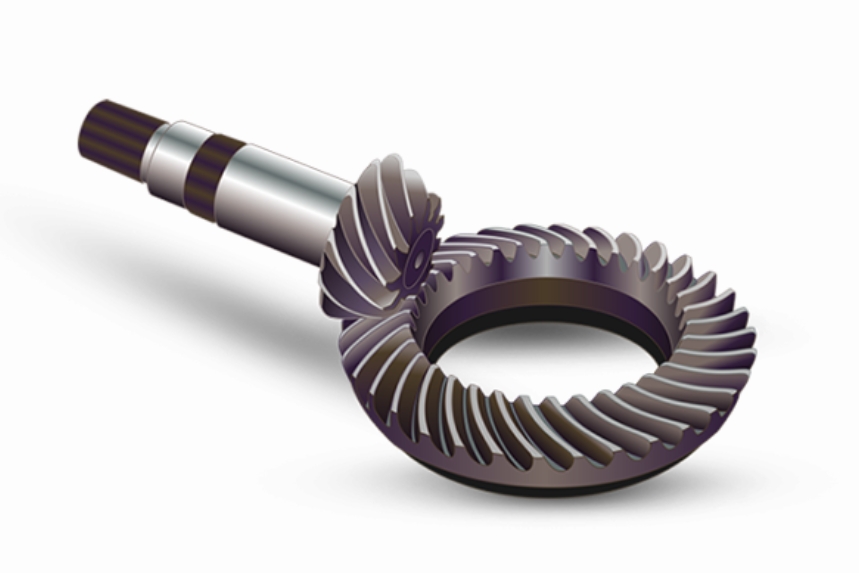
The traditional methods for inspecting tooth form errors in spiral bevel gears involve using gear measuring centers or CMMs. These systems employ coordinate-based geometric analysis, where the gear is treated as a complex geometric entity, and deviations from the designed tooth surface are measured in a established coordinate system. While effective, these methods have limitations. For instance, when measuring pinions with small pitch angles, interference between the probe shaft and the tooth surface or the opposite flank can occur, necessitating the use of star-shaped probes with multiple tips. Additionally, gear measuring centers often require large probe ball radii to avoid interference, which introduces measurement errors due to the radius compensation. The larger the probe ball, the greater the potential error in capturing the true surface profile. This is particularly problematic for spiral bevel gears, where the tooth surfaces are highly curved and require precise measurement.
To address these challenges, I developed an on-machine measurement system integrated into a YK20100 CNC spiral bevel gear grinding machine. This machine features three linear axes (X, Y, Z) and three rotational axes (A, B, C), where A is the workpiece rotation axis, C is the grinding wheel rotation axis, and B adjusts the relative angle between the wheel and workpiece axes. The machine coordinate system, denoted as \( S_M = \{O_M; x_M, y_M, z_M\} \), has its origin at the intersection of the C and B axes when they are aligned, which is a fixed point in the machine space. For on-machine measurement, a Renishaw MP250 3D touch-trigger probe is mounted on the right side of the grinding wheel head, driven by a linear motor along a W-axis parallel to the Z-axis. This setup allows the probe to move in X, Y, and W directions, replacing Z-axis movements to reduce inertia effects and enhance measurement accuracy. The probe has a repeatability of 0.25 µm and uses a straight stylus with a 50 mm length and a ruby ball tip, minimizing triggering force and enabling亚微米级测量 for complex surfaces.
The core of the method lies in the generation principle, which mimics the mating process between the spiral bevel gear and a virtual generating gear. In production, spiral bevel gears are often generated using a planar generating gear, where the grinding wheel surface represents the tooth of the generating gear. The measurement process analogizes this: the probe ball acts as a point on the generating gear tooth surface, and the measurement simulates the meshing between the gear and the generating gear. This allows the use of a smaller probe ball without interference, as the probe trajectory lies within the region enveloped by the inner and outer edges of the grinding wheel. Consequently, measurement errors due to probe radius are reduced, enabling full-tooth surface inspection for spiral bevel gears.
To implement this, the theoretical tooth surface of the spiral bevel gear must be mathematically modeled and discretized. The tooth surface is a conjugate surface derived from the grinding wheel’s conical cutting surface. Using vector operations, the radial vector \(\mathbf{r}\) and normal vector \(\mathbf{n}\) of any point on the cutting surface are expressed in terms of the machine settings, such as the cradle angle \(q\) and blade phase angle \(\theta\). The啮合方程 then yields the corresponding workpiece rotation angle \(\phi\) for conjugate contact. Thus, for a point on the tooth surface in its generated position, the radial vector \(\mathbf{r}_w\) and normal vector \(\mathbf{n}_w\) relative to the design crossing point \(O’\) are obtained. For measurement, the tooth surface is discretized into a grid, typically with 9 points along the tooth length and 5 points along the tooth height, totaling 45 points. The coordinates of these points in the workpiece coordinate system are calculated based on gear blank parameters and grid收缩量. Given a discrete point’s coordinates \((x(i,j), y(i,j))\), the corresponding \(q\), \(\theta\), and \(\phi\) are solved iteratively, allowing computation of \(\mathbf{r}_w(i,j)\) and \(\mathbf{n}_w(i,j)\). These are then transformed into the machine coordinate system \(S_M\) as \(\mathbf{r}_M'(i,j)\) and \(\mathbf{n}_M'(i,j)\).
The on-machine measurement procedure for a spiral bevel gear, say the concave side of a pinion, proceeds as follows. First, the gear is positioned in the machine by aligning a reference point—typically the midpoint of the discrete point grid—with the probe. The probe ball center is moved to a point offset from the theoretical surface along the normal direction by the probe radius \(r\). The workpiece is then rotated until contact occurs, setting the齿形误差 at the reference point to zero and establishing the measurement coordinate system. Next, all theoretical discrete points are offset along their normal vectors by \(r + l\), where \(l\) is an estimated maximum error, yielding coordinates \((x_M”(i,j), y_M”(i,j), z_M”(i,j))\). The relative workpiece rotation angles \(\psi(i,j)\) for each point are computed from the reference point’s angle \(\phi\). The measurement path is planned by sorting \(\psi(i,j)\) to ensure unidirectional rotation of the A-axis, avoiding backlash effects. For each point, the workpiece rotates to the appropriate angle, and the probe moves from the offset position along the normal vector until it triggers upon contacting the actual tooth surface. The machine’s grating scale readings at trigger instant give the probe ball center coordinates \(\mathbf{r}_R(i,j) = (x_R(i,j), y_R(i,j), z_R(i,j))\). The tooth form error at each discrete point is calculated as the projection of the vector from the theoretical point to the probe center onto the normal vector, minus the probe radius:
$$ \delta(i,j) = \left( \mathbf{r}_R(i,j) – \mathbf{r}_M'(i,j) \right) \cdot \mathbf{n}_M'(i,j) – r $$
This process is repeated for convex sides and for multiple teeth (e.g., four teeth spaced 90° apart) to average out errors from gear blank manufacturing, positioning, and random measurement variations. The result is a comprehensive error map of the spiral bevel gear tooth surface.
To validate the method, I conducted experiments using a simulation system developed in AutoCAD VBA, which models the YK20100 grinding machine and the on-machine measurement process. The simulation involves generating a gear实体 based on machine settings and then measuring its tooth form errors against the theoretical surface. For comparison, an actual spiral bevel gear was ground on the YK20100 machine and inspected on an M&M Sigma7 gear measuring center. The gear pair parameters and machine settings are summarized in the tables below.
| Parameter | Value |
|---|---|
| Gear Ratio (i) | 15/51 |
| Transverse Module (m_t, mm) | 12.7 |
| Shaft Angle (Σ, °) | 90 |
| Mean Pressure Angle (α, °) | 20 |
| Midpoint Spiral Angle (β_m, °) | 35 |
| Face Width (b, mm) | 100 |
| Parameter | Value |
|---|---|
| Radial Distance (S, mm) | 247.8557 |
| Cradle Angle (q, °) | 49.8741 |
| Vertical Offset (E_m, mm) | 0.0 |
| Workpiece Installation Angle (δ_M, °) | 70.6078 |
| Horizontal Offset Correction (X_P, mm) | 0.0 |
| Machine Center to Back (X_B, mm) | 0.0 |
| Roll Ratio | 1.040924 |
| Grinding Wheel Diameter (mm) | 457.20 |
| Outer Blade Angle (°) | 18.75 |
| Inner Blade Angle (°) | 21.25 |
| Wheel Top Width (mm) | 8.382 |
In the experiment, the gear was first ground with the settings in Table 2 to establish a baseline surface. Then, the vertical offset was increased by 0.1 mm, and the gear was reground and measured on the gear measuring center. The results showed tooth form errors reflecting the 0.1 mm change. Similarly, the simulation used the modified settings (vertical offset = 0.1 mm) to generate and measure a virtual gear. The simulated errors closely matched the actual measurements, both in magnitude and trend, confirming the accuracy of the on-machine measurement method. Discrepancies were attributed to simulation precision and grid discretization differences.
The mathematical foundation for the tooth surface modeling involves several key equations. The grinding wheel’s conical cutting surface is described by a vector equation \(\mathbf{r}\) as a function of \(q\) and \(\theta\). The unit normal vector \(\mathbf{n}\) and the unit vector along the generatrix \(\mathbf{t}\) are derived. The conjugate condition is given by the啮合方程:
$$ f(q, \theta, \phi) = \mathbf{n} \cdot \mathbf{v}^{(12)} = 0 $$
where \(\mathbf{v}^{(12)}\) is the relative velocity between the wheel and workpiece. Solving this yields the relationship between \(q\), \(\theta\), and \(\phi\). For a discrete point with coordinates \((x, y)\) in the workpiece system, we have:
$$ y = |\mathbf{r}_w \times \mathbf{p}|, \quad x = -\mathbf{r}_w \cdot \mathbf{p} $$
where \(\mathbf{p}\) is the unit vector along the workpiece axis. Given \(x\) and \(y\), \(q\) and \(\theta\) are found via binary iteration, enabling computation of \(\mathbf{r}_w\) and \(\mathbf{n}_w\). The transformation to the machine coordinate system uses a rotation matrix based on the machine kinematics. For the YK20100 machine, the relationship between the workpiece coordinate system and \(S_M\) involves translations and rotations depending on the axis positions. The probe’s position in \(S_M\) is adjusted for the W-axis movement, with coordinates:
$$ \mathbf{P}_M = \mathbf{T} \cdot \mathbf{r}_w + \mathbf{d} $$
where \(\mathbf{T}\) is the transformation matrix and \(\mathbf{d}\) is the offset vector. The normal vector transformation is similar: \(\mathbf{n}_M = \mathbf{R} \cdot \mathbf{n}_w\), where \(\mathbf{R}\) is the rotation matrix.
Error analysis is crucial for measurement reliability. The primary sources of error in this on-machine measurement system include machine geometric errors, probe triggering errors, thermal effects, and numerical approximations in discretization. The use of a high-precision touch-trigger probe with low triggering force minimizes dynamic errors. Additionally, the unidirectional path planning reduces backlash influence from the A-axis. The probe radius compensation is exact in the calculation of \(\delta(i,j)\), as the error is defined along the normal direction. However, for highly curved surfaces like those of spiral bevel gears, the assumption that the contact point and the projection point are close holds true only for small probe radii; hence, the choice of a small ruby ball (e.g., 1 mm diameter) is advantageous.
The advantages of this on-machine measurement method for spiral bevel gears are manifold. It eliminates the need for expensive external measuring equipment, integrates measurement with加工 for quick feedback, and allows for adaptive加工 through error compensation. By using the generation principle, it avoids interference issues common with CMMs, enabling full-surface inspection with a single probe. This is particularly beneficial for large-scale spiral bevel gears, where handling and setup on external machines are cumbersome. Moreover, the method can be adapted to other spiral bevel gear machining centers with similar kinematic structures, such as those from Gleason or Klingelnberg, by adjusting the coordinate transformations.
In conclusion, the on-machine measurement method based on the generation principle offers a viable solution for inspecting tooth form errors in large-scale spiral bevel gears. It leverages existing CNC axes to perform precise measurements without probe interference, using a small probe ball for accuracy. The theoretical modeling, discretization approach, and measurement procedure have been detailed, with experimental validation through simulation and actual gear inspection. This method enhances the manufacturing chain for spiral bevel gears by enabling in-process quality control and error correction, ultimately leading to higher-performance gears in demanding applications. Future work could focus on real-time error compensation algorithms and扩展 the system to measure other gear types, such as hypoid gears or face gears, further advancing the field of precision gear metrology.
To further elaborate on the mathematical aspects, the derivation of the tooth surface for a spiral bevel gear involves complex differential geometry. The surface is defined as the envelope of the family of grinding wheel surfaces relative to the workpiece motion. Let the wheel surface be parameterized by \((u, v)\), with position vector \(\mathbf{R}_w(u,v)\) and normal \(\mathbf{N}_w(u,v)\). Under the machine motion with parameter \(\phi\), the family of surfaces is given by \(\mathbf{R}(u,v,\phi) = M(\phi) \cdot \mathbf{R}_w(u,v)\), where \(M(\phi)\) is the transformation matrix. The envelope condition is:
$$ \frac{\partial \mathbf{R}}{\partial u} \times \frac{\partial \mathbf{R}}{\partial v} \cdot \frac{\partial \mathbf{R}}{\partial \phi} = 0 $$
This leads to a differential equation that can be solved numerically for the tooth surface points. For discretization, the grid points are often chosen based on equal angular increments along the tooth profile and length, but adaptive meshing can improve efficiency. The error calculation formula can be extended to include probe预行程 errors by calibrating the probe trigger point relative to the machine coordinates.
In practice, the implementation of this on-machine measurement system requires careful calibration of the probe and machine axes. A reference artifact, such as a precision sphere, can be used to calibrate the probe tip radius and the machine’s geometric errors. The measurement data can then be processed to generate error maps, which can be fed back to the CNC system to adjust machine settings for subsequent加工 passes. This closed-loop approach is key to achieving high accuracy in spiral bevel gear manufacturing.
The versatility of spiral bevel gears makes them indispensable in many industries, and advancing their measurement technology is crucial for innovation. As demand for larger and more precise gears grows, on-machine measurement systems will become increasingly important. This work contributes to that trend by providing a robust method that combines theoretical rigor with practical applicability, ensuring that spiral bevel gears meet the stringent requirements of modern machinery.