
This paper investigates the on-machine measurement methodology for tooth profile errors of spiral bevel gears in CNC grinding machines. The proposed approach establishes a systematic framework for coordinate transformation, measurement path planning, and error calculation using advanced surface fitting techniques.
1. Machine Tool Configuration and Probe Selection
The H350G CNC spiral bevel gear grinding machine features five motion axes:
$$ \begin{cases}
X\text{-axis: Workpiece carriage longitudinal movement} \\
Y\text{-axis: Wheelhead vertical movement} \\
Z\text{-axis: Wheelhead horizontal movement} \\
A\text{-axis: Workpiece rotation} \\
C\text{-axis: Grinding wheel rotation}
\end{cases} $$
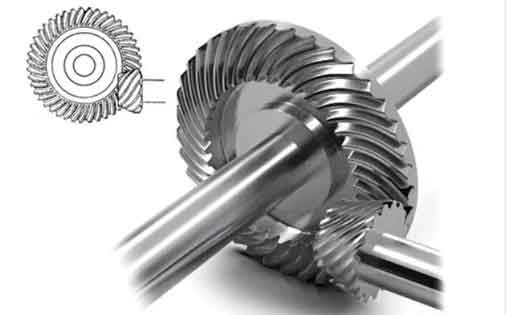
The coordinate transformation between gear and machine coordinate systems is defined as:
$$ \begin{bmatrix}
X_M \\
Y_M \\
Z_M
\end{bmatrix} = \mathbf{R}(\delta_M) \begin{bmatrix}
X_G \\
Y_G \\
Z_G
\end{bmatrix} + \begin{bmatrix}
\Delta X \\
\Delta Y \\
\Delta Z
\end{bmatrix} $$
Where $\mathbf{R}(\delta_M)$ represents the rotation matrix for machine tilt angle $\delta_M$, and $\Delta X$, $\Delta Y$, $\Delta Z$ denote machine offsets.
2. Discrete Point Generation
The tooth surface is discretized using a 9×5 grid pattern based on AGMA 2009-B01 standard. For spiral bevel gears, the parametric coordinates are calculated through:
$$ \begin{cases}
x(i,j) = f(\Delta q_2, \theta_2) \\
y(i,j) = g(\Delta q_2, \theta_2)
\end{cases} $$
Using Newton-Raphson iteration, the corresponding machine coordinates are obtained for each discrete point.
| Grid Position | X Coordinate (mm) | Y Coordinate (mm) | Normal Vector |
|---|---|---|---|
| 1,1 | 45.32 | -12.56 | (0.112, 0.803, 0.585) |
| 5,3 | 52.18 | 0.00 | (0.000, 0.924, 0.383) |
| 9,5 | 58.94 | 15.47 | (-0.098, 0.857, 0.506) |
3. Measurement Path Planning
The probe path is determined by offsetting the theoretical surface along normal vectors:
$$ \begin{cases}
X_{start} = X_{theory} – R \cdot n_x – l \cdot n_x \\
Y_{start} = Y_{theory} – R \cdot n_y – l \cdot n_y \\
Z_{start} = Z_{theory} – R \cdot n_z – l \cdot n_z
\end{cases} $$
Where $R$ is probe radius and $l$ represents expected maximum error.
4. Error Calculation Using NURBS Fitting
The measured points are fitted using NURBS surface:
$$ S(u,v) = \frac{\sum_{i=0}^n \sum_{j=0}^m N_{i,p}(u)N_{j,q}(v)w_{i,j}P_{i,j}}{\sum_{i=0}^n \sum_{j=0}^m N_{i,p}(u)N_{j,q}(v)w_{i,j}}} $$
The tooth profile error is calculated through orthogonal projection:
$$ \epsilon = \min_{\mathbf{P} \in S_{actual}} \| \mathbf{P}_{theory} – \mathbf{P} \| \cdot \mathbf{n} $$
5. Experimental Verification
Comparative results between on-machine measurement and gear measurement center:
| Measurement Point | On-Machine (μm) | CMM (μm) | Deviation (μm) |
|---|---|---|---|
| Concave 1,5 | -39.5 | -47.6 | 8.1 |
| Convex 5,9 | 30.0 | 39.4 | 9.4 |
| Concave 9,1 | -30.0 | -38.3 | 8.3 |
The maximum deviation of 9.4 μm confirms the effectiveness of the proposed method for spiral bevel gear inspection. Main error sources include:
$$ \epsilon_{total} = \sqrt{\epsilon_{machine}^2 + \epsilon_{probe}^2 + \epsilon_{alignment}^2} $$
Where $\epsilon_{machine}$ ≈ ±3 μm (positioning accuracy), $\epsilon_{probe}$ ≈ ±1 μm (MP250 probe specification).
6. Measurement Process Optimization
For spiral bevel gears with large modules (>8mm), the adaptive measurement strategy is implemented:
$$ l = \begin{cases}
0.05m_t & \text{for rough grinding} \\
0.02m_t & \text{for finish grinding}
\end{cases} $$
Where $m_t$ represents transverse module of the spiral bevel gear.
Conclusion
The developed on-machine measurement system achieves ±10 μm accuracy for spiral bevel gear tooth profile inspection, providing an efficient closed-loop manufacturing solution. The integration of NURBS surface fitting and optimized measurement path planning significantly enhances measurement reliability for complex gear geometries.