
In my extensive experience within the heavy industry sector, particularly in ironmaking and sintering operations, I have consistently observed that large spur gears are critical components for ensuring continuous production. These spur gears, often integral to the drive systems of sintering machines, are subjected to significant cyclic loading during operation. This results in high bending stresses at the tooth root, leading to the initiation and propagation of fatigue cracks. Ultimately, this can cause tooth fracture or complete failure of the spur gear. Such failures lead to unplanned downtime, substantial production losses, and high replacement costs due to the prolonged time required for dismantling and installing new spur gears. To mitigate these issues, online welding repair has emerged as a vital strategy. Initially, repairs using a single welding material proved inadequate, offering poor wear resistance and necessitating frequent re-repairs every 2-3 months. Through detailed analysis and practice, I have developed and implemented a combined welding methodology utilizing CO₂ gas shielded welding and stainless steel arc welding. By optimizing welding parameters and enforcing strict process controls, this approach significantly enhances the wear resistance and extends the service life of repaired spur gears.
The fundamental challenge in repairing these large spur gears lies in their weldability. The base material, typically a medium-carbon steel with approximately 0.4% carbon content, presents poor weldability. During welding, the rapid cooling in the heat-affected zone (HAZ) promotes the formation of hard, brittle martensitic structures. The hardness of this martensite can be approximated by the relationship between carbon content and hardness, often expressed empirically. The tendency for martensite formation increases with cooling rate, leading to a high risk of cold cracking under welding stresses. These cracks can even cause detachment of the weld overlay from the parent metal. Furthermore, the substantial mass of these spur gears contributes to a high heat sink effect, accelerating cooling and exacerbating crack susceptibility.
To counteract the formation of deleterious microstructures, a comprehensive thermal management protocol is essential. Preheating the spur gear prior to welding is the first critical step. This reduces the temperature gradient between the weld zone and the bulk material, thereby lowering the cooling rate. The necessary preheat temperature (\(T_p\)) can be estimated using carbon equivalent formulas. A common formula for assessing weldability is the International Institute of Welding (IIW) carbon equivalent:
$$ CE = C + \frac{Mn}{6} + \frac{Cr + Mo + V}{5} + \frac{Ni + Cu}{15} $$
For a typical spur gear material, calculating this value helps determine the required preheat to avoid martensite. Maintaining an adequate interpass temperature (\(T_i\)) during welding is equally crucial to prevent the HAZ from cooling below the martensite start temperature (\(M_s\)). Post-weld heat treatment or, at minimum, controlled slow cooling using insulation is mandatory to minimize residual stresses and avoid delayed hydrogen-induced cracking.
The selection of welding heat input, or linear energy, is a delicate balance. A higher heat input, defined as \( Q = \frac{I \times V \times 60}{v \times 1000} \) kJ/cm (where \(I\) is current in Amperes, \(V\) is voltage in Volts, and \(v\) is travel speed in cm/min), reduces cooling rates and mitigates martensite formation. However, excessive heat input increases the dilution ratio (the proportion of base metal melted into the weld metal), which can elevate the weld metal’s carbon content and its susceptibility to solidification cracking. Conversely, a lower heat input reduces dilution but prolongs welding time, allowing more heat dissipation and increasing the risk of cold cracks. Therefore, a strategic approach is required. I have found that employing a high-deposition-rate process like CO₂ gas shielded welding for the initial layers provides efficient heat input and fast deposition, helping to maintain the required interpass temperature. Subsequently, alternating with shielded metal arc welding (SMAW) using stainless steel electrodes allows for building up layers with desired alloy content without excessively increasing overall heat input.
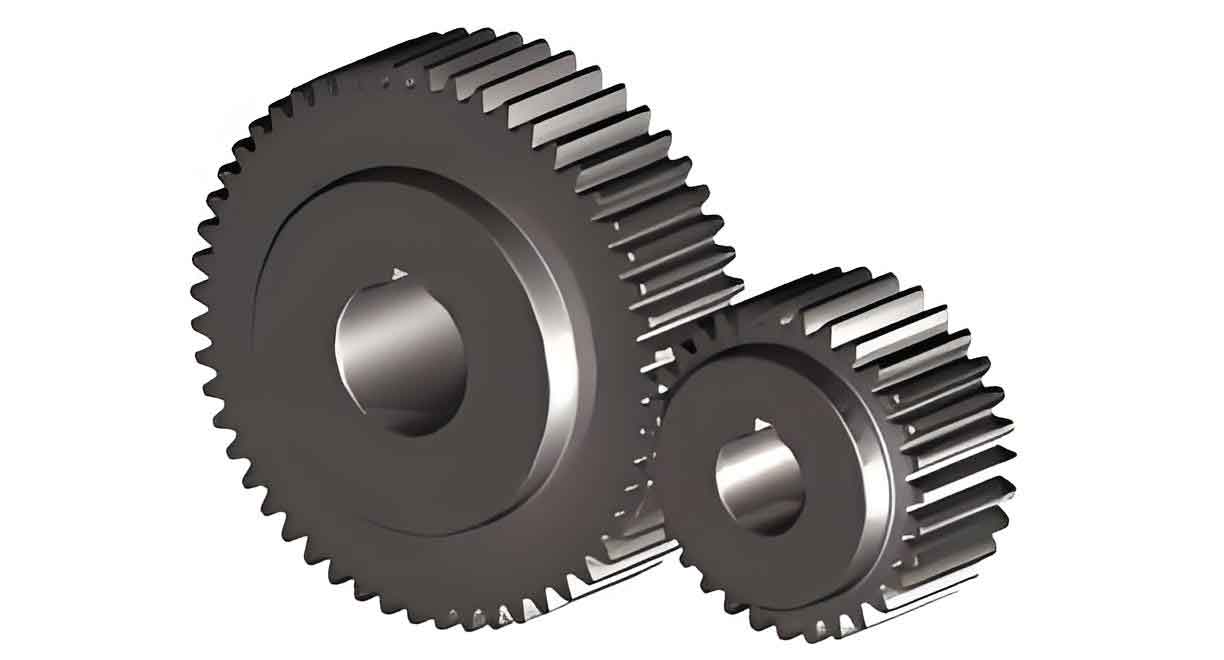
The repair process for a damaged spur gear begins with meticulous preparation. Since the fractured tooth fragment is often lost, a precise template must be fabricated based on the adjacent healthy teeth of the spur gear. This template guides both the deposition of weld metal and the final grinding to achieve the correct tooth profile. The damaged area is then thoroughly cleaned using thermal gouging to remove defective material, followed by grinding with an abrasive wheel until sound, shiny base metal is exposed. This ensures optimal fusion and reduces the risk of defects originating from contamination.
The core of the successful repair lies in the careful selection and control of welding parameters. The choice of filler materials is based on the principle of low-strength matching. Using a weld metal with slightly lower yield strength than the base metal can enhance the tolerance to strain concentrations and improve crack resistance. For the CO₂ welding process, I typically employ an ER50-6 grade wire (conforming to AWS A5.18). For the stainless steel layers, an AWS A307 electrode is selected. This electrode deposits a chromium-enriched weld metal that significantly improves surface hardness and wear resistance, which is paramount for the longevity of the repaired spur gear tooth. The key welding parameters for both processes are summarized in the table below.
| Process | Filler Material | Diameter (mm) | Current (A) | Voltage (V) | Heat Input Range (kJ/cm) | Primary Function |
|---|---|---|---|---|---|---|
| CO₂ Gas Shielded Welding | ER50-6 Wire | 1.2 | 120-135 | 19-21 | 8-12 | High-efficiency deposition, crack prevention |
| Shielded Metal Arc Welding (SMAW) | A307 Electrode | 3.2 | 80-90 | 18-20 | 10-15 | Wear resistance enhancement via Cr addition |
The welding sequence is executed in a precisely controlled manner. The first two layers are deposited using the CO₂ process. After each layer, the surface is ground to remove slag and inspect for defects. The third and fourth layers are then applied using the stainless steel electrode. This alternating pattern—CO₂, SMAW, CO₂, SMAW—continues, with the weld width systematically reduced by 1-2 mm per layer to gradually form the tooth profile of the spur gear. After every layer, the template is used to check the contour. The deposition pattern is also critical; welding is performed in a zigzag manner across the width of the spur gear tooth, with beads sequenced from the root towards the tip. Each bead overlaps the previous one by 1/3 to 1/2 of its width to ensure uniform heat distribution and minimize distortion.
Thermal control during the entire operation is non-negotiable. Preheating is achieved using multiple oxy-acetylene torches until the repair zone reaches a uniform temperature of 300°C, verified by a surface pyrometer. The interpass temperature is maintained above 80°C. If it falls below, heating is resumed before continuing. This thermal management directly influences the final microstructure. The cooling rate (\( \frac{dT}{dt} \)) can be modeled using simplified heat flow equations for a thick plate, which is analogous to a massive spur gear:
$$ \frac{dT}{dt} \approx – \frac{2 \pi k (T – T_0)}{\rho c_p V} $$
Where \(k\) is thermal conductivity, \(\rho\) is density, \(c_p\) is specific heat capacity, \(V\) is volume, and \(T_0\) is ambient temperature. Preheating raises the initial \(T\), thereby reducing the magnitude of \( \frac{dT}{dt} \) and suppressing martensite. Furthermore, to relieve welding stresses during deposition, each bead is peened immediately after welding while it is still hot. Upon completion, the entire repaired spur gear tooth is insulated with ceramic fiber blankets to facilitate very slow cooling to ambient temperature, effectively a stress-relief anneal.
Post-weld inspection and finishing are the final steps. The repaired tooth is first visually inspected, then subjected to non-destructive testing (NDT), typically ultrasonic testing (UT), to verify the absence of internal cracks or lack-of-fusion defects. The sensitivity of UT depends on the acoustic impedance mismatch, which can be calculated. Once integrity is confirmed, the tooth is ground to its final dimensions using the template as a guide. The grinding process must be controlled to avoid introducing new surface stresses that could initiate cracks.
The success of this methodology hinges on several metallurgical and mechanical principles. The use of low-strength matching filler metal for the initial layers enhances fracture toughness. The hardness of the martensite in the HAZ, which is a primary concern, can be related to its carbon content via equations like:
$$ HV \approx 1667C – 926C^2 + 150 $$
Where \(HV\) is Vickers hardness and \(C\) is the carbon content in weight percent. By controlling cooling, we limit the carbon content in the martensite and thus its hardness. The addition of stainless steel layers increases surface hardness through solid solution strengthening and carbide formation. The wear resistance of the spur gear tooth is often proportional to hardness, following Archard’s wear law:
$$ V = K \frac{N \cdot L}{H} $$
Where \(V\) is wear volume, \(K\) is a wear coefficient, \(N\) is normal load, \(L\) is sliding distance, and \(H\) is material hardness. By increasing \(H\) in the top layers, the wear volume \(V\) is reduced, extending service life.
The mechanical performance of the repaired spur gear tooth under bending stress is paramount. The bending stress at the tooth root (\(\sigma_b\)) can be calculated using the Lewis formula, modified for spur gears:
$$ \sigma_b = \frac{F_t}{b \cdot m_n \cdot Y} $$
Here, \(F_t\) is the tangential load, \(b\) is face width, \(m_n\) is normal module, and \(Y\) is the Lewis form factor. The weld repair must restore the tooth’s ability to withstand this cyclic stress. The fatigue strength of the weld metal and the HAZ becomes the limiting factor. The modified Goodman diagram can be used to assess the safe stress amplitude for the repaired spur gear, considering the mean stress and the material’s endurance limit.
Since implementing this combined CO₂ and stainless steel welding repair process for large spur gears in 2015, the results have been outstanding. Repaired spur gears have shown no instances of re-cracking or fracture, with service intervals extending well beyond the previous 2-3 months. This translates directly into reduced downtime and maintenance costs. The methodology is particularly effective for spur gears with a module greater than 20, which are common in heavy industrial settings like sintering machines. The following table compares key performance metrics before and after implementing the optimized repair process.
| Performance Metric | Previous Single-Material Repair | Current Combined Welding Repair |
|---|---|---|
| Average Wear Life Before Re-repair | 2-3 months | > 12 months (and ongoing) |
| Incidence of Cracking/Re-fracture | High (>50% of repairs) | Negligible (<5%) |
| Typical Repair Time (for one tooth) | Similar, but more frequent | Similar, but much less frequent |
| Relative Wear Resistance (Qualitative) | Low | High |
| Key Limiting Factor | Poor wear resistance, cracking | Managed through material selection & thermal control |
In conclusion, the online repair of large spur gears is a complex but highly rewarding engineering challenge. The key lies in a deep understanding of the material science involved—specifically, the transformation kinetics during welding of medium-carbon steels used in spur gears. The strategic use of preheating, interpass temperature control, and post-weld slow cooling is critical to managing microstructural evolution and preventing cold cracks. The innovative alternating use of a high-productivity CO₂ process and a wear-resistant stainless steel SMAW process addresses the dual demands of efficiency and final performance. This approach ensures that the repaired spur gear not only regains its geometric form but also possesses enhanced surface properties to withstand the demanding operational environment. The continued reliability of spur gears repaired with this method stands as a testament to the effectiveness of applying fundamental welding metallurgy principles to practical industrial maintenance problems.