
In the field of mechanical power transmission, the design of gear systems is a fundamental and complex task. Traditional design methods often rely on iterative calculations based on handbook recommendations and designer experience, which may not yield the most efficient or compact solution. This article presents a methodology for the optimal design of involute helical spur gears, framing the design process as a mathematical optimization problem. The core objective is to minimize the center distance of a gear pair, a direct indicator of the system’s compactness and material usage, while rigorously satisfying all mechanical and geometric constraints. The approach detailed here integrates empirical design parameters, typically given in charts or discrete tables, directly into the mathematical model through curve-fitting techniques, allowing for a more rational and automated parameter selection during the optimization search.
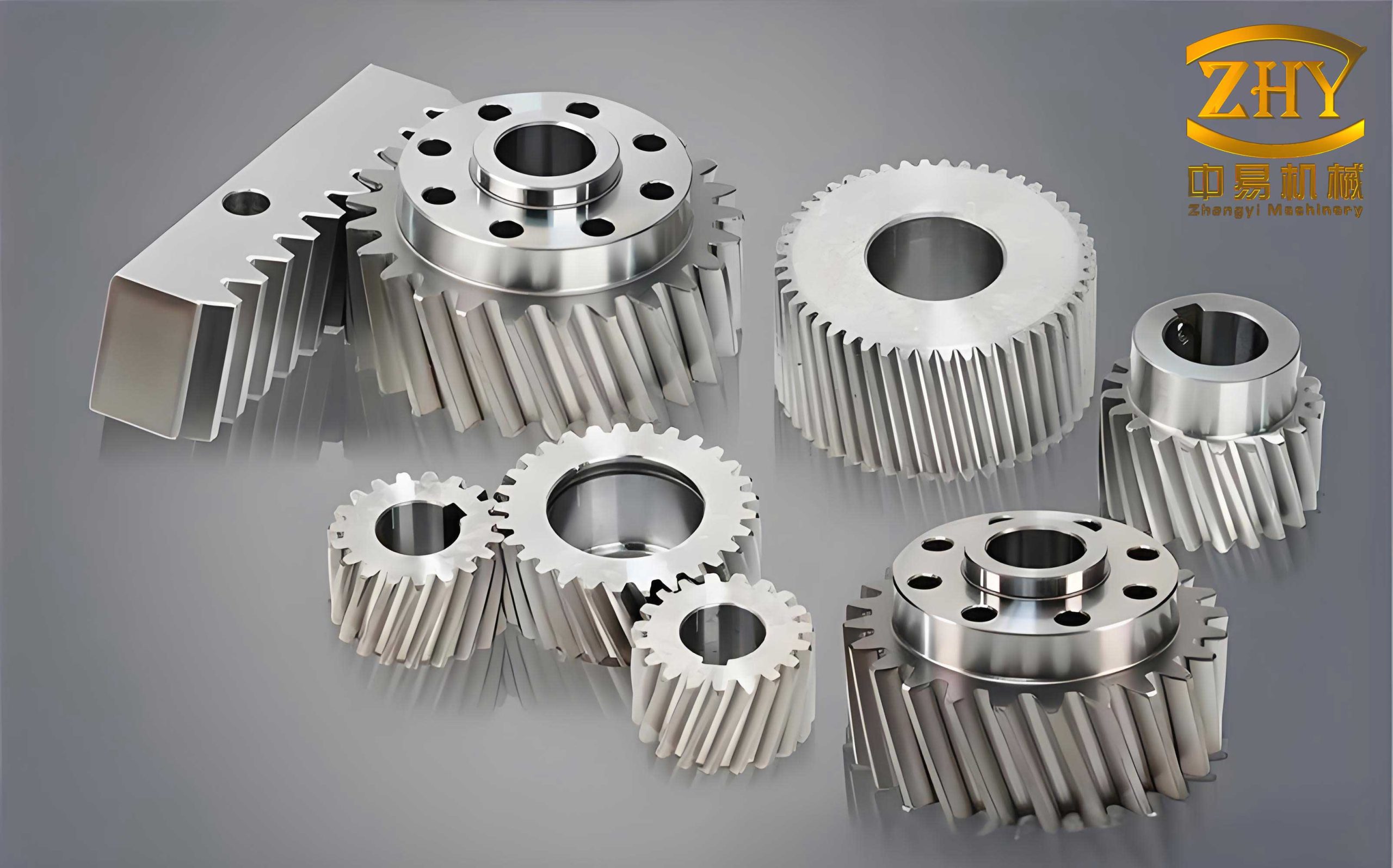
The case study considered involves the helical spur gears within the reducer of a belt conveyor drive mechanism. The operational requirements and efficiencies are specified as follows: the required drum power is known, the speed has a permissible relative error, and the total gear ratio is defined. The efficiencies of various components, including V-belts, rolling bearings, the gear mesh itself, couplings, and sliding bearings, are all accounted for in determining the input torque. The gears are manufactured from a specified steel grade, heat-treated, with defined surface hardness levels for the pinion and gear, a manufacturing precision grade, and a known surface roughness. The operational schedule is two shifts per day, eight hours per shift, for a defined number of days per year over a specific service life. These conditions set the stage for performing a fatigue-driven optimal design of the helical spur gears.
Curve-Fitting of Key Design Parameters
Conventional gear design relies on selecting several coefficients (e.g., $K_v$, $K_{H\beta}$, $Z_H$, $Y_F Y_S$) from charts or tables. To incorporate these parameters seamlessly into an algorithmic optimization model, I have derived analytical expressions through curve-fitting techniques applied to standard reference data. This allows the optimization algorithm to treat these parameters as continuous functions of the design variables, leading to more precise and justifiable selections compared to discrete lookup steps.
| Parameter | Standard Source Reference | Fitted Analytical Expression | Applicable Range / Notes |
|---|---|---|---|
| Dynamic Load Factor, $K_v$ | Chart for Grade 7 precision gears | $K_v = 1 + \frac{0.6}{1+0.4(100v/\pi)^{0.8}}$ where $v$ is pitch line velocity (m/s). |
Derived for the specified precision grade. |
| Face Load Distribution Factor, $K_{H\beta}$ | Chart for $\phi_d = b/d_1 \le 1.2$ | $K_{H\beta} = 1 + 0.6(\phi_d – 0.2)^2 + 0.12\phi_d^3$ For helical gears: $K_{H\beta} = 1 + (K_{H\beta(str)} – 1) \cdot \cos^2(\beta)$ |
Fitted using the least squares method. |
| Zone Factor, $Z_H$ | Standard node region factor chart | $Z_H = \sqrt{\frac{2 \cos(\beta_b)}{\sin(\alpha_t) \cos(\alpha_t)}}$ Fitted approx.: $Z_H = 2.38 \cos(\beta)^{0.85}$ |
For pressure angle $\alpha_n=20^\circ$, range $8^\circ \le \beta \le 30^\circ$. |
| Tooth Form Factor & Stress Correction Product, $Y_F Y_S$ | Combined charts for $Y_F$ and $Y_S$ | For $z_v \le 80$: $Y_F Y_S = 4.45 – 0.0063 z_v + 0.00012 z_v^2 – \tan(\beta)$ For $80 < z_v \le 120$: $Y_F Y_S = 3.85 + 0.003 z_v – \tan(\beta)$ |
$z_v$ is the virtual number of teeth, $z_v = z/\cos^3(\beta)$. Piecewise fitting applied. |
| Size Factor, $Y_X$ | Discrete data from standards | $Y_X = 1.03 – 0.006 m_n$ for $m_n \le 5$ $Y_X = 1.05 – 0.01 m_n$ for $5 < m_n \le 30$ |
$m_n$ is the normal module (mm). |
Determination of Allowable Stresses
The fatigue life of helical spur gears is governed by two primary failure modes: pitting (contact stress) and bending fracture at the tooth root. The allowable stresses must be calculated considering the material properties, heat treatment, required life (number of stress cycles), and operating conditions.
Allowable Contact Stress $[\sigma_H]$
The permissible contact stress for the gear tooth surface is given by:
$$ [\sigma_H] = \frac{\sigma_{H \lim} Z_N Z_R Z_v}{S_H} $$
Where:
$\sigma_{H \lim}$ = Contact fatigue limit of the material. For the specified steel and hardness: $\sigma_{H \lim1} = 720 \text{ MPa}$ (pinion), $\sigma_{H \lim2} = 580 \text{ MPa}$ (gear).
$S_H$ = Safety factor, taken as $S_H = 1.1$.
$Z_N$ = Life factor. As the number of stress cycles exceeds the endurance base, $Z_N = 1.0$.
$Z_R$ = Roughness factor. For a surface roughness of $R_a = 3.2 \mu m$, $Z_R = 0.95$.
$Z_v$ = Velocity factor, taken as $Z_v = 1.0$.
Substituting the values, the allowable contact stresses are:
For the pinion: $[\sigma_H]_1 = 720 \times 1.0 \times 0.95 \times 1.0 / 1.1 \approx 621.8 \text{ MPa}$
For the gear: $[\sigma_H]_2 = 580 \times 1.0 \times 0.95 \times 1.0 / 1.1 \approx 500.9 \text{ MPa}$
The design is governed by the lower value: $[\sigma_H] = 500.9 \text{ MPa}$.
Allowable Bending Stress $[\sigma_F]$
The permissible bending stress at the tooth root is given by:
$$ [\sigma_F] = \frac{\sigma_{F \lim} Y_{ST} Y_N Y_X}{S_F} $$
Where:
$\sigma_{F \lim}$ = Bending fatigue limit. From material data: $\sigma_{F \lim1} = 290 \text{ MPa}$, $\sigma_{F \lim2} = 220 \text{ MPa}$.
$Y_{ST}$ = Stress correction factor (standard value), $Y_{ST} = 2.0$.
$S_F$ = Safety factor, taken as $S_F = 1.4$.
$Y_N$ = Life factor for bending. As stress cycles > endurance base, $Y_N = 1.0$.
$Y_X$ = Size factor, determined from the fitted expression above.
Using a preliminary module estimate (e.g., $m_n=3$ gives $Y_X \approx 1.012$), the allowable bending stresses are:
For the pinion: $[\sigma_F]_1 = 290 \times 2.0 \times 1.0 \times 1.012 / 1.4 \approx 419.3 \text{ MPa}$
For the gear: $[\sigma_F]_2 = 220 \times 2.0 \times 1.0 \times 1.012 / 1.4 \approx 317.9 \text{ MPa}$
Mathematical Model for Optimization
The optimal design problem for the helical spur gears is now formulated as a nonlinear constrained optimization problem.
Design Variables
The independent parameters defining the geometry of the helical spur gear pair are selected as the design vector $\mathbf{X}$:
$$ \mathbf{X} = [x_1, x_2, x_3, x_4]^T = [z_1, m_n, \phi_d, \beta]^T $$
Where:
$z_1$ = Number of teeth on the pinion.
$m_n$ = Normal module (mm).
$\phi_d$ = Face width coefficient, defined as $\phi_d = b / d_1$, where $b$ is the face width and $d_1$ is the pinion pitch diameter.
$\beta$ = Helix angle (degrees).
Objective Function
The primary goal is to minimize the center distance $a$ of the helical spur gear pair, which directly influences the size and weight of the reducer. The objective function is:
$$ \min \, f(\mathbf{X}) = a = \frac{m_n z_1 (1 + i)}{2 \cos(\beta)} $$
Where $i$ is the fixed gear transmission ratio.
Constraint Functions
The design must satisfy a set of inequality constraints $g_j(\mathbf{X}) \le 0$ derived from geometric limits and strength requirements.
| Constraint Type | Mathematical Expression | Description |
|---|---|---|
| 1. Pinion Tooth Count | $g_1(\mathbf{X}) = 17 – z_1 \le 0$ $g_2(\mathbf{X}) = z_1 – 35 \le 0$ |
Lower and upper bounds on $z_1$ to prevent undercutting and ensure smoothness. |
| 2. Face Width | $g_3(\mathbf{X}) = 0.7 – \phi_d \le 0$ $g_4(\mathbf{X}) = \phi_d – 1.2 \le 0$ |
Practical limits on the face width coefficient for helical spur gears. |
| 3. Helix Angle | $g_5(\mathbf{X}) = 8^\circ – \beta \le 0$ $g_6(\mathbf{X}) = \beta – 15^\circ \le 0$ |
Typical range for helix angle in general-purpose helical spur gears. |
| 4. Contact Fatigue Strength | $g_7(\mathbf{X}) = \sigma_H – [\sigma_H] \le 0$ | The calculated contact stress must not exceed the allowable value. |
| 5. Bending Fatigue Strength (Pinion & Gear) | $g_8(\mathbf{X}) = \sigma_{F1} – [\sigma_F]_1 \le 0$ $g_9(\mathbf{X}) = \sigma_{F2} – [\sigma_F]_2 \le 0$ |
The calculated bending stress for both the pinion and gear must be within limits. |
The detailed stress calculation formulas embedded within constraints $g_7$, $g_8$, and $g_9$ are as follows:
Contact Stress $\sigma_H$:
The Hertzian contact stress for helical spur gears is calculated using:
$$ \sigma_H = Z_E Z_H Z_{\epsilon} Z_{\beta} \sqrt{\frac{F_t K_A K_v K_{H\beta} K_{H\alpha}}{b d_1} \cdot \frac{u+1}{u}} $$
Where:
$Z_E = \sqrt{1/(\pi[(1-\nu_1^2)/E_1 + (1-\nu_2^2)/E_2])} \approx 189.8 \sqrt{\text{MPa}}$ (Elastic coefficient for steel).
$Z_H$ is the zone factor from the fitted expression.
$Z_{\epsilon} = \sqrt{(4-\epsilon_{\alpha})/3}$ is the contact ratio factor ($\epsilon_{\alpha}$ is the transverse contact ratio).
$Z_{\beta} = \sqrt{\cos \beta}$ is the helix angle factor.
$F_t = 2000 T_1 / d_1$ is the nominal tangential force (N), with $T_1$ as the pinion torque (N.m).
$K_A=1.25$ is the application factor.
$K_v$, $K_{H\beta}$ are from fitted expressions.
$K_{H\alpha}$ is the transverse load distribution factor (taken as 1.1 for Grade 7).
$u = i$ is the gear ratio.
Substituting constants and the expression for $d_1 = m_n z_1 / \cos \beta$, constraint $g_7$ becomes:
$$ g_7(\mathbf{X}) = 189.8 Z_H Z_{\epsilon} \sqrt{\cos \beta} \sqrt{ \frac{2000 T_1 \cos \beta}{b m_n z_1} \cdot \frac{1.25 K_v K_{H\beta} \cdot 1.1}{1} \cdot \frac{i+1}{i} } – 500.9 \le 0 $$
Recall $b = \phi_d \cdot d_1 = \phi_d m_n z_1 / \cos \beta$. This simplifies the expression under the square root.
Bending Stress $\sigma_F$:
The tooth root bending stress for helical spur gears is given by:
$$ \sigma_F = \frac{F_t K_A K_v K_{F\beta} K_{F\alpha}}{b m_n} Y_F Y_S Y_{\epsilon} Y_{\beta} $$
Where:
$K_{F\beta} \approx K_{H\beta}$ is the bending load distribution factor.
$K_{F\alpha} = K_{H\alpha}$.
$Y_F Y_S$ is the product from the fitted expression (a function of virtual tooth count $z_v$ and $\beta$).
$Y_{\epsilon} = 0.25 + 0.75/\epsilon_{\alpha}$ is the bending contact ratio factor.
$Y_{\beta} = 1 – \epsilon_{\beta} \beta / 120^\circ \ge 0.75$ is the helix angle factor for bending ($\epsilon_{\beta}$ is the overlap ratio).
Substituting $F_t$, $b$, and constants, the bending stress constraints become:
For the pinion ($j=1$):
$$ g_8(\mathbf{X}) = \frac{2000 T_1 \cos \beta}{\phi_d m_n^2 z_1} \cdot 1.25 K_v K_{F\beta} \cdot 1.1 \cdot (Y_F Y_S)_1 Y_{\epsilon} Y_{\beta} – 419.3 \le 0 $$
For the gear ($j=2$), $(Y_F Y_S)_2$ is calculated using the gear’s virtual tooth count $z_{v2} = i z_1 / \cos^3 \beta$:
$$ g_9(\mathbf{X}) = \frac{2000 T_1 \cos \beta}{\phi_d m_n^2 z_1} \cdot 1.25 K_v K_{F\beta} \cdot 1.1 \cdot (Y_F Y_S)_2 Y_{\epsilon} Y_{\beta} – 317.9 \le 0 $$
Optimization Algorithm and Results
The formulated problem is a nonlinear programming problem with a mix of linear and nonlinear constraints. A suitable method for solving such problems is the Sequential Unconstrained Minimization Technique (SUMT) using a penalty function. The interior penalty function method transforms the constrained problem into a sequence of unconstrained problems by adding a barrier term that penalizes points approaching the constraint boundaries. The unconstrained sub-problems can then be solved using robust algorithms like the Davidon-Fletcher-Powell (DFP) variable metric method.
The computational process is summarized as:
- Define the penalty function $P(\mathbf{X}, r_k) = f(\mathbf{X}) + r_k \sum_{j=1}^{9} \frac{1}{g_j(\mathbf{X})}$, where $r_k$ is a positive penalty parameter that is sequentially reduced ($r_{k+1} = c r_k$, $0<c<1$).
- Starting from a feasible initial point $\mathbf{X}^{(0)}$ within the design space, minimize $P(\mathbf{X}, r_k)$ for a given $r_k$.
- Use the optimum from the previous stage as the starting point for the next minimization with a smaller $r_{k+1}$.
- Repeat until convergence, i.e., $\|\mathbf{X}^{(k)} – \mathbf{X}^{(k-1)}\| < \epsilon$ and the change in $f(\mathbf{X})$ is negligible.
</c<1$).
Executing this algorithm for the described helical spur gear design problem yields the following optimal parameter set:
| Design Variable | Optimization Result | Rounded for Manufacture |
|---|---|---|
| Pinion Teeth, $z_1$ | 20.3 | 20 |
| Normal Module, $m_n$ (mm) | 2.87 | 3.0 |
| Face Width Coefficient, $\phi_d$ | 0.92 | 0.92 (implies $b = \phi_d \cdot m_n z_1 / \cos \beta$) |
| Helix Angle, $\beta$ (degrees) | 13.6 | 14.0 |
With the manufactured parameters, the achieved minimum center distance is:
$$ a_{opt} = \frac{3.0 \times 20 \times (1+i)}{2 \times \cos(14^\circ)} $$
(where $i$ is the specified gear ratio).
For comparison, a conventional design following handbook procedures and typical design charts for the same input conditions yielded the following parameters: $z_1′ = 22$, $m_n’ = 3.5 \text{ mm}$, $\phi_d’ = 1.0$, $\beta’ = 12^\circ$. The corresponding center distance is:
$$ a_{conv} = \frac{3.5 \times 22 \times (1+i)}{2 \times \cos(12^\circ)} $$
| Metric | Optimized Design | Conventional Design | Improvement |
|---|---|---|---|
| Center Distance, $a$ | $a_{opt}$ | $a_{conv}$ | Reduction of approximately 14.5% |
| Estimated Gear Mass | $M_{opt}$ | $M_{conv}$ | Reduction of approximately 22% |
The results clearly demonstrate the significant advantage of applying a formal optimization methodology to the design of helical spur gears. The optimized solution achieves a more compact and lighter gearbox without compromising the reliability and fatigue life mandated by the constraints. The integration of curve-fitted expressions for key parameters was instrumental in creating a smooth, continuous, and accurate mathematical model that the optimization algorithm could effectively navigate. This approach can be generalized and applied to a wide range of power transmission design problems involving helical spur gears and other mechanical elements, promoting resource efficiency and performance enhancement in mechanical design.