
In mechanical transmission systems, spur gears are widely used due to their simplicity and efficiency. However, standard involute tooth surfaces, which are theoretically line contacts, often lead to excessive vibration and noise in practical applications due to manufacturing errors, misalignments, and load variations. These vibrations can result in premature failure, reduced reliability, and increased maintenance costs. To address these issues, tooth profile modification techniques have been developed to enhance meshing performance by introducing controlled deviations from the theoretical tooth surface. This article presents a comprehensive approach to optimizing spur gear modifications aimed at minimizing vibration, focusing on reducing loaded transmission error amplitude, meshing impact forces, and relative acceleration along the line of action. We integrate tooth contact analysis (TCA) and loaded tooth contact analysis (LTCA) with a dynamic vibration model that accounts for mesh stiffness fluctuations and entry shocks. Through multi-objective optimization using a genetic algorithm, we determine the optimal modification parameters that significantly improve the dynamic behavior of spur gears. The methodology is validated with a case study, demonstrating the effectiveness of the proposed approach in reducing gear vibration and enhancing overall system performance.
Spur gears are fundamental components in various industries, including automotive, aerospace, and industrial machinery. Their performance is critical for the efficiency and durability of power transmission systems. The inherent design of involute spur gears assumes perfect alignment and no deformations under load, but in reality, factors such as elastic deformations, thermal effects, and assembly errors cause deviations from ideal contact conditions. These deviations lead to transmission error—the discrepancy between the actual and theoretical positions of the driven gear—which is a primary source of vibration and noise. Transmission error excites dynamic forces within the gear mesh, resulting in undesirable oscillations that can propagate through the entire drivetrain. Over time, this vibration contributes to wear, pitting, and even tooth breakage, compromising system integrity. Therefore, controlling transmission error and its associated dynamic effects is essential for high-performance gear design. Tooth profile modification, which involves subtly altering the tooth surface geometry, has emerged as a key strategy to mitigate these issues by optimizing contact patterns and load distribution. This article delves into the mathematical modeling, dynamic analysis, and optimization of spur gear modifications, providing a detailed framework for achieving minimal vibration through systematic design.
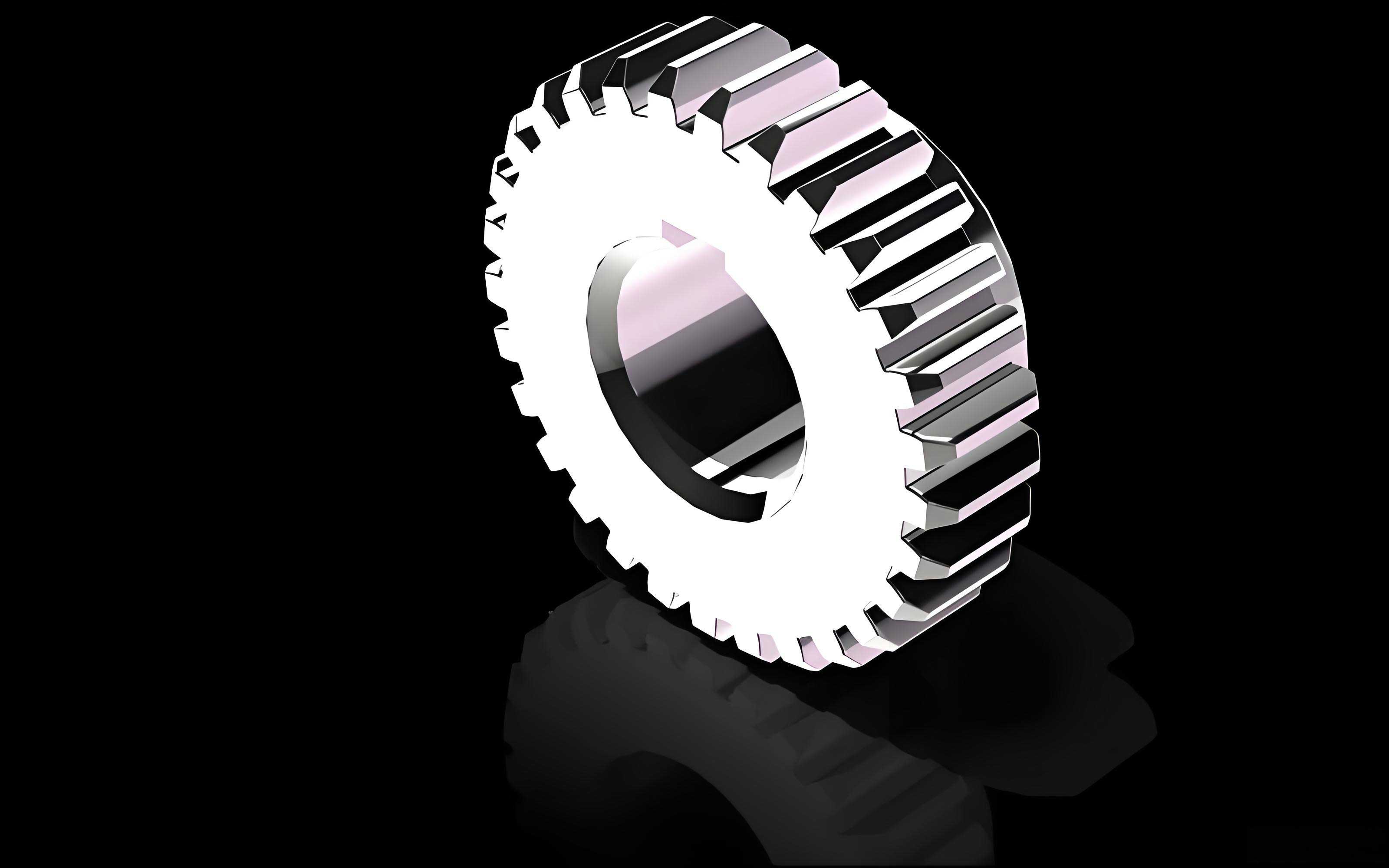
The foundation of our approach lies in the precise mathematical representation of the modified tooth surface for spur gears. We consider a pinion (driving gear) with profile modifications, while the gear (driven gear) retains its theoretical involute surface. The modified surface is constructed by superimposing a deviation function onto the theoretical tooth surface. Let the theoretical tooth surface of the pinion be defined by the position vector $$\mathbf{R}_1(u_1, l_1)$$ and the unit normal vector $$\mathbf{n}_1(u_1, l_1)$$, where $$u_1$$ and $$l_1$$ are surface parameters representing the involute profile and face width directions, respectively. The modified surface $$\mathbf{R}_{1r}(u_1, l_1)$$ is then expressed as:
$$\mathbf{R}_{1r}(u_1, l_1) = \delta(u_1, l_1) \mathbf{n}_1(u_1, l_1) + \mathbf{R}_1(u_1, l_1)$$
Here, $$\delta(u_1, l_1)$$ is the modification function that defines the amount of deviation from the theoretical surface along the normal direction. For spur gears, we focus on profile modifications along the tooth height, typically employing a parabolic or linear function. A common modification curve, as illustrated in the figure, includes parameters such as the amount of tip relief, root relief, and the length of modification. The normal vector of the modified surface $$\mathbf{N}_{1r}$$ is derived from the cross product of partial derivatives:
$$\mathbf{N}_{1r} = \left( \frac{\partial \mathbf{R}_1}{\partial u_1} + \frac{\partial \delta}{\partial u_1} \mathbf{n}_1 + \frac{\partial \mathbf{n}_1}{\partial u_1} \delta \right) \times \left( \frac{\partial \mathbf{R}_1}{\partial l_1} + \frac{\partial \delta}{\partial l_1} \mathbf{n}_1 + \frac{\partial \mathbf{n}_1}{\partial l_1} \delta \right)$$
This representation allows for accurate geometric description of the spur gear tooth surface after modification. The modification function $$\delta(u_1, l_1)$$ is often defined piecewise, with different segments for the tip, active profile, and root regions. For optimization purposes, we parameterize the modification curve using key variables such as the maximum tip relief $$y_1$$, the start point of modification along the profile $$y_2$$, the maximum root relief $$y_3$$, and the end point of modification $$y_4$$. These parameters form the design variables in our optimization problem. By adjusting these variables, we can control the contact pattern and load distribution across the tooth surface, ultimately influencing the dynamic response of the spur gear pair.
To evaluate the performance of modified spur gears, we employ tooth contact analysis (TCA) and loaded tooth contact analysis (LTCA). TCA simulates the meshing process under no-load conditions, determining the contact path and transmission error based solely on geometry. LTCA extends this by considering elastic deformations under load, calculating the actual contact pressures, load sharing among multiple tooth pairs, and the loaded transmission error. For spur gears, the meshing process involves alternating single and double tooth contact zones due to the contact ratio. The transmission error, defined as the angular displacement deviation of the driven gear from its ideal position, is a critical indicator of meshing quality. Under load, the transmission error becomes a dynamic excitation source. The loaded transmission error $$TE$$ is computed from the normal deformation $$Z$$ along the line of action over a mesh cycle:
$$TE = \frac{3600 \cdot Z}{R_{b2} \cos \beta}$$
where $$R_{b2}$$ is the base radius of the driven gear and $$\beta$$ is the helix angle (zero for spur gears). The amplitude of the loaded transmission error, denoted as $$G_1$$, is the difference between the maximum and minimum values over one mesh period:
$$G_1 = \max(TE) – \min(TE)$$
This amplitude reflects the fluctuation in mesh stiffness and is directly correlated with vibration levels. A smaller $$G_1$$ indicates smoother meshing and reduced dynamic excitation. In addition to transmission error, meshing impact forces at the entry and exit points contribute significantly to vibration. When a new tooth pair comes into contact, an impact occurs due to the velocity difference between the mating surfaces. This impact force $$F_s$$ can be derived from impact dynamics theory:
$$F_s = v_s \sqrt{\frac{b J_1 J_2}{(J_1 r’^{2}_{b2} + J_2 r^{2}_{b1}) q_s}}$$
Here, $$v_s$$ is the impact velocity at the entry point, determined from TCA; $$b$$ is the face width; $$J_1$$ and $$J_2$$ are the mass moments of inertia of the pinion and gear, respectively; $$r_{b1}$$ and $$r_{b2}$$ are the base radii; and $$q_s$$ is the comprehensive flexibility at the impact point, calculated as $$q_s = (b Z)/P_n$$, with $$P_n$$ being the normal load. The mesh stiffness $$K$$ varies with time due to changing contact conditions and is given by $$K = F_n / Z_k$$, where $$F_n$$ is the normal force and $$Z_k$$ is the deformation at the contact point.
To capture the dynamic behavior of spur gears, we develop a four-degree-of-freedom bending-torsion coupled vibration model. The model considers translational vibrations of the gear centers in the tangential direction and torsional vibrations of the gears about their axes. The equations of motion are:
$$m_p \ddot{y}_p + c_{py} \dot{y}_p + k_{py} y_p = -F_y – F_s$$
$$I_p \ddot{\theta}_p = -(F_y + F_s) R_p + T_p$$
$$m_g \ddot{y}_g + c_{gy} \dot{y}_g + k_{gy} y_g = F_y + F_s$$
$$I_g \ddot{\theta}_g = (F_y + F_s) R_g – T_g$$
In these equations, $$y_p$$ and $$y_g$$ are the translational displacements of the pinion and gear centers, respectively; $$\theta_p$$ and $$\theta_g$$ are the angular displacements; $$m_p$$, $$m_g$$ are masses; $$I_p$$, $$I_g$$ are moments of inertia; $$c_{py}$$, $$c_{gy}$$ are damping coefficients; $$k_{py}$$, $$k_{gy}$$ are support stiffnesses; $$R_p$$ and $$R_g$$ are pitch radii; $$T_p$$ and $$T_g$$ are input and output torques; and $$F_y$$ is the dynamic mesh force along the line of action, which depends on the mesh stiffness and relative displacement. The model incorporates both the time-varying mesh stiffness $$K(t)$$ and the impact force $$F_s$$ as excitations, providing a realistic simulation of spur gear dynamics.
The optimization objective is to minimize vibration by adjusting the modification parameters. We define a multi-objective function that combines the amplitude of loaded transmission error $$G_1$$, the meshing impact force $$F_s$$, and the root mean square (RMS) of relative acceleration along the line of action $$G_2$$. The relative acceleration RMS is calculated as:
$$G_2 = \sqrt{\frac{\sum_{k=1}^{n} (r_{bp} \ddot{\theta}_{pk} – r_{bg} \ddot{\theta}_{gk})^2}{n}}$$
where $$r_{bp}$$ and $$r_{bg}$$ are base radii, $$\ddot{\theta}_{pk}$$ and $$\ddot{\theta}_{gk}$$ are angular accelerations at discrete time steps over one mesh cycle, and $$n$$ is the number of steps. The overall objective function is formulated as:
$$G(y_i) = \min \{ w_1 f_1 + w_2 f_2 \}$$
$$f_1 = \frac{G_1}{G_{10}}, \quad f_2 = \frac{G_2}{G_{20}}$$
Here, $$y_i$$ represents the design variables (modification parameters), $$G_{10}$$ and $$G_{20}$$ are the reference values for unmodified spur gears, and $$w_1$$ and $$w_2$$ are weighting factors, both set to 1.0 for equal importance. The optimization process involves iterative calls to TCA and LTCA to compute the objective functions for each set of parameters. We employ a genetic algorithm due to its robustness in handling nonlinear, multi-modal optimization problems. The algorithm explores the design space by evolving a population of candidate solutions, using selection, crossover, and mutation operations to converge towards the optimal modification parameters that yield the lowest vibration.
To demonstrate the effectiveness of our approach, we present a case study of a standard spur gear pair. The basic parameters of the spur gears are listed in Table 1. The gears are assumed to be installed with standard center distance and have a manufacturing accuracy grade of 5. The dynamic parameters for the vibration model are given in Table 2. We consider an operating condition with a pinion speed of 2000 rpm and a torque load of 800 N·m on the driven gear. The support stiffness and damping values are chosen based on typical bearing properties.
| Parameter | Pinion | Gear |
|---|---|---|
| Number of Teeth | 19 | 47 |
| Module (mm) | 6 | 6 |
| Pressure Angle (degrees) | 20 | 20 |
| Face Width (mm) | 75 | 75 |
| Base Radius (mm) | 53.6 | 132.5 |
| Parameter | Value |
|---|---|
| Support Stiffness (N/m) | 5 × 10⁹ |
| Support Damping (N·s/m) | 3.4 × 10³ |
| Mass Moment of Inertia, Pinion (kg·m2) | 0.0025 |
| Mass Moment of Inertia, Gear (kg·m2) | 0.015 |
| Input Torque (N·m) | 800 |
| Pinion Speed (rpm) | 2000 |
Using the genetic algorithm, we optimize the modification parameters for the pinion tooth profile. The optimization results are summarized in Table 3. These parameters define the modification curve, with $$y_1$$ and $$y_3$$ representing the maximum tip and root relief in micrometers, and $$y_2$$ and $$y_4$$ indicating the start and end points of modification along the profile in millimeters.
| Parameter | Symbol | Value |
|---|---|---|
| Maximum Tip Relief | $$y_1$$ | 10 μm |
| Start Point of Modification | $$y_2$$ | 1.0 mm |
| Maximum Root Relief | $$y_3$$ | 12 μm |
| End Point of Modification | $$y_4$$ | 2.5 mm |
We compare the dynamic performance of the unmodified and optimized modified spur gears. The loaded transmission error (LTE) is a key metric. For unmodified spur gears, the LTE amplitude increases linearly with load due to elastic deformations that exacerbate misalignments. In contrast, for modified spur gears, the LTE amplitude exhibits different behavior: as load increases, the contact ratio gradually rises because the modifications allow for better load sharing, leading to fluctuations in amplitude before stabilizing at higher loads. This stabilization indicates that the modifications effectively accommodate load variations, reducing sensitivity to operational conditions. The LTE amplitude for the modified spur gear is significantly lower than that of the unmodified gear across the load range, demonstrating the vibration-reduction benefits.
The load distribution along the tooth profile also shows marked improvement. In unmodified spur gears, high load concentrations occur at the entry and exit points of the mesh, leading to sharp impact forces. After optimization, the load is more evenly distributed across the active profile, with reduced peaks at the ends. This results in lower meshing impact forces, as calculated from the impact dynamics model. The reduction in impact force directly contributes to lower vibration levels, particularly in the high-frequency range associated with impact events.
Mesh stiffness variation is another critical factor. For unmodified spur gears, the mesh stiffness fluctuates considerably over a mesh cycle due to alternating single and double tooth contact. The amplitude of this fluctuation excites dynamic responses. With modification, the mesh stiffness curve becomes smoother, with reduced amplitude of variation. This is because the modifications alleviate edge contacts and ensure more gradual transitions between tooth pairs. The average mesh stiffness may decrease slightly, but the reduction in fluctuation amplitude outweighs this, leading to lower dynamic excitation.
The vibration responses are evaluated through simulations of the dynamic model. The relative acceleration along the line of action, expressed as RMS values, is substantially lower for the modified spur gear. When considering both mesh stiffness excitation and impact forces, the modified gear shows a reduction in acceleration RMS by approximately 40-50% compared to the unmodified gear. The translational vibrations of the gear centers in the tangential direction also decrease significantly. Frequency domain analysis reveals that the modified spur gear maintains similar natural frequencies but with reduced resonance peaks, particularly at the mesh frequency (1×) and its half-order (0.5×). This indicates that the modifications dampen the dynamic amplification without altering the fundamental structural dynamics.
To further illustrate the optimization outcomes, we present analytical formulas summarizing the relationships. The loaded transmission error for a spur gear pair can be approximated as a function of modification parameters and load. Let $$L$$ denote the applied torque load. For unmodified spur gears, a linear relationship is often observed:
$$G_1^{\text{unmodified}} = a L + b$$
where $$a$$ and $$b$$ are constants dependent on geometry and material. For modified spur gears, the relationship becomes nonlinear due to increased contact ratio $$\epsilon$$:
$$G_1^{\text{modified}} = \frac{c L}{\epsilon(L)} + d$$
Here, $$c$$ and $$d$$ are constants, and $$\epsilon(L)$$ increases with load, leading to the saturation effect. The contact ratio can be estimated from LTCA results as the average number of tooth pairs in contact over a cycle. The impact force $$F_s$$ is proportional to the velocity mismatch $$\Delta v$$ at entry:
$$F_s \propto \Delta v \sqrt{\frac{k_{\text{eq}}}{m_{\text{eq}}}}$$
where $$k_{\text{eq}}$$ and $$m_{\text{eq}}$$ are equivalent stiffness and mass. Modifications reduce $$\Delta v$$ by aligning the surfaces better, thus lowering $$F_s$$. The relative acceleration RMS $$G_2$$ is influenced by the excitation spectrum. Assuming sinusoidal excitation at mesh frequency $$f_m$$, the response acceleration amplitude $$A$$ is:
$$A = \frac{F_{\text{exc}} / m_{\text{eq}}}{\sqrt{(1 – r^2)^2 + (2 \zeta r)^2}}$$
with $$r = f_m / f_n$$ (ratio of mesh to natural frequency) and $$\zeta$$ as damping ratio. Modifications reduce $$F_{\text{exc}}$$ (the excitation force amplitude), thereby reducing $$A$$ and $$G_2$$.
In summary, the optimization of spur gear profile modification based on vibration minimization yields substantial benefits. The optimized modification parameters, derived through integrated TCA, LTCA, and dynamic modeling, effectively reduce loaded transmission error amplitude, meshing impact forces, and vibration accelerations. The case study confirms that the proposed methodology can achieve significant vibration reduction, enhancing the reliability and performance of spur gear transmissions. Future work could extend this approach to helical gears or incorporate thermal effects and wear considerations. Nevertheless, the current framework provides a robust tool for designers seeking to optimize spur gears for quiet and durable operation.
The study underscores the importance of systematic design in mitigating spur gear vibration. By moving beyond trial-and-error methods and employing advanced analytical techniques, engineers can tailor tooth modifications to specific operating conditions. This not only improves product quality but also contributes to energy efficiency and longer service life. As industries continue to demand higher performance from mechanical systems, such optimization approaches will become increasingly vital in the development of next-generation spur gear drives.