
In mechanical engineering, straight bevel gear drives are widely used for transmitting power between intersecting shafts. The strength conditions primarily involve tooth surface contact strength and tooth root bending fatigue strength. For strength verification, the calculation method according to GB/T10062-2003 for bevel gear load capacity is applied. Conventional design of straight bevel gear drives can be performed based on established literature, while optimization design often employs algorithms such as genetic algorithms, enumeration methods, and hybrid discrete complex methods. This paper focuses on the optimization of straight bevel gear drives by selecting key design variables to minimize the total volume of the gears, subject to boundary and strength constraints. The optimization model is solved using MATLAB for continuous variables and LINGO for discrete variables, resulting in a significant reduction in overall volume compared to conventional design.
The design variables for the straight bevel gear drive optimization include the large end module \( m_{et} \), the pinion tooth number \( z_1 \), and the gear width \( b \). These are defined as the vector \( \mathbf{X} = [x_1, x_2, x_3] = [m_{et}, z_1, b] \). The objective function aims to minimize the sum of the volumes of the pinion and gear, approximated using the truncated cone volume between the large and small end pitch circles due to the complexity of exact geometric representation. The volume calculation is given by:
$$ \min f(\mathbf{x}) = V_1(\mathbf{x}) + V_2(\mathbf{x}) = \frac{\pi b \cos \delta_1}{3} \left[ \left( \frac{m_{et} z_1}{2} \right)^2 + \frac{m_{et} z_1}{2} \cdot \frac{m_{et} z_1}{2} \cdot \frac{R_e – b}{R_e} + \left( \frac{m_{et} z_1}{2} \cdot \frac{R_e – b}{R_e} \right)^2 \right] + \frac{\pi b \cos \delta_2}{3} \left[ \left( \frac{m_{et} z_2}{2} \right)^2 + \frac{m_{et} z_2}{2} \cdot \frac{m_{et} z_2}{2} \cdot \frac{R_e – b}{R_e} + \left( \frac{m_{et} z_2}{2} \cdot \frac{R_e – b}{R_e} \right)^2 \right] $$
where \( \tan \delta_1 = z_1 / z_2 = 1/u \), \( \tan \delta_2 = z_2 / z_1 = u \), \( z_2 = u z_1 \), and the outer cone distance \( R_e \) is calculated as:
$$ R_e = \frac{m_{et} z_1 \sqrt{u^2 + 1}}{2} $$
The constraint conditions for the straight bevel gear drive optimization include boundaries and strength requirements. The boundary constraints are:
- Large end module \( m_{et} \) must be between 2 and 10: \( g(1) = 2 – x_1 \leq 0 \), \( g(2) = x_1 – 10 \leq 0 \).
- Pinion tooth number \( z_1 \) must be between 16 and 30: \( g(3) = 16 – x_2 \leq 0 \), \( g(4) = x_2 – 30 \leq 0 \).
- Gear width \( b \) must satisfy the face width coefficient \( \Phi_R \) between 1/4 and 1/3: \( g(5) = 0.25 – x_3 / R_e \leq 0 \), \( g(6) = x_3 / R_e – 0.33 \leq 0 \).
The strength constraints are based on GB/T10062-2003. The tooth surface contact fatigue strength condition is:
$$ \sigma_H = \frac{F_{mt} K_A K_V K_{H\beta} K_{H\alpha}}{d_{m1} l_{bm}} \cdot \sqrt{\frac{u^2 + 1}{u}} \cdot Z_{M-B} Z_H Z_E Z_{LS} Z_{\beta} Z_K \leq \sigma_{HP} $$
where \( \sigma_H \) is the contact stress, \( \sigma_{HP} \) is the allowable contact stress, \( F_{mt} \) is the nominal tangential force at the midpoint, \( K_A \) is the application factor, \( K_V \) is the dynamic factor, \( K_{H\beta} \) is the contact load distribution factor, \( K_{H\alpha} \) is the contact load sharing factor, \( Z_{M-B} \) is the midpoint zone factor, \( Z_H \) is the zone factor, \( Z_E \) is the elasticity factor, \( Z_{LS} \) is the load sharing factor, \( Z_{\beta} \) is the spiral angle factor, \( Z_K \) is the bevel gear factor, \( d_{m1} \) is the pinion midpoint pitch diameter, and \( l_{bm} \) is the midpoint contact length. The constraint is \( g(7) = \sigma_H – \sigma_{HP} \leq 0 \).
The tooth root bending fatigue strength condition for the straight bevel gear drive is:
$$ \sigma_F = \frac{F_{mt}}{b m_{mn}} \cdot Y_{Fa} Y_{sa} Y_{\epsilon} Y_K Y_{LS} K_A K_V K_{F\beta} K_{F\alpha} \leq \sigma_{FP} $$
where \( \sigma_F \) is the bending stress, \( \sigma_{FP} \) is the allowable bending stress, \( m_{mn} \) is the midpoint normal module, \( Y_{Fa} \) is the form factor, \( Y_{sa} \) is the stress correction factor, \( Y_{\epsilon} \) is the contact ratio factor, \( Y_K \) is the bending strength bevel gear factor, \( Y_{LS} \) is the bending strength load sharing factor, \( K_{F\beta} \) is the bending load distribution factor, and \( K_{F\alpha} \) is the bending load sharing factor. The constraint is \( g(8) = \sigma_F – \sigma_{FP} \leq 0 \).
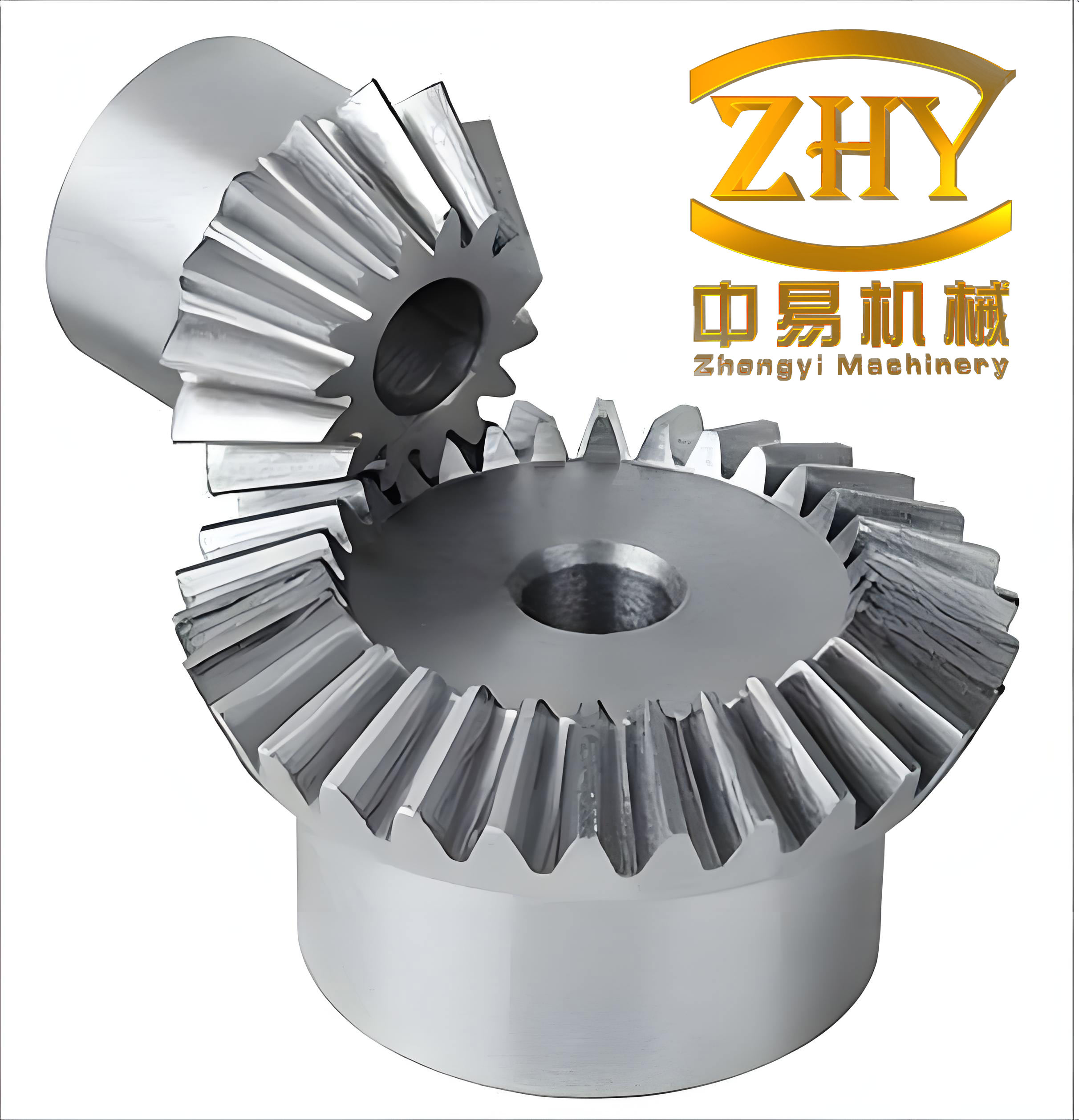
For the design example, consider a closed straight bevel gear drive with the following conditions: pinion torque \( T_1 = 400 \, \text{N·m} \), pinion speed \( n_1 = 960 \, \text{r/min} \), gear ratio \( u = 3 \), shaft angle \( \Sigma = 90^\circ \), accuracy grade IT6, and long-term operation. Both gears are made of 20Cr, carburized and quenched, with surface hardness 58-63 HRC, allowable contact stress \( \sigma_{HP} = 1087 \, \text{MPa} \), and allowable bending stress \( \sigma_{FP} = 450 \, \text{MPa} \). The conventional design procedure yields initial parameters: \( m_{et} = 5.5 \), \( z_1 = 19 \), \( z_2 = 57 \), \( R_e = 165.229 \, \text{mm} \), \( b = 50 \, \text{mm} \), and face width coefficient \( \Phi_R = 0.3026 \). The pinion large end pitch diameter is \( d_{e1} = 104.5 \, \text{mm} \), and the gear large end pitch diameter is \( d_{e2} = 313.5 \, \text{mm} \). Other parameters are computed accordingly.
Optimization solving involves continuous variable optimization using MATLAB and discrete variable optimization using LINGO. For continuous variables, the fmincon function and particle swarm optimization (PSO) algorithm are applied. The fmincon function is used with an initial point based on the conventional design, and the constraints are defined in separate files. The PSO algorithm is implemented with programming in MATLAB to compare results. The solutions from both methods are similar, and after rounding and standardization, the optimized variables are obtained. For discrete variables, LINGO is used to handle the discrete nature of \( m_{et} \), \( z_1 \), and \( b \), by setting them to standard values and integers, respectively.
The table below summarizes the conventional design and optimization results for the straight bevel gear drive, including the design variables, constraints, and objective function value (total volume).
| Item | \( m_{et} \) | \( z_1 \) | \( b \) (mm) | \( \Phi_R \) | \( \sigma_H \) (MPa) | \( \sigma_F \) (MPa) | \( f(\mathbf{x}) \) (×10^5 mm³) |
|---|---|---|---|---|---|---|---|
| Conventional Design | 5.5 | 19 | 50 | 0.3026 | 906.8 | 275.4 | 11.8455 |
| fmincon Solution | 4.5214 | 21.0216 | 38.4166 | 0.2556 | 1087 | 450 | 7.9246 |
| PSO Solution | 4.5218 | 21.0240 | 38.4365 | 0.2557 | 1086.8 | 449.7 | 7.9314 |
| Rounded Solution | 4.5 | 21 | 39 | 0.2610 | 1088.7 | 450.6 | 7.9064 |
| Discrete Solution | 4.5 | 21 | 40 | 0.2677 | 1079.0 | 442.6 | 8.0505 |
The optimization results show that the continuous variable solutions from fmincon and PSO are nearly identical, with the total volume reduced by approximately 33% compared to the conventional design. However, the rounded solution may not strictly satisfy the strength constraints, as the contact and bending stresses are very close to the allowable values. In contrast, the discrete solution from LINGO fully satisfies the constraints with stresses below the limits. The optimal design for the straight bevel gear drive is determined as \( m_{et} = 4.5 \), \( z_1 = 21 \), and \( b = 40 \, \text{mm} \), resulting in a volume reduction of about 32%. This demonstrates the effectiveness of the optimization approach for straight bevel gear drives.
In conclusion, the optimization of straight bevel gear drives using MATLAB and LINGO provides a systematic method to minimize gear volume while adhering to design constraints. The continuous variable optimization offers a baseline, while discrete variable optimization ensures practical feasibility. The straight bevel gear drive optimization model can be extended to other gear types, and the methods presented here serve as a reference for mechanical design applications. Future work could explore additional constraints or multi-objective optimization for straight bevel gear drives to further enhance performance and efficiency.