
In the field of gear manufacturing, the design of milling cutters for straight bevel gears plays a critical role in ensuring the accuracy and efficiency of gear production. Straight bevel gears are widely used to transmit rotational motion between intersecting shafts with a constant transmission ratio. Their design and manufacturing processes are simpler compared to spiral bevel gears, making them a common choice in various mechanical systems. However, the complex geometry of straight bevel gears, which involves spherical involutes, poses challenges in cutter design. This paper presents an optimized approach for designing the tooth profile of milling cutters for straight bevel gears using MATLAB, focusing on improving precision, automation, and reliability.
The tooth profile of a straight bevel gear is based on spherical involutes, which cannot be developed on a plane. To simplify this, the concept of an equivalent spur gear derived from the back cone is employed. This equivalent gear approximates the actual gear geometry, allowing for easier computation and manufacturing. The milling cutter profile is designed using this equivalent tooth shape, and traditional methods like point-by-point plotting or single-arc fitting often fail to achieve the required accuracy. In this work, we utilize MATLAB for polynomial fitting and double-arc methods to optimize the cutter profile, ensuring smooth transitions between the effective tooth profile, transition curve, and tip arc sections. This approach not only enhances design precision but also addresses issues like stress concentration and tool strength.
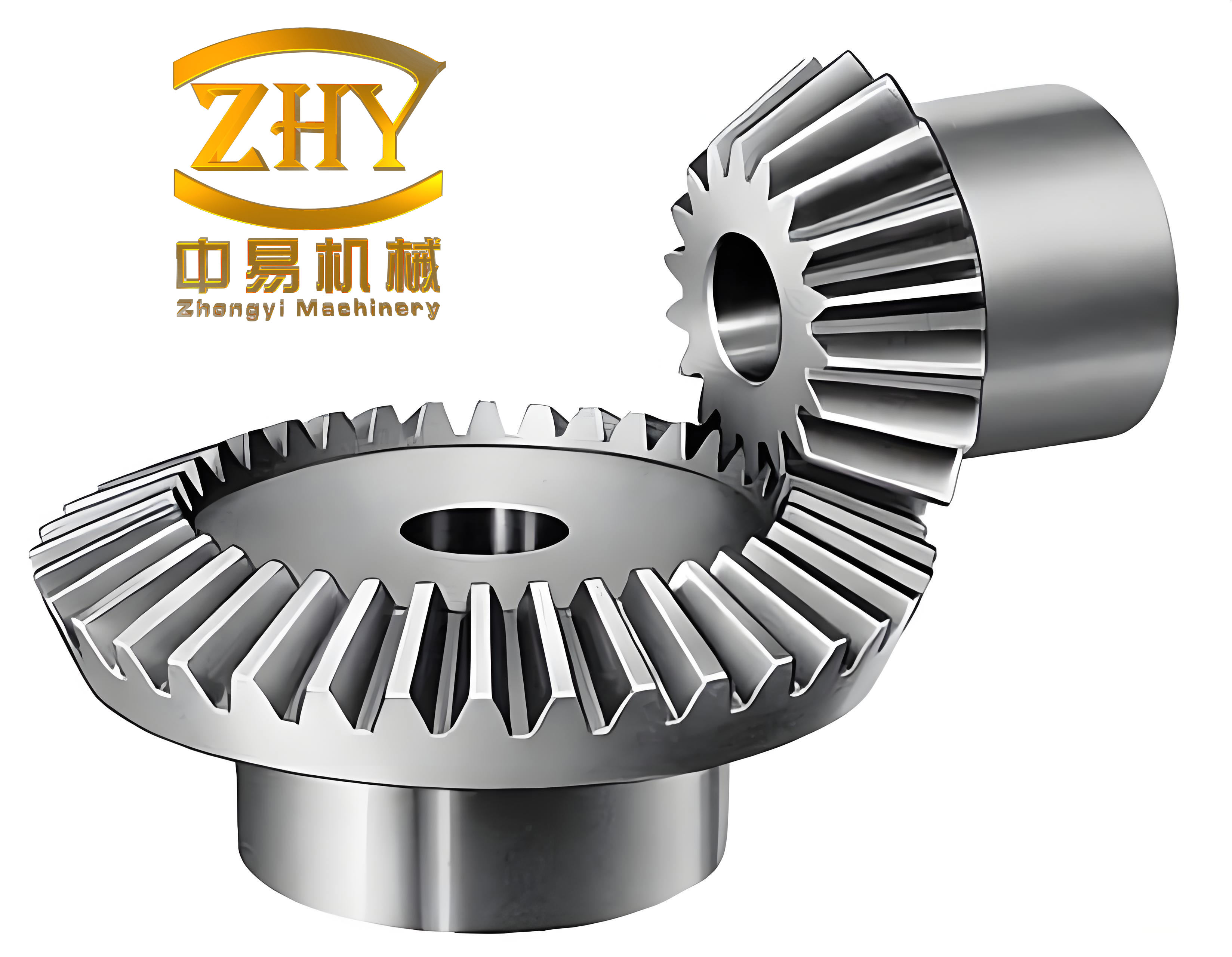
The design of the milling cutter profile for straight bevel gears involves two main parts: the effective tooth profile and the transition curve. The effective profile is derived from the equivalent spur gear of the large end back cone. The coordinate system is set with the origin at the midpoint of the slot bottom, and the symmetric axis of the tooth slot as the y-axis. The coordinates of the tooth slot profile are given by:
$$x = r_y \sin \eta_y$$
$$y = r_y \cos \eta_y – \frac{m z_v}{2} – 1.2 m$$
where \( z_v = \frac{z}{\cos \delta} \) is the equivalent number of teeth, \( \eta = \frac{\pi – 4x \tan \alpha}{2z_v} \) is the half-angle of the tooth slot center at the pitch circle, \( \alpha_y = \arccos \left( \frac{r_o}{r_y} \right) \) is the pressure angle at any radius \( r_y \), and \( \eta_y = \eta – \text{inv} \alpha + \text{inv} \alpha_y \) is the half-angle of the tooth slot center at \( r_y \). Here, \( r_o = \frac{1}{2} m z_v \cos \alpha \). The coordinates at the pitch circle node are \( x_p = \frac{m z_v}{2} \sin \eta \) and \( y_p = \frac{m z_v}{2} \cos \eta \). The intersection point coordinates \( (x_{p1}, y_{p1}) \) with the small end equivalent gear are found iteratively using the equation:
$$x^2 + \left( y + \frac{m z_v}{3} – \frac{13}{15} \right)^2 = \left( \frac{1}{3} m z_v \right)^2$$
The rotation angle \( \tau \) and offset \( e \) for milling are calculated as:
$$\tau = \frac{\pi}{2z_v} – \frac{6g}{m z_v}$$
$$e = \frac{x_p – g – y_{p1} \tan \tau}{\cos \tau} – x’_{p1}$$
where \( g = \frac{m z_v}{2} \sin \eta – x_{p1} \) and \( x’_{p1} = \frac{2}{3} x_p \). The effective cutter profile coordinates \( (x’, y’) \) are then transformed as:
$$x’ = x \cos \tau – y \sin \tau – e$$
$$y’ = x \sin \tau + y \cos \tau$$
The transition curve part of the cutter profile is designed to avoid interference during gear meshing and to ensure smooth transitions. For gears with a pressure angle of 20° and teeth less than 17, root cutting may occur, so designs should avoid low tooth counts. For teeth between 19 and 34, the transition curve consists of a tip arc and a straight line. The radial coordinate of the point of tangency between the extended involute and the involute is:
$$r_F = m \sqrt{ \frac{z^2}{4} – h’_a z + \frac{h’_r}{\sin^2 \alpha_0} }$$
The coordinates of the common tangent point are \( x_F = r_F \sin \eta_F \) and \( y_F = r_F \cos \eta_F \), where \( \eta_F = \eta – \text{inv} \alpha_0 + \text{inv} \alpha_F \) and \( \alpha_F = \arccos (r_b / r_F) \). The angle \( \delta \) is given by \( \delta = \eta_F + \alpha_F \), and the radius of the transition curve arc is:
$$r_c = \frac{ x_F – y_{1F} \tan \delta }{ \tan \left( \frac{90^\circ – \delta}{2} \right) }$$
For gears with 35 or more teeth, the transition curve includes a straight line and an arc, with the arc radius as:
$$r_c = \frac{ y_F – r_{f1} }{ 1 – \sin \delta }$$
Fitting the cutter profile accurately is essential for minimizing errors. Traditional single-arc fitting often fails to meet precision requirements, so we employ double-arc and polynomial fitting methods. In double-arc fitting, two arcs are used to approximate the profile. For three points \( (x_1, y_1) \), \( (x_2, y_2) \), and \( (x_3, y_3) \), the radius \( R \) and center \( (x_a, y_a) \) of the arc are calculated as:
$$R = \frac{ x_3 – x_2 }{ 2 \sin \beta \sin (\phi – \varepsilon) }$$
$$x_a = R \cos (\beta + \phi – \varepsilon) + x_3$$
$$y_a = -R \sin (\beta + \phi – \varepsilon) + y_3$$
where \( \tan \beta = \frac{x_3 – x_2}{y_3 – y_2} \), \( \tan \phi = \frac{y_2 – y_1}{x_2 – x_1} \), and \( \tan \varepsilon = \frac{y_3 – y_1}{x_3 – x_1} \). For double-arc fitting, six points are selected, and two arcs are computed similarly.
Polynomial fitting using MATLAB offers a more flexible approach. The fitting polynomial \( \phi(x) = a_0 + a_1 x + \cdots + a_n x^n \) is determined using the least squares method. For \( m \) data points \( (x_i, y_i) \), the coefficients are solved from the system:
$$\begin{bmatrix}
m & \sum x_i & \cdots & \sum x_i^n \\
\sum x_i & \sum x_i^2 & \cdots & \sum x_i^{n+1} \\
\vdots & \vdots & \ddots & \vdots \\
\sum x_i^n & \sum x_i^{n+1} & \cdots & \sum x_i^{2n}
\end{bmatrix}
\begin{bmatrix}
a_0 \\ a_1 \\ \vdots \\ a_n
\end{bmatrix}
=
\begin{bmatrix}
\sum y_i \\ \sum x_i y_i \\ \vdots \\ \sum x_i^n y_i
\end{bmatrix}$$
The fitting error is \( \delta_i = \phi(x_i) – y_i \). Higher polynomial degrees \( n \) generally improve accuracy, but must be balanced against overfitting.
Optimization of the straight bevel gear milling cutter profile in MATLAB focuses on three aspects: precision in the effective profile, smooth transitions, and tool strength. First, for the effective profile, coordinate points are computed using the transformed equations. The number of points depends on the gear module and required precision; higher modules and精度需求 necessitate more points. The MATLAB function polyfit is used for polynomial fitting, with the polynomial degree adjusted until errors are within tolerance. For example, with a module of 3 mm and a tolerance of 0.08 mm, a fourth-degree polynomial may suffice.
Second, transitions between the effective profile, transition line, and tip arc are optimized for smoothness. The transition line with angle \( \delta \) has the equation:
$$y – y_1 = \tan \delta (x – x_1)$$
where \( (x_1, y_1) \) is the intersection point. The tip arc radius \( r_c \) is optimized using:
$$r_c = \frac{ y_1 – x_1 \tan \delta – r_c }{ \sqrt{ \tan^2 \delta + 1 } }$$
This ensures tangency between the line and arc, reducing stress concentrations. Additionally, a rounded tip arc enhances tool strength, preventing chipping and improving durability.
Third, tool strength is addressed by optimizing the tip arc size. A larger arc radius reduces stress at the tool tip, mitigating failure risks. Standard straight bevel gear milling cutters are grouped by tooth number ranges to minimize variety, but this can lead to non-smooth transitions. MATLAB optimization allows for custom adjustments within non-interference limits.
To demonstrate the optimization, consider a straight bevel gear with module \( m = 3 \), tooth count \( z_1 = 22 \), pressure angle \( \alpha_f = 20^\circ \), shift coefficient \( \xi = 0 \), pitch angle \( \phi_1 = 26^\circ 34′ \), and pitch radius \( r_{f1} = 33 \). The equivalent tooth number is \( z_i = \frac{z_1}{\cos \phi_1} = 25 \), corresponding to cutter number 4. The transition curve has a radius \( R = 1.29 \) mm and angle \( \delta = 5^\circ 04′ \). The coordinates of the cutter profile points are listed in Table 1.
| Point | x (mm) | y (mm) |
|---|---|---|
| 1 | 1.40 | 1.78 |
| 2 | 1.46 | 2.17 |
| 3 | 1.61 | 2.78 |
| 4 | 1.82 | 3.38 |
| 5 | 2.08 | 3.99 |
| 6 | 2.37 | 4.61 |
| 7 | 2.71 | 5.22 |
| 8 | 3.09 | 5.83 |
| 9 | 3.50 | 6.45 |
| 10 | 3.96 | 7.07 |
For single-arc fitting, points (1.40, 1.78), (2.08, 3.99), and (3.96, 7.07) yield \( R = 12.1832 \), \( x_a = 13.3277 \), and \( y_a = 0.7254 \), with a maximum error of 0.1409 mm, exceeding the 0.08 mm tolerance. Thus, single-arc is inadequate. For double-arc fitting, points (1.40, 1.78), (1.61, 2.78), (2.08, 3.99) and (2.08, 3.99), (2.71, 5.22), (3.96, 7.07) are used. The first arc has \( R_1 = 7.1028 \), \( x_{a1} = 8.4381 \), \( y_{a1} = 0.824 \), and error 0.0211 mm. The second arc has \( R_2 = 14.9649 \), \( x_{a2} = 15.7 \), \( y_{a2} = -2.2098 \), and error 0.0185 mm, both within tolerance.
The transition line equation is \( y – 1.78 = 11.2789 (x – 1.40) \), and the optimized tip arc radius is \( r_c = 1.36 \) mm. The complete cutter profile equations are:
- For \( 2.08 \leq x \leq 3.96 \): \( (x – 15.7)^2 + (y + 2.2098)^2 = (14.9649)^2 \)
- For \( 1.40 \leq x \leq 2.08 \): \( (x – 8.4381)^2 + (y – 0.824)^2 = (7.1028)^2 \)
- For \( 1.34 \leq x \leq 1.40 \): \( y – 1.78 = 11.2789 (x – 1.40) \)
- For \( -1.34 \leq x \leq 1.34 \): \( x^2 + (y – 1.36)^2 = (1.36)^2 \)
- For \( -1.40 \leq x \leq -1.34 \): \( y – 1.78 = -11.2789 (x + 1.40) \)
- For \( -2.08 \leq x \leq -1.40 \): \( (x + 8.4381)^2 + (y – 0.824)^2 = (7.1028)^2 \)
- For \( -3.96 \leq x \leq -2.08 \): \( (x + 15.7)^2 + (y + 2.2098)^2 = (14.9649)^2 \)
For polynomial fitting, the coordinates are fitted with a fourth-degree polynomial using MATLAB. The resulting polynomial is:
$$\phi(x) = -14.7418 + 22.5382x – 10.5621x^2 + 2.3701x^3 – 0.1992x^4$$
with a maximum error of 0.0681 mm. The transition curve optimization remains the same as in double-arc fitting. The polynomial-based profile equations are:
- For \( 1.40 \leq x \leq 3.96 \): \( y = -14.7418 + 22.5382x – 10.5621x^2 + 2.3701x^3 – 0.1992x^4 \)
- For \( 1.34 \leq x \leq 1.40 \): \( y – 1.78 = 11.2789 (x – 1.40) \)
- For \( -1.34 \leq x \leq 1.34 \): \( x^2 + (y – 1.36)^2 = (1.36)^2 \)
- For \( -1.40 \leq x \leq -1.34 \): \( y – 1.78 = -11.2789 (x + 1.40) \)
- For \( -3.96 \leq x \leq -1.40 \): \( y = -14.7418 – 22.5382x – 10.5621x^2 – 2.3701x^3 – 0.1992x^4 \)
The optimization results show that both double-arc and polynomial methods significantly improve accuracy compared to traditional approaches. The double-arc method reduces errors to below 0.03 mm, while polynomial fitting offers flexibility with errors around 0.07 mm. Smooth transitions are achieved through mathematical optimization, eliminating sharp corners that could cause stress concentrations. The increased tip arc radius to 1.36 mm enhances tool strength, reducing the risk of failure during machining. MATLAB’s computational capabilities enable automated and reliable design, reducing manual effort and potential errors.
In conclusion, the optimized design of straight bevel gear milling cutter profiles using MATLAB demonstrates substantial improvements in precision, smoothness, and durability. The use of polynomial and double-arc fitting methods ensures high accuracy in the effective tooth profile, while transition optimizations prevent stress concentrations and improve tool life. This approach enhances the automation and reliability of cutter design, contributing to better performance in straight bevel gear manufacturing. Future work could explore real-time optimization and integration with CAD systems for broader applications.