
The design and optimization of mechanical power transmission systems constitute a fundamental challenge in mechanical engineering. Among various transmission elements, cylindrical gears, particularly spur gears, are ubiquitous due to their high efficiency, reliability, and ability to transmit significant torque and power in a compact form factor. The design of a multi-stage gearbox, such as a two-stage reduction unit, involves navigating a complex design space governed by numerous interdependent parameters, material properties, and stringent performance constraints related to strength, geometry, and manufacturability.
Conventional design methodologies for such cylindrical gear systems are often iterative, experience-dependent, and computationally tedious. An engineer typically selects initial parameters based on empirical guidelines and handbook data, followed by exhaustive verification of contact and bending stress against allowable limits. If the design fails validation, the process repeats with adjusted parameters. This trial-and-error approach not only lacks efficiency but also seldom yields an optimal solution in terms of material usage, weight, or compactness. The resulting design, while safe, is often over-engineered, leading to unnecessary material cost, increased inertia, and a larger spatial footprint.
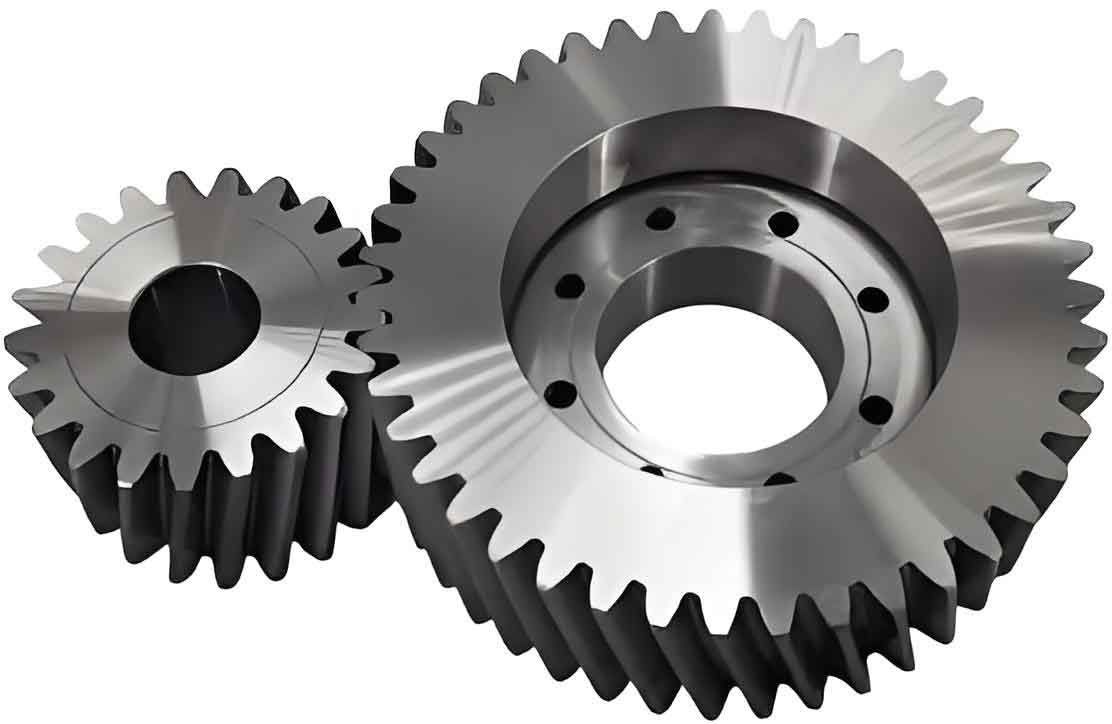
To overcome these limitations, this work presents an automated optimization framework for the design of a two-stage spur cylindrical gear reducer. The primary objective is to minimize the total volume of the gear pairs, thereby enhancing compactness and reducing material consumption. The core of this framework is a robust mathematical model of the system, coupled with a powerful metaheuristic optimization algorithm—an enhanced version of the Particle Swarm Optimization (PSO) algorithm. The integration of a linear decreasing inertia weight and a simulated annealing-based acceptance criterion significantly improves the algorithm’s ability to explore the complex, constrained design space and converge to a high-quality, feasible solution.
1. Mathematical Modeling of the Two-Stage Cylindrical Gear System
The system under consideration is a standard two-stage spur cylindrical gear speed reducer. The first (high-speed) stage consists of Pinion 1 and Gear 2, and the second (low-speed) stage consists of Pinion 3 and Gear 4. The input power and speed are reduced across these two stages to achieve the desired output speed and torque.
1.1 Optimization Objective Function
The primary goal is to minimize the total material volume of the four cylindrical gears. Assuming solid gears, the volume of a gear is proportional to the area of its pitch circle multiplied by its face width. The combined volume \( V \) for both stages is formulated as follows:
$$
V = \frac{\pi}{4} b_1 m_1^2 z_1^2 \left(1 + i_1^2\right) + \frac{\pi}{4} b_2 m_2^2 z_3^2 \left(1 + i_2^2\right)
$$
where \( i_2 = i_{total} / i_1 \). Recognizing that face width \( b \) is commonly expressed via the face width coefficient \( \phi_d \) (\( b = \phi_d \cdot d \), where \( d \) is the pitch diameter), the objective function is refined to:
$$
\text{Minimize: } f(\mathbf{x}) = \frac{\pi z_1^3 m_1^3}{4} (1 + i_1^2) \phi_{d1} + \frac{\pi z_3^3 m_2^3}{4} (1 + i_2^2) \phi_{d2}
$$
This function \( f(\mathbf{x}) \) represents the total enclosed volume proportional to the gear masses, providing a direct metric for compactness and material use.
1.2 Design Variables
The design variables are the key independent parameters defining the geometry of the cylindrical gear stages. The following five variables are chosen:
$$
\mathbf{x} = [x_1, x_2, x_3, x_4, x_5]^T = [z_1, z_3, m_1, m_2, i_1]^T
$$
The number of teeth for Gears 2 and 4 are dependent variables, calculated as \( z_2 = z_1 \cdot i_1 \) and \( z_4 = z_3 \cdot i_2 \), ensuring they are integers through post-processing.
| Variable | Symbol | Lower Bound | Upper Bound | Description |
|---|---|---|---|---|
| \( x_1 \) | \( z_1 \) | 17 | 35 | Teeth on high-speed pinion |
| \( x_2 \) | \( z_3 \) | 17 | 35 | Teeth on low-speed pinion |
| \( x_3 \) | \( m_1 \) (mm) | 2.0 | 5.0 | Module of high-speed stage |
| \( x_4 \) | \( m_2 \) (mm) | 2.0 | 5.0 | Module of low-speed stage |
| \( x_5 \) | \( i_1 \) | 3.7 | 4.5 | Gear ratio of high-speed stage |
1.3 Constraint Functions
The design must satisfy a set of geometric, kinematic, and strength constraints to ensure safe and functional operation of the cylindrical gear transmission.
1.3.1 Geometric and Interference Constraints
- Minimum Module: To ensure sufficient bending strength and avoid manufacturing difficulties: \( m_1 \geq 2.0 \), \( m_2 \geq 2.0 \).
- Minimum Teeth (Undercutting): To prevent undercutting in spur gears with standard rack cutters: \( z_1 \geq 17 \), \( z_3 \geq 17 \).
- Stage Clearance: To prevent physical interference between the high-speed gear and the low-speed shaft, a minimum center distance difference \( Q \) must be maintained:
$$ \frac{(z_3 m_2 + z_3 m_2 i_2)}{2} – \frac{z_1 m_1 i_1}{2} \geq Q $$
1.3.2 Contact Fatigue (Pitting) Strength Constraints
The contact stress \( \sigma_H \) at the pitch line must not exceed the allowable stress \( [\sigma_H] \) for both gear pairs. The standard AGMA/ISO contact stress formula is used:
$$
\sigma_H = Z_E Z_H \sqrt{ \frac{2 K T_1}{\phi_d d_1^3} \cdot \frac{u \pm 1}{u} } \leq [\sigma_H]
$$
Applied to both stages:
High-speed stage:
$$ g_1(\mathbf{x}): \sigma_{H1} = Z_E Z_H \sqrt{ \frac{2 K_1 T_1}{\phi_{d1} m_1^3 z_1^3} \cdot \frac{i_1 + 1}{i_1} } – [\sigma_H] \leq 0 $$
Low-speed stage: (where \( T_2 = T_1 i_1 \eta \))
$$ g_2(\mathbf{x}): \sigma_{H2} = Z_E Z_H \sqrt{ \frac{2 K_2 T_2}{\phi_{d2} m_2^3 z_3^3} \cdot \frac{i_2 + 1}{i_2} } – [\sigma_H] \leq 0 $$
Here, \( Z_E \) is the elasticity factor, \( Z_H \) is the zone factor, \( K \) is the load factor, and \( T \) is the transmitted torque.
1.3.3 Bending Fatigue (Root) Strength Constraints
The bending stress \( \sigma_F \) at the tooth root must be below the allowable bending stress \( [\sigma_F] \) for each of the four gears. The standard formula is:
$$
\sigma_F = \frac{2 K T}{\phi_d m^3 z^2} Y_{Fa} Y_{Sa} \leq [\sigma_F]
$$
where \( Y_{Fa} \) is the form factor and \( Y_{Sa} \) is the stress correction factor, both dependent on the number of teeth. This yields four distinct constraints:
High-speed Pinion (1): \( g_3(\mathbf{x}): \sigma_{F1} = \frac{2 K_1 T_1 Y_{Fa1} Y_{Sa1}}{\phi_{d1} m_1^3 z_1^2} – [\sigma_{F1}] \leq 0 \)
High-speed Gear (2): \( g_4(\mathbf{x}): \sigma_{F2} = \frac{2 K_1 T_1 Y_{Fa2} Y_{Sa2}}{\phi_{d1} m_1^3 z_1^2} – [\sigma_{F2}] \leq 0 \)
Low-speed Pinion (3): \( g_5(\mathbf{x}): \sigma_{F3} = \frac{2 K_2 T_2 Y_{Fa3} Y_{Sa3}}{\phi_{d2} m_2^3 z_3^2} – [\sigma_{F3}] \leq 0 \)
Low-speed Gear (4): \( g_6(\mathbf{x}): \sigma_{F4} = \frac{2 K_2 T_2 Y_{Fa4} Y_{Sa4}}{\phi_{d2} m_2^3 z_3^2} – [\sigma_{F4}] \leq 0 \)
| Constraint Type | Function | Description |
|---|---|---|
| Geometric | \( g_{G1}, g_{G2} \) | Module \( m_1, m_2 \geq 2.0 \) |
| \( g_{G3}, g_{G4} \) | Teeth \( z_1, z_3 \geq 17 \) | |
| \( g_{G5} \) | Inter-stage clearance \( \geq Q \) | |
| Contact Strength | \( g_{H1}, g_{H2} \) | Pitting stress for Stage 1 & 2 |
| Bending Strength | \( g_{F1} \) | Root stress, Pinion 1 |
| \( g_{F2} \) | Root stress, Gear 2 | |
| \( g_{F3} \) | Root stress, Pinion 3 | |
| \( g_{F4} \) | Root stress, Gear 4 |
2. Enhanced Particle Swarm Optimization (PSO) Algorithm
Particle Swarm Optimization is a population-based stochastic optimization technique inspired by the social behavior of bird flocking. It is well-suited for continuous, nonlinear problems like the optimization of cylindrical gear parameters. However, the basic PSO can suffer from premature convergence. To enhance its performance for this constrained engineering problem, two key modifications are incorporated.
2.1 Standard PSO Formulation
In PSO, a swarm of \( N \) particles explores the \( D \)-dimensional search space (here, \( D=5 \)). Each particle \( i \) has a position \( \mathbf{x}_i \) (a candidate design) and a velocity \( \mathbf{v}_i \). Particles remember their personal best position \( \mathbf{pbest}_i \) and communicate to find the global best position \( \mathbf{gbest} \) found by the swarm.
The velocity and position update equations for the \( j \)-th dimension of particle \( i \) at iteration \( k+1 \) are:
$$
v_{ij}^{(k+1)} = w v_{ij}^{(k)} + c_1 r_1 (pbest_{ij}^{(k)} – x_{ij}^{(k)}) + c_2 r_2 (gbest_{j}^{(k)} – x_{ij}^{(k)})
$$
$$
x_{ij}^{(k+1)} = x_{ij}^{(k)} + v_{ij}^{(k+1)}
$$
where \( w \) is the inertia weight, \( c_1 \) and \( c_2 \) are acceleration coefficients, and \( r_1, r_2 \) are random numbers in [0,1].
2.2 Linear Decreasing Inertia Weight (LDIW)
The inertia weight \( w \) controls the influence of the previous velocity. A high \( w \) favors global exploration, while a low \( w \) favors local exploitation. To balance this trade-off over the optimization run, a Linear Decreasing Inertia Weight strategy is employed:
$$
w^{(k)} = w_{max} – \frac{k}{T_{max}} (w_{max} – w_{min})
$$
where \( w_{max} \) and \( w_{min} \) are the initial and final inertia weights, \( k \) is the current iteration, and \( T_{max} \) is the maximum number of iterations. This allows the swarm to explore widely initially and refine the search later.
2.3 Incorporation of Simulated Annealing (SA) Selection
To further prevent convergence to local minima—a common issue in optimizing complex cylindrical gear systems—a selection mechanism inspired by Simulated Annealing is integrated into the PSO’s update of \( \mathbf{pbest} \). When evaluating a new position \( \mathbf{x}_i^{(k+1)} \), it is compared to the current \( \mathbf{pbest}_i \). The Metropolis criterion is used to decide whether to accept it as the new \( \mathbf{pbest}_i \), even if it is worse.
Let \( \Delta f = f(\mathbf{x}_i^{(k+1)}) – f(\mathbf{pbest}_i^{(k)}) \). The probability \( P \) of accepting the new position is:
$$
P = \begin{cases}
1 & \text{if } \Delta f < 0 \\
\exp\left(-\frac{\Delta f}{a \cdot T^{(k)}}\right) & \text{if } \Delta f \geq 0
\end{cases}
$$
Here, \( T^{(k)} \) is a “temperature” parameter that decreases over time (e.g., \( T^{(k+1)} = a \cdot T^{(k)} \), with \( a \) as a cooling rate, \( 0 < a < 1 \)). This stochastic acceptance allows the algorithm to occasionally escape local optima by accepting temporarily worse solutions, especially in the early stages when \( T \) is high.
2.4 Constraint Handling via Penalty Function
PSO is inherently an unconstrained optimizer. To handle the multiple constraints \( g_l(\mathbf{x}) \leq 0 \) of the cylindrical gear problem, a static penalty function method is used. The original objective function \( f(\mathbf{x}) \) is transformed into a penalty function \( F(\mathbf{x}) \):
$$
F(\mathbf{x}) = f(\mathbf{x}) + \lambda \sum_{l=1}^{L} \left[ \max(0, \, g_l(\mathbf{x})) \right]^2
$$
where \( \lambda \) is a large positive penalty coefficient. This function penalizes infeasible solutions proportionally to their constraint violations, guiding the swarm towards the feasible region of the cylindrical gear design space.
2.5 Algorithm Workflow
- Initialization: Define PSO parameters (\( N, w_{max}, w_{min}, c_1, c_2, T_{max} \)) and SA parameters (\( T_0, a \)). Randomly initialize particle positions and velocities within bounds. Evaluate initial penalty function \( F(\mathbf{x}) \) for all particles and initialize \( \mathbf{pbest} \) and \( \mathbf{gbest} \).
- Main Loop (for \( k = 1 \) to \( T_{max} \)):
- Update inertia weight \( w^{(k)} \) using LDIW.
- For each particle \( i \):
- Update velocity \( \mathbf{v}_i^{(k)} \) and position \( \mathbf{x}_i^{(k)} \). Apply bounds.
- Evaluate new penalty function value \( F(\mathbf{x}_i^{(k)}) \).
- Apply SA Metropolis criterion to decide whether to update \( \mathbf{pbest}_i \) with \( \mathbf{x}_i^{(k)} \).
- Update global best \( \mathbf{gbest}^{(k)} \).
- Apply cooling: \( T^{(k+1)} = a \cdot T^{(k)} \).
- Termination & Output: Output \( \mathbf{gbest} \) as the optimal set of parameters for the cylindrical gear transmission system.
| Parameter Category | Symbol | Value |
|---|---|---|
| PSO Core | Swarm Size (\( N \)) | 50 |
| Max Iterations (\( T_{max} \)) | 500 | |
| Cognitive/Social Coeff. (\( c_1, c_2 \)) | 2.0, 2.0 | |
| Inertia Weight (\( w_{max} / w_{min} \)) | 0.9 / 0.4 | |
| Penalty Coefficient (\( \lambda \)) | 109 | |
| Simulated Annealing | Initial Temperature (\( T_0 \)) | 100 |
| Cooling Rate (\( a \)) | 0.90 | |
| Acceptance Criterion | Metropolis Rule |
3. Optimization Case Study and Results
A practical design scenario is considered to validate the proposed framework for optimizing a two-stage cylindrical gear reducer.
Given Data:
- Input Power \( P = 10 \, \text{kW} \), Input Speed \( n_1 = 1450 \, \text{rpm} \).
- Total Transmission Ratio \( i_{total} = 15 \).
- Material: Pinions and Gears made of steel (45钢), with appropriate heat treatment.
- Face Width Coefficients: \( \phi_{d1} = \phi_{d2} = 0.8 \).
- Minimum Center Distance Clearance: \( Q = 50 \, \text{mm} \).
- Other Factors: \( Z_H = 2.5, Z_E = 189.8 \sqrt{\text{MPa}}, \eta \approx 0.98 \), Load factors \( K_1, K_2 \) and allowable stresses \( [\sigma_H], [\sigma_F] \) are determined from material properties and standard calculations.
3.1 Optimization Execution
The Enhanced PSO algorithm, as described in Section 2, was implemented in a computational environment (e.g., MATLAB/Python). The algorithm was run for 500 iterations with a swarm size of 50. For comparison, the standard PSO (with constant inertia weight \( w=0.7 \)) was also executed under the same conditions. Both algorithms were run 10 times from different random seeds to assess robustness and consistency in finding the optimal cylindrical gear design.
3.2 Convergence Analysis
The average convergence history of the best-found penalty function value \( F(\mathbf{x}) \) over the 10 runs for both algorithms is plotted. The Enhanced PSO (with LDIW and SA) demonstrates superior performance:
- Faster Descent: It reduces the objective value more rapidly in the initial phase due to the higher exploration weight (\( w_{max}=0.9 \)).
- Better Final Solution: It converges to a significantly lower final volume compared to the standard PSO, indicating a more effective search of the design space and avoidance of local optima, which is critical for the highly constrained cylindrical gear problem.
- Stability: The variance in final results across multiple runs is smaller for the Enhanced PSO, showing improved reliability.
3.3 Optimized Design Results
The best solution found by the Enhanced PSO algorithm is extracted. The continuous variables (like \( z_1, z_3, i_1 \)) are then post-processed; gear teeth numbers are rounded to the nearest integer, and the module values are rounded to standard preferred series values. The stage ratio \( i_1 \) is recalculated to maintain the total ratio after rounding. This rounded, practical design is then compared against a baseline design obtained via conventional handbook methods.
| Design Parameter | Symbol | Conventional Method | Enhanced PSO (Rounded) | Unit |
|---|---|---|---|---|
| High-Speed Pinion Teeth | \( z_1 \) | 21 | 23 | – |
| High-Speed Gear Teeth | \( z_2 \) | 84 | 101 | – |
| Low-Speed Pinion Teeth | \( z_3 \) | 24 | 27 | – |
| Low-Speed Gear Teeth | \( z_4 \) | 90 | 92 | – |
| High-Speed Stage Module | \( m_1 \) | 3.0 | 2.5 | mm |
| Low-Speed Stage Module | \( m_2 \) | 4.0 | 3.5 | mm |
| High-Speed Stage Ratio | \( i_1 \) | 4.00 | 4.39* | – |
| Total Gear Volume (approx.) | \( V \) | \( 1.1044 \times 10^7 \) | \( 9.1095 \times 10^6 \) | mm³ |
| Volume Reduction | – | Approx. 17.5% | – | |
| * Adjusted to maintain total ratio \( i_{total} = 15 \) after rounding teeth numbers. | ||||
3.4 Discussion of Results
The optimization framework successfully identified a superior design for the two-stage cylindrical gear transmission. The key outcomes are:
- Significant Volume Reduction: The optimized design achieves approximately a 17.5% reduction in the calculated gear volume compared to the conventional design. This translates directly into material savings, reduced weight, and a more compact gearbox envelope.
- Design Parameter Trends: The algorithm intelligently balanced the trade-offs:
- It reduced the module values (\( m_1, m_2 \)), which directly and cubically reduces volume.
- To compensate for the reduced module and maintain bending strength, it increased the number of teeth on the pinions (\( z_1, z_3 \)). More teeth improve the contact ratio (smoother operation) and increase the form factor \( Y_{Fa} \), favorably impacting bending stress.
- It redistributed the stage ratio (\( i_1 \)) to balance the load and stress conditions between the two pairs of cylindrical gears.
- Constraint Satisfaction: The final rounded design was verified against all geometric and strength constraints (G1-G5, H1-H2, F1-F4). All constraints were satisfied with positive safety margins, confirming the feasibility of the optimized cylindrical gear system.
- Algorithm Efficacy: The Enhanced PSO proved more effective than the standard PSO for this problem. The LDIW strategy provided a balanced search, and the SA mechanism helped avoid stagnation in local minima, which are common in highly constrained mechanical design problems like this one.
4. Conclusion
This work demonstrates a successful application of an intelligent optimization algorithm to the engineering design of a two-stage spur cylindrical gear reducer. By formulating the design challenge as a constrained minimization problem with volume as the objective, and solving it with an Enhanced Particle Swarm Optimization algorithm, a significantly improved design was obtained.
The proposed Enhanced PSO, incorporating a Linear Decreasing Inertia Weight and a Simulated Annealing-based selection rule, effectively navigated the complex, non-linear, and constrained design space of the cylindrical gear system. The resulting optimal design achieved a volume reduction of about 17.5% compared to a conventional design approach, while fully satisfying all critical geometric, contact fatigue, and bending fatigue constraints. This leads to tangible benefits in material cost, system weight, and spatial efficiency.
The presented framework is generic and can be readily extended or adapted. Future work may involve multi-objective optimization (e.g., minimizing volume while maximizing efficiency), incorporating more detailed models for dynamic loads and manufacturing tolerances, or applying the algorithm to other types of gear systems such as helical or bevel cylindrical gears. This study confirms that metaheuristic optimization algorithms are powerful tools for advancing the design of mechanical components beyond traditional, conservative methods, paving the way for more efficient and innovative engineering solutions.