
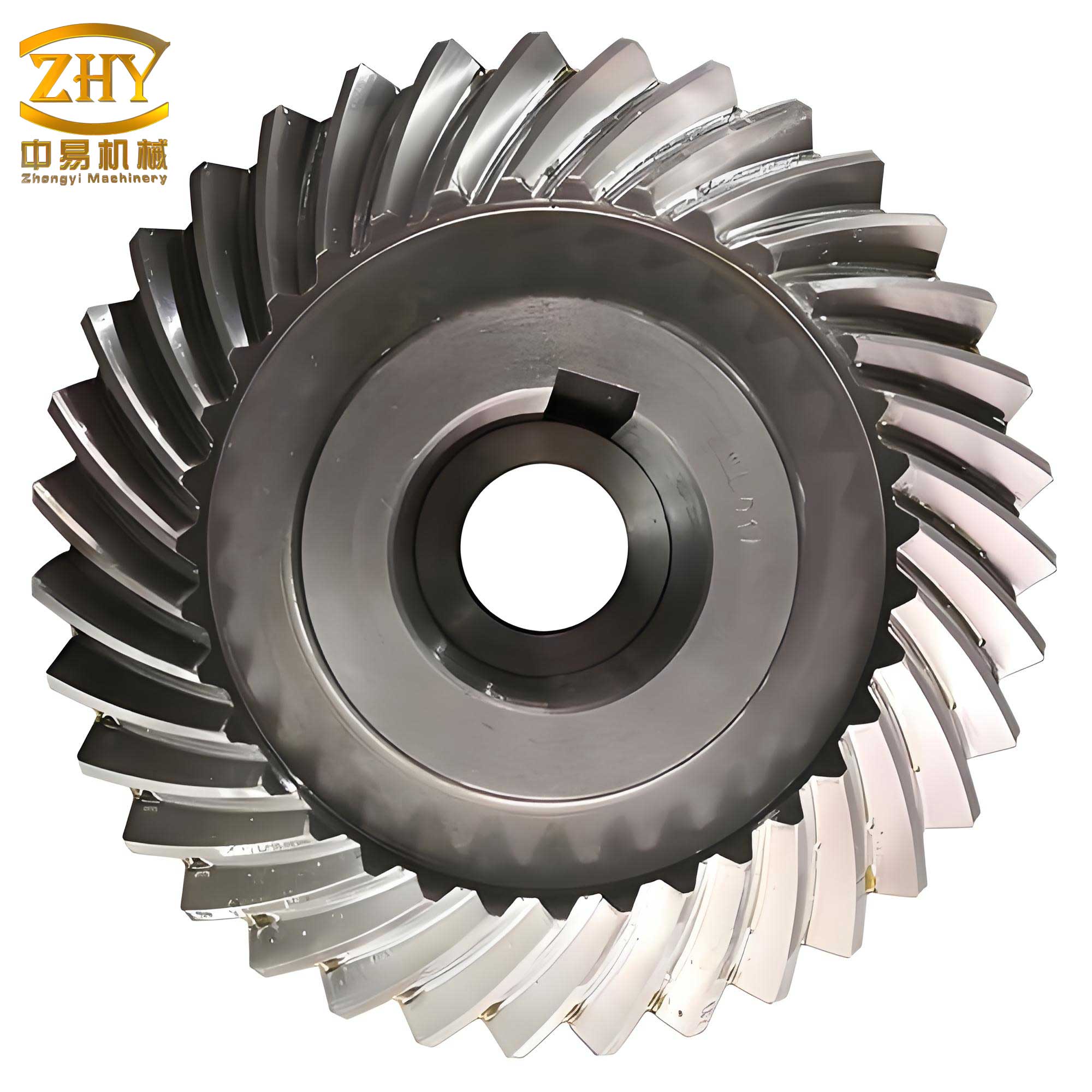
In the realm of mechanical transmission, spiral gears, especially those with large prime numbers of teeth, offer significant advantages such as smooth engagement, high load-bearing capacity, and extended service life. These spiral gears are commonly manufactured using gear hobbing, a process that requires precise adjustment of change gears on the machine tool. However, machining large prime number spiral gears presents a unique challenge due to the need for three sets of change gears: indexing, feed, and differential. The conventional method of selecting these gears often leads to errors because the actual transmission ratios deviate from theoretical values. In this article, I will detail an improved approach that eliminates errors from indexing and feed change gears, leaving only the differential change gear as the source of error, thereby substantially enhancing the machining precision of spiral gears.
The core issue in machining large prime number spiral gears lies in the compensation mechanism. Since change gears with prime numbers greater than 100 are typically unavailable, a differential drive chain is used to compensate for the fractional tooth division. This involves adjusting the rotation of the hob relative to the workpiece to achieve correct indexing while simultaneously forming the required helix. The motion balance equations yield formulas for the change gears, but discrepancies between theoretical and actual transmission ratios introduce errors in tooth spacing and helix direction. Through rigorous analysis, I have developed a method that optimizes the selection process, focusing on minimizing these errors for spiral gears.
To understand the optimization, let’s start with the fundamental formulas for change gear selection. For a spiral gear with tooth count \(Z\), hob head count \(K\), and a compensation factor \(P\) (typically ranging from \(1/5\) to \(1/50\), positive or negative), the indexing change gear ratio \(u_x\) is given by:
$$u_x = \frac{k_f \cdot K}{Z + P} \approx \frac{a}{b} \times \frac{c}{d} \approx u_x’$$
Here, \(k_f\) is the indexing constant (e.g., 24 for Y38 and Y3150E gear hobbing machines when \(e/f = 36/36\), or 48 when \(e/f = 24/48\)), and \(a, b, c, d\) are the tooth numbers of the indexing change gears, with \(u_x’\) being the actual ratio. The differential change gear ratio \(u_y\) accounts for both compensation and helix formation, expressed as:
$$u_y = \pm \frac{k_{c2} \cdot \sin \beta (Z + P)}{m_n \cdot Z \cdot K} – \frac{k_{c1} \cdot P}{u_s \cdot K} \approx \frac{a_2}{b_2} \cdot \frac{c_2}{d_2} = u_y’$$
where \(k_{c1}\) and \(k_{c2}\) are differential constants (for Y38, \(k_{c1} = 25\), \(k_{c2} = 7.95775\); for Y3150E, \(k_{c2} = 9\), \(k_{c1} = 625/32\)), \(m_n\) is the normal module, \(\beta\) is the helix angle, and \(u_s\) is the axial feed change gear ratio. The sign in the equation depends on the relative direction of the hob and gear helices: use “−” for same direction and “+” for opposite. The feed change gear ratio \(u_s\) is calculated based on the feed rate \(s_0\); for Y3150E, it is:
$$u_s = \frac{s_0}{0.4608 \cdot \pi} \approx \frac{a_1}{b_1} \times u_{\text{feed box}} \approx u_s’$$
and for Y38, \(u_s = s_0 \approx \frac{a_1}{b_1} \cdot \frac{c_1}{d_1} \times \frac{4}{3} \approx u_s’\), with \(a_1, b_1, c_1, d_1\) as feed change gear teeth.
The errors arise because \(u_x’\), \(u_s’\), and \(u_y’\) differ from \(u_x\), \(u_s\), and \(u_y\). Let \(\Delta p\) represent the additional rotation error per workpiece revolution, encompassing tooth spacing and helix direction errors. By deriving partial derivatives, we can quantify these errors. From the indexing formula, we have:
$$Z + P = \frac{k_f \cdot K}{u_x}$$
Taking the derivative with respect to \(u_x\):
$$\frac{dP}{du_x} = -\frac{k_f \cdot K}{u_x^2}$$
Thus, the error due to indexing change gears is:
$$\Delta p_1 = \frac{dP}{du_x} \cdot \Delta u_x = -k_f \cdot K \cdot \frac{1}{u_x} (u_x’ – u_x)$$
For the differential chain, we treat \(P\) as a function of \(u_s\) and \(u_y\). Starting from the implicit equation derived from \(u_y\):
$$u_y \cdot m_n \cdot u_s \cdot Z \cdot K = \pm k_{c2} \cdot \sin \beta (Z + P) \cdot u_s – k_{c1} \cdot m_n \cdot Z \cdot P$$
We compute partial derivatives \(\frac{\partial P}{\partial u_s}\) and \(\frac{\partial P}{\partial u_y}\). For \(\frac{\partial P}{\partial u_s}\):
$$\frac{\partial P}{\partial u_s} = \frac{u_y \cdot m_n \cdot Z \cdot K \pm k_{c2} \cdot \sin \beta (Z + P)}{-k_{c1} \cdot m_n \cdot Z \pm k_{c2} \cdot \sin \beta \cdot u_s}$$
where the signs are selected based on helix directions: for opposite helices, use “−” in numerator and “+” in denominator; for same helices, use “+” in numerator and “−” in denominator. For \(\frac{\partial P}{\partial u_y}\):
$$\frac{\partial P}{\partial u_y} = \frac{u_s \cdot m_n \cdot Z \cdot K}{-k_{c1} \cdot m_n \cdot Z \pm k_{c2} \cdot \sin \beta \cdot u_s}$$
with denominator signs: “−” for same helices, “+” for opposite. Then, the error from feed and differential change gears is:
$$\Delta p_2 = \frac{\partial P}{\partial u_s} \Delta u_s + \frac{\partial P}{\partial u_y} \Delta u_y$$
where \(\Delta u_s = u_s’ – u_s\) and \(\Delta u_y = u_y’ – u_y\). The total error is \(\Delta p = \Delta p_1 + \Delta p_2\). This error translates to circumferential pitch error as \(\Delta p \times \pi \times m_n\), affecting the accuracy of the spiral gear.
To improve precision, I propose a modified selection method that eliminates \(\Delta p_1\) and the \(\Delta u_s\) contribution to \(\Delta p_2\), leaving only \(\Delta u_y\) as the error source. The steps are as follows:
- Calculate \(u_x\) from the indexing formula, then select approximate change gears to get \(u_x’ = \frac{a}{b} \times \frac{c}{d}\). Compute the adjusted compensation factor \(P’\) using:
$$P’ = \frac{k_f \cdot K}{u_x’} – Z$$ - Determine \(u_s\) from the feed rate \(s_0\), select feed change gears to obtain \(u_s’\).
- Substitute \(P’\) and \(u_s’\) into the differential formula to compute \(u_y\):
$$u_y = \pm \frac{k_{c2} \cdot \sin \beta (Z + P’)}{m_n \cdot Z \cdot K} – \frac{k_{c1} \cdot P’}{u_s’ \cdot K}$$ - Choose differential change gears such that \(u_y’ = \frac{a_2}{b_2} \cdot \frac{c_2}{d_2}\) closely approximates \(u_y\), aiming for \(|\Delta u_y| \leq 10^{-5}\). This can be aided by gear calculation tools.
- Verify accuracy using the error formula (since \(\Delta u_s = 0\) and \(\Delta p_1 = 0\)):
$$\Delta p = \frac{u_s’ \cdot m_n \cdot Z \cdot K}{-k_{c1} \cdot m_n \cdot Z \pm k_{c2} \cdot \sin \beta \cdot u_s’} \Delta u_y$$
If unsatisfactory, iterate by varying \(P\) and repeating from step 1, keeping \(u_s’\) constant.
This method ensures that only the differential change gear error affects the spiral gear, drastically reducing overall inaccuracies. To illustrate, consider the following comparison between conventional and improved approaches for machining a spiral gear.
Let’s examine a case study: a spiral gear with \(Z = 113\), \(m_n = 2\), \(K = 1\), \(s_0 = 1\), and \(\beta = 30^\circ\), processed on a Y3150E machine. The tables below summarize the calculations and errors for both methods.
| Parameter | Value | Description |
|---|---|---|
| \(P\) | \(1/35 \approx 0.0285714\) | Compensation factor |
| \(u_x\) | \(48 \times 1 / (113 + 1/35) \approx 0.4246714\) | Theoretical indexing ratio |
| \(u_x’\) | \(53/48 \times 25/65 \approx 0.4246795\) | Actual indexing ratio |
| \(\Delta u_x\) | \(8.0 \times 10^{-6}\) | Indexing error |
| \(u_s\) | \(1 / (0.4608 \times \pi) \approx 0.690777\) | Theoretical feed ratio |
| \(u_s’\) | \(48/98 \times 49/35 \approx 0.6857143\) | Actual feed ratio |
| \(\Delta u_s\) | \(-5.06 \times 10^{-3}\) | Feed error |
| \(u_y\) | \(-3.0584070\) (for same helices) | Theoretical differential ratio |
| \(u_y’\) | \(85/23 \times 48/58 \approx -3.0584707\) | Actual differential ratio |
| \(\Delta u_y\) | \(-6.4 \times 10^{-5}\) | Differential error |
| \(\Delta p_1\) | \(-0.00213\) | Indexing error contribution |
| \(\Delta p_2\) | \(-2.06 \times 10^{-4}\) | Feed and differential error contribution |
| Total \(\Delta p\) | \(-0.00234\) | Overall rotation error |
| Circumferential error | \(7.35 \times 10^{-3}\) mm | \(\Delta p \times \pi \times m_n\) |
Now, applying the improved method for the same spiral gear:
| Step | Calculation | Result |
|---|---|---|
| 1: Compute \(u_x’\) | \(u_x’ = 53/48 \times 25/65 \approx 0.4246795\) | Same as conventional |
| 1: Compute \(P’\) | \(P’ = 48 / 0.4246795 – 113 \approx 0.0264116\) | Adjusted compensation |
| 2: Determine \(u_s’\) | \(u_s’ = 0.6857143\) (from feed gears) | Same as conventional |
| 3: Compute \(u_y\) | \(u_y = -3.002810\) using \(P’\) and \(u_s’\) | Theoretical differential ratio |
| 4: Select \(u_y’\) | \(u_y’ = 97/26 \times 33/41 \approx -3.002814\) | Actual differential ratio |
| 4: \(\Delta u_y\) | \(4.3 \times 10^{-6}\) | Reduced error |
| 5: Compute \(\Delta p\) | \(\Delta p = 1.52 \times 10^{-7}\) from formula | Minimal error |
| Circumferential error | \(9.55 \times 10^{-7}\) mm | Significant improvement |
The tables clearly demonstrate that the improved method reduces the error by orders of magnitude, emphasizing its efficacy for spiral gear machining. This optimization is crucial because spiral gears rely on precise tooth geometry for smooth operation. By focusing on the differential change gear as the sole error source, we can achieve higher accuracy in production.
To further elaborate, let’s discuss the mathematical foundations. The error analysis involves calculus to derive sensitivity coefficients. For spiral gears, the helix angle \(\beta\) plays a key role. Consider the partial derivative \(\frac{\partial P}{\partial u_s}\) in more detail. From the implicit equation, we can rearrange to express \(P\) explicitly in terms of \(u_s\) and \(u_y\), but for error propagation, the derivative form suffices. The general formula for \(\frac{\partial P}{\partial u_s}\) can be written as:
$$\frac{\partial P}{\partial u_s} = \frac{u_y \cdot m_n \cdot Z \cdot K \pm k_{c2} \cdot \sin \beta (Z + P)}{-k_{c1} \cdot m_n \cdot Z \pm k_{c2} \cdot \sin \beta \cdot u_s}$$
Similarly, \(\frac{\partial P}{\partial u_y}\) is:
$$\frac{\partial P}{\partial u_y} = \frac{u_s \cdot m_n \cdot Z \cdot K}{-k_{c1} \cdot m_n \cdot Z \pm k_{c2} \cdot \sin \beta \cdot u_s}$$
These derivatives indicate how changes in feed and differential ratios affect the compensation factor \(P\). For spiral gears with large prime numbers, small errors can accumulate, making this analysis vital. The improved method sets \(\Delta u_s = 0\) by using the actual feed ratio \(u_s’\) in the differential calculation, thus nullifying its contribution. This is achieved by selecting feed change gears first and keeping them fixed during iterations.
Moreover, the indexing error \(\Delta p_1\) is eliminated because we compute \(P’\) from the actual indexing ratio \(u_x’\), effectively absorbing any discrepancy into the adjusted compensation. This leaves \(\Delta u_y\) as the only variable, which we minimize by precise gear selection. In practice, for spiral gears, we can use numerical methods or software tools to find optimal change gear combinations that satisfy \(|\Delta u_y| \leq 10^{-5}\). The following table outlines typical gear sets for common spiral gear parameters on Y3150E machines.
| Gear Type | Teeth Numbers | Typical Ratios | Application Notes |
|---|---|---|---|
| Indexing Gears | a=53, b=48, c=25, d=65 | \(u_x’ \approx 0.4247\) | For Z=113, K=1 |
| Feed Gears | a1=48, b1=98, c1=49, d1=35 | \(u_s’ \approx 0.6857\) | For s0=1 mm/rev |
| Differential Gears | a2=97, b2=26, c2=33, d2=41 | \(u_y’ \approx -3.0028\) | For β=30°, same helices |
| Alternative Sets | Various combinations | Ratios within \(10^{-5}\) error | Optimized via iteration |
Beyond the formulas, the physical implementation involves mounting these change gears on the machine tool. For spiral gears, it’s essential to verify the helix direction and adjust the differential sign accordingly. The error formula for \(\Delta p\) in the improved method simplifies to a linear function of \(\Delta u_y\), making it easier to predict and control precision. Specifically, for a spiral gear with given parameters, we can compute the coefficient:
$$C = \frac{u_s’ \cdot m_n \cdot Z \cdot K}{-k_{c1} \cdot m_n \cdot Z \pm k_{c2} \cdot \sin \beta \cdot u_s’}$$
Then, \(\Delta p = C \cdot \Delta u_y\). To ensure high accuracy for spiral gears, we aim for \(|\Delta u_y|\) as small as possible, often using gear teeth from standard sets (e.g., 20 to 120 teeth). Modern CNC gear hobbing machines may automate this, but for manual machines, this method remains invaluable.
In conclusion, the optimization of change gear selection for machining large prime number spiral gears hinges on isolating errors to the differential change gear. By recalculating the compensation factor based on actual indexing and feed ratios, we eliminate two major error sources, leading to a dramatic improvement in gear accuracy. This approach is not only mathematically sound but also practical for workshop applications. Spiral gears, with their complex geometry, benefit greatly from such precision enhancements, ensuring reliable performance in mechanical systems. Future work could involve extending this method to other gear types or integrating it with digital tools for real-time error correction. Regardless, the core principle remains: meticulous attention to change gear ratios is key to mastering spiral gear manufacturing.
To reinforce the concepts, here are key takeaways in formula form for spiral gears:
- Indexing ratio: $$u_x = \frac{k_f \cdot K}{Z + P}$$
- Differential ratio: $$u_y = \pm \frac{k_{c2} \cdot \sin \beta (Z + P)}{m_n \cdot Z \cdot K} – \frac{k_{c1} \cdot P}{u_s \cdot K}$$
- Improved error: $$\Delta p = \frac{u_s’ \cdot m_n \cdot Z \cdot K}{-k_{c1} \cdot m_n \cdot Z \pm k_{c2} \cdot \sin \beta \cdot u_s’} \Delta u_y$$
By applying these formulas iteratively, we can achieve exceptional accuracy for spiral gears, making this method a cornerstone in gear machining technology. Spiral gears continue to be integral in industries like automotive and aerospace, where precision is paramount, and this optimization contributes directly to their quality and durability.