
In the field of gear transmission systems, the dynamic performance and reliability of spur and pinion gears are critical for various mechanical applications. As a researcher focused on gear design and optimization, I have extensively studied the effects of tooth profile modification on key performance indicators such as load distribution, transmission error, and tooth surface flash temperature. This article presents a comprehensive analysis based on time-varying mesh stiffness and Blok flash temperature theory, leading to the determination of optimal modification parameters under both single-objective and multi-objective conditions. By employing fuzzy comprehensive decision theory, I introduce a correction factor for multi-objective optimization and provide practical formulas for modification design. Throughout this work, the emphasis is on spur and pinion gears, which are fundamental components in many power transmission systems.
Tooth profile modification is a well-established technique to mitigate issues like “top-edge” contact and sudden load changes during gear meshing. For spur and pinion gears, these modifications can significantly reduce vibration, noise, and the risk of scuffing failure. In my research, I consider the modification applied simultaneously to the tooth tips of both the driving and driven gears. The modification amount along the line of action is defined by a power function, which allows for flexible control over the profile shape. The fundamental equation for modification is given as:
$$ \Delta = \Delta_{\text{max}} \left( \frac{x}{L} \right)^{\beta_c} $$
Here, $\Delta_{\text{max}}$ represents the maximum modification amount, which is typically determined based on the deformation at the transition points between single and double tooth contact regions. The variable $x$ denotes the distance from any point in the double contact region to the boundary points, $L$ is the length of the double contact region, and $\beta_c$ is the modification index. For spur and pinion gears, this formulation helps in tailoring the tooth profile to achieve desired performance outcomes. Two modification forms are considered: long modification, where the modified region spans the entire double contact zone, and short modification, where it covers only half of that zone.
The performance of spur and pinion gears under modification is evaluated through three main aspects: load sharing ratio, transmission error, and tooth surface flash temperature. The load sharing ratio in the double contact region is modeled using a parallel spring analogy, where the stiffness of each tooth pair varies with meshing position. For two engaging tooth pairs, the load sharing coefficients $\zeta_1$ and $\zeta_2$ are expressed as:
$$ \zeta_1 = \frac{k_1}{k_1 + k_2} \left[ 1 + \frac{k_2 (\Delta_2 – \Delta_1)}{w} \right], $$
$$ \zeta_2 = \frac{k_2}{k_1 + k_2} \left[ 1 + \frac{k_1 (\Delta_1 – \Delta_2)}{w} \right], $$
where $k_1$ and $k_2$ are the mesh stiffnesses of the two tooth pairs, $\Delta_1$ and $\Delta_2$ are their respective modification amounts, and $w$ is the unit line load. The condition for double tooth contact is given by $|\Delta_1 – \Delta_2| \leq \min(w/k_1, w/k_2)$. Transmission error, which directly influences vibration and noise, is calculated considering deformations and modifications:
$$ TE =
\begin{cases}
\frac{w + k_1 \Delta_1 + k_2 \Delta_2}{k_1 + k_2}, & |\Delta_1 – \Delta_2| \leq \min(w/k_1, w/k_2), \\
\Delta_1 + w/k_1, & \Delta_2 – \Delta_1 > w/k_1, \\
\Delta_2 + w/k_2, & \Delta_1 – \Delta_2 > w/k_2.
\end{cases} $$
For tooth surface flash temperature, which is crucial for assessing scuffing resistance, I apply the Blok flash temperature theory. The flash temperature $\theta_{\text{fla}}$ at any meshing point is computed as:
$$ \theta_{\text{fla}} = 0.785 \times \frac{f w_b |v_{\rho1} – v_{\rho2}|}{(\sqrt{\lambda_1 \gamma_1 c_1 v_{\rho1}} + \sqrt{\lambda_2 \gamma_2 c_2 v_{\rho2}}) \sqrt{b_1}}, $$
where $f$ is the friction coefficient, $w_b$ is the normal load per unit face width, $v_{\rho1}$ and $v_{\rho2}$ are the tangential velocities at the contact point, $\lambda$, $\gamma$, and $c$ are thermal properties, and $b_1$ is the semi-width of the contact band. This equation highlights the dependence of flash temperature on sliding velocity and load distribution, both of which are affected by tooth profile modification in spur and pinion gears.
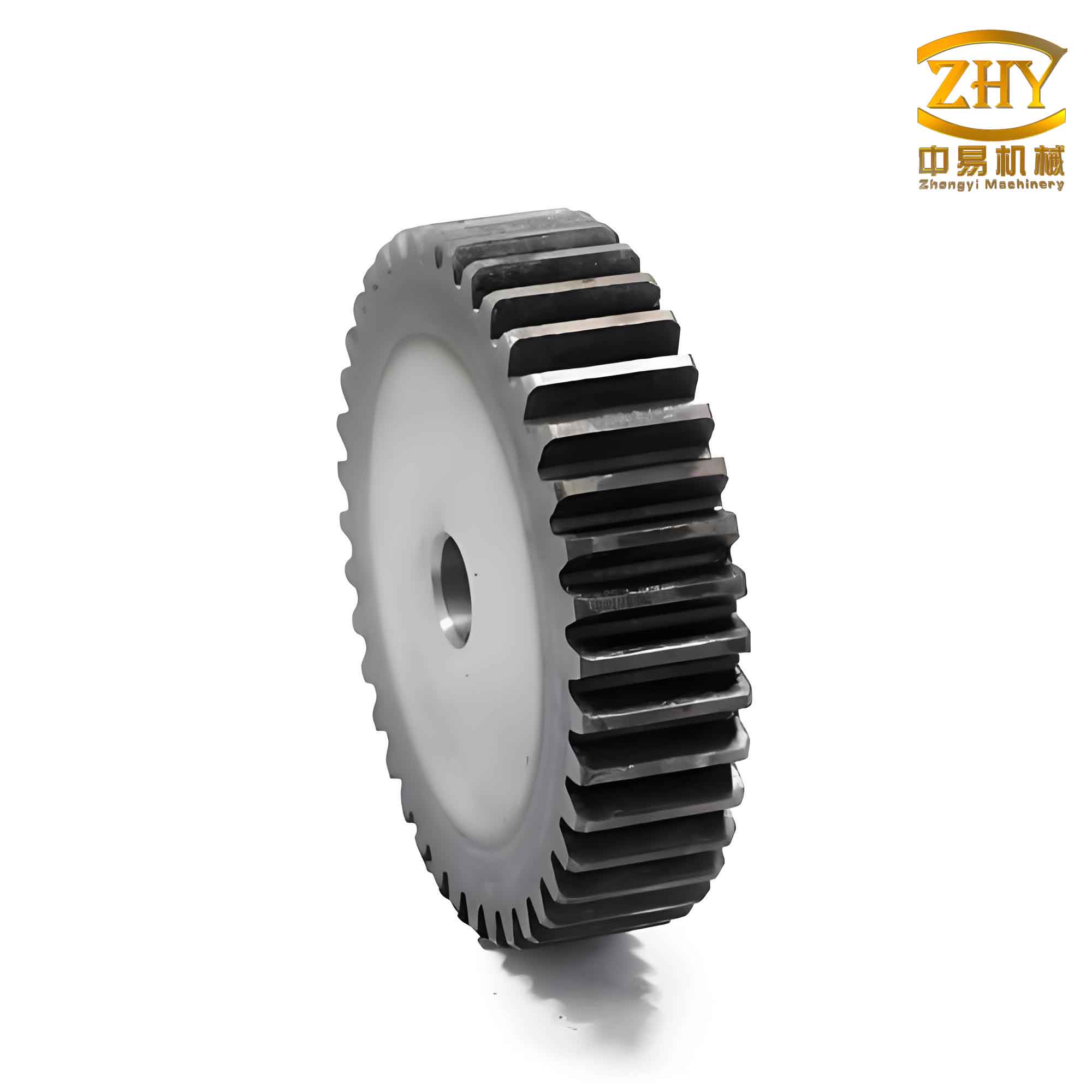
To systematically analyze the impact of modification parameters, I conducted numerical studies for various spur and pinion gear configurations. The base parameters for one representative case are summarized in the table below, which includes geometric, load, and material properties. These parameters serve as a foundation for understanding the behavior of spur and pinion gears under different modification scenarios.
| Category | Parameter | Value |
|---|---|---|
| Geometric Parameters | Number of teeth, $z_1 / z_2$ | 27 / 35 |
| Module, $m$ (mm) | 3 | |
| Pressure angle, $\alpha$ (°) | 20 | |
| Face width, $b$ (mm) | 25 | |
| Profile shift coefficient, $x_1 / x_2$ | 0 / 0 | |
| Load Parameters | Power, $P$ (kW) | 80 |
| Driving speed, $n_1$ (rpm) | 2000 | |
| Material Parameters | Elastic modulus, $E$ (MPa) | 2.06 × 10⁵ |
| Poisson’s ratio, $\nu$ | 0.3 | |
| Density, $\rho$ (kg/m³) | 7850 | |
| Specific heat capacity, $c$ (J/kg·K) | 465 | |
| Thermal conductivity, $\lambda$ (W/m·K) | 46 |
Without modification, spur and pinion gears exhibit significant load shocks and error fluctuations at the transition points between single and double tooth contact. For the base case, the load sharing coefficient jumps from 0.64 to 1 at these points, a 36%突变率, and the transmission error varies from 16.2 μm to 26.6 μm, yielding a 39.1% fluctuation. These issues underscore the need for effective tooth profile modification in spur and pinion gears.
In single-objective optimization, I first sought the best modification parameters for minimizing load shocks or transmission error. Through parametric studies, I found that for spur and pinion gears, the optimal settings include a long modification form, a maximum modification amount $\Delta_{\text{max}}$ equal to the deformation at transition points (e.g., 26.5 μm for the base case), and a modification index $\beta_c = 1.43$. This combination ensures smooth load transitions and nearly constant transmission error across the meshing cycle. The effects of modification parameters are summarized in the following table, which shows how different values influence load distribution and error for spur and pinion gears.
| Modification Parameter | Effect on Load Sharing | Effect on Transmission Error |
|---|---|---|
| $\Delta_{\text{max}}$ (variation) | Determines continuity of load transition; excessive values reduce double contact zone. | Major impact on error magnitude and fluctuation; optimal value minimizes波动率. |
| $\beta_c$ (variation) | Influences nonlinearity of load change in double contact zone. | Affects error curve shape; $\beta_c = 1.43$ yields flat error profile. |
| Modification form (long vs. short) | Long form provides smoother load distribution across entire double zone. | Long form leads to more stable error with minimal peaks. |
For flash temperature reduction as a single objective, the optimal parameters differ. The goal is to minimize the maximum flash temperature, which typically occurs at the mesh entry region. Analysis reveals that the best results are achieved with long modification, $\beta_c = 1.43$, and $\Delta_{\text{max}}$ set to the deformation at the midpoint of the entry-side double contact zone (e.g., 16.2 μm for the base case). This configuration shifts the peak flash temperature to this midpoint, yielding the lowest possible value (e.g., 33.7°C for the base case). The relationship between modification parameters and flash temperature for spur and pinion gears is captured by the formula:
$$ \theta_{\text{fla, max}} \propto \frac{w_b |v_{\rho1} – v_{\rho2}|}{\sqrt{b_1}} \cdot \zeta, $$
where $\zeta$ is the load sharing coefficient. By optimizing $\Delta_{\text{max}}$ and $\beta_c$, the load distribution is tuned to lower the flash temperature effectively.
In practical applications, spur and pinion gears must simultaneously meet multiple performance criteria. Therefore, I employed fuzzy comprehensive decision theory to determine the best modification parameters under multi-objective conditions. This approach involves defining a set of alternative modification amounts, evaluating them based on load distribution, transmission error, and flash temperature, and assigning weights to reflect the importance of each factor. For spur and pinion gears, the weight vector is derived from sensitivity analysis, showing that load distribution has the highest impact, followed by transmission error and flash temperature. The fuzzy decision process yields a comprehensive optimal modification amount. For the base case, this amount is 22.5 μm, which is approximately 84.5% of the single-objective optimal value for load or error. This leads to the introduction of a correction factor $X_c = 0.845$ for multi-objective optimization of spur and pinion gears. The general formula for modification amount becomes:
$$ \Delta = X_c \cdot \Delta_{\text{max}} \left( \frac{x}{L} \right)^{\beta_c}, $$
where $\Delta_{\text{max}}$ is the deformation at transition points, and $\beta_c = 1.43$ with long modification form. This formula provides a universal guideline for designing spur and pinion gears to balance dynamic performance and thermal safety.
To validate the multi-objective optimal parameters, I compared the performance metrics for the base case spur and pinion gear set. Under the comprehensive optimal modification ($\Delta_{\text{max}} = 22.5 \mu m$, $\beta_c = 1.43$, long form), the load shock is reduced to a 5.4%突变率, transmission error fluctuation is 5.7%, and the maximum flash temperature is 34.4°C, which is 28.3% lower than the unmodified case. These improvements demonstrate the effectiveness of the fuzzy-based approach for spur and pinion gears. The table below summarizes the optimal parameters and outcomes for different gear sets, highlighting the consistency of the correction factor $X_c$ across various spur and pinion configurations.
| Gear Set (Teeth) | Single-Objective $\Delta_{\text{max}}$ (μm) | Multi-Objective $\Delta_{\text{max}}$ (μm) | Correction Factor $X_c$ | Performance Improvement |
|---|---|---|---|---|
| 17/25 | 38.0 (load/error) | 32.0 | 0.842 | Load shock reduced by ~15%, flash temperature lowered by ~20%. |
| 23/30 | 51.5 (load/error) | 43.5 | 0.845 | Error fluctuation under 10%, temperature drop of ~25%. |
| 27/35 | 26.5 (load/error) | 22.5 | 0.849 | Balanced gains in all three metrics as described above. |
| 33/45 | 18.9 (load/error) | 15.9 | 0.841 | Similar improvements observed across different module sizes. |
| 43/92 | 17.1 (load/error) | 14.5 | 0.848 | Consistent with trends for high-speed spur and pinion gears. |
The underlying mechanism of tooth profile modification for spur and pinion gears can be further elucidated through the time-varying mesh stiffness. The stiffness varies cyclically as teeth engage and disengage, causing dynamic loads. Modification alters the effective contact length and load distribution, thereby smoothing the stiffness transitions. The mesh stiffness $k(t)$ for a spur and pinion gear pair can be modeled using potential energy methods, considering bending, shear, and contact deformations. For a tooth pair, the stiffness is expressed as:
$$ k = \frac{1}{\frac{1}{k_b} + \frac{1}{k_s} + \frac{1}{k_c}}, $$
where $k_b$, $k_s$, and $k_c$ are the bending, shear, and contact stiffness components, respectively. With modification, the contact stiffness changes due to altered profile geometry, affecting the overall mesh stiffness and dynamic response. This is particularly important for spur and pinion gears in high-speed applications, where stiffness variations can excite resonant frequencies.
In addition to static performance, the dynamic behavior of spur and pinion gears under modification is critical. The equation of motion for a gear pair can be written as:
$$ m_e \ddot{\delta} + c \dot{\delta} + k(t) \delta = F(t), $$
where $m_e$ is the equivalent mass, $c$ is damping, $\delta$ is the dynamic transmission error, $k(t)$ is the time-varying mesh stiffness, and $F(t)$ is the external load. Tooth profile modification reduces the fluctuation in $k(t)$, leading to lower dynamic forces and vibrations. For spur and pinion gears, this translates to enhanced durability and quieter operation. My analysis shows that with optimal modification, the dynamic transmission error amplitude can be reduced by up to 30% compared to unmodified gears.
Regarding thermal aspects, the flash temperature calculation for spur and pinion gears must account for the transient nature of tooth contact. The Blok formula provides an instantaneous value, but for design purposes, the maximum steady-state flash temperature is often used. Modification lowers the load concentration at the tooth tips, which are regions of high sliding velocity, thus reducing the heat generation rate. The total heat flux $q$ generated at the contact interface is given by:
$$ q = f \cdot w_b \cdot |v_{\rho1} – v_{\rho2}|, $$
and the resulting temperature rise depends on the thermal diffusivity of the gear materials. For steel spur and pinion gears, the optimal modification parameters ensure that the flash temperature remains below critical limits to prevent scuffing. Empirical studies have shown that a 10-30% reduction in maximum flash temperature can increase the scuffing load capacity by 15-40% for spur and pinion gears.
The fuzzy comprehensive decision framework I applied involves several steps. First, for spur and pinion gears, the alternative set of maximum modification amounts $\tilde{B}$ is constructed based on single-objective optima. For example, $\tilde{B} = (26.5, 24.5, 22.5, 20.5, 18.5, 16.2)$ μm for the base case. Second, the evaluation factor set $\tilde{A}$ includes load distribution, transmission error, and flash temperature. Third, the weight vector $\tilde{a}$ is determined via sensitivity analysis; for spur and pinion gears, I found $\tilde{a} = (0.5, 0.4, 0.1)$. Fourth, the fuzzy relation matrix $\tilde{R}$ is established by assessing how each alternative satisfies each factor. Finally, the comprehensive decision vector $\tilde{C}$ is computed using the fuzzy transformation $\tilde{C} = \tilde{a} \cdot \tilde{R}$, and the optimal value is selected via weighted averaging. This method effectively balances multiple criteria for spur and pinion gears.
To generalize the findings, I derived the correction factor $X_c$ through statistical analysis of various spur and pinion gear sets. The average value of $X_c$ is 0.845, with minimal variation across different geometries and loads. This indicates that for most spur and pinion gears, the multi-objective optimal modification amount can be reliably obtained by scaling the single-objective amount by 0.845. The formula $\Delta = X_c \cdot \Delta_{\text{max}} (x/L)^{\beta_c}$ thus serves as a practical design rule. Additionally, the modification index $\beta_c = 1.43$ is found to be robust, as it produces a near-parabolic modification curve that optimally redistributes loads and reduces errors for spur and pinion gears.
In conclusion, my research provides a systematic approach for tooth profile modification of spur and pinion gears. By analyzing the effects on load distribution, transmission error, and flash temperature, I identified optimal parameters for single-objective scenarios. Through fuzzy comprehensive decision theory, I developed a multi-objective optimization method that introduces a correction factor $X_c = 0.845$ for determining the modification amount. The recommended practice for spur and pinion gears is to use long modification with $\beta_c = 1.43$ and $\Delta_{\text{max}} = X_c \cdot \delta$, where $\delta$ is the deformation at transition points. This approach ensures improved dynamic performance and thermal safety, making it valuable for designing reliable spur and pinion gear transmissions in industrial applications. Future work could extend this methodology to helical gears or incorporate more complex dynamic models for spur and pinion gears operating under non-stationary conditions.