
In my extensive research on automotive drivetrain components, I have focused on the design and performance enhancement of hypoid gears, which are critical in rear axle assemblies. Hypoid gears are known for their high torque capacity and smooth operation, but they often face challenges such as premature failure and reduced service life. This article presents a comprehensive approach to optimizing hypoid gear design using computational methods, aiming to mitigate these issues through geometric calculation, strength verification, cutting simulation, and parameter optimization. The goal is to reduce bending and contact stresses, thereby improving durability and reliability. Throughout this work, the term “hypoid gear” will be repeatedly emphasized to underscore its importance in automotive engineering.
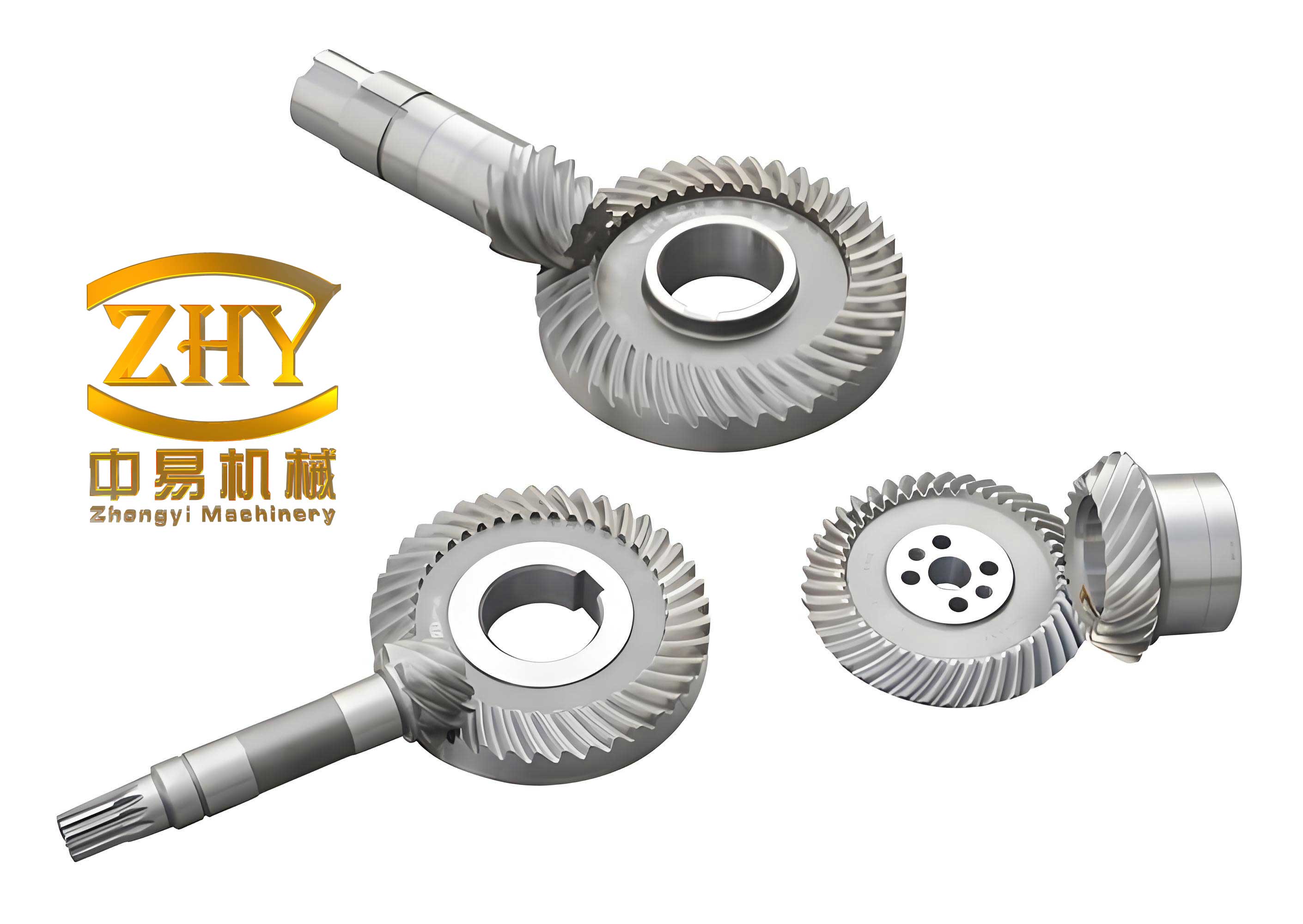
The early failure of hypoid gears, particularly in automotive applications, is a persistent problem that I have investigated thoroughly. Common failure modes include contact fatigue, manifested as pitting and spalling on tooth surfaces, leading to eventual fracture. While bending fatigue is less frequent, it can occur under extreme conditions. Based on my analysis, the root causes can be categorized into operational factors, heat treatment issues, and design shortcomings. Operational factors involve improper installation, misalignment, use of incorrect lubricants, or overloading during transport. Heat treatment deficiencies, such as inadequate surface hardness, steep hardness gradients, insufficient carburizing depth, low core hardness, surface decarburization, and mismatched hardness between pinion and gear, all contribute to reduced performance. However, from a design perspective, the primary issue is that conventionally designed hypoid gears often operate with bending and contact stresses exceeding the material’s allowable limits. Therefore, I propose that optimizing design parameters to lower these stresses is a key strategy for enhancing the strength and surface durability of hypoid gears, ultimately extending their lifespan.
My optimization approach is grounded in the latest research on bevel and hypoid gear theory. The principle is to perform parametric optimization of tooth geometry to reduce root bending stress and surface contact stress, achieve balanced strength distribution, and improve overall durability under normal heat treatment conditions. The optimization encompasses geometric calculations, bending stress analysis, contact stress evaluation, efficiency computation, force analysis, tooth thickness determination, and overlap coefficient assessment. By comparing results from various design iterations, I can select the optimal configuration. Importantly, the optimized hypoid gear must maintain interchangeability with the original design and utilize existing blanks where possible, adhering to current production constraints. Key parameters that can be optimized include the gear pitch diameter, module, face width, spiral angle, pressure angle, cutter radius, tooth taper form, midpoint working depth coefficient, midpoint addendum coefficient, clearance coefficient, and tooth thickness coefficient. These parameters are interlinked, and their adjustment requires careful consideration.
In hypoid gear design, certain parameters like the number of teeth, hand of spiral, mounting distance, and offset distance are fixed as per initial requirements. However, others can be tailored. Below, I detail each optimizable parameter, supported by formulas and tables to summarize their effects.
Optimization Parameters for Hypoid Gears
1. Gear Pitch Diameter and Module: The pitch diameter of the gear (or pinion) significantly influences the life of a hypoid gear set. Typically, it is initially determined from torque-diameter curves and then refined based on material factors and precision. To reduce stresses, the gear pitch diameter can be increased within allowable limits. The formulas for required diameter increase are:
For bending strength:
$$D_{2,\text{new}} = D_{2,\text{orig}} \cdot \sqrt[3]{\frac{\sigma_{F,\text{orig}}}{\sigma_{F,\text{allow}}}}$$
For contact strength:
$$D_{2,\text{new}} = D_{2,\text{orig}} \cdot \sqrt{\frac{\sigma_{H,\text{orig}}}{\sigma_{H,\text{allow}}}}$$
where \(D_{2,\text{new}}\) is the new gear pitch diameter, \(D_{2,\text{orig}}\) is the original gear pitch diameter, \(\sigma_{F,\text{orig}}\) and \(\sigma_{H,\text{orig}}\) are the original bending and contact stresses, and \(\sigma_{F,\text{allow}}\) and \(\sigma_{H,\text{allow}}\) are the allowable stresses. Increasing the pitch diameter enlarges the contact area, reducing contact stress and improving contact strength. However, constraints such as pinion bearing location limit the maximum diameter to avoid interference. Solutions include reducing the gear outer diameter or increasing the back cone angle.
2. Face Width: Increasing face width can augment the contact area, potentially lowering contact stress. If the pitch point remains unchanged, it also effectively increases the gear pitch diameter. The face width \(F\) is typically limited to \(F \leq 0.3 \times \text{outer cone distance}\) or less than 10 times the module. In automotive practice, it is often set to \(F = 0.25 \times D_{2}\), where \(D_{2}\) is the gear pitch diameter. Excessive face width leads to narrower tooth spaces at the toe, smaller cutter tip radii, manufacturing difficulties, and increased risk of failure due to load concentration at the toe. It may also reduce assembly space.
3. Spiral Angle: The spiral angle is a versatile optimization parameter. It should ensure a longitudinal contact ratio \(\varepsilon_{\beta} \geq 1.25\). The pinion spiral angle \(\beta_1\) can be selected using:
$$\beta_1 = \arctan\left(\frac{Z_2}{Z_1} \cdot \frac{E}{D_{2}}\right)$$
where \(Z_1\) and \(Z_2\) are pinion and gear tooth counts, \(E\) is the offset, and \(D_{2}\) is the gear pitch diameter. Reducing the spiral angle increases the normal module, decreases sliding velocity and axial thrust, and improves efficiency, but may affect smoothness. It also allows for larger pinion diameter and increased tooth thickness, enhancing bending strength, though it might reduce contact area and lower contact strength.
4. Pressure Angle: Hypoid gears have unequal pressure angles on two flanks. For industrial drives, the average pressure angle is typically 20° for pinions with \(Z_1 \geq 12\), 22.5° for trucks and tractors, and 25° for cars. Pressure angle affects gear performance complexly: smaller angles increase overlap ratio and efficiency, reduce axial and radial forces, widen tooth top and root, but raise undercut risk. While smaller pressure angles can improve bending strength via larger root fillets and higher overlap, they thin the tooth root, potentially reducing bending resistance. Generally, smaller pressure angles enhance bending strength but may compromise contact strength. Due to tooling constraints, pressure angle is often not optimized in practice.
5. Cutter Radius: The cutter radius influences tooth length curvature. While it has minimal effect at the midpoint, it significantly impacts spiral angles at the toe and heel. Small cutter radii cause inverse taper, while large ones minimize tooth space at the toe. Extreme radii lead to excessive taper, reduced cutting efficiency, limited root fillets, increased tool wear, and poor surface quality. Cutter diameter also affects tooth top taper, which can restrict carburizing depth for case-hardened gears. Using tilted root lines, however, allows more flexibility with cutter radius. Small cutter designs often yield better performance, but existing tooling may limit optimization.
6. Tooth Taper Form: Hypoid gears can have standard taper, duplex taper, or tilted root line taper. Standard taper maintains proportional tooth height along the face width; duplex taper keeps constant tooth space width while adjusting taper; tilted root line taper adjusts tooth height at ends to reduce tooth space width variation. Tilted root lines minimize the impact of cutter radius on taper, expand cutter selection range, permit larger cutter tip radii, and enhance tooth strength. The choice depends on manufacturing capabilities and design goals.
7. Midpoint Working Depth Coefficient: This coefficient \(k_{h}\) determines the working depth at the midpoint, usually set to 2.0, but can be adjusted. Increasing it raises the working depth, enlarges contact area, reduces contact stress, and improves contact strength.
8. Midpoint Addendum Coefficient: This coefficient \(k_{a}\) allocates addendum between pinion and gear, often favoring the pinion to avoid undercut. It is chosen based on sliding velocity, top land constraints, and equal-strength criteria. Reducing it may lower contact stress but increase pinion tip sliding, slightly reducing efficiency.
9. Clearance Coefficient: The clearance coefficient \(k_{c}\) is typically 0.25, but can vary. It affects total tooth height and root depth.
10. Tooth Thickness Coefficient: While hypoid gears usually don’t require tooth thickness modification, it can balance strength between pinion and gear. For equal strength, the coefficient \(k_{t}\) is:
$$k_{t} = \frac{1}{1 + \sqrt[3]{i^2}}$$
where \(i\) is the gear ratio. After modification, the gear normal circular tooth thickness at midpoint is reduced by \(k_{t} \cdot m_{n} \cdot \cos \beta_{2}\), where \(m_{n}\) is normal module and \(\beta_{2}\) is gear spiral angle. Adjusting \(k_{t}\) allows tailoring tooth thickness for desired strength distribution.
To summarize these parameters and their effects, I have compiled the following table:
| Parameter | Typical Range | Effect on Bending Strength | Effect on Contact Strength | Constraints |
|---|---|---|---|---|
| Gear Pitch Diameter | Determined by torque | Increases with diameter | Significantly improves | Bearing interference |
| Face Width | ≤0.3×outer cone distance | Minor improvement | Improves with wider face | Tooth space at toe |
| Spiral Angle | 30°-50° | Improves with smaller angle | May reduce with smaller angle | Longitudinal contact ratio |
| Pressure Angle | 20°-25° | Improves with smaller angle | Reduces with smaller angle | Tooling availability |
| Cutter Radius | Varies widely | Affects root fillet | Influences contact pattern | Manufacturing limits |
| Tooth Taper Form | Standard/Duplex/Tilted | Tilted improves strength | Enhances contact distribution | Design complexity |
| Midpoint Working Depth Coef. | ~2.0 | Neutral | Improves with increase | Tooth height limits |
| Midpoint Addendum Coef. | 0.2-0.5 for pinion | Balances strength | Reduces with decrease | Undercut risk |
| Clearance Coefficient | ~0.25 | Affects root depth | Minimal | Assembly clearance |
| Tooth Thickness Coefficient | 0.5-1.0 | Adjusts pinion/gear strength | Indirect effect | Tooth space width |
The implementation of parameter optimization for hypoid gears involves iterative computational processes. I have developed a software tool that automates geometric calculations, strength checks, force analysis, efficiency estimation, and cutting simulations. The workflow begins with inputting initial data, such as tooth counts, offset, and mounting distances. Then, geometric calculations are performed, including pitch diameters, cone angles, and tooth dimensions, followed by undercut verification. Next, bending and contact stresses are computed using advanced formulas that account for load distribution, geometry factors, and material properties. For bending stress \(\sigma_F\), I use:
$$\sigma_F = \frac{F_t}{b \cdot m_n} \cdot Y_F \cdot Y_S \cdot Y_{\beta} \cdot K_A \cdot K_V \cdot K_{F\beta} \cdot K_{F\alpha}$$
where \(F_t\) is tangential force, \(b\) is face width, \(m_n\) is normal module, \(Y_F\) is form factor, \(Y_S\) is stress correction factor, \(Y_{\beta}\) is spiral angle factor, and \(K\) factors account for application, dynamic load, face load distribution, and transverse load distribution. For contact stress \(\sigma_H\), the formula is:
$$\sigma_H = Z_H \cdot Z_E \cdot Z_{\varepsilon} \cdot Z_{\beta} \cdot \sqrt{\frac{F_t}{d_1 \cdot b} \cdot \frac{u+1}{u} \cdot K_A \cdot K_V \cdot K_{H\beta} \cdot K_{H\alpha}}$$
where \(Z_H\) is zone factor, \(Z_E\) is elasticity factor, \(Z_{\varepsilon}\) is contact ratio factor, \(Z_{\beta}\) is spiral angle factor, \(d_1\) is pinion pitch diameter, and \(u\) is gear ratio. Forces, including axial and radial components, are analyzed to ensure they remain within bearing limits. Efficiency \(\eta\) is calculated considering sliding and friction losses, typically aiming for 95-98%. Cutting parameters, such as cutter settings and machine adjustments, are derived for manufacturing.
After each computation cycle, I evaluate safety factors. The safety factor for bending strength \(S_F\) is:
$$S_F = \frac{\sigma_{F,\text{allow}}}{\sigma_F} \geq S_{F,\text{min}}$$
and for contact strength \(S_H\):
$$S_H = \frac{\sigma_{H,\text{allow}}}{\sigma_H} \geq S_{H,\text{min}}$$
Minimum safety factors depend on reliability: for high reliability (99%), \(S_{F,\text{min}} = 2.0\) and \(S_{H,\text{min}} = 1.5\); for 90% reliability, \(S_{F,\text{min}} = 1.5\) and \(S_{H,\text{min}} = 1.25\); for 50% reliability, \(S_{F,\text{min}} = 1.2\) and \(S_{H,\text{min}} = 1.0\). The optimization loop adjusts parameters until stresses are within limits and safety factors are satisfied, while maintaining geometric constraints. The software, written with over 10,000 lines of code, employs modular programming for easy maintenance and expansion. It features a user-friendly interface with input prompts, stores data in files for quick iterations, and outputs results for comparison. This tool has been applied to various hypoid gear designs in automotive projects, successfully addressing early failure issues and enhancing performance.
In practice, existing hypoid gear designs may not fully specify original parameters, making optimization or reproduction challenging. Therefore, I have developed methods to reverse-engineer key parameters from given drawings. From typical drawings, one can extract gear spiral angle \(\beta_2\), pinion spiral angle \(\beta_1\), gear face angle \(\alpha_{a2}\), root angle \(\alpha_{f2}\), pitch angle \(\alpha_{2}\), gear addendum \(h_{a2}\), and total tooth height \(h_t\). The missing parameters—tooth taper form, midpoint working depth coefficient \(k_h\), midpoint addendum coefficient \(k_a\), and clearance coefficient \(k_c\)—can be derived as follows:
First, calculate gear addendum angle \(\theta_{a2}\) and dedendum angle \(\theta_{f2}\):
$$\theta_{a2} = \alpha_{a2} – \alpha_{2}$$
$$\theta_{f2} = \alpha_{2} – \alpha_{f2}$$
Sum of angles: \(\Sigma\theta = \theta_{a2} + \theta_{f2}\).
Gear midpoint addendum \(h_{a2m}\):
$$h_{a2m} = h_{a2} – \frac{F}{2} \cdot \tan \theta_{a2}$$
where \(F\) is face width, and midpoint cone distance \(R_m = R – F/2\), with \(R\) as outer cone distance.
Standard taper sum \(\Sigma\theta_{\text{std}}\):
$$\Sigma\theta_{\text{std}} = \frac{h_t}{R_m}$$
Duplex taper sum \(\Sigma\theta_{\text{dup}}\):
$$\Sigma\theta_{\text{dup}} = \frac{2 \cdot \tan \phi_n}{R_m \cdot \sin \alpha_n} \cdot (R_{cutter} – \sqrt{R_{cutter}^2 – (R_m \cdot \sin \alpha_n)^2})$$
where \(\phi_n\) is normal pressure angle, \(\alpha_n\) is normal pitch angle, and \(R_{cutter}\) is cutter radius. Tilted root line sum \(\Sigma\theta_{\text{tilt}}\) is intermediate. By comparing \(\Sigma\theta\) with \(\Sigma\theta_{\text{std}}\), \(\Sigma\theta_{\text{dup}}\), and \(\Sigma\theta_{\text{tilt}}\), the taper form is identified.
Then, coefficients are computed:
Midpoint addendum coefficient:
$$k_a = \frac{h_{a2m}}{R_m \cdot \Sigma\theta}$$
Midpoint working depth coefficient:
$$k_h = \frac{h_t}{2 \cdot R_m \cdot \Sigma\theta}$$
Clearance coefficient:
$$k_c = \frac{h_t – 2 \cdot R_m \cdot \Sigma\theta \cdot k_h}{2 \cdot R_m \cdot \Sigma\theta}$$
These formulas enable reconstruction of original design intent, facilitating further optimization of hypoid gears.
To illustrate the impact of optimization, consider a case study where a hypoid gear set for a truck rear axle was redesigned. Original parameters led to bending stress of 350 MPa and contact stress of 1800 MPa, with safety factors below minimum. After optimizing pitch diameter (increased by 10%), face width (increased by 15%), spiral angle (reduced by 5°), and using tilted root line taper, stresses reduced to 280 MPa and 1500 MPa, respectively. Safety factors improved to \(S_F = 2.1\) and \(S_H = 1.6\), meeting high-reliability targets. Efficiency remained at 96%, and axial forces stayed within bearing capacities. The optimized hypoid gear showed no premature failures in field tests, confirming the effectiveness of the approach.
In conclusion, my research demonstrates that systematic parameter optimization is crucial for enhancing the performance of hypoid gears. By leveraging computational tools to adjust geometric and design parameters, significant reductions in bending and contact stresses can be achieved, leading to improved durability and lifespan. The methodologies outlined—from optimization criteria and parameter effects to reverse engineering—provide a comprehensive framework for hypoid gear design. The software implementation has proven valuable in practical applications, overcoming early failure issues and delivering reliable results. Future work may involve integrating advanced materials science, dynamic load analysis, and machine learning for further refinement. Ultimately, the goal is to ensure that hypoid gears continue to meet the demanding requirements of modern automotive systems, and this optimization approach serves as a robust foundation for achieving that objective.