
The worm gear drive is a cornerstone of power transmission systems requiring high reduction ratios in compact spaces. In modern automotive Electric Power Steering (EPS) systems, the demand for smooth, quiet, and cost-effective steering feel has led to the widespread adoption of a specific variant: the nylon helical gear paired with a steel worm. This configuration replaces the traditional bronze worm wheel with an injection-molded nylon helical gear, offering significant advantages in weight, noise damping, and manufacturing cost. However, the stark difference in material properties between the polymer gear and the metal worm renders classical worm gear design criteria inadequate. Traditional methods, developed for metal-on-metal contact, do not account for the viscoelastic behavior, lower strength, and different wear mechanisms of engineering plastics. This necessitates a specialized design approach to ensure reliability, performance, and longevity. A critical yet often ambiguously addressed parameter in such designs is the profile shift coefficient (modification factor) for the helical gear. This article delves into the optimization of this specific worm gear drive, proposing a principled method for determining the profile shift to achieve balanced strength, establishes a complete design methodology, and validates the results through advanced simulation tools.
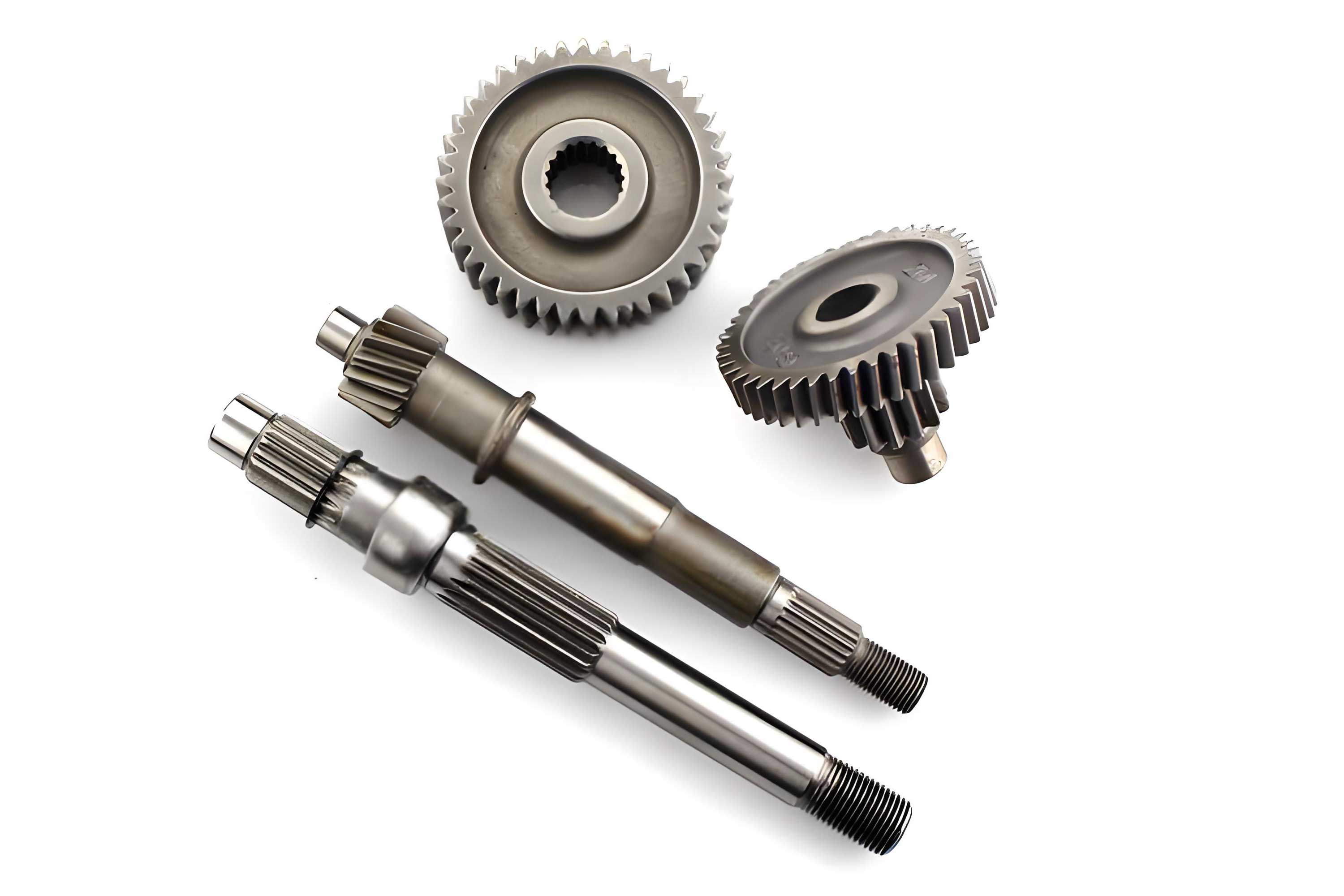
Fundamentally, a worm gear drive consisting of a steel worm and a nylon helical gear can be analyzed as a crossed-axes helical gear pair. The worm is essentially a helical gear with a very small number of teeth (equal to the number of starts) and a large helix angle. This perspective simplifies the understanding of its kinematics and meshing action. The primary failure modes for the nylon gear are tooth bending fatigue and pitting/wear on the tooth surface, while the steel worm is typically evaluated for bending strength and, crucially, the risk of tooth tip becoming too thin and weak after modification. The bending stress at the root of the helical gear is the governing factor for its design and can be expressed by the fundamental formula derived from standards like ISO 6336:
$$
\sigma_F = \frac{F_t}{b m_n} K_A K_V K_{F\beta} K_{F\alpha} Y_F Y_S Y_{\beta} Y_{B} Y_{DT}
$$
Where:
$\sigma_F$ is the nominal tooth root stress,
$F_t = \frac{2T}{d}$ is the tangential load at the reference circle,
$b$ is the face width,
$m_n$ is the normal module,
$K_A$, $K_V$, $K_{F\beta}$, $K_{F\alpha}$ are the application, dynamic, face load, and transverse load distribution factors,
$Y_F$ is the form factor,
$Y_S$ is the stress correction factor,
$Y_{\beta}$ is the helix angle factor,
$Y_B$ is the rim thickness factor,
$Y_{DT}$ is the deep tooth factor.
For a polymer gear, the permissible bending stress $\sigma_{FP}$ is significantly lower than for steel and is highly dependent on temperature, moisture absorption, and cyclic loading. The core of optimizing this worm gear drive lies in manipulating the gear geometry to minimize $\sigma_F$ for the nylon gear without inducing failure in the steel worm. Profile shifting is the most direct tool for this. In a standard, non-shifted gear pair, the tooth thickness at the reference circle is:
$$
s = \frac{\pi m_n}{2}
$$
When a profile shift coefficient $x$ is applied (positive for the gear, often correspondingly negative for the worm to maintain standard center distance), the tooth thickness changes. For the helical gear, the tooth thickness on the reference circle increases:
$$
s_{gear} = m_n \left( \frac{\pi}{2} + 2x \tan\alpha_n \right)
$$
Conversely, for the worm, the tooth thickness decreases:
$$
s_{worm} = m_n \left( \frac{\pi}{2} – 2x \tan\alpha_n \right)
$$
If the profile shift is applied without altering the tip diameters (a common practice to maintain center distance and clearance), the tooth thickness at the worm tip becomes critically thin. This worm tip thickness $s_{a,worm}$ must be checked to prevent weakening. It can be approximated as:
$$
s_{a,worm} \approx m_n \left( \frac{\pi}{2} – 2 \tan\alpha_n – 2x \tan\alpha_n \right)
$$
To ensure the structural integrity of the steel worm in the worm gear drive, a minimum allowable tip thickness $s_{a,min}$ must be maintained. A practical rule is $s_{a,min} = (0.4 \sim 0.5)m_n$, ensuring sufficient strength. Setting $s_{a,worm} = 0.4m_n$ and solving for the profile shift coefficient $x$ yields the maximum permissible shift from the worm’s perspective:
$$
0.4m_n = m_n \left( \frac{\pi}{2} – 2 \tan\alpha_n – 2x \tan\alpha_n \right)
$$
$$
0.4 = \frac{\pi}{2} – 2 \tan\alpha_n – 2x \tan\alpha_n
$$
$$
2x \tan\alpha_n = \frac{\pi}{2} – 2 \tan\alpha_n – 0.4
$$
$$
x = \frac{\pi}{4\tan\alpha_n} – 1 – \frac{0.2}{\tan\alpha_n}
$$
This provides a clear, mechanically-grounded limit for the profile shift in the worm gear drive design. Some existing methodologies suggest a fixed tooth thickness ratio (e.g., 7:3 gear-to-worm) based on experience, which leads to a different formulation: $x = \frac{\pi}{10\tan\alpha_n}$. For common pressure angles (e.g., $14.5^\circ$), the “worm tip integrity” formula proposed above results in a slightly larger, more conservative positive shift for the gear, which in turn provides a greater strengthening effect for the nylon component of the worm gear drive. This forms the theoretical cornerstone of our optimization approach.
To demonstrate the application of this methodology, a detailed design case for an automotive EPS actuator is presented. The key requirements for the worm gear drive are outlined below.
| Parameter | Specification |
|---|---|
| Normal Module, $m_n$ | 2.0 mm |
| Normal Pressure Angle, $\alpha_n$ | 13.5° |
| Target Center Distance, $a$ | 50.0 mm |
| Gear Ratio | ~20.5 |
| Worm Input Power, $P$ | 0.3 kW |
| Worm Input Speed, $n$ | 1000 rpm |
Material selection is paramount. The gear is specified as PA66 (Polyamide 66), a common engineering plastic for such duties, while the worm is 40Cr, a medium-carbon alloy steel. Their properties are summarized as follows.
| Material | Elastic Modulus, $E$ [GPa] | Poisson’s Ratio, $\nu$ | Density, $\rho$ [kg/m³] | Yield Strength [MPa] |
|---|---|---|---|---|
| PA66 (Gear) | 1.4 | 0.38 | 1140 | 83 |
| 40Cr (Worm) | 211.7 | 0.30 | 7850 | 785 |
The design process was executed using dedicated gear design software (Kisssoft). The initial step involved setting up a crossed helical gear pair with the given constraints. A worm with $z_1 = 2$ starts and a helical gear with $z_2 = 41$ teeth were chosen to approximate the required ratio (20.5:1). The helix angles were calculated to satisfy the center distance. The primary results for the standard (zero-shift) worm gear drive are shown below.
| Component | Worm | Helical Gear |
|---|---|---|
| Number of Teeth/Starts | 2 | 41 |
| Reference Diameter, $d$ [mm] | 15.455 | 85.145 |
| Tip Diameter, $d_a$ [mm] | 18.855 | 89.145 |
| Helix Angle, $\beta$ [°] | 74.3795 | 15.6205 |
| Transverse Contact Ratio, $\epsilon_{\alpha}$ | 2.184 | |
| Tooth Root Safety Factor, $S_F$ | 10.70 | 1.60 |
The results clearly show the weakness of the nylon gear ($S_F = 1.60$) compared to the over-designed steel worm ($S_F = 10.70$). This imbalance is the target for optimization via profile shifting. Applying the proposed “worm tip integrity” formula:
$$
x = \frac{\pi}{4\tan(13.5^\circ)} – 1 – \frac{0.2}{\tan(13.5^\circ)} \approx 1.438
$$
For comparison, the alternative “fixed ratio” method gives $x = \frac{\pi}{10\tan(13.5^\circ)} \approx 1.309$. Both shift values were applied positively to the gear (with a corresponding negative shift for the worm to keep tip diameters constant). The resulting safety factors from the software calculation are highly informative.
| Design Scenario | Gear Root Safety Factor, $S_{F,gear}$ | Worm Root Safety Factor, $S_{F,worm}$ | Gear Strength Increase |
|---|---|---|---|
| Standard ($x=0$) | 1.60 | 10.70 | Baseline |
| Fixed Ratio Method ($x=1.309$) | 2.43 | 5.35 | +52% |
| Proposed Method ($x=1.438$) | 2.51 | 4.90 | +57% |
The table demonstrates the dramatic improvement in the nylon gear’s bending strength (over 50% increase) with profile shifting. While the worm’s safety factor decreases, it remains well above the required minimum (typically $S_F > 2.0$). The proposed method offers a marginal but meaningful further improvement in gear strength compared to the empirical fixed-ratio method, validating its effectiveness for optimizing the worm gear drive.
To perform a more detailed verification, a static structural analysis was conducted using Finite Element Analysis (FEA) software (Ansys Workbench). Three-dimensional models of the gear pair were created for the standard and both shifted designs. The boundary conditions simulated a torque reaction test: the worm was fixed at its shaft ends, and a static output torque of 60 Nm was applied to the gear’s hub. The contact was set as bonded in the region of meshing teeth corresponding to the transverse contact ratio of ~2.2, meaning two tooth pairs were engaged in the model. The maximum equivalent (von Mises) stress in the nylon gear tooth root fillet was extracted for comparison.
The FEA results provided vivid stress contours and precise numerical values. For the standard worm gear drive, the maximum root stress in the nylon gear was 62.24 MPa. For the shifted designs, the stress reduced significantly: to 41.12 MPa for $x=1.309$ and to 38.18 MPa for $x=1.438$. Comparing these to the material yield strength (83 MPa for PA66) gives calculated safety factors of 2.02 and 2.17 respectively, which are in reasonable agreement with the more comprehensive rating software results (2.43 and 2.51). The discrepancy is expected as the FEA model represents a specific, static two-tooth contact condition, whereas the rating software considers dynamic loads, load distribution across the face width, and a probabilistic survival approach. Crucially, both analyses confirm the same trend: profile shifting greatly enhances gear strength, and the proposed method yields the best result.
In conclusion, the design of a nylon helical gear and steel worm gear drive for demanding applications like automotive EPS requires a dedicated approach that diverges from traditional metal worm gear design rules. The fundamental challenge of balancing the strength disparity between the two materials can be effectively addressed through strategic profile shifting of the helical gear. This article has proposed and validated a clear, mechanically-derived criterion for determining the optimal profile shift coefficient based on maintaining a minimum tooth tip thickness on the steel worm. This method ensures the worm’s structural integrity while maximizing the bending strength of the polymer gear. The comprehensive design analysis, utilizing both specialized gear software and finite element analysis, demonstrates that applying this principle leads to a worm gear drive with significantly improved and balanced performance. The optimized drive meets all specified requirements, exhibiting superior gear strength, maintained worm safety, and consequently, enhanced overall reliability for the EPS system. This methodology provides a valuable and practical guideline for engineers developing efficient and durable polymer-metal worm gear drives.