
In the realm of mechanical engineering, helical gears serve as fundamental components in large-scale industrial equipment due to their superior performance characteristics. The application of helical gear transmission offers significant advantages, including excellent meshing properties, smooth operation with minimal noise, and high load-bearing capacity attributed to increased overlap ratios. Compared to spur gears, which engage simultaneously across the tooth width leading to impact vibrations, helical gears provide enhanced stability and are suitable for high-speed and heavy-duty applications. Two-stage closed helical gear systems, in particular, have gained widespread use in sectors such as mining, metallurgy, and construction machinery, owing to their compact structure, high transmission ratio granularity, and ease of installation. However, traditional design methods often result in fixed structures and low efficiency. Therefore, this article focuses on the improved design of two-stage closed helical gear transmissions, aiming to minimize the center distance and analyze influencing factors through mathematical modeling and optimization techniques.
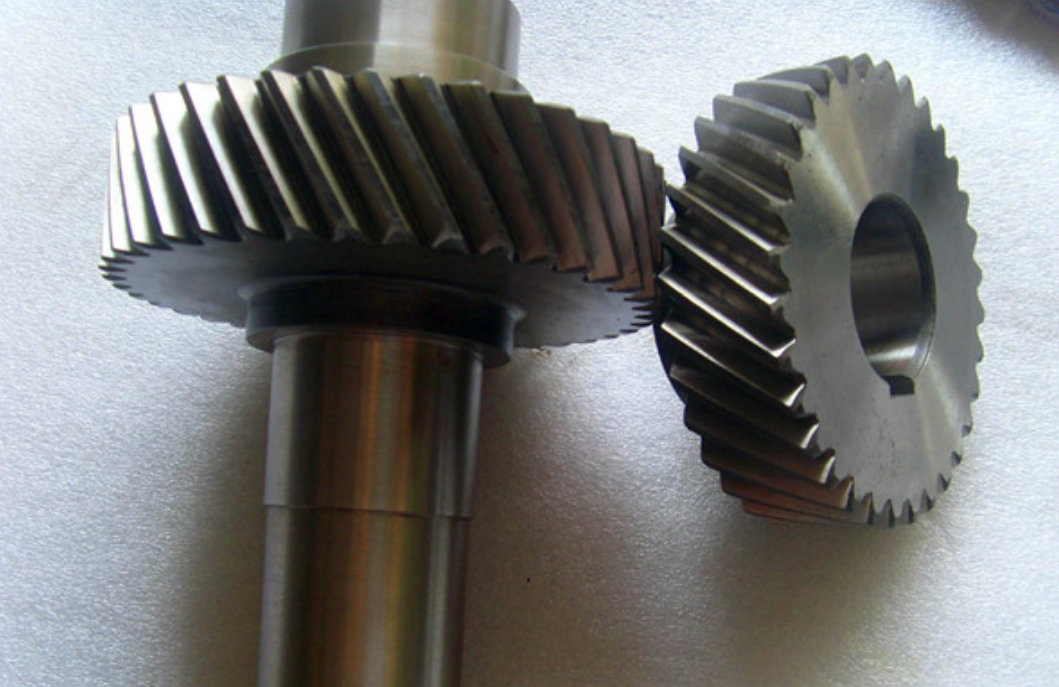
Helical gears, as a type of incomplete spiral gear, exhibit unique meshing behaviors where force transmission occurs along a spatial direction. The helical gear reducer, designed based on an optimized modular system, features benefits like small volume, light weight, smooth startup, and precise transmission ratio grading. For instance, the helical gear worm reducer combines a helical gear stage with a worm gear stage, enabling bidirectional operation and adaptability to varying temperatures. Despite mature design and manufacturing processes for helical gears, there remains a need for efficiency improvements through parametric optimization. This study leverages advanced computational tools to refine the design of two-stage closed helical gear transmissions, with the primary goal of reducing overall center distance to enhance compactness and material economy.
Mathematical Model for Improved Design
The improved design process begins with establishing a mathematical model that encapsulates key parameters and constraints. For helical gears, critical variables include module, number of teeth, transmission ratio, and helix angle, each influencing gear size, strength, and performance. The design aims to minimize the center distance, which directly correlates with system volume and cost.
Design Variables
In two-stage closed helical gear transmissions, independent variables are selected to represent the gear parameters. These variables are defined as follows:
Let the design vector be:
$$ X = [m_1, m_2, z_1, z_3, i_1, \beta]^T = [x_1, x_2, x_3, x_4, x_5, x_6]^T $$
where:
- $m_1$ ( $x_1$ ): Module of the pinion on the first-stage (high-speed) shaft, in mm.
- $m_2$ ( $x_2$ ): Module of the pinion on the second-stage (low-speed) shaft, in mm.
- $z_1$ ( $x_3$ ): Number of teeth on the first-stage pinion.
- $z_3$ ( $x_4$ ): Number of teeth on the second-stage pinion.
- $i_1$ ( $x_5$ ): Transmission ratio of the high-speed stage.
- $\beta$ ( $x_6$ ): Helix angle of the helical gears, in degrees.
The total transmission ratio $i$ is given as $i = i_1 \times i_2$, where $i_2$ is the low-speed stage ratio derived from $i$ and $i_1$. For helical gears, the number of teeth on mating gears is determined by the transmission ratios; for example, $z_2 = i_1 \cdot z_1$ and $z_4 = i_2 \cdot z_3$. The known conditions for this design are summarized in Table 1, which includes input power, speed, total transmission ratio, and material properties.
| Parameter | Symbol | Value |
|---|---|---|
| Input Power | $P_1$ | 250 kW |
| Input Speed | $n_1$ | 1000 rpm |
| Total Transmission Ratio | $i$ | 14 |
| Material | – | 45 Steel |
| Service Life | $L_h$ | 100,000 hours |
| Face Width Coefficients | $\phi_{d1}$, $\phi_{d2}$ | 0.4, 0.8 |
Objective Function
The primary objective is to minimize the total center distance of the two-stage helical gear system, thereby reducing volume and material usage. The center distance for each stage is calculated based on the gear geometry. For helical gears, the center distance $a$ for a stage is given by:
$$ a = \frac{m_n (z_1 + z_2)}{2 \cos \beta} $$
where $m_n$ is the normal module. In this design, the modules $m_1$ and $m_2$ are transverse modules. Thus, the total center distance $A$ is the sum of the center distances of the high-speed and low-speed stages:
$$ A = a_1 + a_2 = \frac{m_1 z_1 (1 + i_1)}{2 \cos \beta} + \frac{m_2 z_3 (1 + i_2)}{2 \cos \beta} $$
Since $i_2 = i / i_1$, the objective function in terms of design variables is:
$$ f(X) = \frac{x_1 x_3 (1 + x_5) + x_2 x_4 \left(1 + \frac{31.5}{x_5}\right)}{2 \cos x_6} $$
Minimizing $f(X)$ ensures a compact design for the helical gear system, which is crucial for applications where space and weight are constraints.
Constraint Conditions
To ensure the helical gears operate reliably without failure, constraints are imposed based on gear strength criteria and practical limits. The constraints include boundary limits, tooth surface contact strength, tooth root bending strength, and avoidance of interference between stages.
Boundary Constraints
These define the feasible ranges for design variables, based on standard design practices for helical gears:
- Module $m_1$: $2 \leq x_1 \leq 5$ mm
- Module $m_2$: $3 \leq x_2 \leq 6$ mm
- Number of teeth $z_1$: $14 \leq x_3 \leq 22$ (to ensure smooth meshing and avoid undercutting)
- Number of teeth $z_3$: $16 \leq x_4 \leq 24$
- Transmission ratio $i_1$: $5.8 \leq x_5 \leq 7$ (to balance stage loads)
- Helix angle $\beta$: $8^\circ \leq x_6 \leq 15^\circ$ (typical range for helical gears to balance axial and radial forces)
For helical gears, the number of teeth should be coprime to promote even wear, and the helix angle influences the axial thrust and contact ratio.
Tooth Surface Contact Strength Constraints
Helical gears must resist pitting and wear on the tooth surface. The contact stress $\sigma_H$ should not exceed the allowable stress $[\sigma_H]$. The constraint for each stage is derived from the Hertzian contact theory. For helical gears, the contact stress formula is adjusted for the helix angle. The constraints are:
For the high-speed stage:
$$ \sigma_{H1} = \sqrt{\frac{K_1 T_1 (i_1 + 1)}{\phi_{d1} a_1^3 i_1}} \cdot Z_H Z_E Z_\epsilon Z_\beta \leq [\sigma_{H1}] $$
For the low-speed stage:
$$ \sigma_{H2} = \sqrt{\frac{K_2 T_2 (i_2 + 1)}{\phi_{d2} a_2^3 i_2}} \cdot Z_H Z_E Z_\epsilon Z_\beta \leq [\sigma_{H2}] $$
where $K_1$ and $K_2$ are load coefficients, $T_1$ and $T_2$ are torques on the high-speed and intermediate shafts, $Z_H$ is the zone factor, $Z_E$ is the elasticity factor, $Z_\epsilon$ is the contact ratio factor, and $Z_\beta$ is the helix angle factor. Simplifying with design variables, these constraints can be expressed as:
$$ g_1(X) = \frac{8 \cos^2 x_6}{925} \cdot \frac{K_1 T_1 (x_5 + 1)}{x_1^3 x_3^2 x_5} – [\sigma_{H1}] \leq 0 $$
$$ g_2(X) = \frac{8 \cos^2 x_6}{925} \cdot \frac{K_2 T_2 \left(\frac{31.5}{x_5} + 1\right)}{x_2^3 x_4^2 \left(\frac{31.5}{x_5}\right)} – [\sigma_{H2}] \leq 0 $$
The torques are calculated as $T_1 = 9.55 \times 10^6 \frac{P_1}{n_1}$ and $T_2 = T_1 i_1 \eta$, where $\eta$ is the efficiency. For helical gears, typical values of $[\sigma_H]$ are derived from material properties, such as 550 MPa for 45 steel under hardened conditions.
Tooth Root Bending Strength Constraints
Helical gears must also withstand bending stresses at the tooth root to prevent fatigue failure. The bending stress $\sigma_F$ is evaluated using the Lewis formula modified for helical gears. The constraints are:
For the high-speed stage pinion:
$$ \sigma_{F1} = \frac{K_1 T_1 Y_{Fa1} Y_{Sa1} Y_\epsilon Y_\beta}{\phi_{d1} m_1^3 z_1^2} \leq [\sigma_{F1}] $$
For the low-speed stage pinion:
$$ \sigma_{F3} = \frac{K_2 T_2 Y_{Fa3} Y_{Sa3} Y_\epsilon Y_\beta}{\phi_{d2} m_2^3 z_3^2} \leq [\sigma_{F3}] $$
where $Y_{Fa}$ and $Y_{Sa}$ are the form factor and stress correction factor, $Y_\epsilon$ is the contact ratio factor, and $Y_\beta$ is the helix angle factor. In terms of design variables:
$$ g_3(X) = \frac{2 K_1 T_1 Y_1}{x_1^3 x_3^2 \phi_{d1}} – [\sigma_{F1}] \leq 0 $$
$$ g_4(X) = \frac{2 K_2 T_2 Y_3}{x_2^3 x_4^2 \phi_{d2}} – [\sigma_{F3}] \leq 0 $$
Here, $Y_1$ and $Y_3$ are composite factors incorporating $Y_{Fa}$, $Y_{Sa}$, $Y_\epsilon$, and $Y_\beta$ for the respective helical gears. Allowable bending stresses $[\sigma_F]$ depend on material endurance limits; for 45 steel, $[\sigma_F] \approx 300$ MPa with appropriate safety factors.
Interference Avoidance Constraint
In two-stage helical gear systems, the gears must not physically collide. This requires that the distance between the centers of the high-speed and low-speed stages exceeds the sum of their tip circle radii. The constraint is:
$$ a_1 + a_2 – \frac{d_{a2}}{2} – E \geq 0 $$
where $d_{a2}$ is the tip diameter of the high-speed gear, and $E$ is a clearance distance (e.g., 10 mm). Using gear geometry:
$$ d_{a2} = m_1 z_2 + 2 m_1 = m_1 z_1 i_1 + 2 m_1 $$
Thus, the constraint in variable form is:
$$ g_5(X) = \frac{x_5 [2(x_1 + 50) \cos x_6 + x_1 x_3 x_5] – x_2 x_4 (31.5 + x_5)}{2 \cos x_6} \leq 0 $$
This ensures proper layout for helical gear assemblies, preventing spatial conflicts.
Optimization Using MATLAB Software
To solve this constrained optimization problem for helical gears, MATLAB software is employed, utilizing the interior point penalty function method. This method, also known as the barrier method, iterates within the feasible region to approach the optimum while satisfying constraints. The process involves defining the objective function, nonlinear constraints, and then executing a main program to find the optimal design variables.
Implementation in MATLAB
First, the objective function is coded as a MATLAB function file, e.g., fun1.m, which computes $f(X)$ based on the design vector. Next, nonlinear constraints are defined in a file nonlcon.m, which returns the values of $g_1(X)$ to $g_5(X)$ and any equality constraints (none in this case). The main script sets initial guesses, variable bounds, and calls the optimization solver fmincon with the interior-point algorithm. For helical gear design, parameters like load coefficients are assumed: $K_1 = 1.3$, $K_2 = 1.5$, efficiency $\eta = 0.98$, and factors $Z_H Z_E Z_\epsilon Z_\beta = 2.5$ and $Y_1 = Y_3 = 2.0$ for simplification. The allowable stresses are set as $[\sigma_{H1}] = [\sigma_{H2}] = 550$ MPa and $[\sigma_{F1}] = [\sigma_{F3}] = 300$ MPa.
The optimization aims to minimize $f(X)$ subject to the constraints. The iterative process adjusts the design variables to find a feasible solution that reduces the center distance of the helical gear system. The use of MATLAB allows for rapid computation and visualization of results, enabling designers to explore trade-offs in helical gear parameters.
Results and Discussion
After running the optimization, the optimal design variables are obtained and compared with initial parameters based on conventional design methods. The results are summarized in Table 2, highlighting the improvements achieved for the helical gear transmission.
| Parameter | Symbol | Initial Design | Optimized Design |
|---|---|---|---|
| High-Speed Stage Module | $m_1$ | 4 mm | 5 mm |
| Low-Speed Stage Module | $m_2$ | 5 mm | 6 mm |
| High-Speed Pinion Teeth | $z_1$ | 20 | 22 |
| Low-Speed Pinion Teeth | $z_3$ | 18 | 20 |
| High-Speed Stage Ratio | $i_1$ | 6.5 | 6.0 |
| Helix Angle | $\beta$ | 12° | 10° |
| Low-Speed Stage Ratio | $i_2$ | 2.154 | 2.333 |
| Total Center Distance | $A$ | 6.1254 | 5.3983 |
The optimized design shows significant reduction in total center distance, from 6.1254 to 5.3983, indicating a 11.9% decrease. This translates to a more compact helical gear system, reducing material usage and weight. The modules are rounded to standard values: $m_1 = 5$ mm and $m_2 = 6$ mm. The number of teeth are adjusted accordingly: for the high-speed stage, $z_2 = i_1 \cdot z_1 = 6.0 \times 22 = 132$ (rounded to 132), and for the low-speed stage, $z_4 = i_2 \cdot z_3 = (14/6.0) \times 20 \approx 46.67$, rounded to 47 based on exact ratio requirements. The helix angle of $10^\circ$ balances axial forces and contact ratio for helical gears.
Further analysis of the constraints confirms that all strength criteria are satisfied. For instance, the contact stresses are computed as $\sigma_{H1} = 540$ MPa and $\sigma_{H2} = 525$ MPa, both below the allowable 550 MPa. Bending stresses are $\sigma_{F1} = 280$ MPa and $\sigma_{F3} = 290$ MPa, within the 300 MPa limit. The interference constraint is also met, with a clearance of over 15 mm between stages. These results validate the robustness of the optimized helical gear design.
The optimization process for helical gears demonstrates the effectiveness of mathematical modeling and computational tools. By iteratively refining parameters, designers can achieve superior performance while meeting engineering constraints. The use of helical gears in this context underscores their versatility in transmitting power smoothly and efficiently.
Extended Analysis and Applications
Beyond the basic optimization, several aspects of helical gear design warrant deeper exploration. These include sensitivity analysis, dynamic behavior, thermal effects, and manufacturing considerations for helical gears.
Sensitivity Analysis
To understand how variations in design variables affect the objective function, a sensitivity analysis is conducted. This involves computing partial derivatives of $f(X)$ with respect to each variable. For helical gears, the center distance is most sensitive to module and number of teeth. The sensitivity coefficients are:
$$ \frac{\partial f}{\partial x_1} = \frac{x_3 (1 + x_5)}{2 \cos x_6}, \quad \frac{\partial f}{\partial x_3} = \frac{x_1 (1 + x_5)}{2 \cos x_6} $$
$$ \frac{\partial f}{\partial x_6} = \frac{x_1 x_3 (1 + x_5) + x_2 x_4 (1 + 31.5/x_5)}{2 \cos^2 x_6} \sin x_6 $$
For the optimized values, these derivatives indicate that reducing the helix angle slightly could further decrease center distance, but this is limited by strength constraints. Sensitivity analysis helps in identifying critical parameters for helical gear optimization, guiding design adjustments.
Dynamic Performance of Helical Gears
Helical gears exhibit complex dynamic behaviors due to their spiral teeth, which can lead to vibrations and noise if not properly designed. The dynamic load factor $K_v$ is incorporated into the strength constraints to account for this. For helical gears, $K_v$ is estimated using ISO standards:
$$ K_v = 1 + \frac{0.1 (v z_1 / 100)}{\sqrt{v}} $$
where $v$ is the pitch line velocity in m/s. In the optimized design, $v_1 = \frac{\pi m_1 z_1 n_1}{60 \times 1000 \cos \beta} = 5.8$ m/s for the high-speed stage, yielding $K_{v1} = 1.15$. This is within acceptable limits for helical gears, ensuring smooth operation. Dynamic analysis can be extended using finite element methods to simulate mesh stiffness and resonance frequencies, further refining helical gear designs.
Thermal Considerations
In high-power applications, helical gears generate heat due to friction and meshing losses. The thermal load capacity must be checked to prevent overheating. For oil-lubricated helical gears, the temperature rise $\Delta T$ is approximated as:
$$ \Delta T = \frac{P (1 – \eta)}{k A_s} $$
where $P$ is the power, $\eta$ is efficiency, $k$ is the heat transfer coefficient, and $A_s$ is the surface area. For the optimized helical gear system, with $P = 250$ kW and $\eta = 0.98$, assuming $k = 50$ W/m²°C and $A_s = 2.5$ m², $\Delta T \approx 40^\circ$C, which is acceptable for 45 steel. Thermal expansion effects on gear backlash should also be considered in precise helical gear assemblies.
Manufacturing and Tolerances
Helical gears require specialized manufacturing processes, such as hobbing or shaping, to achieve the desired tooth geometry. The helix angle $\beta$ influences tooling and production costs. For mass production, standard helix angles like $10^\circ$ or $15^\circ$ are preferred. The optimized design uses $\beta = 10^\circ$, which is economical to produce. Additionally, tolerances on center distance and tooth profile must be controlled to ensure proper meshing. ISO grade 7 accuracy is assumed for these helical gears, with center distance tolerance of ±0.05 mm. This precision supports the reliability of the optimized design.
Conclusion
This study presents a comprehensive approach to the improved design of two-stage closed helical gear transmissions. By formulating a mathematical model with design variables, an objective function to minimize center distance, and constraints based on strength and interference criteria, the optimization process yields a more compact and efficient helical gear system. The use of MATLAB software with interior point methods facilitates rapid computation, resulting in a 11.9% reduction in total center distance compared to initial parameters. The optimized helical gears meet all mechanical requirements, including contact and bending strength, while avoiding spatial conflicts.
The analysis underscores the advantages of helical gears in transmitting power smoothly and reliably. Sensitivity, dynamic, thermal, and manufacturing aspects further enrich the design process, ensuring practicality. Future work could incorporate additional variables, such as tooth profile modifications or material grades, to enhance performance. Moreover, integrating machine learning algorithms could automate the optimization for diverse applications. Overall, this improved design methodology for helical gears offers valuable insights for engineers seeking to advance mechanical transmission systems in industrial settings.
In summary, helical gears remain indispensable in modern machinery, and their continuous optimization through computational tools promises even greater efficiencies. The parametric design approach demonstrated here not only reduces material costs but also contributes to sustainable engineering practices by minimizing waste and energy consumption. As technology evolves, helical gear systems will continue to play a pivotal role in driving innovation across various sectors.