
The pursuit of enhanced passenger comfort has made vehicular noise, particularly driveline noise, a critical focus in automotive design. Among the key contributors to driveline noise, the main rear axle reducer stands out. The gear meshing noise generated within the hypoid bevel gear set of the reducer is often the dominant acoustic source, surpassing contributions from bearings and lubrication churning. While improving manufacturing and assembly precision is one approach to mitigate this noise, it is often costly and yields diminishing returns. A more fundamental and effective strategy lies in the optimal parametric design of the gear pair itself. This article presents a comprehensive methodology for the optimization design of automotive hypoid bevel gears, with the primary objective of minimizing meshing noise through systematic parameter adjustment, ensuring strength and传动比 requirements are concurrently met.
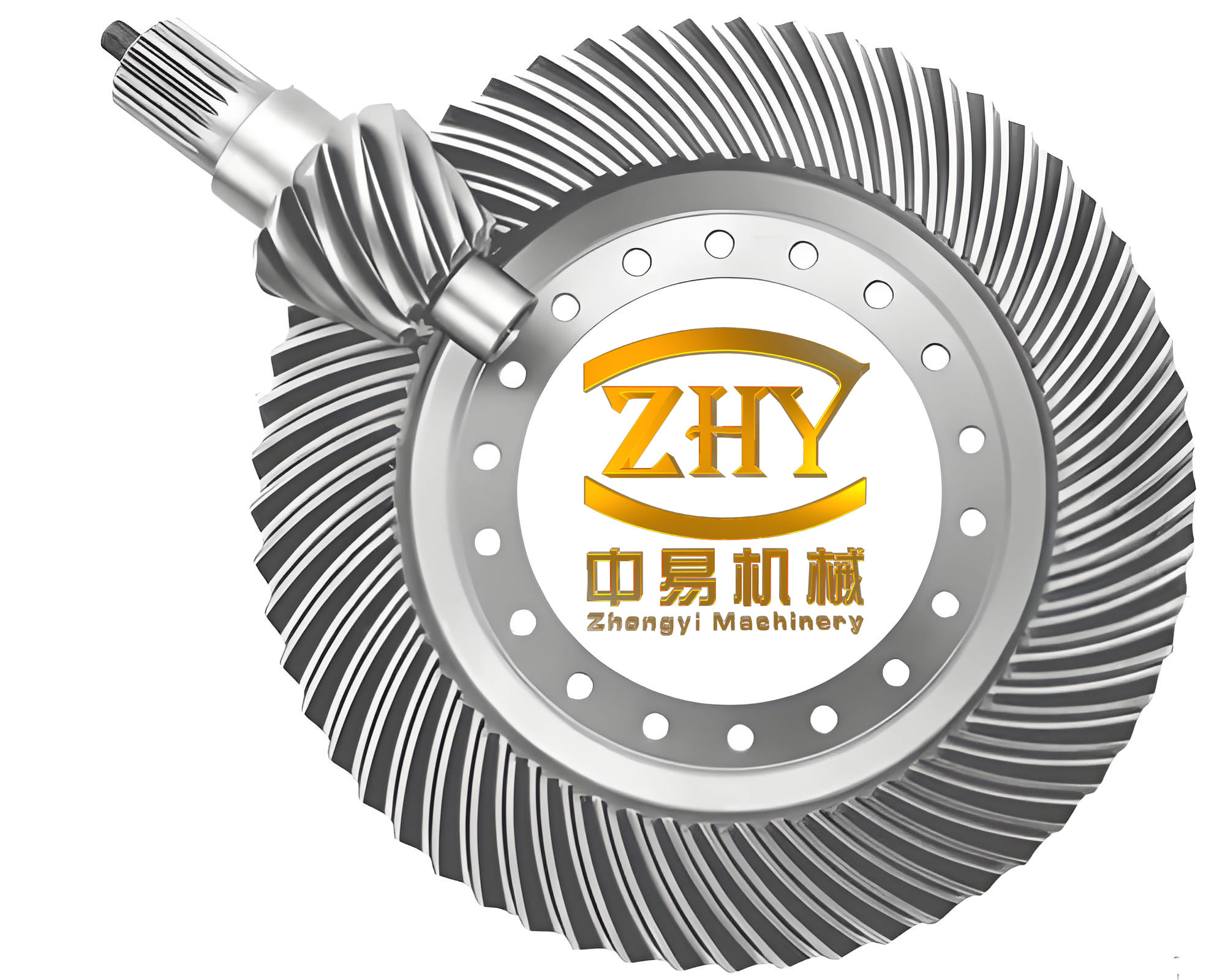
Hypoid bevel gears are the preferred choice for automotive main reducers due to their significant advantages: high传动比 capability, superior strength and durability, smooth and quiet operation, and the ability to lower the vehicle’s center of gravity by allowing for axle shaft offset. The core principle guiding low-noise design is the maximization of the contact ratio (or overlap ratio). A higher contact ratio implies a greater average number of tooth pairs in contact during the meshing cycle. This leads to a more uniform load distribution, reduced dynamic load fluctuations, and consequently, lower vibration and noise emission. For hypoid bevel gears, empirical and experimental data indicate that the meshing noise reaches a minimum when the contact ratio approaches a value of 2. This relationship is conceptually illustrated below, showing noise level as a function of contact ratio, with a clear minimum in the region near σ ≈ 2.
The contact ratio (σ) for a hypoid bevel gear pair is a function of several design parameters. Its calculation is more complex than for parallel axis gears due to the hypoid offset. A fundamental formula derived from the geometry of the equivalent virtual cylindrical gears can be expressed as:
$$ \sigma = \left( G_2 \cdot \tan\alpha – \frac{G_2^3}{3} \cdot \tan^3\alpha \right) \cdot \frac{A_0}{\pi \cdot m} $$
Where:
- σ = Contact Ratio (Overlap Coefficient)
- α = Spiral Angle of the pinion (typically at the mean point)
- m = Module at the gear outer end
- A₀ = Pitch Cone Distance (Reference)
- G₂ = A virtual gear parameter, often termed the “equivalent gear coefficient,” which is itself a function of the gear geometry and offset.
The equivalent gear coefficient \( G_2 \) is critically dependent on the hypoid offset (E) and the face width (D) relative to the pitch distance. A common representation involves the ratio of face width to pitch cone distance:
$$ G_2 = f\left(\frac{D}{A_0}, E, i\right) $$
For practical optimization, a more explicit, empirically validated formula is often used, such as:
$$ G_2 \approx \frac{D}{A_0} – \left( \frac{D}{A_0} \right)^2 \cdot \left(1 – \frac{D}{A_0} \right) \cdot K(E, i) $$
Where \( K(E, i) \) is a correction factor accounting for the offset (E) and传动比 (i). The precise form of \( G_2 \) is derived from the hypoid gear generation process and tooth contact analysis.
Establishing the Optimization Mathematical Model
The core of the optimization is to find the set of gear parameters that drives the calculated contact ratio σ as close as possible to the target optimal value of 2, while satisfying all mechanical and geometric constraints. Therefore, the objective function (T) to be minimized is defined as the absolute deviation from this target:
$$ \text{Minimize: } T(\mathbf{Y}) = | \, 2 – \sigma(\mathbf{Y}) \, | $$
Substituting the expression for σ, the objective function becomes:
$$ T(\mathbf{Y}) = \left| \, 2 – \left[ \left( G_2(\mathbf{Y}) \cdot \tan\alpha – \frac{G_2(\mathbf{Y})^3}{3} \cdot \tan^3\alpha \right) \cdot \frac{A_0}{\pi \cdot m} \right] \, \right| $$
The vector \(\mathbf{Y}\) represents the design variables. For a comprehensive optimization of hypoid bevel gears, we consider six key parameters:
$$ \mathbf{Y} = [y_1, y_2, y_3, y_4, y_5, y_6]^T = [\alpha, m, D, i, E, A_0]^T $$
Where:
| Symbol | Design Variable | Description |
|---|---|---|
| α | Spiral Angle | Pinion spiral angle at the mean point. |
| m | Module | Gear outer end module. |
| D | Face Width | Net face width of the ring gear (and pinion). |
| i | Gear Ratio | Ratio of ring gear teeth to pinion teeth (N_g / N_p). |
| E | Offset | Hypoid offset distance. |
| A₀ | Pitch Distance | Reference pitch cone distance of the ring gear. |
Design Constraints for Hypoid Bevel Gears
The optimization must operate within a feasible domain defined by geometric, kinematic, and strength constraints. These constraints ensure the designed hypoid bevel gears are manufacturable, functional, and reliable.
1. Geometric and Kinematic Constraints
- Tooth Numbers (N_p, N_g): To avoid undercutting on the pinion and ensure smooth meshing.
$$ N_p \geq 17 $$
$$ N_g + N_p \geq 40 \text{ (for trucks)} $$
$$ N_g + N_p \geq 50 \text{ (for passenger cars)} $$
For typical automotive applications, the total tooth count often lies between 40 and 60. - Face Width (D): Excessive width increases cost and weight, while insufficient width reduces strength. A practical rule is:
$$ D \leq 10 \cdot m $$ - Offset (E): A large offset can weaken the pinion shaft and lead to uneven wear. It is typically limited by the pitch distance:
$$ E \leq 0.2 \cdot A_0 $$ - Spiral Angle (α): Typically constrained within a standard range for automotive hypoid bevel gears.
$$ 30^\circ \leq \alpha \leq 50^\circ $$
2. Strength Constraints (Bending and Contact)
The gear pair must withstand the operational loads without failure. The bending stress and contact (Hertzian) stress must be below the allowable limits for the chosen material. The AGMA (American Gear Manufacturers Association) formulas for hypoid gears are commonly applied. Simplified forms are presented here, where K factors account for overload, dynamic load, size, load distribution, etc.
Bending Stress (σ_w): For the pinion (p) and gear (g).
$$ \sigma_{wp} = \frac{2000 \cdot T_p \cdot K_o \cdot K_s \cdot K_m}{K_v \cdot m^2 \cdot D \cdot N_p \cdot J_p} \leq [\sigma_{wp}] $$
$$ \sigma_{wg} = \frac{2000 \cdot T_g \cdot K_o \cdot K_s \cdot K_m}{K_v \cdot m^2 \cdot D \cdot N_g \cdot J_g} \leq [\sigma_{wg}] $$
Contact Stress (σ_c): For the pinion and gear (the maximum Hertzian stress).
$$ \sigma_c = C_p \cdot \sqrt{ \frac{2000 \cdot T_p \cdot K_o \cdot K_s \cdot K_m \cdot K_f}{K_v \cdot D \cdot A_0 \cdot I} } \leq [\sigma_c] $$
Where:
- T_p, T_g = Pinion and gear torque (N.m).
- K_o = Overload factor.
- K_v = Dynamic factor.
- K_s = Size factor.
- K_m = Load distribution factor.
- K_f = Surface condition factor.
- J_p, J_g = Bending strength geometry factors.
- I = Surface durability geometry (pitting) factor.
- C_p = Elastic coefficient (√(N/mm²)).
- [σ_w], [σ_c] = Allowable bending and contact stress limits.
A comprehensive list of constraints can be summarized in the following table:
| Constraint Category | Mathematical Expression | Physical Meaning |
|---|---|---|
| Tooth Number | \( N_{p,min} \leq N_p \leq N_{p,max} \) \( N_{g,min} \leq N_g \leq N_{g,max} \) \( N_g + N_p \geq Z_{sum,min} \) |
Avoid undercut, ensure smoothness. |
| Face Width | \( D_{min} \leq D \leq k_1 \cdot m \) | Ensure strength, limit size/weight. |
| Offset | \( E \leq k_2 \cdot A_0 \) | Prevent excessive weakening & wear. |
| Spiral Angle | \( \alpha_{min} \leq \alpha \leq \alpha_{max} \) | Standard manufacturing range. |
| Bending Stress | \( \sigma_{wp} \leq [\sigma_{wp}], \quad \sigma_{wg} \leq [\sigma_{wg}] \) | Prevent tooth breakage. |
| Contact Stress | \( \sigma_c \leq [\sigma_c] \) | Prevent surface pitting/spalling. |
| 传动比 Tolerance | \( |i – i_{target}| \leq \Delta i \) | Meet vehicle performance requirement. |
Optimization Algorithm and Process
The defined problem is a constrained nonlinear optimization. Modern computational techniques like genetic algorithms (GA), particle swarm optimization (PSO), or sequential quadratic programming (SQP) are well-suited for this task due to their ability to handle complex, non-convex design spaces and multiple constraints.
A typical workflow is:
- Initialization: Define the design variable vector \(\mathbf{Y}\), their bounds, and the constraint functions.
- Evaluation: For a candidate design \(\mathbf{Y}\), calculate the contact ratio σ(\(\mathbf{Y}\)) and the objective function T(\(\mathbf{Y}\)).
- Constraint Checking: Evaluate all geometric and strength constraints. Apply a penalty to the objective function if constraints are violated.
- Optimization Loop: The optimization algorithm (e.g., GA) generates a population of designs, evaluates their fitness (penalized T(\(\mathbf{Y}\))), and uses selection, crossover, and mutation to evolve towards better solutions over many generations.
- Convergence: The process stops when a termination criterion is met (e.g., max generations, stall in improvement). The design with the minimum feasible T(\(\mathbf{Y}\)) is the optimal solution.
Case Study: Optimization of an Automotive Hypoid Bevel Gear Set
To demonstrate the effectiveness of the proposed methodology, an optimization was performed on a hypoid bevel gear set from a commercial vehicle main reducer. The initial design parameters and the optimized results are compared below.
| Parameter | Symbol | Initial Design | Optimized Design |
|---|---|---|---|
| Spiral Angle | α | 16° | 18° |
| Pitch Distance | A₀ | 32.0 mm | 31.5 mm |
| Pinion Teeth | N_p | 20 | 17 |
| Gear Teeth | N_g | 37 | 43 |
| 传动比 | i | 1.85 | 2.529 |
| Module | m | 1.8 mm | 1.85 mm |
| Offset | E | 15.0 mm | 16.0 mm |
| Face Width | D | Assumed 18 mm | Optimized Value |
Calculation of Contact Ratio:
Using the formula for σ with the appropriate \(G_2\) calculation:
- Initial Design Contact Ratio: σ_initial ≈ 1.74
- Optimized Design Contact Ratio: σ_optimized ≈ 1.945
The optimization successfully increased the contact ratio from 1.74 to 1.945, bringing it significantly closer to the theoretical noise-optimal value of 2. Consequently, a measurable reduction in meshing noise is expected from the optimized hypoid bevel gears. All strength constraints (bending and contact stress) were verified to be satisfied for the optimized design under the specified load conditions.
Extended Discussion on Noise Mechanisms and Advanced Considerations
While the contact ratio is a primary indicator, the complete acoustic performance of hypoid bevel gears involves other factors influenced by the same design parameters.
Transmission Error (TE): This is the deviation between the actual and theoretical position of the driven gear, and is a direct excitation source for gear noise. Optimization for low noise must also consider minimizing static and dynamic TE. The parameters affecting contact ratio (spiral angle, pressure angle corrections, micro-geometry) also profoundly affect TE. An advanced multi-objective optimization could target both high contact ratio and low TE simultaneously.
$$ TE(\theta) = \theta_{gear,actual} – ( \theta_{pinion,actual} \cdot i ) $$
Mesh Stiffness Variation: The periodic change in the total mesh stiffness as tooth pairs engage and disengage causes dynamic forces. A higher contact ratio reduces the amplitude of this variation, smoothing the force transmission.
Impact of Micro-Geometry: The macro-parameters (α, m, E, etc.) set the stage, but final noise refinement is achieved through micro-geometry modifications (profile crowning, lead crowning, bias modifications). These are applied to the tooth surfaces to localize bearing contact and compensate for deflections under load, further reducing transmission error and noise. The optimal macro-parameters found through this process provide the best foundation for effective micro-geometry design.
Conclusion
This article has detailed a systematic optimization design method for automotive hypoid bevel gears with a focus on minimizing meshing noise. The methodology establishes the maximization of the contact ratio (targeting a value near 2) as the primary objective within a framework of rigorous geometric and strength constraints. By defining an appropriate objective function and a comprehensive set of constraints encompassing tooth numbers, face width, offset, spiral angle, bending stress, and contact stress, a mathematical model for optimization is constructed. The application of modern optimization algorithms to this model enables the efficient exploration of the design space to identify the optimal combination of parameters. A practical case study confirms the method’s efficacy, showing a significant improvement in the contact ratio for an optimized hypoid bevel gear set, directly leading to lower meshing noise. This approach provides a powerful and rational pathway for the low-noise design of hypoid bevel gears, moving beyond trial-and-error and laying a foundation for integrating noise performance directly into the initial design phase of automotive drivetrains.