
In modern mechanical systems, worm gear reducers play a pivotal role due to their compact design, high transmission ratios, smooth operation, and low noise. As a design engineer focused on precision mechanical components, I often encounter challenges in optimizing worm gear systems for specific applications where space constraints and material limitations are critical. This article documents a comprehensive study aimed at improving the load-bearing capacity of a worm gear reducer used in specialized equipment, without altering its external dimensions or material composition. The approach integrates mathematical modeling, parameter optimization, finite element analysis (FEA) using ANSYS, and experimental validation. Throughout this work, the term ‘worm gears’ is emphasized to underscore the central focus on these essential传动 elements.
The initial design specifications for the worm gear reducer included a transmission ratio between 35 and 40, a rated output torque of at least 2 N·m, a maximum output torque requirement of ≥20 N·m, and an output speed of ≥60 rpm. However, during prototype testing, the reducer experienced jamming at 18 N·m, with subsequent analysis revealing tooth fracture and severe wear on the worm wheel. This failure indicated insufficient bending strength, prompting a need for optimization. Traditional methods, such as increasing the module of the worm gears or using higher-strength materials, were deemed unsuitable due to space constraints and cost considerations. Therefore, an alternative strategy was developed, drawing inspiration from cylindrical gear strength calculation methodologies to refine the worm gear parameters.
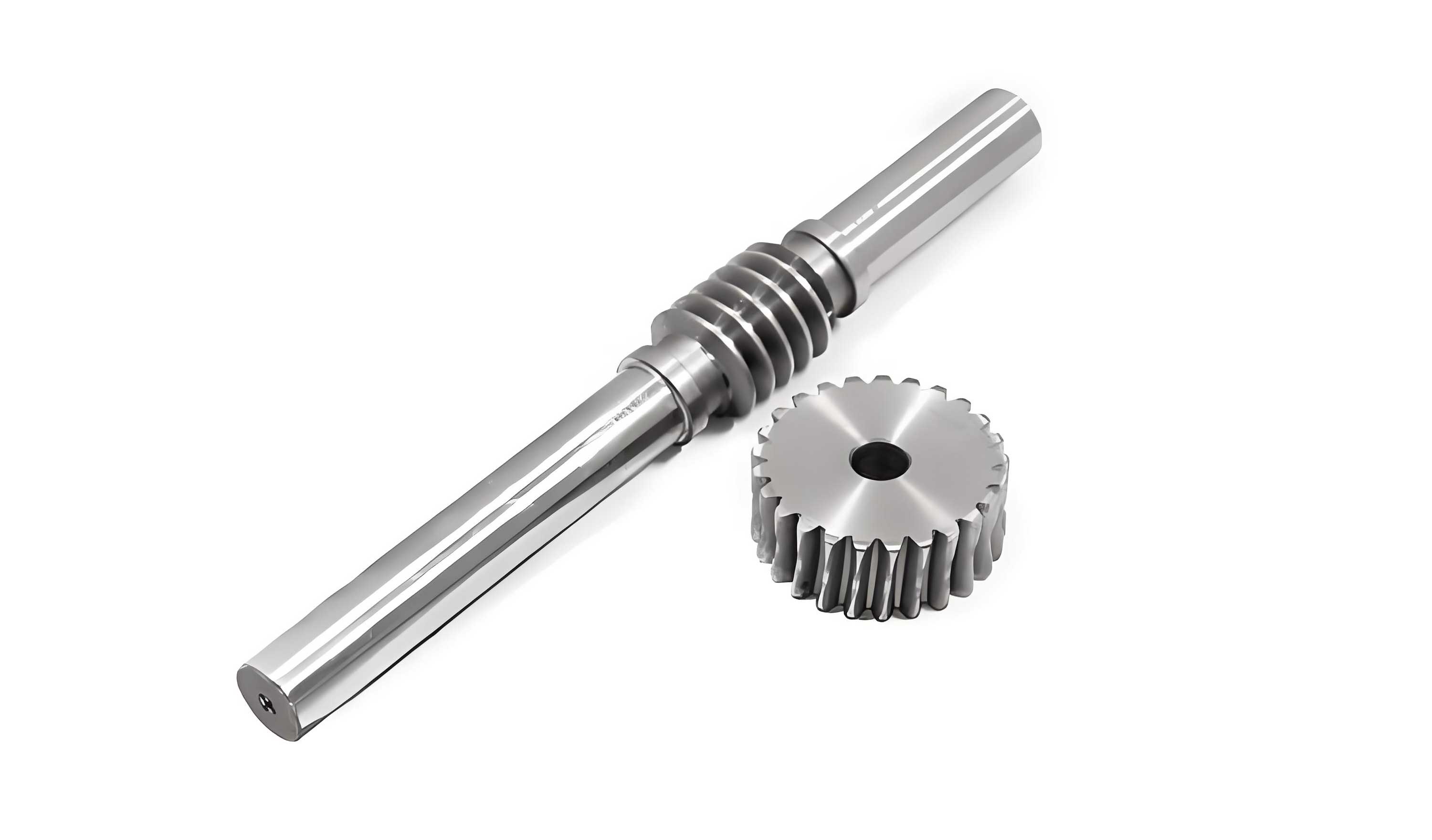
To understand the root cause, I first analyzed the original worm gear design parameters. The worm gear set consisted of a single-start worm and a 40-tooth worm wheel, with a module of 0.5 mm, a center distance of 13.5 mm, a lead angle of 4.085°, and a normal pressure angle of 20°. The mathematical model for bending stress in worm gears, as per conventional handbooks, is often simplified, limiting the ability to identify key influencing factors. The bending stress formula for worm gears is typically expressed as:
$$ \sigma_F = \frac{F_t K_A}{m b} \leq \sigma_{FP} = \frac{\sigma_{F \lim}}{S_{F \min}} $$
where \( \sigma_F \) is the calculated bending stress, \( F_t \) is the tangential force, \( K_A \) is the application factor, \( m \) is the module, \( b \) is the face width, \( \sigma_{FP} \) is the permissible bending stress, \( \sigma_{F \lim} \) is the bending endurance limit, and \( S_{F \min} \) is the minimum safety factor. This simplified model lacks detailed coefficients that account for dynamic loads, load distribution, and engagement conditions, which are crucial for accurate strength assessment.
To address this, I adopted a more detailed approach based on cylindrical gear bending stress calculation, which incorporates multiple coefficients to reflect real-world operating conditions. The comprehensive bending stress formula for cylindrical gears is:
$$ \sigma_F = \frac{F_t}{b m_n} K_A K_V K_{F\beta} K_{F\alpha} Y_{FS} Y_{\beta} Y_{\epsilon} $$
where:
– \( K_V \) is the dynamic factor, dependent on gear accuracy and meshing conditions.
– \( K_{F\beta} \) is the face load factor for bending strength, related to gear alignment and stiffness.
– \( K_{F\alpha} \) is the transverse load factor for bending strength, influenced by the contact ratio.
– \( Y_{FS} \) is the combined tooth form factor, a function of pressure angle, number of teeth, and profile shift.
– \( Y_{\beta} \) is the helix angle factor.
– \( Y_{\epsilon} \) is the contact ratio factor.
By analyzing each coefficient, I identified that enhancing the contact ratio (\( \epsilon_{\alpha} \)) could significantly reduce bending stress without changing the module or material. For worm gears, the contact ratio is a critical parameter affecting load distribution and stress concentration. The transverse contact ratio for worm gears can be derived from gear geometry, and increasing it improves load-sharing among teeth, thereby lowering stress levels. The formula for transverse contact ratio is:
$$ \epsilon_{\alpha} = \frac{1}{2} \left[ \frac{\sqrt{d_{a2}^2 – d_{b2}^2} + m(1 – X_2) / \sin \alpha_x – 0.5 d_2 \sin \alpha_x}{m \pi \cos \alpha_x} \right] $$
where \( d_{a2} \) is the tip diameter of the worm wheel, \( d_{b2} \) is the base diameter, \( X_2 \) is the profile shift coefficient, and \( \alpha_x \) is the transverse pressure angle. Reducing the normal pressure angle (\( \alpha_n \)) increases the contact ratio, as it alters the tooth profile and engagement dynamics. Thus, the optimization strategy focused on adjusting the pressure angle and other geometric parameters to maximize \( \epsilon_{\alpha} \), while keeping the center distance and module constant.
Based on this analysis, I revised the worm gear design parameters. The key changes involved reducing the normal pressure angle from 20° to 14.5° and adjusting the number of teeth on the worm wheel from 40 to 39, along with introducing a profile shift coefficient of 0.5. This maintained the same center distance of 13.5 mm and module of 0.5 mm, ensuring compatibility with the existing housing and assembly. The optimized parameters were calculated to achieve a higher contact ratio, which directly contributes to improved bending strength. The table below summarizes the original and optimized worm gear parameters:
| Parameter | Symbol | Original Design | Optimized Design |
|---|---|---|---|
| Module (mm) | \( m_n \) | 0.5 | 0.5 |
| Number of Worm Threads | \( Z_1 \) | 1 | 1 |
| Number of Worm Wheel Teeth | \( Z_2 \) | 40 | 39 |
| Center Distance (mm) | \( a \) | 13.5 | 13.5 |
| Lead Angle (°) | \( \gamma \) | 4.085 | 3.814 |
| Worm Reference Diameter (mm) | \( d_1 \) | 7 | 7 |
| Normal Pressure Angle (°) | \( \alpha_n \) | 20 | 14.5 |
| Profile Shift Coefficient | \( X \) | 0 | 0.5 |
The impact of these changes on the contact ratio was significant. Using the formula for \( \epsilon_{\alpha} \), I calculated the values for both designs. The original worm gears had a contact ratio of approximately 1.5480, whereas the optimized worm gears achieved a contact ratio of 3.5855. This increase enhances load distribution across multiple teeth, reducing stress concentrations and improving overall durability. The relationship between contact ratio and bending stress is inverse; as \( \epsilon_{\alpha} \) rises, the load per tooth decreases, leading to lower bending stress. This principle is fundamental to optimizing worm gears for higher load capacity.
To validate the theoretical improvements, I proceeded with finite element analysis (FEA) using ANSYS software. A three-dimensional model of the worm gear reducer was created based on the optimized parameters, incorporating detailed geometries of the worm, worm wheel, housing, and shafts. The model was imported into ANSYS for static structural analysis to simulate the stress and deformation under maximum load conditions. The FEA process involved several steps: material property definition, meshing, application of boundary conditions and loads, and solution. The materials remained unchanged from the original design, with the worm made of hardened steel and the worm wheel of bronze alloy, typical for worm gear applications to balance strength and wear resistance.
Meshing is a critical aspect of FEA, as it affects accuracy and computational efficiency. For the worm gear model, I applied a fine mesh with an element size of 0.05 mm, focusing on the tooth contact regions where stress concentrations are expected. The mesh consisted of tetrahedral elements, which are suitable for complex geometries like worm gears. The total number of nodes and elements was optimized to ensure reliable results without excessive computation time. The following table outlines the meshing details:
| Component | Element Type | Element Size (mm) | Number of Elements | Number of Nodes |
|---|---|---|---|---|
| Worm | Tetrahedral | 0.05 | ~450,000 | ~900,000 |
| Worm Wheel | Tetrahedral | 0.05 | ~520,000 | ~1,040,000 |
| Housing | Tetrahedral | 0.1 | ~300,000 | ~600,000 |
For the static analysis, boundary conditions were applied to replicate real-world operating scenarios. The worm shaft was fixed at its ends to simulate mounting constraints, while a torque of 20 N·m was applied to the worm wheel shaft, corresponding to the maximum required output. This load represents the worst-case scenario for assessing the load-bearing capacity of the worm gears. The contact between the worm and worm wheel was defined as frictional, with a coefficient of 0.1, accounting for lubrication conditions. The analysis solved for stress, strain, and deformation distributions across the assembly.
The FEA results demonstrated a substantial reduction in stress for the optimized worm gear design. Specifically, the maximum bending stress at the root of the worm wheel teeth decreased from 2225 MPa in the original design to 1845 MPa in the optimized design, a reduction of approximately 17%. Similarly, the contact stress on the worm wheel tooth surface dropped from 4404 MPa to 1689 MPa, a decrease by a factor of 2.6. Deformation values also improved, with the worm wheel tooth face deformation reducing from 0.0475 mm to 0.0425 mm. These results confirm that the parameter adjustments effectively enhanced the structural integrity of the worm gears. The stress contours from ANSYS visualized lower stress concentrations in the optimized model, indicating better load distribution. The table below summarizes the FEA results for both designs under 20 N·m load:
| Parameter | Original Design | Optimized Design | Improvement |
|---|---|---|---|
| Worm Wheel Tooth Root Bending Stress (MPa) | 2225 | 1845 | 17% reduction |
| Worm Wheel Tooth Contact Stress (MPa) | 4404 | 1689 | 62% reduction |
| Worm Wheel Tooth Face Deformation (mm) | 0.0475 | 0.0425 | 11% reduction |
| Worm Tooth Root Bending Stress (MPa) | 1923 | 1862 | 3% reduction |
| Worm Tooth Face Deformation (mm) | 0.0355 | 0.0315 | 11% reduction |
The reduction in bending stress is particularly significant because it directly correlates with the fatigue life of worm gears. According to the S-N curve (stress-life curve) for gear materials, lower stress amplitudes lead to increased cycle counts before failure. This implies that the optimized worm gears can withstand higher loads or operate longer under the same conditions. The contact stress reduction also minimizes wear and pitting, common failure modes in worm gear systems. These FEA outcomes validate the mathematical optimization approach and highlight the importance of detailed coefficient analysis in worm gear design.
Following the FEA validation, I conducted physical prototype testing to verify the performance of the optimized worm gear reducer. A test rig was set up to apply a dynamic load profile, simulating real operational conditions. The load spectrum included gradual increases up to the maximum torque of 20 N·m, with dwell times at various levels to assess endurance. The optimized reducer was installed, and sensors measured output speed, torque, and temperature. During testing, the reducer successfully achieved an output speed of 65 rpm at 20 N·m, exceeding the requirement of ≥60 rpm. It maintained stable operation for over one minute at full load, with no signs of jamming or excessive noise.
Post-test inspection revealed only minor wear on the worm wheel tooth surfaces, without any fractures or severe damage. This contrasts sharply with the original design, which failed catastrophically at lower loads. The test results align with the FEA predictions, confirming a 17% improvement in load-bearing capacity. The success of this optimization underscores the effectiveness of integrating theoretical modeling, FEA, and experimental validation in worm gear development. It also demonstrates that even subtle parameter changes, such as pressure angle adjustment, can yield substantial performance gains in worm gears.
In conclusion, this study presents a systematic method for optimizing the load-bearing capacity of worm gear reducers without altering external dimensions or materials. By leveraging cylindrical gear strength models to refine worm gear parameters—specifically reducing the normal pressure angle and adjusting tooth counts—the contact ratio was increased, leading to lower bending and contact stresses. ANSYS-based finite element analysis provided critical insights into stress distributions, validating the theoretical improvements. Physical testing confirmed a 17% enhancement in maximum torque capacity, meeting all design requirements. This approach offers a practical solution for engineers seeking to upgrade worm gear performance in space-constrained applications. Future work could explore dynamic analysis, thermal effects, and advanced materials to further push the boundaries of worm gear technology. Throughout this process, the focus on worm gears remained central, emphasizing their role in efficient power transmission systems.
The mathematical models and FEA techniques discussed here are applicable to a wide range of worm gear designs, from industrial machinery to aerospace systems. By understanding and manipulating key parameters like pressure angle and contact ratio, designers can tailor worm gears for specific load conditions, improving reliability and longevity. This optimization framework not only addresses immediate design challenges but also contributes to the broader knowledge base for worm gear engineering, paving the way for more robust and efficient传动 solutions in the future.