
The pursuit of superior vehicle performance and packaging efficiency has consistently driven innovations in powertrain design. Within the automotive final drive, the gearset that transmits power from the driveshaft to the axle shafts is paramount. While spiral bevel gears have served this purpose for decades, the hypoid gear has emerged as a significantly superior solution for many passenger cars, SUVs, and light trucks. The defining characteristic of the hypoid gear pair is the intentional offset between the axes of the driving pinion and the driven ring gear. This offset allows the pinion to be positioned lower, enabling a lower driveline tunnel for improved passenger compartment space, or conversely, raising the ground clearance for enhanced off-road capability. More importantly, hypoid gears offer larger overlap ratios, resulting in smoother and quieter operation, higher torque capacity, and increased tooth strength due to the sliding/rolling contact action along the tooth flank.
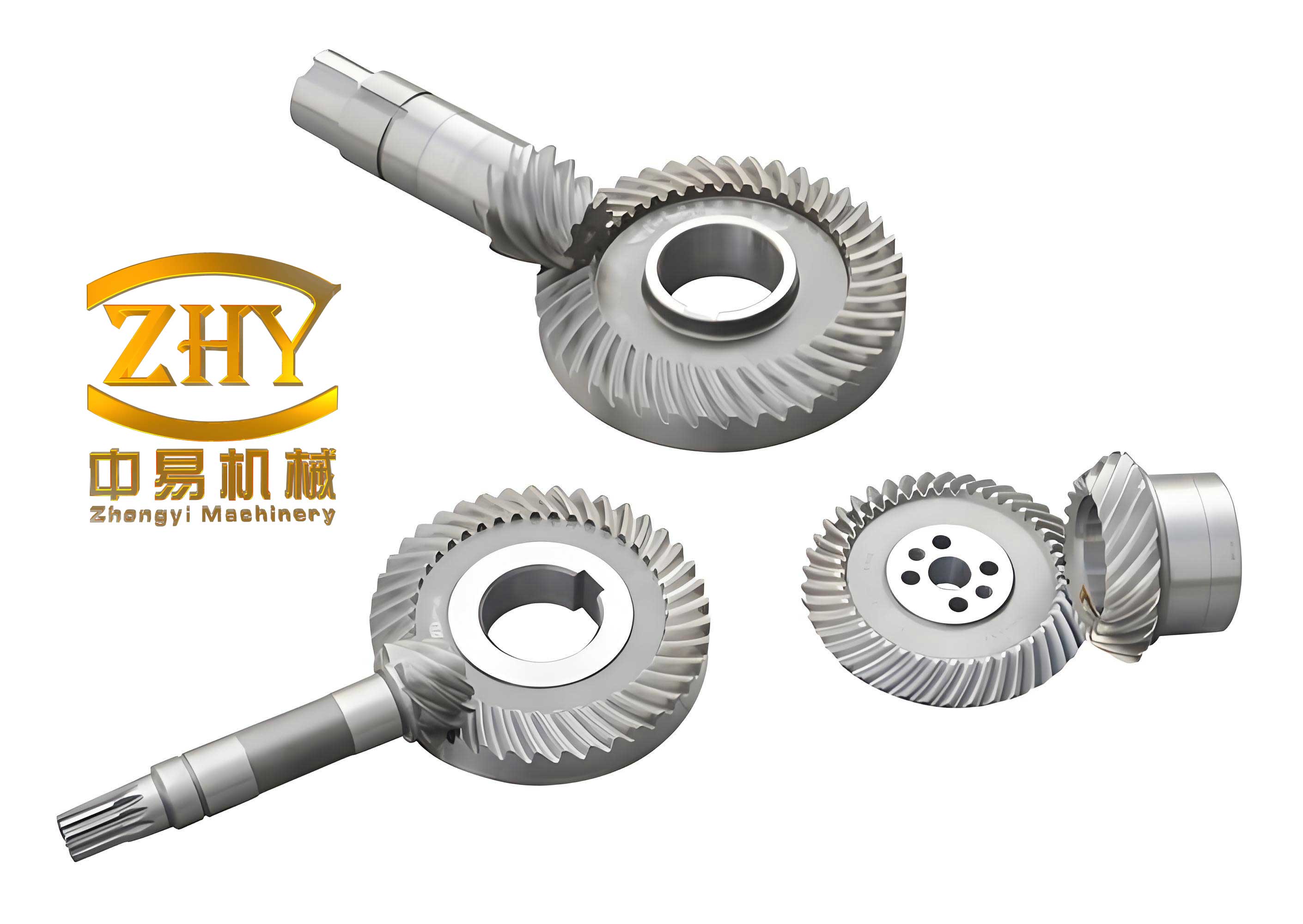
However, the design of a hypoid gear set is a complex, multi-parameter problem. Parameters such as gear diameters, tooth counts, face width, pinion offset, and spiral angles are deeply interrelated. Traditional design methods rely heavily on empirical formulas and iterative adjustments based on designer experience, which can be time-consuming and may not yield the most optimal configuration. Particularly for high reduction ratios (often i ≥ 4.5), a non-optimized hypoid gear set can become excessively large, negatively impacting the vehicle’s underbody packaging and ground clearance—a critical metric for off-road vehicles often referred to as “breakover angle.”
This article presents a structured, mathematical approach to the design of a final drive hypoid gear set. The core objective is to develop an optimization model that minimizes the total volume of the gear pair while strictly adhering to all necessary mechanical and geometric constraints. This method systematically navigates the complex design space to find the most compact and efficient solution, directly enhancing vehicle performance and manufacturability.
Mathematical Modeling of the Hypoid Gear Optimization Problem
To apply optimization techniques, we must first translate the physical design problem into a formal mathematical model consisting of design variables, an objective function, and a set of constraints.
1. Design Variables
The geometric and operational characteristics of a hypoid gear pair are governed by several key parameters. Selecting these as our design variables forms the basis of our optimization search space. We define the vector of design variables, X, as follows:
$$ \mathbf{X} = [z_1, z_2, d_2, m_1, F, E, \beta_1]^T = [x_1, x_2, x_3, x_4, x_5, x_6, x_7]^T $$
Where:
| Variable | Symbol | Description |
|---|---|---|
| $x_1$ | $z_1$ | Number of teeth on the hypoid pinion (driver). |
| $x_2$ | $z_2$ | Number of teeth on the hypoid ring gear (driven). |
| $x_3$ | $d_2$ | Pitch diameter of the ring gear [mm]. |
| $x_4$ | $m_1$ | Transverse module at the pinion [mm]. |
| $x_5$ | $F$ | Face width of the ring gear [mm]. |
| $x_6$ | $E$ | Hypoid offset (Pinion offset) [mm]. |
| $x_7$ | $\beta_1$ | Mean spiral angle at the pinion [degrees]. |
2. Objective Function
The primary goal is to minimize the overall space occupied by the final drive unit, which is largely dictated by the physical volume of the hypoid gear pair. A more compact gear set allows for better vehicle packaging and increased ground clearance. Therefore, we define our objective function, $F(\mathbf{X})$, as the sum of the approximate volumes of the pinion and ring gear, aiming to minimize it.
$$ \min_{\mathbf{X} \in \mathbb{R}^n} F(\mathbf{X}) = V_1(z_1, m_1, \dots) + V_2(d_2, F, \dots) $$
The exact formulation of $V_1$ and $V_2$ can be derived based on the gear geometry (modeled as frustums of cones). The optimization algorithm will seek the combination of design variables that yields the smallest possible value for $F(\mathbf{X})$.
3. Constraint Functions
The design must satisfy a comprehensive set of constraints drawn from geometry, strength theory, manufacturing limits, and vehicle requirements. These constraints ensure the hypoid gear is functional, durable, and suitable for its application.
3.1 Geometric and Configuration Constraints
a) Ring Gear Diameter for Ground Clearance: The ring gear diameter must allow sufficient space beneath the axle housing to meet the vehicle’s minimum ground clearance requirement, $X_g$.
$$ \frac{d_2}{2} + h \leq r_k – X_g $$
Here, $h$ is the sum of the housing thickness and internal clearance, and $r_k$ is the tire’s loaded radius.
b) Ring Gear Diameter for Torque Capacity: The diameter must be sufficient to handle the input torque. It is checked under two critical driving conditions: first gear at maximum engine torque, and direct drive at maximum engine torque. The larger resulting value serves as a lower bound.
$$ d_2 \geq 3.46 \sqrt[3]{\frac{M_{emax} \cdot i_1 \cdot i_0}{\sigma_b \cdot K}} \quad \text{(1st Gear)} $$
$$ d_2 \geq 3.46 \sqrt[3]{\frac{0.85 G_2 \cdot r_k \cdot \phi}{\sigma_b \cdot K}} \quad \text{(Wheel Slip)} $$
$$ d_2 \geq 5.74 \sqrt[3]{\frac{M_{emax} \cdot i_0}{\sigma_b \cdot K}} \quad \text{(Direct Drive)} $$
$M_{emax}$ is max engine torque, $i_1$ is 1st gear ratio, $i_0$ is final drive ratio, $G_2$ is axle load, $\phi$ is adhesion coefficient, $\sigma_b$ is allowable bending stress, and $K$ is a load factor.
c) Tooth Number Constraints: Tooth counts affect smoothness, noise, and the achievable gear ratio.
$$ z_1 + z_2 \geq 45 \quad \text{(for smoothness)} $$
$$ 7 \leq z_1 \leq 12 \quad \text{(typical pinion range)} $$
$$ |z_1 \cdot i_0 – z_2| \leq \Delta Z \quad \text{(ratio accuracy, } \Delta Z \text{ is 1 or 2)} $$
d) Pinion Module Constraint: The module is linked to the ring gear diameter and tooth count.
$$ 1.3 \frac{d_2}{z_1 i_0} \leq m_1 \leq 1.5 \frac{d_2}{z_1 i_0} $$
e) Face Width Constraint: Excessively wide teeth are difficult to manufacture and do not proportionally increase strength.
$$ |F – 0.155 \cdot d_2| \leq K_F $$
$K_F$ defines an allowable tolerance band around the empirical recommendation.
f) Hypoid Offset Constraint: The offset $E$ is critical to hypoid gear performance. Too small, and benefits are lost; too large, and sliding friction and undercutting increase.
$$ 0.12 \cdot d_2 \leq E \leq 0.20 \cdot d_2 $$
g) Spiral Angle Constraint: The mean spiral angle affects contact pattern, overlap, and axial thrust loads. For automotive hypoid gears, it typically falls within a specific range.
$$ 35^\circ \leq \beta_m \leq 40^\circ $$
Where the mean spiral angle $\beta_m$ for a hypoid gear pair is approximately:
$$ \beta_m = \frac{\beta_1 + \beta_2}{2} = \beta_1 – \frac{\epsilon}{2} $$
and the offset angle $\epsilon$ is:
$$ \epsilon \approx \sin^{-1}\left( \frac{2E}{d_2 – F} \right) $$
Therefore, the constraint becomes:
$$ 35^\circ \leq \beta_1 – \frac{1}{2} \sin^{-1}\left( \frac{2E}{d_2 – F} \right) \leq 40^\circ $$
3.2 Strength Constraints
a) Contact (Surface Durability) Stress Constraint: The primary failure mode for well-lubricated hypoid gears is surface pitting. The contact stress $\sigma_H$ must not exceed the allowable stress $[\sigma_H]$.
$$ \sigma_H = C_p \sqrt{ \frac{2 M_{p,calc} \cdot K_o \cdot K_s \cdot K_m \cdot K_f \cdot 10^3}{K_v \cdot F \cdot d_1 \cdot J} } \leq [\sigma_H] $$
Where $C_p$ is the elastic coefficient, $M_{p,calc}$ is the calculated pinion torque, $d_1 = m_1 z_1$ is the pinion pitch diameter, and $J$ is the geometry factor for contact stress. $K$ factors account for overload, size, load distribution, dynamics, and surface finish.
b) Bending Stress Constraints: Both the pinion and ring gear teeth must withstand bending loads.
$$ \sigma_{W1} = \frac{2 M_{p,calc} \cdot K_o \cdot K_s \cdot K_m \cdot 10^3}{K_v \cdot F’ \cdot z_1 \cdot m_1^2 \cdot J_{W1}} \leq [\sigma_W] $$
$$ \sigma_{W2} = \frac{2 M_{g,calc} \cdot K_o \cdot K_s \cdot K_m \cdot 10^3}{K_v \cdot F \cdot z_2 \cdot m_2^2 \cdot J_{W2}} \leq [\sigma_W] $$
Here, $F’ \approx 1.1F$ is the pinion face width, $m_2 = d_2/z_2$ is the ring gear module, and $J_{W1}, J_{W2}$ are bending geometry factors. $M_{g,calc}$ is the calculated ring gear torque.
Our complete Non-Linear Programming (NLP) problem is summarized as:
$$ \begin{aligned}
& \underset{\mathbf{X}}{\text{minimize}}
& & F(\mathbf{X}) = V_1 + V_2 \\
& \text{subject to}
& & g_u(\mathbf{X}) \leq 0, \quad u = 1, 2, \dots, m \\
& & & \mathbf{X}^L \leq \mathbf{X} \leq \mathbf{X}^U
\end{aligned} $$
Where $g_u(\mathbf{X})$ are the inequality constraints derived from the above equations (rearranged to the form $g(\mathbf{X}) \leq 0$), and $\mathbf{X}^L, \mathbf{X}^U$ are explicit lower and upper bounds for the variables.
Solution Methodology and a Computational Example
Problems of this nature, with non-linear objective and constraint functions, are typically solved using gradient-based optimization algorithms or direct search methods. The Sequential Quadratic Programming (SQP) method or methods based on penalty functions (like the Interior Point or Augmented Lagrangian method) are well-suited. These algorithms iteratively adjust the design variables, evaluating the objective and constraints at each step, until a minimum satisfying all constraints is found.
Consider the design of a hypoid gear final drive for a light越野 vehicle with the following specifications:
| Parameter | Symbol | Value |
|---|---|---|
| Max Engine Torque | $M_{emax}$ | 172 Nm |
| 1st Gear Ratio | $i_1$ | 3.115 |
| Final Drive Ratio | $i_0$ | 4.55 |
| Tire Loaded Radius | $r_k$ | 0.375 m |
Traditional Design Result: Based on handbook recommendations and iterative calculations, a traditional design yielded:
$\mathbf{X}_{trad} = [z_1=9, z_2=41, d_2=223\text{mm}, m_1=8\text{mm}, F=32\text{mm}, E=40\text{mm}, \beta_1=50^\circ]^T$ with an approximate combined gear volume $F_{trad} \approx 1,111,544 \text{ mm}^3$.
Optimization Result: Applying the formulated model using a penalty function method (as indicated in the algorithm output “IRC=2 IQU=35…”) provided an optimal solution. After practical rounding of parameters, the optimized hypoid gear design is:
| Variable | Optimized Value | Traditional Value |
|---|---|---|
| $z_1$ | 9 | 9 |
| $z_2$ | 41 | 41 |
| $d_2$ [mm] | 190 | 223 |
| $m_1$ [mm] | 6.5 | 8 |
| $F$ [mm] | 29 | 32 |
| $E$ [mm] | 24 | 40 |
| $\beta_1$ [deg] | 50 | 50 |
The optimized volume is $F_{opt} \approx 811,575 \text{ mm}^3$.
Analysis and Discussion of Optimization Results
The comparison between the traditional and optimized hypoid gear designs reveals significant advantages offered by the systematic approach.
1. Substantial Volume Reduction: The total gear volume was reduced by approximately 22.5%.
$$ \text{Volume Reduction} = \frac{F_{trad} – F_{opt}}{F_{trad}} \times 100\% = \frac{1,111,544 – 811,575}{1,111,544} \times 100\% \approx 22.5\% $$
This directly translates to a more compact final drive assembly. For the vehicle, this means either a lower center of gravity or increased ground clearance, directly improving stability and off-road capability—a critical performance metric the design aimed to address.
2. Rationalization of Hypoid Offset: The optimization algorithm significantly reduced the pinion offset $E$ from 40mm to 24mm. While a large offset is a hallmark of hypoid gears, an excessively large value increases sliding velocities, raising the risk of scoring and reducing mechanical efficiency. The optimized value represents a more balanced trade-off, retaining the benefits of the hypoid gear (lower pinion placement, smoothness) while mitigating excessive sliding friction. The new offset is about 12.6% of $d_2$, which is within the recommended lower bound and promotes efficiency.
3. Coherent Parameter Adjustment: The optimization did not change parameters in isolation. The reduction in ring gear diameter $d_2$ was accompanied by a proportional reduction in face width $F$ and pinion module $m_1$. This coherent scaling ensured all strength constraints (contact and bending) remained satisfied. The algorithm found that the traditional design was somewhat over-designed in terms of physical dimensions, and it identified a smaller, yet still robust, configuration.
4. Enhanced Design Efficiency: Beyond the tangible improvements in gear size, the optimization process itself represents a major leap in design methodology. It replaces weeks of iterative handbook calculations and prototype testing with a computationally-driven search that can converge on a superior solution in a fraction of the time. This allows engineers to explore the design space more thoroughly and respond rapidly to changing vehicle requirements.
Advanced Considerations in Hypoid Gear Optimization
The model presented is a foundational single-objective optimization. Real-world hypoid gear design can be extended by incorporating more sophisticated objectives and constraints.
1. Multi-Objective Optimization: Instead of just minimizing volume, we could simultaneously optimize for multiple, often competing, goals. A Pareto-optimal front can be sought for objectives like:
- Minimize Volume: For packaging and weight.
- Maximize Efficiency: Minimize power losses from sliding friction and churning.
- Minimize Noise Emission: Optimize parameters for lowest mesh excitation (Transmission Error).
This would involve techniques like the Weighted Sum method or evolutionary algorithms (e.g., NSGA-II).
2. Dynamic and TE Load Constraints: The static load models can be augmented with dynamic analysis. A constraint on the maximum Transmission Error (TE) under load can be included to directly target noise-vibration-harshness (NVH) performance, which is crucial in modern vehicles.
3. Manufacturing and Cost Constraints: The model can include constraints related to manufacturability, such as limits on tooling (cutter head diameters) to avoid interference, or minimum tooth thickness at the heel for cutting tool strength. A simplified cost model based on material volume and machining complexity could also be integrated into the objective function.
4. System-Level Integration: The hypoid gear does not operate in isolation. The optimization could be expanded to include the design of supporting bearings and the housing stiffness, creating a system-level model that optimizes for overall axle efficiency, durability, and weight.
Conclusion
The design of an automotive final drive hypoid gear set is a complex engineering challenge with numerous interdependent parameters. The traditional empirical approach, while functional, often leads to sub-optimal designs that may be larger or less efficient than necessary. By formulating the design task as a constrained optimization problem—with the combined gear volume as the objective and a comprehensive set of geometric, strength, and application-specific requirements as constraints—engineers can systematically navigate the design space.
The presented methodology demonstrates a clear path toward superior outcomes. In the case study, it yielded a hypoid gear design that was over 20% more compact than the traditional design while meeting all performance criteria. This directly enhances vehicle attributes like ground clearance and packaging efficiency. Furthermore, the rationalization of key parameters like the hypoid offset contributes to improved operational efficiency. Adopting such mathematical optimization techniques is not merely an academic exercise but a practical necessity for developing competitive, high-performance, and efficient automotive drivetrains in the modern engineering landscape.