
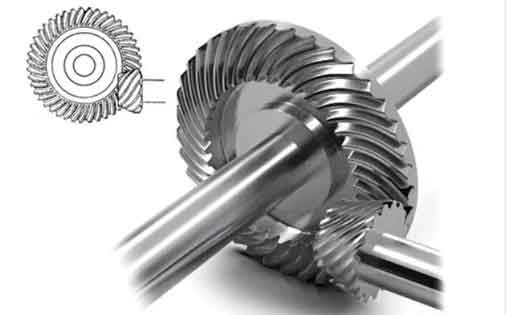
In practical engineering applications, the presence of assembly errors, deformations, and other random deviations is inevitable for spiral bevel gear transmissions. These imperfections cause the contact pattern on the tooth flank to shift from its ideal state and alter the transmission error curve, leading to adverse effects such as operational instability, vibration, and shock, which can potentially compromise the normal function of the gear pair. Considering the current state of manufacturing technology and cost constraints, it is often impractical to mitigate these negative influences solely by improving the precision of the gear components and the overall system. Therefore, a critical aspect in the design of spiral bevel gear tooth surfaces is minimizing the sensitivity of meshing quality to these unavoidable installation errors.
Traditional design methods, while effective in defining basic geometry, often lack proactive control over how the gear pair will behave under misaligned conditions. This work focuses on a fundamental topological approach: optimizing the total curvature of the difference surface between the mating tooth flanks. By strategically designing the curvature relationship, we can inherently reduce the sensitivity of the contact characteristics to positional errors, leading to more robust and predictable performance.
1. Theoretical Foundation: Sensitivity Analysis via Differential Surface Curvature
The core concept for analyzing error sensitivity lies in examining the geometry of the two mating tooth surfaces in close proximity to their intended point of contact. Consider two surfaces, $\Sigma_1$ (pinion) and $\Sigma_2$ (gear), which are in perfect tangency at a designed point $M_0$. They share a common unit normal vector $\mathbf{n}$ and a tangent plane $T$ at this point.
Let $\delta_1$ and $\delta_2$ represent the normal distances from surfaces $\Sigma_1$ and $\Sigma_2$, respectively, to the common tangent plane $T$ in the neighborhood of $M_0$. For a given direction $\boldsymbol{\alpha}$ in the tangent plane, the distances can be approximated using their normal curvatures:
$$
\delta_1 \approx \frac{1}{2} k_n^{(1)} (\Delta s)^2, \quad \delta_2 \approx \frac{1}{2} k_n^{(2)} (\Delta s)^2
$$
where $k_n^{(1)}$ and $k_n^{(2)}$ are the normal curvatures of $\Sigma_1$ and $\Sigma_2$ in the direction $\boldsymbol{\alpha}$, and $\Delta s$ is a small distance along $\boldsymbol{\alpha}$. The separation between the two surfaces, $\Delta \delta = \delta_1 – \delta_2$, is therefore:
$$
\Delta \delta = \frac{1}{2} (k_n^{(1)} – k_n^{(2)}) (\Delta s)^2 = \frac{1}{2} \Delta k_n^{(\alpha)} (\Delta s)^2
$$
The term $\Delta k_n^{(\alpha)} = k_n^{(1)} – k_n^{(2)}$ is defined as the relative normal curvature or difference curvature in direction $\boldsymbol{\alpha}$.
To fully characterize the local separation, we consider an orthogonal coordinate frame $(\boldsymbol{\alpha}_1, \boldsymbol{\alpha}_2)$ on the tangent plane. The relative curvatures along these principal directions and the relative geodesic torsion are:
$$
\Delta k_{n1} = k_{n1}^{(1)} – k_{n1}^{(2)}, \quad \Delta k_{n2} = k_{n2}^{(1)} – k_{n2}^{(2)}, \quad \Delta \tau_{g} = \tau_{g}^{(1)} – \tau_{g}^{(2)}
$$
Using Euler’s formula, the relative curvature in any direction $\boldsymbol{\alpha}$ making an angle $\theta$ with $\boldsymbol{\alpha}_1$ is:
$$
\Delta k_n^{(\alpha)} = \Delta k_{n1} \cos^2\theta + 2\Delta \tau_{g} \sin\theta \cos\theta + \Delta k_{n2} \sin^2\theta
$$
This formulation describes an imaginary difference surface, whose normal curvature in any direction equals the difference in normal curvatures of the two real tooth surfaces. The intrinsic geometry of this difference surface is pivotal. Its Gaussian curvature, known as the total relative curvature or the sensitivity coefficient $K^{(12)}$, is given by:
$$
K^{(12)} = \Delta k_{n1} \cdot \Delta k_{n2} – (\Delta \tau_{g})^2
$$
This coefficient $K^{(12)}$ is a key indicator of error sensitivity. For a perfect line contact pairing, $K^{(12)} = 0$, implying infinite sensitivity to misalignment as the contact instantly degrades to a point or loses contact. For a designed point contact pairing, $K^{(12)} \neq 0$. A larger magnitude of $K^{(12)}$ generally indicates a more localized, less conforming contact that is less sensitive to small installation errors because the contact ellipse simply shifts and distorts slightly rather than breaking down. Conversely, a value of $K^{(12)}$ approaching zero indicates a contact condition nearing line contact, which is highly sensitive. Therefore, managing the magnitude and variation of $K^{(12)}$ across the meshing cycle is central to achieving robust spiral bevel gears.
2. Sensitivity Evaluation Along the Tooth Profile
To practically apply this theory, we must evaluate $K^{(12)}$ at points along the path of contact. The process begins with defining the tooth profile direction. For consistency, we evaluate sensitivity along the gear’s tooth lengthwise direction. The following steps outline the procedure:
Step 1: Determine the position vectors and unit normals for the contact point of interest $M_0(\theta_0, \phi_0)$, as well as for the inner cone point $M_1$ and outer cone point $M_2$ on the gear tooth.
Step 2: Project points $M_1$ and $M_2$ onto the common tangent plane $T$ at $M_0$, resulting in projected points $M’_1$ and $M’_2$. The lengthwise direction vector $\boldsymbol{\alpha}$ is then:
$$
\boldsymbol{\alpha} = \frac{\overrightarrow{M’_1 M’_2}}{\|\overrightarrow{M’_1 M’_2}\|}
$$
Step 3: For the gear surface $\Sigma_2$ at $M_0$, let the principal directions be $\mathbf{e}_s$ and $\mathbf{e}_q$ with corresponding principal curvatures $\kappa_s$ and $\kappa_q$. For the pinion surface $\Sigma_1$, let the principal directions be $\mathbf{e}_f$ and $\mathbf{e}_h$ with principal curvatures $\kappa_f$ and $\kappa_h$. The angles $\theta_1$ and $\theta_2$ are defined as the angles between $\mathbf{e}_f$ and $\boldsymbol{\alpha}$, and $\mathbf{e}_s$ and $\boldsymbol{\alpha}$, respectively.
Step 4: Calculate the normal curvatures $k_n^{(1)}$ and $k_n^{(2)}$ in direction $\boldsymbol{\alpha}$ using Euler’s formula:
$$
k_n^{(1)} = \kappa_f \cos^2\theta_1 + \kappa_h \sin^2\theta_1
$$
$$
k_n^{(2)} = \kappa_s \cos^2\theta_2 + \kappa_q \sin^2\theta_2
$$
(Assuming the principal directions are aligned such that twist is minimal for this calculation). The relative curvature $\Delta k_n^{(\alpha)}$ is their difference. Using the full curvature tensors, the complete sensitivity coefficient $K^{(12)}$ is computed via its definition involving both principal relative curvatures and the relative geodesic torsion.
3. Influence of Design Parameters on Sensitivity
The local synthesis method for spiral bevel gears pre-defines second-order contact properties at a reference point $M_0$. These parameters directly influence the sensitivity coefficient $K^{(12)}$ at that point and its behavior along the contact path. The key parameters are:
- $\Delta X, \Delta Y$: Reference point location coordinates (shift along the face width and profile height).
- $\eta_2$: Direction of the contact path on the gear tooth surface.
- $m_{21}’$: First derivative of the transmission function (related to the slope of the transmission error curve).
- $a$: Semi-major axis length of the contact ellipse at the reference point under a given load.
A parametric study reveals the following general trends, which are crucial for guiding the optimization of spiral bevel gears:
| Design Parameter | Effect on Sensitivity Coefficient $K^{(12)}$ | Practical Consideration |
|---|---|---|
| $\Delta X$ (Shift towards toe/heel) | $|K^{(12)}|$ generally decreases when moving the reference point from the toe towards the heel. | Must avoid edge contact at the heel or toe which causes stress concentration. |
| $\Delta Y$ (Shift root/top) | $|K^{(12)}|$ tends to increase when moving from the root towards the topland. | Risk of tip/tooth edge contact under load; affects symmetry of transmission error. |
| $\eta_2$ (Contact path angle) | $|K^{(12)}|$ increases with a steeper (more tilted) contact path angle. | A tilted path improves overlap ratio but increases sensitivity. A path near perpendicular to the root line minimizes sensitivity but may reduce smoothness. |
| $m_{21}’$ (First derivative of ratio) | $|K^{(12)}|$ decreases as $|m_{21}’|$ increases. | Directly controls the amplitude and parabolic shape of the transmission error curve. |
| $a$ (Contact ellipse size) | $|K^{(12)}|$ decreases significantly as the designed contact ellipse size increases. | Larger ellipse indicates better load distribution and lower contact stress, strongly promoting lower sensitivity. |
This analysis provides qualitative guidance. However, an optimal design for spiral bevel gears requires a holistic approach that balances low sensitivity with other critical performance metrics like transmission error amplitude, contact pattern location and size, and structural strength.
4. Optimization Strategy for Low-Sensitivity Spiral Bevel Gears
The goal is to obtain a pinion machine-tool setting that generates a tooth surface which, when paired with the gear, exhibits low sensitivity to assembly errors across the entire meshing cycle, while maintaining a favorable, low-amplitude transmission error. The proposed optimization-driven design flow is as follows:
Stage 1: Optimization of the Sensitivity Coefficient Uniformity.
The aim is to minimize the fluctuation of $K^{(12)}$ along the path of contact relative to its value at the reference point. This promotes stable contact behavior. The first derivative of the transmission ratio, $m_{21}’$, is chosen as the primary optimization variable due to its significant influence.
- Set initial local synthesis parameters: $\eta_2$, $2a$, and an initial guess for $m_{21}’$.
- Perform local synthesis to calculate the pinion machine settings.
- Execute Tooth Contact Analysis (TCA) to obtain the unloaded path of contact and calculate $K^{(12)}_i$ at $n$ discrete points along the mesh cycle.
- Define the objective function to minimize the variance of the sensitivity coefficient:
$$
\min_{m_{21}’} f(m_{21}’) = \min_{m_{21}’} \sum_{i=1}^{n} \left\| K^{(12)}_i – K^{(12)}_0 \right\|^2
$$
where $K^{(12)}_0$ is the value at the design reference point. - Apply constraints based on allowable transmission error amplitude to bound the search space for $m_{21}’$.
- Solve this single-variable constrained optimization problem using a direct search method (e.g., Golden Section, Powells) to find the optimal $m_{21}’$.
Stage 2: Optimization for Ideal Transmission Error.
The result from Stage 1 ensures good sensitivity characteristics but may not yield an ideal transmission error (TE) curve. We then optimize the higher-order modification coefficients (often called modified roll coefficients) to tailor the TE.
- The second-order modification coefficient $C$ is optimized to achieve the desired parabolic amplitude $\Delta \delta$ of the transmission error curve: $TE(\phi) \approx -\frac{1}{2} m_{21}’ \phi^2 + C \phi + …$
- The third-order modification coefficient $D$ is subsequently adjusted to ensure the TE curve is symmetric about the mean contact point, preventing a biased contact pattern that is prone to edge contact under load.
Stage 3: Adjustment for Practical Manufacturability and Tolerance.
Finally, the design is checked and adjusted for practical constraints.
- Tolerance Analysis: The contact pattern and TE are evaluated under the maximum expected assembly errors (pinion axial offset $H_p$, gear axial offset $H_g$, offset $V$, and shaft angle error $\Sigma$). The contact path angle $\eta_2$ is slightly adjusted if necessary to ensure the contact ellipse remains within acceptable boundaries under all tolerance stack-up conditions.
- Machine Setting Feasibility: For traditional mechanical cradle-type machines, the calculated vertical offset $E_{m1}$ must fall within the physical limits of the machine. The parameter $\eta_2$ also has a strong influence on $E_{m1}$. If the required $E_{m1}$ is out of range, $\eta_2$ is iteratively adjusted within the sensitivity and tolerance constraints to find a feasible solution.
This comprehensive optimization yields a set of pinion machining parameters for spiral bevel gears that deliver low error sensitivity, controlled transmission error, and a robust contact pattern. If the optimal higher-order coefficients ($C$, $D$) cannot be physically realized on a mechanical machine, the settings can be directly translated for execution on modern CNC gear grinding or cutting machines, which offer full freedom in generating the desired flank modifications.
5. Numerical Case Study
To demonstrate the effectiveness of the proposed method, a spiral bevel gear pair is designed and analyzed. The basic blank data is provided below:
| Parameter | Pinion | Gear |
|---|---|---|
| Number of Teeth, $Z$ | 23 | 86 |
| Module, $m_n$ (mm) | 4.25 | |
| Normal Pressure Angle, $\alpha_n$ (°) | 20 | |
| Mean Spiral Angle, $\beta_m$ (°) | 25 | |
| Spiral Hand | Left | Right |
| Shaft Angle, $\Sigma$ (°) | 51°9’7″ | |
The local synthesis parameters for the drive (concave) and coast (convex) sides after optimization are:
| Parameter | Drive Side | Coast Side |
|---|---|---|
| Contact Path Direction, $\eta_2$ (°) | 20.6432 | 15.8493 |
| Gear Ratio 1st Deriv., $m_{21}’$ | -0.004238 | -0.005148 |
| Contact Ellipse Major Axis, $2a$ (mm) | 12.9 | |
The final machine settings for the pinion, including the optimized modification coefficients, are summarized below:
| Pinion Machine Settings | ||
|---|---|---|
| Parameter | Concave Flank | Convex Flank |
| Cutter Radius, $R_{p}$ (mm) | 158.6791 | 146.6578 |
| Cutter Pressure Angle, $\alpha_{1}$ (°) | 18.0 | 22.0 |
| Radial Setting, $S_{r1}$ (mm) | 242.7659 | 231.2996 |
| Machine Root Angle, $\gamma_1$ (°) | 9.75 | |
| 2nd Order Mod. Coeff., $C$ | 0.103244 | -0.114567 |
| 3rd Order Mod. Coeff., $D$ | 0.075732 | 0.102421 |
Results and Discussion
Transmission Error and Contact Pattern: The TCA results confirm successful design. For the drive side, the unloaded contact pattern is located in the central region of the tooth flank, slightly biased towards the toe. Under load, it is expected to shift favorably towards the center and heel. The transmission error curve is parabolic and symmetric with an amplitude of 7.269 arc-seconds, which meets a typical design target of ≤ 8.0 arc-seconds. The coast side shows similar quality with a slightly higher TE amplitude of 10.706 arc-seconds, which is often acceptable for the non-driving side.
Sensitivity Coefficient Analysis: The primary outcome of the optimization is illustrated in the behavior of the sensitivity coefficient $K^{(12)}$. The calculated values of $K^{(12)}$ along the path of contact for both flanks are plotted. Crucially, the variation of $K^{(12)}$ over the entire meshing cycle is minimal. This small fluctuation indicates that the contact condition—defined by the curvature relationship of the spiral bevel gears—remains consistently stable. A nearly constant $K^{(12)}$ implies the contact ellipse dimensions and orientation change very little during mesh, which directly translates to low sensitivity to assembly errors. This structural robustness is a direct consequence of optimizing for uniformity in the total curvature of the difference surface.
Tolerance Capacity: The final design was tested with imposed assembly errors. The calculated allowable misalignment limits, within which the contact pattern remains acceptable and no edge contact occurs, are substantial, as shown below:
| Assembly Error Parameter | Positive Limit | Negative Limit |
|---|---|---|
| Gear Axial Offset, $H_g$ (mm) | +0.4852 | -0.3644 |
| Pinion Axial Offset, $H_p$ (mm) | +0.4254 | -0.7121 |
| Offset, $V$ (mm) | +0.8032 | -0.5486 |
| Shaft Angle Error, $\Delta \Sigma$ (arc-min) | +2.8647 | -2.3245 |
These tolerance ranges are practically achievable in industrial assembly, confirming that the optimized spiral bevel gears are not only theoretically robust but also manufacturable and assembleable with standard precision levels.
6. Conclusion
This work presents a comprehensive methodology for the optimization design of spiral bevel gears focused on minimizing their sensitivity to installation errors. The key conclusions are:
- Fundamental Metric: The total curvature of the difference surface $K^{(12)}$ serves as a fundamental and effective metric for quantifying the intrinsic error sensitivity of a spiral bevel gear pair. Managing its value and variation is critical for robust design.
- Optimization Strategy: A multi-stage optimization procedure is essential. Optimizing the first derivative of the transmission ratio $m_{21}’$ is highly effective for stabilizing the sensitivity coefficient $K^{(12)}$ across the mesh cycle. Subsequent optimization of higher-order modification coefficients ($C$, $D$) is necessary to fine-tune the transmission error amplitude and symmetry without compromising the achieved sensitivity performance.
- Design Trade-offs: A straight contact path (low $\eta_2$) minimizes sensitivity but may reduce the overlap ratio. A compromise must be struck based on application requirements for smoothness versus robustness. A larger design contact ellipse (larger $a$) consistently promotes lower sensitivity and higher load capacity.
- Practical Outcome: The proposed method successfully generates machine settings for spiral bevel gears that exhibit:
- Minimal fluctuation in the sensitivity coefficient during meshing.
- A controlled, low-amplitude, and symmetric transmission error curve.
- A well-centered contact pattern with significant tolerance to assembly misalignments.
By proactively designing the tooth surface topology from the perspective of differential geometry and error sensitivity, this approach enables the development of high-performance spiral bevel gears that maintain their meshing quality under real-world imperfect mounting conditions, thereby enhancing the reliability and longevity of the transmission system.