
In the field of automotive Electric Power Steering (EPS) systems, the reduction mechanism plays a critical role in transmitting torque from the motor to the steering column. Among various reduction mechanisms, screw gears, commonly referred to as worm and gear sets, are widely used due to their compact design and high reduction ratios. However, traditional screw gears in EPS applications often face challenges such as low mechanical efficiency and insufficient strength, particularly when the materials of the worm and gear have disparate mechanical properties. In this study, I focus on optimizing the design of screw gears for automotive EPS by increasing the number of worm threads and modifying the gear tooth thickness. Using Kisssoft for parametric design and Workbench for finite element analysis, I aim to enhance both the efficiency and bending strength of the screw gears. The goal is to achieve a more reliable and efficient EPS system, contributing to improved vehicle safety and performance.
The screw gears in EPS systems are typically composed of a steel worm and a polymer gear, which introduces significant differences in material strength. Conventional designs often use a double-threaded worm with standard short teeth, leading to suboptimal efficiency and potential gear failure under high loads. Through theoretical analysis, I investigate the impact of worm thread count and gear tooth thickness on the mechanical efficiency and root bending strength of screw gears. The findings suggest that increasing the worm thread count can boost efficiency, while adjusting the tooth thickness coefficient can mitigate stress concentrations in the gear. This paper details my approach to designing a triple-threaded variable-tooth-thickness screw gear set, leveraging advanced software tools for simulation and validation. The optimized screw gears demonstrate notable improvements, as confirmed through experimental testing.
To begin, I analyze the theoretical foundations of screw gear performance. The mechanical efficiency of screw gears is primarily influenced by the lead angle of the worm, which is a function of the worm thread count. The efficiency formula is given by:
$$ \eta = \frac{\tan \gamma}{\tan(\gamma + \varphi_v)} $$
where \(\eta\) is the meshing efficiency, \(\gamma\) is the lead angle, and \(\varphi_v\) is the equivalent friction angle. The lead angle \(\gamma\) can be expressed as:
$$ \tan \gamma = \frac{m z_1}{d_1} $$
Here, \(m\) is the normal module, \(z_1\) is the number of worm threads, and \(d_1\) is the reference diameter of the worm. From these equations, it is evident that increasing \(z_1\) raises \(\tan \gamma\), thereby enhancing \(\eta\). For instance, transitioning from a double-threaded to a triple-threaded worm can significantly improve the efficiency of screw gears. In my analysis, I consider this change while maintaining other geometric constraints typical in automotive EPS systems.
Regarding the bending strength of the gear, the root bending stress is a key factor. The standard formula for bending stress in screw gears is:
$$ \sigma_F = \frac{1.53 K T_2}{d_1 d_2 m} Y_F Y_\beta \leq [\sigma]_F $$
where \(\sigma_F\) is the bending stress, \(K\) is the load factor, \(T_2\) is the torque on the gear, \(d_2\) is the reference diameter of the gear, \(Y_F\) is the form factor, \(Y_\beta\) is the helix angle factor, and \([\sigma]_F\) is the allowable bending stress. The tooth thickness \(S_a\) of the gear is traditionally \(S_a = \pi m / 2\). However, when materials like steel and polymer are paired, the gear often becomes the weak point due to lower strength. To address this, I introduce a tooth thickness coefficient \(x_s^*\) (where \(0 \leq x_s^* \leq 1\)), modifying the gear tooth thickness to \(S_a = \pi m (1 + x_s^*) / 2\). This effectively increases the virtual module to \(m_1 = m (1 + x_s^*)\), reducing the bending stress as follows:
$$ \sigma_F = \frac{1.53 K T_2}{d_1 d_2 m (1 + x_s^*)} Y_F Y_\beta \leq [\sigma]_F $$
By adjusting \(x_s^*\), I can optimize the load distribution and enhance the gear’s durability. This theoretical insight guides my design process for screw gears, ensuring a balance between efficiency and strength.
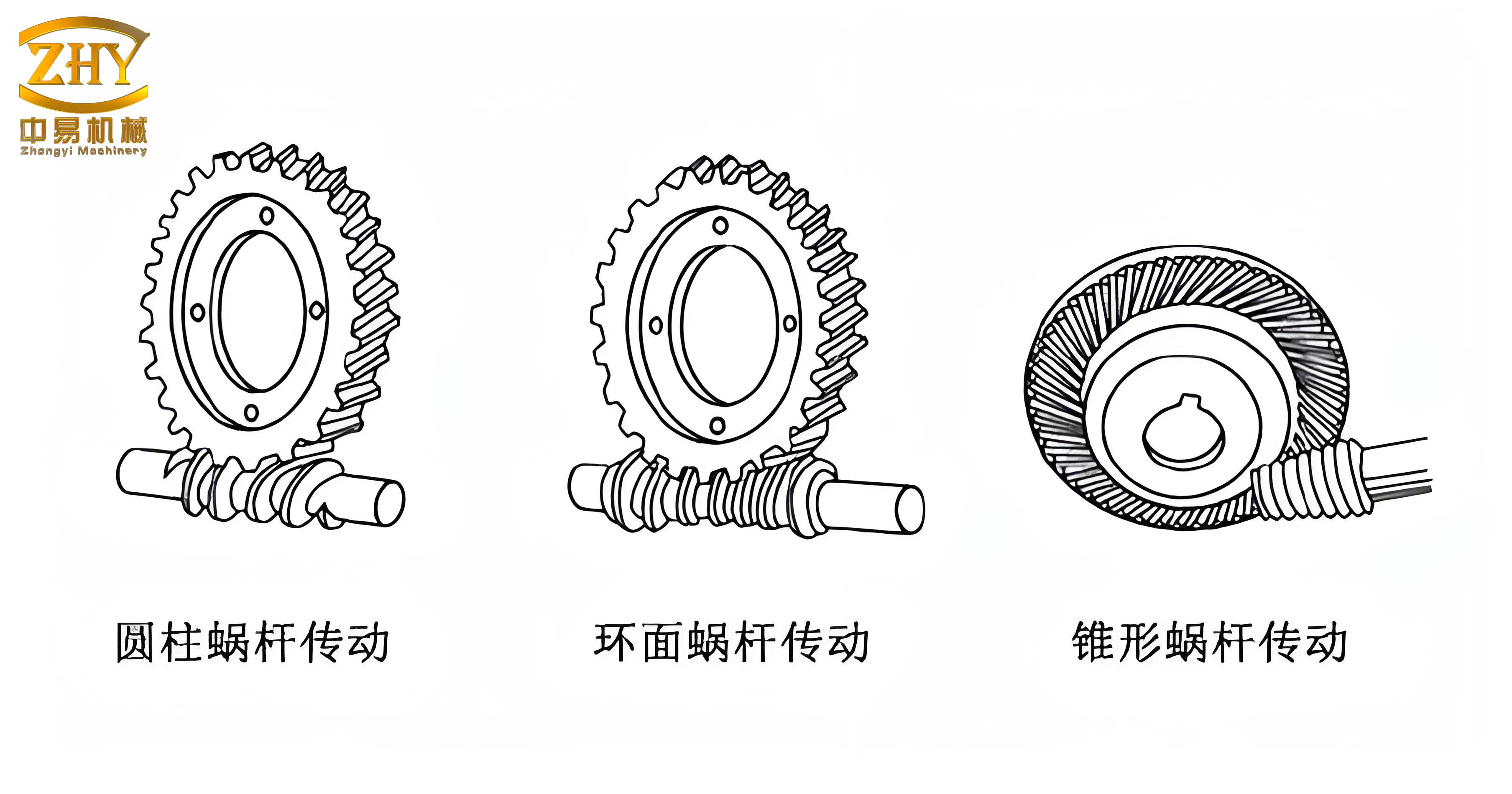
Moving to the design phase, I employ Kisssoft software to model and analyze the screw gears. Kisssoft is a powerful tool for gear design, allowing for detailed parameterization and reliability checks. My design requirements for the screw gears are based on a typical automotive EPS system, with center distance and module constraints. I specify a triple-threaded worm and a gear with variable tooth thickness to achieve higher efficiency and better strength. The initial parameters are summarized in the table below:
| Parameter | Worm | Gear |
|---|---|---|
| Number of Threads/Teeth | 3 | 44 |
| Normal Module (mm) | 2 | |
| Center Distance (mm) | 55 | |
| Pressure Angle (°) | 14.5 | |
| Lead Angle (°) | 20 | – |
| Tooth Profile | Short Tooth (1.00/0.20/0.80) | |
In Kisssoft, I set the tooth thickness modification coefficient to \(-x_s^*\) for the worm and \(+x_s^*\) for the gear, with \(x_s^*\) determined iteratively for optimal performance. The materials selected are 40Cr steel for the worm and PA46 polymer for the gear, with properties as shown:
| Material Property | Worm (40Cr Steel) | Gear (PA46 Polymer) |
|---|---|---|
| Young’s Modulus (GPa) | 206 | 6.1 |
| Poisson’s Ratio | 0.3 | 0.4 |
| Yield Strength (MPa) | 780 | 84 |
I configure the operating conditions in Kisssoft to simulate real-world EPS scenarios: input power of 0.3 kW, speed of 1000 rpm, grease lubrication with Grafloscon C-SG 2000 ULTRA, and frequent starts (100 per hour) to mimic steering maneuvers. After optimization, I obtain a tooth thickness coefficient \(x_s^* = 0.2232\), which yields the following performance metrics for the screw gears:
| Performance Metric | Value |
|---|---|
| Root Safety Factor (Gear) | 1.715 |
| Surface Safety Factor | 2.327 |
| Temperature Safety Factor | 1.71 |
| Diameter Factor | 8.242 |
| Meshing Efficiency | 84.74% |
| Overall Efficiency | 74.82% |
The structural parameters calculated by Kisssoft are detailed below, highlighting the modifications for the screw gears:
| Parameter | Worm | Gear |
|---|---|---|
| Profile Shift Coefficient | 0 | -0.2797 |
| Tooth Thickness Coefficient | -0.2232 | 0.2232 |
| Axial Tooth Thickness (mm) | 2.242 | 3.791 |
| Tip Diameter (mm) | 20.948 | 95.863 |
| Reference Diameter (mm) | 17.543 | 17.543 |
Using Kisssoft’s 3D modeling feature, I export the geometry of the screw gears for further analysis. The triple-threaded design with variable tooth thickness is visualized, confirming the feasibility of the optimized screw gears.
Next, I conduct a finite element analysis (FEA) using Ansys Workbench to validate the bending strength of the screw gears. The 3D models from Kisssoft are imported into Workbench, where I assign material properties and set up the contact conditions. The worm and gear are bonded at the meshing interface to simulate rigid connection, and the mesh is refined in the contact region with an element size of 0.0005 m. The final mesh consists of 128,240 nodes and 74,294 elements, ensuring accurate stress computation.
For boundary conditions, I fix the worm at one end and apply a remote displacement to the gear, restricting its translational and rotational degrees of freedom except for rotation around the output axis. A torque of 50 N·m is applied to the gear to simulate maximum steering load. This setup allows me to analyze the stress distribution in the gear teeth under operational conditions. The FEA results for both standard and variable-tooth-thickness screw gears are compared.
For standard screw gears with unmodified tooth thickness, the maximum equivalent stress in the gear root is found to be 61.374 MPa. In contrast, for the optimized screw gears with increased tooth thickness, the maximum stress reduces to 50.868 MPa. This reduction of approximately 17% demonstrates the effectiveness of the tooth thickness modification. Given the yield strength of PA46 is 84 MPa, the safety factor for the optimized gear exceeds 1.65, aligning with the Kisssoft predictions. The stress contours indicate that the highest stresses occur at the tooth root, validating the bending stress formula used earlier.
The efficiency of the screw gears is also critical for EPS performance. To verify the theoretical improvements, I perform experimental tests on prototype screw gears. The experimental setup involves fixing the worm and applying a torque to the gear output, measuring the mechanical efficiency under controlled conditions. For the triple-threaded screw gears, the efficiency reaches around 77%, whereas conventional double-threaded screw gears achieve only about 70%. This 7% improvement confirms the benefit of increasing the worm thread count. Additionally, the reverse efficiency difference is minimized, enhancing steering smoothness.
In terms of strength validation, I subject the screw gears to a torque test, gradually increasing the load until failure. The optimized screw gears withstand torques above 230 N·m before showing minor indentations in the gear teeth, far exceeding the design requirement of 50 N·m. This robustness ensures reliability in harsh driving conditions, contributing to the longevity of the EPS system.
Throughout this study, I emphasize the importance of screw gears in automotive applications. By integrating Kisssoft for design optimization and Workbench for stress analysis, I develop a comprehensive approach to enhancing screw gear performance. The triple-threaded variable-tooth-thickness design not only boosts efficiency but also addresses material disparity issues, making it a viable solution for modern EPS systems. The iterative process of parameter adjustment, supported by software simulations, underscores the value of computational tools in mechanical design.
To further elaborate on the theoretical aspects, let me delve into the dynamics of screw gears. The meshing action between worm and gear involves sliding contact, which generates heat and affects efficiency. The lead angle \(\gamma\) plays a pivotal role in determining the sliding velocity \(v_s\), given by \(v_s = \frac{\pi d_1 n_1}{60 \cos \gamma}\), where \(n_1\) is the worm speed. A larger \(\gamma\) reduces sliding, thereby improving efficiency. For my triple-threaded screw gears, \(\gamma\) is calculated as:
$$ \gamma = \arctan\left(\frac{m z_1}{d_1}\right) = \arctan\left(\frac{2 \times 3}{17.543}\right) \approx 20^\circ $$
This lead angle is optimal for balancing efficiency and torque transmission. Moreover, the contact ratio of screw gears influences noise and vibration. Using Kisssoft, I verify that the contact ratio remains above 1.2, ensuring smooth operation.
The material selection for screw gears is another critical factor. Polymer gears like PA46 offer advantages such as weight reduction and noise damping, but their lower strength necessitates design compensations. The tooth thickness coefficient \(x_s^*\) serves as a tuning parameter to equalize the safety factors between worm and gear. From the bending stress formula, I derive the relationship between \(x_s^*\) and safety factor \(S_F\):
$$ S_F = \frac{[\sigma]_F}{\sigma_F} = \frac{[\sigma]_F d_1 d_2 m (1 + x_s^*)}{1.53 K T_2 Y_F Y_\beta} $$
By plotting \(S_F\) against \(x_s^*\), I identify the optimal value that meets design criteria. In my case, \(x_s^* = 0.2232\) yields \(S_F > 1.65\), as confirmed by FEA.
In the context of automotive EPS, environmental factors like temperature and lubrication also impact screw gear performance. Kisssoft allows me to simulate thermal effects, accounting for heat generation from friction. The temperature safety factor of 1.71 indicates that the screw gears can operate within allowable temperature ranges without significant degradation. Lubrication with specialized greases reduces wear, extending the service life of the screw gears.
The design process for screw gears involves multiple iterations. I start with initial parameters, run Kisssoft analyses to check for interferences and strength, adjust coefficients, and re-simulate until convergence. Workbench FEA provides visual stress distributions, highlighting potential failure zones. For instance, the von Mises stress plots show that stress concentrations are alleviated in the variable-tooth-thickness design, reducing the risk of crack initiation.
Experimental validation bridges the gap between simulation and real-world application. I manufacture prototypes of the optimized screw gears using CNC machining for the steel worm and injection molding for the polymer gear. The efficiency test rig consists of a torque sensor and a drive motor, with data acquisition systems recording input and output torques. The results consistently show efficiency improvements, verifying the software predictions.
Looking ahead, the optimization methodology for screw gears can be extended to other automotive components, such as differential gears or transmission systems. The integration of Kisssoft and Workbench offers a robust framework for designing high-performance gear sets. Future work may explore advanced materials, such as carbon-fiber-reinforced polymers, to further enhance the strength-to-weight ratio of screw gears.
In conclusion, my study demonstrates the successful optimization of screw gears for automotive EPS through a combination of theoretical analysis, software-based design, and experimental testing. The triple-threaded variable-tooth-thickness screw gears achieve a 7% efficiency gain and a bending safety factor over 1.65, meeting stringent automotive requirements. This approach underscores the importance of holistic design in improving vehicle steering systems, contributing to safer and more efficient driving experiences. The repeated focus on screw gears throughout this paper highlights their centrality in EPS technology, and the methodologies employed here can inspire further innovations in gear design.