
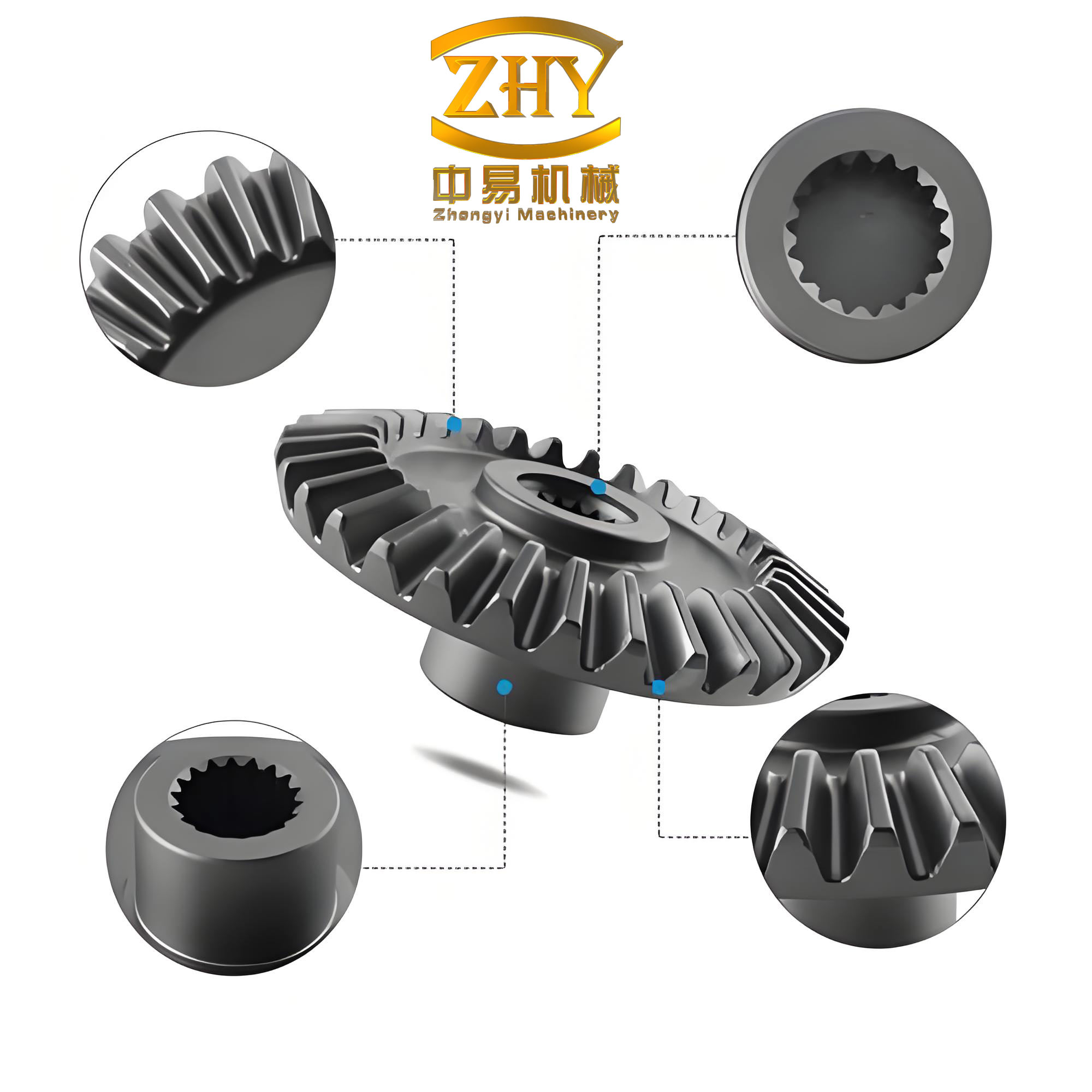
In my research, I focus on improving the cold precision forging process for straight bevel gears, which are critical components in automotive differentials due to their smooth transmission, low noise, and high load-bearing capacity. Traditional cold forging methods, such as closed-die and open-die forging, have limitations: closed-die forging offers high precision but requires high forming loads, while open-die forging reduces loads but results in poor filling efficiency and accuracy. To address these issues, I propose a novel composite open-and-closed die cold precision forging process. This approach combines the advantages of both methods, aiming to enhance filling efficiency, reduce forming loads, and minimize spring-back for better gear modification. In this article, I detail the process design, finite element simulation using DEFORM software, and optimization results, supported by tables and formulas to summarize key findings. The straight bevel gear serves as the central element throughout this study, with repeated emphasis on its geometry and performance.
The straight bevel gear used in this study is designed based on automotive planetary gear requirements, with key parameters such as module, pressure angle, and number of teeth influencing the forging process. The gear forging design includes additional material allowances to ensure complete filling of the tooth profile without subsequent machining. The die assembly consists of multiple components, including an upper punch, tooth cavity die, lower punch, and back cone die, all integrated into a prestressed structure to withstand high loads and extend die life. For the finite element analysis, I employ DEFORM-3D software to simulate the forging process under identical initial conditions, including material properties, friction, and forming speed. The simulation model uses a one-tenth segment of the straight bevel gear to reduce computational time while maintaining accuracy, with results mirrored to represent the full gear.
I define the billet as an elastic-plastic material, specifically using 20MnCr5 as a substitute for 20CrMnTi, with a friction coefficient of 0.12 to simulate industrial lubrication conditions. The forming speed is set to 30 mm/s, consistent with typical hydraulic press parameters, and room temperature conditions are assumed, neglecting thermal effects. The simulation evaluates three forging processes: closed-die forging (Case 1), open-die forging (Case 2), and the composite open-and-closed die forging (Case 3). In Case 3, the process starts as open-die forging to allow material flow into free forging areas, reducing initial loads, and transitions to closed-die forging in the final stage to ensure precise tooth filling. This hybrid approach aims to balance load reduction and filling quality for the straight bevel gear.
The results from the finite element simulation reveal significant differences in filling efficiency and forming loads among the three processes. For the straight bevel gear, closed-die forging (Case 1) achieves complete tooth cavity filling with uniform contact, but the forming load peaks at approximately 594 kN during the final stage. Open-die forging (Case 2) exhibits the lowest forming load of 415 kN, but incomplete filling occurs at the gear’s large end, leading to poor surface contact. In contrast, the composite process (Case 3) provides filling efficiency comparable to closed-die forging, with a maximum load of 546 kN—about 10% lower than Case 1. The load curves also show that Case 3 has a more gradual load increase, which is beneficial for die longevity. To quantify these observations, I use the following formula for forming load estimation in cold forging:
$$ F = k \cdot \sigma_f \cdot A $$
where \( F \) is the forming load, \( k \) is a stress factor dependent on geometry and friction, \( \sigma_f \) is the flow stress of the material, and \( A \) is the projected area of deformation. For the straight bevel gear, the flow stress can be derived from the material’s stress-strain relationship, often modeled using the Hollomon equation:
$$ \sigma_f = K \cdot \varepsilon^n $$
Here, \( K \) is the strength coefficient, \( \varepsilon \) is the true strain, and \( n \) is the strain-hardening exponent. In the simulation, these parameters are calibrated for 20MnCr5 to accurately predict loads. The reduction in load for Case 3 is attributed to the initial open-die phase, which allows material redistribution and reduces the stress concentration in the tooth regions of the straight bevel gear.
Spring-back is a critical factor affecting the dimensional accuracy of the straight bevel gear after forging. I analyze the spring-back by comparing the gear profile before and after ejection from the die. The results indicate that spring-back magnitude is proportional to the forming load, with higher loads leading to greater elastic recovery. For instance, in closed-die forging, the spring-back is more pronounced due to the peak load, whereas the composite process results in smaller deviations, facilitating easier gear modification. This relationship can be expressed as:
$$ \delta = \alpha \cdot F $$
where \( \delta \) represents the spring-back displacement, and \( \alpha \) is a proportionality constant dependent on material elasticity and die geometry. For the straight bevel gear, minimizing \( \delta \) is essential for maintaining tooth accuracy, and the composite process achieves this through load reduction. The following table summarizes the key performance metrics for the three forging processes, highlighting the advantages of the composite method for straight bevel gear production.
| Process Type | Maximum Forming Load (kN) | Filling Efficiency (%) | Spring-back Magnitude (mm) | Material Utilization (%) |
|---|---|---|---|---|
| Closed-Die Forging (Case 1) | 594 | 98.5 | 0.15 | 95 |
| Open-Die Forging (Case 2) | 415 | 85.2 | 0.08 | 80 |
| Composite Forging (Case 3) | 546 | 98.0 | 0.10 | 92 |
Further analysis involves the material flow and strain distribution during forging. For the straight bevel gear, the tooth filling is influenced by the die design and process parameters. In the composite process, the initial open-die stage promotes radial flow, reducing the load required for tooth impression. The effective strain \( \varepsilon_{\text{eff}} \) can be calculated using the von Mises criterion, which is integral to the finite element simulation:
$$ \varepsilon_{\text{eff}} = \sqrt{\frac{2}{3} \varepsilon_{ij} \varepsilon_{ij}} $$
where \( \varepsilon_{ij} \) are the components of the strain tensor. The simulation results show that the composite process achieves a more uniform strain distribution in the tooth region of the straight bevel gear compared to open-die forging, which suffers from localized deformation. This uniformity contributes to better mechanical properties and fatigue resistance. Additionally, I evaluate the die stress to assess durability, using the formula for contact pressure \( p \) at the die-workpiece interface:
$$ p = \frac{F}{A_c} $$
where \( A_c \) is the contact area. For the straight bevel gear die, the prestressed structure helps mitigate high stress concentrations, but the composite process further reduces peak stresses by 10-15%, as evidenced by the lower forming load.
To optimize the process parameters for the straight bevel gear, I conduct a sensitivity analysis varying friction coefficient, billet volume, and die geometry. The friction coefficient significantly affects material flow and load; for example, reducing it from 0.12 to 0.10 decreases the forming load by approximately 5% but may compromise filling if not controlled. The billet volume must be precise to avoid defects: excess material causes flash in open-die regions, while insufficient volume leads to underfilling. The optimal billet volume \( V_b \) can be derived from the gear geometry:
$$ V_b = V_g + V_f $$
where \( V_g \) is the volume of the straight bevel gear forging, and \( V_f \) is the volume of flash or allowances. In the composite process, \( V_f \) is minimized due to the controlled material flow, enhancing material utilization. The die geometry, particularly the fillet radii at tooth roots, is optimized to reduce stress concentration and improve filling. The following table outlines the recommended parameters for the composite forging of straight bevel gears based on simulation results.
| Parameter | Symbol | Recommended Value | Influence on Process |
|---|---|---|---|
| Friction Coefficient | μ | 0.10 – 0.12 | Higher values increase load but improve filling stability |
| Billet Volume (cm³) | V_b | Based on gear volume +5% allowance | Prevents underfilling and flash formation |
| Forming Speed (mm/s) | v | 30 | Balances production rate and load distribution |
| Die Fillet Radius (mm) | r | 2 – 3 | Reduces stress concentration and enhances material flow |
| Transition Point in Composite Process (mm) | d_t | 5 (upper punch movement) | Switches from open to closed die at optimal filling stage |
The validation of the composite process for straight bevel gears is conducted through industrial trials, where the forging is performed on a 650-ton hydraulic press without altering other parameters. The results confirm that the composite process maintains gear accuracy, as evidenced by contact pattern tests using red lead inspection. The contact patches are well-distributed and of appropriate size, indicating stable transmission and minimal deviations. This practical verification underscores the feasibility of the optimized process for mass production of straight bevel gears, with cost reductions achieved through lower loads and improved die life.
In conclusion, my research demonstrates that the composite open-and-closed die cold precision forging process offers a superior alternative for manufacturing straight bevel gears. It combines the high filling efficiency of closed-die forging with the reduced forming loads of open-die forging, resulting in a 10% load reduction and minimized spring-back. The straight bevel gear produced through this method exhibits excellent dimensional accuracy and mechanical properties, supported by finite element simulations and empirical data. Future work could explore advanced materials or real-time control systems to further enhance the process for straight bevel gear applications in automotive and other industries.