
In the field of precision mechanical transmission, the harmonic drive gear stands out due to its unique principle of operation, which relies on the elastic deformation of a flexible component to transmit motion and power. This system typically comprises three fundamental elements: the flexspline (柔轮), the circular spline (刚轮), and the wave generator (波发生器). As an engineer specializing in mechanical design and optimization, I have long been fascinated by the efficiency and compactness of harmonic drive gears. However, their structural peculiarities present significant challenges in parameter design, often leading to suboptimal performance if traditional methods are employed. In this study, I aim to address these challenges by developing a robust optimization framework that minimizes the volume of a harmonic drive gear, a critical factor for applications in aerospace, robotics, and other weight-sensitive industries. The core of my approach lies in formulating a mixed-discrete variable optimization model and enhancing a genetic algorithm to handle the discrete nature of design parameters effectively, ensuring that the results are not only theoretically sound but also directly applicable to manufacturing.
The harmonic drive gear’s operation involves the wave generator deforming the flexspline, causing it to mesh with the circular spline in a progressive manner. This results in high reduction ratios, compact size, and zero-backlash characteristics, but it also subjects the flexspline to cyclic stresses, making it the critical component for durability and performance. Traditional optimization studies have often treated design variables as continuous, leading to parameters that require rounding or adjustment before practical use, which can compromise optimality or even violate constraints. Therefore, I propose a method that explicitly accounts for the mixed-discrete nature of these variables—where some are integers (e.g., tooth counts), some are standard discrete values (e.g., module), and others are continuous but require precision control for manufacturing (e.g., wall thickness). This realism is essential for bridging the gap between computational optimization and engineering practice.
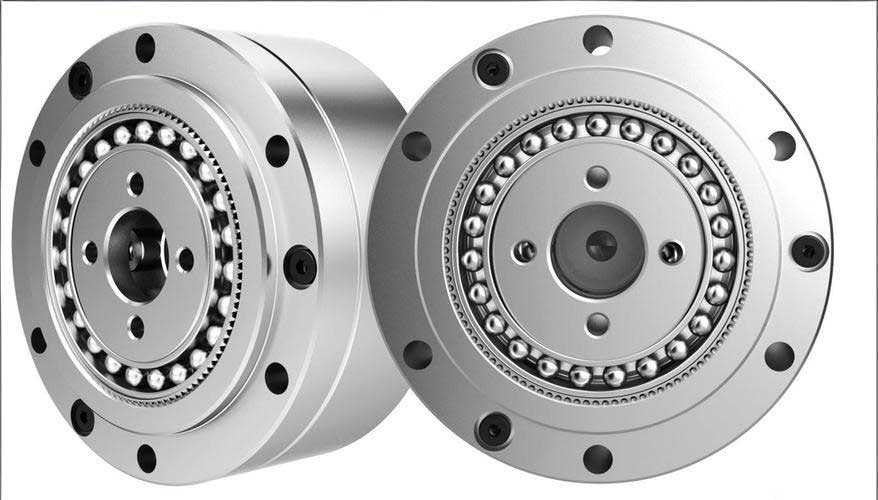
To begin, I establish the mathematical model for optimizing a single-stage harmonic drive gear reducer with a wave generator input, fixed circular spline, and flexspline output. For this analysis, I consider a double-wave, four-contact wave generator, which is common in industrial applications. The primary goal is to minimize the overall volume, which correlates directly with mass—a key metric for lightweight design. After simplifying the geometry, the objective function can be expressed in terms of design variables. Let \( Z_G \) and \( Z_R \) denote the tooth numbers of the circular spline and flexspline, respectively; \( m \) represent the module; \( L \) be the length of the flexspline shell; \( b \) signify the width of the gear; and \( h_2 \) indicate the wall thickness of the flexspline. The volume minimization function is derived as follows:
$$ f(\mathbf{x}) = \pi L h_2 \left( Z_R m – \frac{9}{4}m – 3h_2 \right) + 22\pi b m^2 Z_G $$
where the design vector is \( \mathbf{x} = [Z_G, Z_R, m, L, b, h_2]^T = [x_1, x_2, x_3, x_4, x_5, x_6]^T \). In this formulation, \( Z_G \), \( Z_R \), \( L \), and \( b \) are integer variables; \( m \) is a non-equidistant discrete variable due to standard module values; and \( h_2 \) is continuous but, for practical purposes, controlled to one decimal place. This mix of variable types defines a mixed-discrete optimization problem, which cannot be solved effectively with conventional continuous-variable techniques. While volume minimization is my focus here, the framework can be extended to other objectives like maximizing transmission efficiency or minimizing backlash, or even to multi-objective optimization for complex design requirements.
The constraints for the harmonic drive gear optimization are multifaceted, encompassing stress analysis, geometric compatibility, and performance specifications. First, the flexspline undergoes alternating stresses during operation, making its strength a paramount concern. The stress components include bending stresses from radial deformation and torsional stresses from load transmission. Based on mechanical principles, I calculate the following stresses for the flexspline:
$$ \sigma_{RZ} = K_M K_d C_R \frac{w_0 E h_2}{r_m^2} $$
$$ \sigma_{RU} = K_M K_d C_R \frac{w_0 E h_2}{r_m^2} $$
$$ \tau_{ZU} = K_M K_d C_S \frac{w_0 E h_2}{r_m L} $$
$$ \tau_M = K_u K_d \frac{M_1}{2\pi h_2 r_m^2} $$
Here, \( \sigma_{RZ} \) and \( \sigma_{RU} \) are normal stresses along the meridian and circumferential directions, respectively; \( \tau_{ZU} \) and \( \tau_M \) are shear stresses; \( M_1 \) is the actual load torque; \( w_0 \) is the maximum radial displacement (approximately half the wave height); \( r_m \) is the neutral layer radius of the flexspline shell; \( E \) is the elastic modulus; and \( K_M \), \( K_d \), \( K_u \), \( C_R \), \( C_S \) are correction factors accounting for structural effects and load variations. The stress amplitudes and mean stresses are derived as \( \sigma_a = \sigma_{RU} \), \( \sigma_m = 0 \), \( \tau_a = \tau_m = 0.5(\tau_M + \tau_{ZU}) \). The safety factors for normal and shear stresses are:
$$ S_R = \frac{\sigma_{-1}}{K_R \sigma_a} $$
$$ S_S = \frac{\tau_{-1}}{K_S \tau_a + 0.2 \tau_m} $$
where \( \sigma_{-1} \) and \( \tau_{-1} \) are the endurance limits for bending and shear, and \( K_R \), \( K_S \) are stress concentration factors. The overall strength constraint for the flexspline is given by the combined safety factor:
$$ S = \frac{S_R S_S}{\sqrt{S_R^2 + K_Z S_S^2}} \geq 1.5 $$
with \( K_Z \) as a correction coefficient for additional stress influences.
Second, to prevent tooth tip interference during meshing, a geometric constraint must be satisfied. This ensures that the engagement and disengagement of teeth occur smoothly without collision. From kinematic analysis, the condition can be expressed as:
$$ \theta_{L1} – \theta_{L2} \geq 0 $$
where \( \theta_{L1} \) and \( \theta_{L2} \) are angles related to the tooth profiles of the circular spline and flexspline, respectively, derived from their geometry and displacement parameters. Detailed formulas for these angles involve radii, pressure angles, and tooth thicknesses, which I incorporate algorithmically in the optimization routine.
Third, the transmission ratio constraint is critical for meeting design specifications. For a harmonic drive gear with wave generator input and fixed circular spline, the ratio \( i \) relates the tooth numbers as:
$$ i (Z_G – Z_R) – Z_R = 0 $$
This equality constraint must be strictly enforced to achieve the desired speed reduction.
Finally, based on design guidelines and empirical data, I impose bounds on the geometric parameters to ensure feasibility and performance. These include:
$$ 0.8 d_R \leq L \leq 0.2 d_R $$
$$ 0.2 d_R \leq b \leq 0.25 d_R $$
$$ 0.01 d_R \leq h_2 \leq 0.015 d_R $$
$$ 180 \leq Z_G \leq 230 $$
$$ 180 \leq Z_R \leq 230 $$
where \( d_R \) is the pitch diameter of the flexspline. Additional constraints for profile shifting, such as avoiding undercut or tip sharpness, can be included if needed. Collectively, these constraints form a nonlinear optimization problem with both equality and inequality constraints, tailored to the harmonic drive gear system.
To solve this mixed-discrete optimization problem, I develop an improved genetic algorithm that integrates chaos theory for enhanced global search capability. Genetic algorithms are well-suited for such complex problems due to their population-based approach, but standard versions often struggle with discrete variables and premature convergence. My enhancements address these issues through several key innovations.
First, I employ real-number encoding for chromosomes, which directly represents the design variables. To handle constraints, I use an exact penalty function method, constructing a penalized objective function \( F(\mathbf{x}, A) \) that incorporates constraint violations. For a population of size \( P \), the fitness of each chromosome is assigned as:
$$ f_i(\mathbf{x}, A) = C_{\text{max}} – F_i(\mathbf{x}, A) \quad \text{for} \quad i = 1, 2, \dots, P $$
where \( C_{\text{max}} \) is the maximum \( F(\mathbf{x}, A) \) in the current generation. This transformation ensures that fitter solutions have higher fitness values, driving selection toward feasibility and optimality.
Second, I introduce a practical discretization method for design variables, aligning with manufacturing requirements. For non-equidistant discrete variables like the module \( m \), which takes values from a set \( \{m_1, m_2, \dots, m_z\} \), after genetic operations (crossover or mutation), the offspring value \( x_s^j \) is adjusted to the nearest discrete value. Specifically, if \( x_s^j \) lies between two discrete values \( m_i \) and \( m_{i+1} \), it is assigned to the closer one. Similarly, integer variables are rounded to the nearest integer within bounds. For continuous variables like \( h_2 \), which in practice are manufactured to a specific precision (e.g., one decimal place), I apply an engineering rounding step:
$$ y = \text{round}(x_c^j \times 10^w) $$
$$ x_c^j = y / 10^w $$
where \( w \) is the number of decimal places required. This approach ensures that all optimized parameters are directly usable in design and production without post-processing.
Third, to maintain population diversity and avoid premature convergence, I incorporate a chaos immigration operator. Chaos theory provides a mechanism to generate diverse individuals by leveraging the ergodic and random-like properties of chaotic maps. In my algorithm, I use a logistic map for chaos generation, defined as:
$$ z_{k+1} = \mu z_k (1 – z_k) $$
with \( \mu = 4 \) for full chaos. Periodically, every \( k \) generations (I set \( k = 10 \)), a portion of the population (e.g., 20%) is replaced by immigrants generated through this chaotic process. These immigrants introduce new genetic material, helping the algorithm escape local optima and explore the search space more thoroughly. However, to balance exploration and computational cost, I limit immigration to every tenth generation, reducing overhead while preserving benefits.
The overall genetic algorithm employs standard operators: single-point crossover with a probability of 0.6, dynamic mutation with a rate of 0.06, and roulette wheel selection based on fitness. Additionally, I implement an elitist strategy to preserve the best solution across generations. The algorithm terminates after a fixed number of generations (e.g., 500) or when convergence criteria are met. I program this hybrid approach in MATLAB, creating a tool named LS-CHGA (Linear Search Chaos Hybrid Genetic Algorithm) for mixed-discrete optimization.
To validate my method, I apply it to a practical design case: a harmonic drive gear reducer with a transmission ratio of 100, an output torque of 500 N·m, and an input motor speed of 3000 r/min. The flexspline material is 40CrNiMoA, with endurance limits \( \sigma_{-1} = 500 \) MPa and \( \tau_{-1} = 250 \) MPa. The operating conditions assume no shock loading and daily usage of 8–10 hours. Using LS-CHGA with a population size of 50, crossover rate 0.6, mutation rate 0.06, immigration proportion 0.2, and 500 generations, I obtain the optimized parameters. For comparison, I also run a continuous-variable genetic optimization on the same problem, treating all variables as continuous. The results are summarized in the table below:
| Design Method | \( Z_G \) | \( Z_R \) | \( m \) (mm) | \( L \) (mm) | \( b \) (mm) | \( h_2 \) (mm) | \( f(\mathbf{x}) \) (mm³) |
|---|---|---|---|---|---|---|---|
| Mixed-Discrete Genetic Optimization | 202 | 200 | 0.5 | 118 | 20 | 1.0 | 105,347.81 |
| Continuous Genetic Optimization | 199.0906 | 197.1194 | 0.5082 | 120.1909 | 20.0466 | 1.0064 | 106,866.79 |
The table clearly demonstrates the advantage of the mixed-discrete approach. The continuous optimization yields fractional values for variables like tooth counts and module, which are impractical for manufacturing; rounding these values could lead to constraint violations or suboptimal performance. In contrast, my method produces integer tooth numbers, a standard module, and dimensions with controlled precision, all satisfying the constraints and ready for immediate use in engineering drawings. The volume is also slightly lower, indicating better optimization within the discrete feasible space. This underscores the importance of incorporating variable discreteness from the outset in harmonic drive gear design.
Further analysis reveals that the stress constraints are critical drivers in the optimization. For instance, the flexspline wall thickness \( h_2 \) converges to 1.0 mm, which balances strength and weight, while the length \( L \) and width \( b \) are optimized to reduce volume without compromising meshing or structural integrity. The tooth numbers \( Z_G \) and \( Z_R \) satisfy the transmission ratio constraint exactly, with \( Z_G – Z_R = 2 \) for the double-wave configuration. The algorithm’s ability to handle the equality constraint \( i(Z_G – Z_R) – Z_R = 0 \) is facilitated by the penalty function, which penalizes deviations heavily, steering solutions toward feasibility.
In terms of computational performance, the chaos immigration operator proves effective in maintaining diversity. I observe that without immigration, the algorithm tends to converge prematurely to local optima, especially given the nonlinear constraints. With periodic immigration, the population explores more regions of the search space, leading to a better global optimum. The discrete variable handling also reduces the search space size, improving efficiency compared to treating variables as continuous and then discretizing post-optimization.
To provide deeper insight, I present additional formulas and tables that summarize key aspects of the harmonic drive gear optimization. For example, the relationship between design variables and geometric parameters can be expressed as follows. The pitch diameters are \( d_G = m Z_G \) for the circular spline and \( d_R = m Z_R \) for the flexspline. The wave height is \( d = 2m \), and the flexspline root diameter is \( d_{f2} = d_R – \frac{9}{8}d = m Z_R – \frac{9}{4}m \). These formulas are embedded in the objective function and constraints. Moreover, the stress correction factors \( K_M \), \( K_d \), \( C_R \), \( C_S \), \( K_u \), \( K_R \), \( K_S \), and \( K_Z \) depend on material properties and geometry, and I derive them from empirical data or handbooks. For brevity, I list typical values used in my calculations:
| Parameter | Symbol | Value | Description |
|---|---|---|---|
| Poisson’s Ratio | \( \nu \) | 0.3 | For steel material |
| Elastic Modulus | \( E \) | 210 GPa | For 40CrNiMoA steel |
| Bending Endurance Limit | \( \sigma_{-1} \) | 500 MPa | As given |
| Shear Endurance Limit | \( \tau_{-1} \) | 250 MPa | As given |
| Stress Concentration Factor | \( K_R \) | 1.5 | For flexspline geometry |
| Stress Concentration Factor | \( K_S \) | 1.2 | For torsional stress |
| Correction Coefficient | \( K_Z \) | 0.8 | For combined stress effect |
These parameters are integral to the constraint evaluations. In practice, they may vary based on specific design conditions, but my optimization framework can accommodate such variations through adjustable inputs.
The success of this optimization hinges on the harmonic drive gear’s unique mechanics, which I leverage to formulate accurate models. For instance, the wave generator induces a radial displacement \( w_0 \) in the flexspline, approximated as half the wave height: \( w_0 = m \). This simplifies stress calculations but retains sufficient accuracy for design purposes. The neutral layer radius \( r_m \) is computed from the flexspline geometry: \( r_m = \frac{d_{f2} + h_2}{2} \). Substituting these into the stress formulas yields explicit expressions in terms of design variables, enabling efficient constraint checking during optimization.
From a broader perspective, the mixed-discrete optimization approach I propose is not limited to harmonic drive gears; it can be adapted to other mechanical systems with discrete design choices, such as gear trains, bearings, or structural components. The key lies in the variable discretization method and the enhanced genetic algorithm, which together ensure practical feasibility. In future work, I plan to extend this to multi-objective optimization, considering trade-offs between volume, efficiency, and cost, or to dynamic loading conditions for more robust harmonic drive gear designs.
In conclusion, I have developed a comprehensive framework for optimizing harmonic drive gear systems using a hybrid genetic algorithm tailored for mixed-discrete variables. By incorporating chaos immigration and practical discretization techniques, the method achieves global convergence and yields parameters that align with manufacturing standards. The design example demonstrates its effectiveness, producing a volume-minimized harmonic drive gear with directly applicable dimensions. This work underscores the importance of integrating engineering realities into optimization algorithms, bridging the gap between theoretical design and practical implementation for harmonic drive gears and similar complex mechanical systems.