
In the manufacturing of heavy-duty gears, which are essential components in industries such as mining, steel production, and transportation, the gear hobbing process plays a critical role. Heavy-duty gears, often exceeding diameters of 4 meters, require specialized equipment like the gear hobbing machine to achieve precision and efficiency. However, long processing cycles remain a significant challenge, driving the need for high-speed gear hobbing solutions to enhance productivity. This article focuses on optimizing the tool holder of a high-speed heavy-duty gear hobbing machine, a key innovation aimed at improving machining accuracy, reliability, and speed. By applying modern design methodologies, we address structural weaknesses in the tool holder, specifically the front bracket, to reduce deformation and stress concentrations under dynamic loads. The optimization leverages finite element analysis and response surface methods, enabling multi-variable and multi-objective improvements that overcome traditional limitations in gear hobbing machine design. Through this approach, we aim to establish a foundation for achieving higher cutting speeds and better performance in gear hobbing applications, ultimately contributing to advancements in industrial gear production.
The gear hobbing machine operates through a complex mechanism involving rotational and translational motions. In the high-speed heavy-duty gear hobbing machine, the main motion is driven by a servo motor, which transmits power through a three-stage reduction gear system and a spline coupling to the spindle. Simultaneously, a ball screw mechanism facilitates the lateral movement of the slide plate and spindle components. This setup is crucial for the gear hobbing process, where the tool holder must withstand significant cutting forces and torques. For instance, during gear hobbing, the tool holder experiences maximum cutting forces of up to 36,000 N and torques of 5,000 N·m. The front bracket, as a primary support component for the tool holder, is fixed by a pressure plate and bears the brunt of these loads. However, its stiffness is inferior to that of integrated structures, making it a bottleneck in the overall system. The complex internal cavity structure of the front bracket, including features like blind holes for sand cleaning and through holes for disassembly, presents opportunities for optimization to enhance the gear hobbing machine’s performance under high-speed conditions.
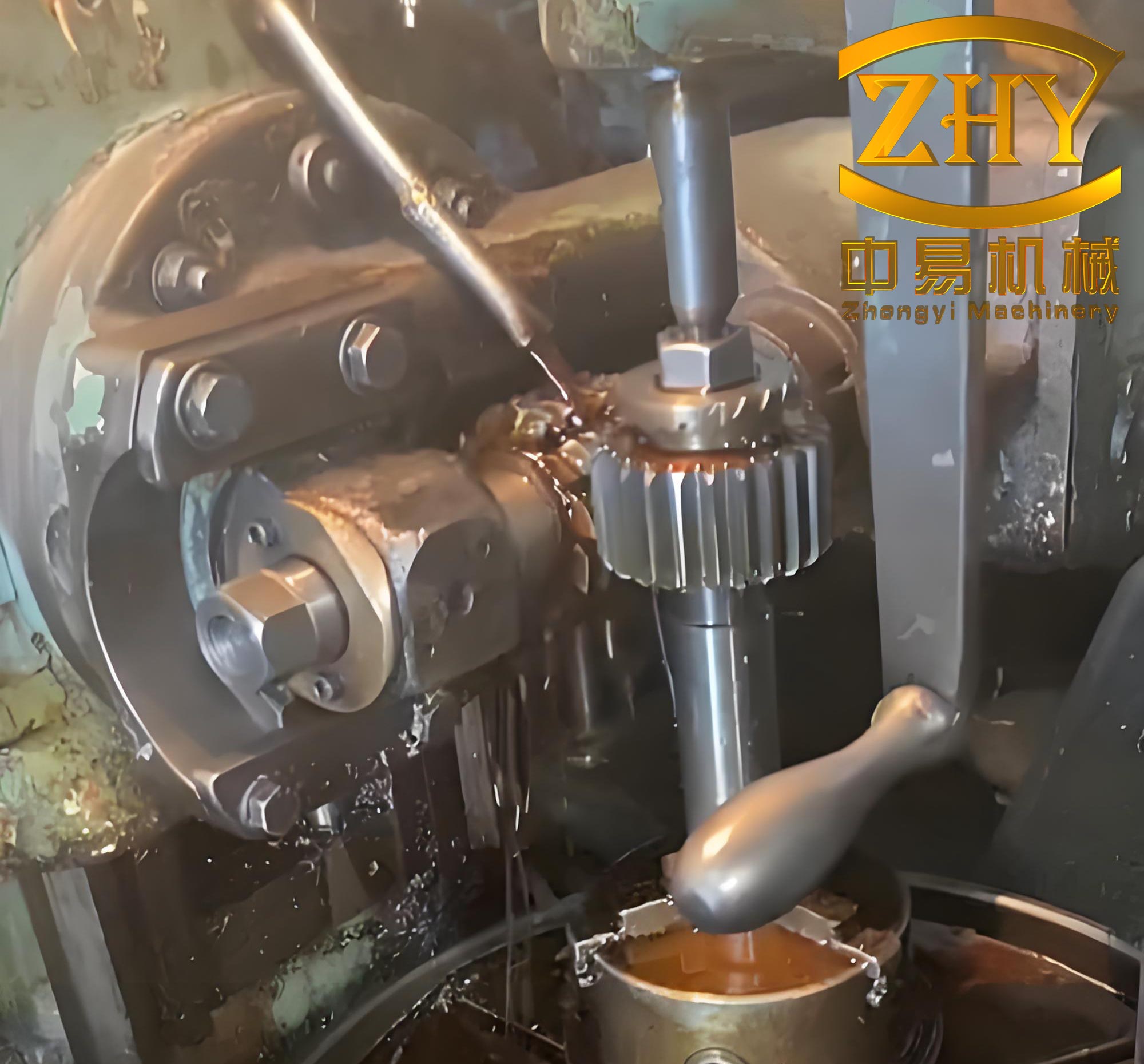
To identify the critical parameters for optimization, we conducted a static structural analysis using finite element software. The analysis revealed that the front bracket exhibits significant deformation and stress concentrations under operational loads. The total deformation is characterized by an upward displacement, primarily influenced by the bracket’s structural flexibility, insufficient stiffness of the pressure plate, and unconstrained tangential movement. The maximum deformation displacement was found to be $$2.44 \times 10^{-5} \, \text{m}$$, with an average of $$1.67 \times 10^{-5} \, \text{m}$$. This periodic deformation, induced by cyclic loads during gear hobbing, directly contributes to machining errors that cannot be compensated for by tool adjustments. Similarly, stress analysis indicated a maximum equivalent stress of 12.735 MPa, occurring in thin sections between the tailstock hole and sand-cleaning hole. The stress distribution is highly non-uniform, with variations exceeding a factor of ten, increasing the risk of fatigue failure. Therefore, optimizing the front bracket to reduce maximum deformation and stress, while achieving a more uniform stress distribution, is essential for improving the gear hobbing machine’s durability and precision.
Based on the analysis, we selected six key parameters for optimization, considering manufacturing feasibility and structural characteristics. These parameters include distances and angles related to hole positions and wall thicknesses, as they are easily adjustable in production and do not affect interfacing components. The parameter ranges are summarized in Table 1, covering various structural layouts to ensure comprehensive optimization. For example, the distance between the sand-cleaning hole and the bearing hole (L1) and the wall thickness on the guide rail side (H1) are critical variables that influence both stress and deformation in the gear hobbing process.
| Variable | Range | Description |
|---|---|---|
| L1 (mm) | 155–190 | Distance between sand-cleaning hole and bearing hole centers |
| D1 (°) | 50–54 | Angle between sand-cleaning hole-bearing hole line and horizontal |
| L2 (mm) | 170–200 | Distance between tailstock hole and bearing hole centers |
| D2 (°) | 18–23 | Angle between tailstock hole-bearing hole line and horizontal |
| H1 (mm) | 10–30 | Wall thickness parameter on guide rail side |
| H2 (mm) | 95–150 | Wall thickness parameter on hydrostatic bearing side |
We employed a response surface optimization design to handle the multiple variables and objectives efficiently. This method involves parameterizing the model, identifying primary parameters, fitting response surfaces, and solving the optimization problem. Initially, we performed a correlation analysis to determine the influence of each input parameter on the output variables, such as maximum stress and deformation. The correlation matrix, as illustrated in Figure 7, showed that parameters H1 and H2 significantly affect all outputs, particularly deformation, making them primary parameters for optimization. In contrast, D1, D2, and L2 have a greater impact on stress levels, while L1 is a secondary parameter with minimal influence. To simplify the optimization process, we divided it into two steps: first, optimizing D1, D2, and L2 to reduce maximum stress and achieve stress uniformity; second, optimizing H1 and H2 to minimize deformation. This stepwise approach reduces the number of sampling points required for response surface fitting and enhances the likelihood of obtaining satisfactory results for the gear hobbing machine.
The mathematical formulation for the first step of optimization is given by Equation (1), where we aim to minimize the maximum stress and deformation by adjusting the hole position parameters within their specified ranges. Similarly, the second step is defined by Equation (2), focusing on wall thickness parameters to further reduce deformation and stress. The response surfaces for stress and deformation, as functions of the key parameters, are depicted in Figures 8 and 9, respectively. These surfaces are constructed by uniformly sampling points across the design space and computing the corresponding outputs, allowing us to approximate the input-output relationships accurately. For instance, the stress response surface shows how variations in D1 and L2 affect the maximum equivalent stress, providing insights into optimal parameter combinations for the gear hobbing machine tool holder.
$$ \text{Minimize } f(\mathbf{x}) = [\sigma_{\text{max}}, \delta_{\text{max}}] \quad \text{subject to} \quad \begin{cases} 50 \leq D1 \leq 54 \\ 18 \leq D2 \leq 23 \\ 170 \leq L2 \leq 200 \end{cases} \tag{1} $$
$$ \text{Minimize } g(\mathbf{y}) = [\sigma_{\text{max}}, \delta_{\text{max}}] \quad \text{subject to} \quad \begin{cases} 10 \leq H1 \leq 30 \\ 95 \leq H2 \leq 150 \end{cases} \tag{2} $$
After establishing the response surfaces, we performed optimization to identify candidate design points that meet our objectives. The final optimized parameters, along with the improvements in maximum deformation and stress, are presented in Table 2. The results demonstrate a significant reduction in both targets: maximum deformation decreased by 18.48%, and maximum equivalent stress reduced by 26.22%. This optimization not only enhances the structural stability of the front bracket but also allows the gear hobbing machine to operate at higher speeds and loads without compromising accuracy. The adjusted hole positions contribute to a more uniform stress distribution, mitigating fatigue risks, while the increased wall thicknesses improve resistance to deformation. These advancements are crucial for achieving high-speed gear hobbing in heavy-duty applications, as they directly impact machining precision and tool life.
| Parameter or Result | Original Design | Optimized Design | Improvement |
|---|---|---|---|
| D2 (°) | 24.5 | 18 | — |
| L2 (mm) | 198 | 200 | — |
| D1 (°) | 52 | 54 | — |
| L1 (mm) | 175 | 175 | — |
| H1 (mm) | 20 | 30 | — |
| H2 (mm) | 125 | 150 | — |
| Maximum Deformation (mm) | 0.02441 | 0.01990 | 18.48% |
| Maximum Equivalent Stress (MPa) | 12.735 | 9.3972 | 26.22% |
The optimization outcomes are visually compared in Figure 10, showing contour plots of stress and deformation before and after optimization. The optimized design exhibits a more uniform stress distribution and reduced deformation, validating the effectiveness of our approach. For example, the stress concentrations in thin sections are alleviated, and the overall stiffness is enhanced. This improvement is vital for the gear hobbing machine, as it enables stable performance under high-speed conditions, reducing the likelihood of errors in gear tooth profiles. By addressing multiple variables and objectives simultaneously, we have demonstrated a robust methodology for structural optimization in complex systems like the gear hobbing machine tool holder. This work not only advances the state of heavy-duty gear hobbing but also provides a reference for future multi-parameter optimizations in mechanical design.
In conclusion, the optimization of the front bracket in the high-speed heavy-duty gear hobbing machine tool holder has yielded substantial benefits in terms of reduced deformation and stress. Through a systematic process involving finite element analysis and response surface optimization, we achieved a 18.48% decrease in maximum deformation and a 26.22% reduction in maximum equivalent stress. These improvements enhance the machine’s ability to maintain precision at higher cutting speeds, directly addressing the challenge of long processing cycles in heavy-duty gear hobbing. The use of multiple optimization variables and targets underscores the importance of comprehensive design approaches in modern gear hobbing machines. As the demand for efficient and reliable gear production grows, such optimizations will play a pivotal role in advancing manufacturing capabilities. Future work could explore dynamic analyses or material innovations to further push the boundaries of high-speed gear hobbing, ensuring continuous improvement in industrial applications.