
Abstract:
Hydrostatic bearings are widely used in precision and high-speed gear shaper spindles due to their high rotational accuracy and oil film stiffness. However, the heat generated by the reciprocating motion of the spindle and the periodic variation of the lateral force on the spindle caused by the rocker arm will lead to changes in the stiffness of the hydrostatic oil film, thereby affecting the machining accuracy. This paper addresses the issue of insufficient stiffness of the hydrostatic spindle in the large-tooth-width and long-stroke gear shaper YKW51160. By establishing a finite element analysis model of the oil film and adopting two structural optimization designs, namely oil cavity edge chamfering and double-loop oil cavity, the stiffness and carrying capacity of the hydrostatic oil film are improved. The optimized hydrostatic bearing’s carrying capacity and oil film stiffness are analyzed and verified using the fluid-structure interaction (FSI) method. Simulation and case study results indicate that the bearing capacity and oil film stiffness of the optimized bearing are improved by up to 12% and 12.3%, respectively, meeting the requirements for carrying capacity and oil film stiffness necessary to withstand the periodic radial impact of the rocker arm on the spindle.
1. Introduction
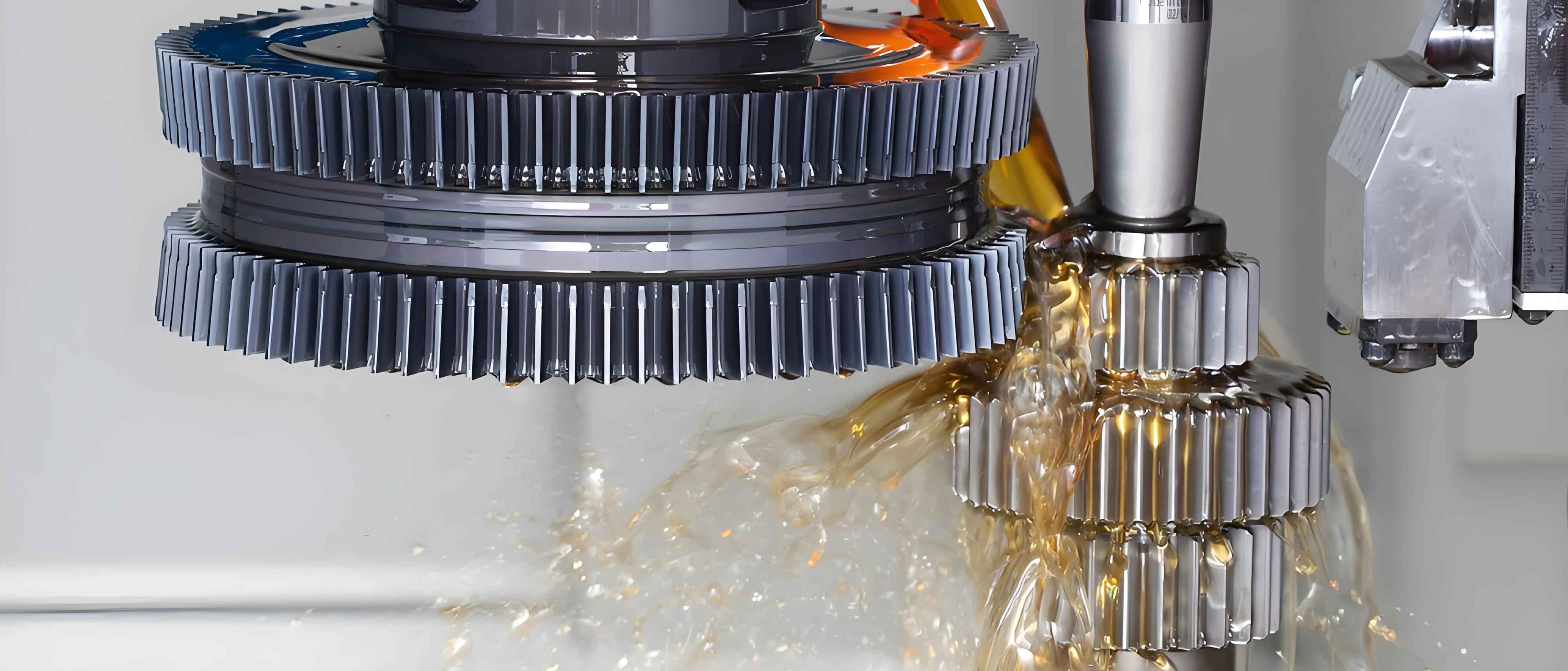
Hydrostatic bearings are renowned for their high carrying capacity, low power consumption, high motion accuracy, strong vibration resistance, and long service life, making them widely applicable in large, heavy-duty precision equipment. Gear shapers are commonly used to machine internal spline hubs for wind turbines, which feature a large tooth width (exceeding 300 mm) and high manufacturing accuracy (above Grade 7 according to national standards), thereby placing stringent demands on the carrying capacity and oil film stiffness of the hydrostatic spindle bearings in gear shapers.
Many factors influence the oil film stiffness of hydrostatic bearings, including the geometric structure of the oil cavity, heat generated by the reciprocating motion of the spindle, and the periodic variation of the lateral force on the spindle caused by the ball-and-rod mechanism. To enhance the oil film stiffness and carrying capacity of hydrostatic bearings, scholars worldwide have conducted in-depth research on the bearing capacity analysis, throttle control, and oil cavity structural design of hydrostatic spindle bearings.
2. Literature Review
- Xiong Wanli et al. investigated the influence of controllable throttle parameters on the bearing capacity of hydrostatic bearings, confirming the effectiveness of controllable throttle schemes.
- KANE et al. proposed a design method for a new self-compensating hydrostatic rotary bearing based on an inclined surface.
- MICHALEC et al. comprehensively summarized potential issues and solutions in the design of large hydrostatic bearings.
- ZHANG et al. used the finite volume method to simulate the pressure and temperature fields of hydrostatic thrust bearings, noting that elliptical oil cavities have higher carrying capacities than fan-shaped ones but exhibit more uneven temperature distributions.
- Zhang Jinqiong analyzed a hydrostatic bearing for grinding machines using the FSI method, obtaining the radial bearing capacity and radial dynamic characteristics, which provided theoretical support for bearing optimization design.
- Yu Xiaodong et al. analyzed the tribological deformation, fluid-thermal coupling of hydrostatic thrust bearings, revealing the tribological failure mechanism of high-speed heavy-duty hydrostatic supports.
- Meng Wen et al. utilized the APDL module in ANSYS to simulate hydrostatic bearings and hydrostatic guideways of gear shapers, analyzing the influence of bearing structural parameters on carrying capacity and oil film stiffness.
3. Structural Analysis and Calculation of Hydrostatic Spindle
3.1 Structural Analysis of Hydrostatic Spindle
The structure of the hydrostatic bearing in the gear shaper, and the initial structural parameters are listed in Table 1.
Table 1. Initial Structural Parameters of Hydrostatic Bearing
| Parameter | Value |
|---|---|
| Oil film thickness | 0.02 mm |
| Oil cavity shape | Initial |
| Material of spindle | Steel |
| Material of bearing | Bronze |
3.2 Modeling and Simulation Method
Three-dimensional assembly models of the bearing and shaft were created using SolidWorks and then converted into an intermediate format for import into SpaceClaim. Due to the challenges in directly creating a finite element model of an ultra-thin oil film, which often results in meshing issues or inefficient computation times, a secondary 3D modeling method for ultra-thin oil films was developed through trial and error. The secondary modeling process in SpaceClaim.
4. Structural Optimization Design of Hydrostatic Bearing
4.1 Oil Cavity Edge Chamfering
4.2 Double-Loop Oil Cavity
4.3 Optimization Results and Analysis
Traditional formulas cannot accurately calculate the effective bearing area of the bearing, nor can they directly analyze the oil film stiffness of the optimized bearing. The FSI method is primarily used to solve multi-physical coupling fields involving fluid dynamics and structural mechanics. Therefore, the FSI method was adopted in this paper to map the supporting force generated by the oil film onto the surface of the gear shaper spindle and solve the equivalent stress through statics analysis. The effective bearing area of each oil cavity was then determined based on the equivalent stress. Simultaneously, FSI was applied to the oil film and hydrostatic bearing to analyze the stress distribution of the hydrostatic bearing. The establishment of the FSI field. The calculation and analysis process for the carrying capacity and oil film stiffness of the hydrostatic bearing.
5. Results and Discussion
The simplified model was theoretically calculated using MATLAB, with the results. The maximum radial force on the bearing was 1071 N. Due to simplifications in the theoretical calculation, such as reducing the surface force on the hydrostatic bearing to the center of the bearing, there may be some impact on the accuracy of the calculation results. Therefore, an spindle dynamics model was established using ADAMS to calculate the radial force on the spindle. The results of the radial force on the spindle obtained through simulation using ADAMS, with the maximum radial force on the bearing being 1451 N.
5.1 Oil Cavity Edge Chamfering
The influence of oil cavity edge chamfering on the carrying capacity and oil film stiffness of the hydrostatic bearing was analyzed. The results showed that edge chamfering had a negligible impact on improving the carrying capacity and oil film stiffness of the hydrostatic bearing.
5.2 Double-Loop Oil Cavity
The double-loop oil cavity design significantly improved the performance of the hydrostatic bearing. Specifically, the carrying capacity and oil film stiffness were increased by 12% and 12.3%, respectively.
6. Conclusion
(1) A new secondary modeling method was developed for ultra-thin oil films, ensuring proper meshing of the 3D model and convergence of the solution.
(2) Two methods for structural optimization of the hydrostatic oil cavity, namely oil cavity edge chamfering and the use of a double-loop oil cavity, were adopted. It was found that edge chamfering had a limited impact on improving the carrying capacity and oil film stiffness of the hydrostatic bearing, while the use of a double-loop oil cavity resulted in significant improvements of 12% and 12.3%, respectively.
(3) The FSI method was employed to map the supporting force generated by the oil film onto the surface of the gear shaper spindle and solve for the equivalent stress through statics analysis. The carrying capacity and oil film stiffness of the oil film were then determined based on the equivalent stress, providing a feasible method for the optimization design analysis of hydrostatic spindle structures with practical engineering significance.