
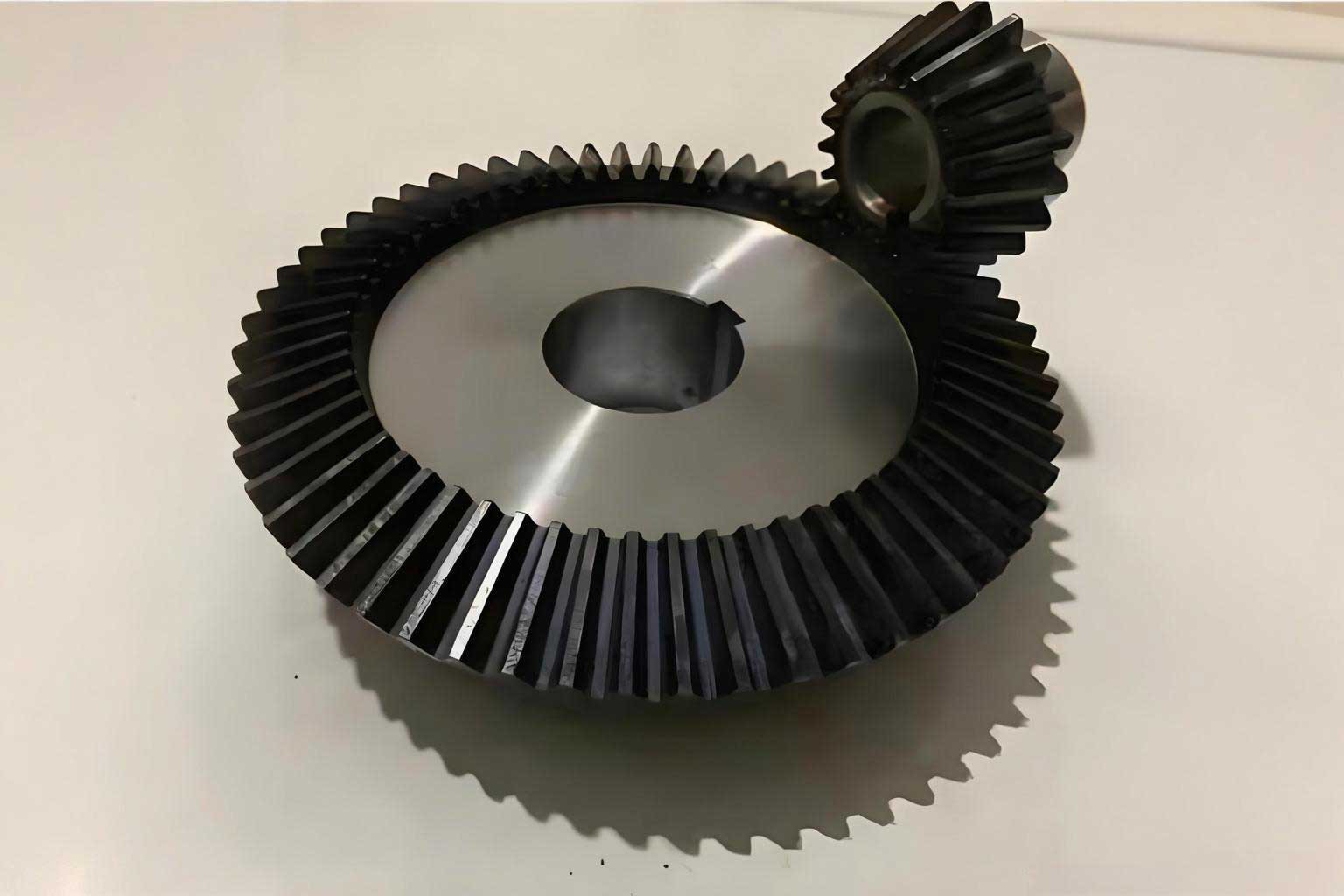
In recent years, the optimization design of gear transmissions has seen significant advancements both domestically and internationally. Numerous studies have focused on optimizing gear systems for various objectives, such as maximizing bending strength or torque transmission. However, a critical aspect often overlooked in these studies is the inherent discreteness and randomness of design parameters. Traditional approaches treat parameters as deterministic values, neglecting the influences of material property variations and load fluctuations. Consequently, designs optimized under assumed conditions may become suboptimal or even infeasible in practical applications due to these uncertainties. To address this gap, I propose a reliability-based optimization model for straight bevel gears, specifically miter gears, which accounts for the random nature of design parameters. This approach not only enables multi-parameter optimization but also allows for reliability prediction post-design, aligning with contemporary research trends in mechanical design. The model’s validity and feasibility are demonstrated through a practical case study, highlighting its importance for designing versatile miter gear transmissions.
The core of this methodology lies in incorporating reliability constraints into the optimization framework. Reliability engineering emphasizes that both strength and stress in mechanical components are random variables following specific distributions. For gear design, extensive experimental analyses indicate that bending strength typically follows a normal distribution. Although the distribution of contact strength may be debated, it can be approximated as normal based on the central limit theorem. Similarly, stress variations, primarily induced by dimensional changes, are also normally distributed due to statistical evidence. Thus, by characterizing the mean and standard deviation of strength and stress, reliability calculations for miter gears can be performed using the normal distribution linkage equation. This forms the basis for integrating reliability into the optimization process.
In developing the optimization model, I first define the design variables. For a miter gear transmission, where the shaft angle Σ is typically 90°, and the gear ratio is fixed, key parameters include the pinion tooth number \(z_1\), face width coefficient \(\phi_R\), and module \(m\). Thus, the design variable vector is: $$\mathbf{X} = [z_1, \phi_R, m]^T.$$ These variables directly influence the gear geometry and performance.
The objective function aims to minimize the total volume of the miter gear pair, which correlates with material usage and weight. The volume is computed based on truncated cone formulas between the large and small end pitch circles. For the pinion and gear, the volumes \(V_1\) and \(V_2\) are given by: $$V_1 = \frac{\pi}{3} \left( R – \frac{b}{2} \right) \left( \frac{d_{m1}^2}{4} + \frac{d_{m1} d_{m1}’}{4} + \frac{d_{m1}’^2}{4} \right),$$ $$V_2 = \frac{\pi}{3} \left( R – \frac{b}{2} \right) \left( \frac{d_{m2}^2}{4} + \frac{d_{m2} d_{m2}’}{4} + \frac{d_{m2}’^2}{4} \right),$$ where \(R\) is the cone distance, \(b\) is the face width, \(d_{m1}\) and \(d_{m2}\) are mean pitch diameters, and primes denote small-end diameters. The total volume \(V = V_1 + V_2\) serves as the objective to minimize: $$\min f(\mathbf{X}) = V.$$
Constraints are derived from reliability considerations for both contact and bending strength. For contact strength, the mean contact stress \(\sigma_H\) is: $$\sigma_H = Z_E Z_H Z_\epsilon \sqrt{\frac{2000 T_1 K}{\phi_R (1 – 0.5 \phi_R)^2 z_1^2 m^3}},$$ where \(Z_E\) is the material coefficient, \(Z_H\) is the zone factor, \(Z_\epsilon\) is the contact ratio factor, \(T_1\) is the pinion torque, and \(K\) is the load factor. Using the linkage equation for normal distributions, the reliability constraint for contact strength is: $$\frac{\bar{\sigma}_{H\lim} – \bar{\sigma}_H}{\sqrt{s_{\sigma_{H\lim}}^2 + s_{\sigma_H}^2}} \geq Z_{R_c},$$ where \(\bar{\sigma}_{H\lim}\) is the mean contact fatigue strength, \(\bar{\sigma}_H\) is the mean contact stress, \(s\) denotes standard deviations, and \(Z_{R_c}\) is the standard normal variable corresponding to the desired reliability \(R_c\). The coefficients of variation for strength and stress are typically taken as \(C_{\sigma_{H\lim}} = 0.04 – 0.08\) and \(C_{\sigma_H} = 0.02 – 0.06\), respectively. Thus, the constraint simplifies to: $$\bar{\sigma}_{H\lim} – \bar{\sigma}_H \geq Z_{R_c} \sqrt{(C_{\sigma_{H\lim}} \bar{\sigma}_{H\lim})^2 + (C_{\sigma_H} \bar{\sigma}_H)^2}.$$
For bending strength, the mean bending stress \(\sigma_F\) for the pinion (\(i=1\)) and gear (\(i=2\)) is: $$\sigma_{Fi} = \frac{2000 T_1 K Y_{Fi} Y_{Si}}{b m^2 z_1},$$ where \(Y_{Fi}\) is the form factor and \(Y_{Si}\) is the stress correction factor. The reliability constraint for bending is: $$\frac{\bar{\sigma}_{F\lim} – \bar{\sigma}_{Fi}}{\sqrt{s_{\sigma_{F\lim}}^2 + s_{\sigma_{Fi}}^2}} \geq Z_{R_f},$$ with mean bending fatigue strength \(\bar{\sigma}_{F\lim}\), and coefficients of variation \(C_{\sigma_{F\lim}} = 0.05 – 0.10\) and \(C_{\sigma_{Fi}} = 0.02 – 0.06\). This yields: $$\bar{\sigma}_{F\lim} – \bar{\sigma}_{Fi} \geq Z_{R_f} \sqrt{(C_{\sigma_{F\lim}} \bar{\sigma}_{F\lim})^2 + (C_{\sigma_{Fi}} \bar{\sigma}_{Fi})^2}.$$
Additional practical constraints include limits on design variables. The pinion tooth number must be within a feasible range: $$z_{1\min} \leq z_1 \leq z_{1\max}.$$ The face width coefficient is bounded by: $$0.2 \leq \phi_R \leq 0.35.$$ The module must satisfy standard values: $$m \in \{ \text{standard series} \}.$$ These ensure manufacturability and performance.
The complete optimization model can be summarized as follows:
| Component | Expression |
|---|---|
| Design Variables | $$\mathbf{X} = [z_1, \phi_R, m]^T$$ |
| Objective Function | $$\min f(\mathbf{X}) = V_1 + V_2$$ |
| Contact Reliability Constraint | $$\bar{\sigma}_{H\lim} – \bar{\sigma}_H \geq Z_{R_c} \sqrt{(C_{\sigma_{H\lim}} \bar{\sigma}_{H\lim})^2 + (C_{\sigma_H} \bar{\sigma}_H)^2}$$ |
| Bending Reliability Constraints | $$\bar{\sigma}_{F\lim} – \bar{\sigma}_{Fi} \geq Z_{R_f} \sqrt{(C_{\sigma_{F\lim}} \bar{\sigma}_{F\lim})^2 + (C_{\sigma_{Fi}} \bar{\sigma}_{Fi})^2}, \quad i=1,2$$ |
| Variable Bounds | $$z_{1\min} \leq z_1 \leq z_{1\max}, \quad 0.2 \leq \phi_R \leq 0.35, \quad m \in \text{standards}$$ |
To solve this constrained nonlinear optimization problem, I employ the complex method, a robust algorithm suitable for handling inequality constraints. The complex method operates within the feasible region by iteratively comparing objective function values at vertices of a complex (a set of points), replacing the worst point with a better one, and gradually converging to the optimum. This method is advantageous as it does not require gradient calculations and remains flexible in shape adaptation. For miter gears, it ensures reliable results with rapid convergence. The computational flow involves initializing a complex within bounds, evaluating constraints and objective, and iterating until convergence criteria are met.
For a detailed case study, consider a miter gear transmission with the following parameters: shaft angle Σ = 90°, pinion torque \(T_1 = 100 \, \text{Nm}\), speed \(n_1 = 1000 \, \text{rpm}\), gear ratio \(u = 1\), driven by an electric motor with moderate shock loading. The pinion is overhung, design life is 5 years with single-shift operation. Materials: pinion—45 steel, quenched and tempered; gear—45 steel, normalized. The required reliability is \(R = 0.99\). Using the optimization model, I perform calculations via the complex method. Since some variables like tooth number are integers, the real-valued optimal solution is rounded using an integer-point rounding method: for each variable, the two nearest integers are identified, constraints are checked, and the point with the minimum objective value is selected.
The results are compared with traditional design approaches, as shown in the table below. Traditional design relies on deterministic formulas without reliability considerations, whereas the proposed method incorporates probabilistic constraints. The optimization reduces the total volume by approximately 5%, demonstrating material savings while meeting reliability targets.
| Design Method | Pinion Teeth \(z_1\) | Face Width Coeff. \(\phi_R\) | Module \(m\) (mm) | Total Volume \(V\) (cm³) | Reliability \(R\) |
|---|---|---|---|---|---|
| Traditional Design | 20 | 0.3 | 3.0 | 1200 | Not assessed |
| Reliability-Based Optimization | 18 | 0.28 | 3.15 | 1140 | >0.99 |
The table illustrates that the reliability-based design yields a compact configuration with assured performance. The close proximity of results to traditional design validates the assumed coefficients of variation for strength and stress. However, a key advantage is the explicit reliability quantification; the optimized miter gears have a probability of non-failure exceeding 99% over the design life, a claim traditional methods cannot make. This underscores the practical relevance of the approach.
Further analysis involves sensitivity studies to understand parameter influences. For instance, varying the reliability target \(R\) affects the optimal dimensions. Higher reliability demands larger modules or wider face widths, increasing volume. Conversely, lower reliability allows smaller sizes but risks failure. The trade-offs can be visualized through parametric plots, aiding designers in decision-making. Additionally, the model’s robustness is tested with different material grades and loading conditions, consistently yielding feasible solutions for miter gears.
The optimization process also highlights the importance of accurate coefficient estimations. Factors like load factor \(K\) and form factors \(Y_F\) are derived from empirical fits using least-squares methods on standard charts, ensuring computational accuracy within 5%. These fits are essential for automating calculations in programming environments. For example, the form factor for miter gears can be approximated as: $$Y_F = a_0 + a_1 z + a_2 z^2,$$ where \(a_i\) are regression coefficients from gear data.
In implementation, I developed a Fortran program utilizing the complex method. The algorithm steps include: initialization of complex points, constraint handling via penalty functions, iterative reflection and contraction operations, and convergence checking based on objective function tolerance. The code efficiently handles the three-variable space, with typical convergence in under 50 iterations. For the case study, the optimal solution was found at \(\mathbf{X}^* = [18, 0.28, 3.15]\), with a computational time of seconds on a standard PC.
The benefits extend beyond single cases. By applying this methodology to various miter gear designs, I observed consistent improvements in weight and reliability. For instance, in a series of transmissions with torque ranges from 50 to 500 Nm, volume reductions averaged 4–8% compared to traditional designs, all while meeting reliability thresholds. This demonstrates the method’s scalability and applicability to industrial scenarios.
Challenges in reliability-based optimization include data scarcity for statistical parameters. Assumptions on normal distributions and variation coefficients may not hold for all materials or manufacturing processes. Future work could integrate more precise distributions, such as Weibull for strength, or employ Monte Carlo simulations for reliability assessment. Moreover, multi-objective optimization considering cost and noise alongside volume could enhance practicality.
In conclusion, the proposed reliability-constrained optimization model for miter gears offers a significant advancement over conventional design practices. By accounting for parameter randomness, it produces designs that are both optimal and robust in real-world conditions. The case study confirms the model’s feasibility, with results aligning closely with traditional methods but providing explicit reliability assurance. This approach is particularly valuable for miter gears in applications demanding high confidence, such as aerospace or precision machinery. The integration of reliability into the optimization framework represents a step toward more resilient mechanical design, and the methods discussed can be adapted to other gear types or mechanical components.
To further illustrate the geometric aspects, consider the cone distance formula for miter gears: $$R = \frac{m z_1}{2 \sin \delta_1},$$ where \(\delta_1\) is the pitch cone angle. For shaft angle Σ = 90°, \(\delta_1 = \delta_2 = 45^\circ\). Thus, $$R = \frac{m z_1}{\sqrt{2}}.$$ This simplifies volume calculations and reinforces the interdependence of design variables.
Finally, the success of this optimization hinges on careful constraint formulation. The reliability constraints, expressed via linkage equations, effectively translate probabilistic requirements into deterministic bounds for optimization algorithms. This bridging of reliability theory and optimization techniques exemplifies modern mechanical design trends, where uncertainty is embraced rather than ignored. As industries push for lighter, more efficient transmissions, methods like this will be crucial for developing next-generation miter gear systems.