
In the field of mechanical transmission, miter gears play a crucial role due to their ability to transmit motion between intersecting shafts, typically at a 90-degree angle. As a researcher specializing in forging technology, I have extensively studied the forming processes of miter gears, focusing on improving their strength, precision, and cost-effectiveness. The adoption of forging techniques, particularly hot-cold compound forming, has become increasingly popular for producing miter gears, as it offers advantages such as enhanced mechanical properties, reduced material waste, and better surface quality. However, the design of the pre-forging tooth profile is a critical aspect that significantly influences the final gear quality. In this article, I will share my insights and findings on optimizing the pre-forging tooth profile for miter gears, based on numerical simulations and physical experiments, while emphasizing the importance of avoiding defects like folding and ensuring high surface accuracy.
The hot-cold compound forming process for miter gears involves several steps: heating the billet, upsetting, hot forging, trimming, cooling with shot blasting, phosphating and soaping treatment, and finally cold finishing. This method combines the benefits of hot forging, such as lower forming forces and better material flow, with the precision and surface finish achievable through cold forging. For a typical miter gear used in automotive differentials, such as a planetary gear, the material is often 20CrMnTi steel. The gear parameters, including tooth number, pressure angle, and module, are essential for design. Below is a table summarizing the key parameters of the miter gear under study:
| Parameter | Value |
|---|---|
| Number of Teeth | 11 |
| Pressure Angle (degrees) | 22.5 |
| Module (mm) | 6.5 |
| Face Width (mm) | 30 |
| Pitch Cone Angle (degrees) | 31.43 |
| Root Cone Angle (degrees) | 26.18 |
| Tip Cone Angle (degrees) | 36.10 |
The pre-forging tooth profile design is pivotal because it directly affects the cold finishing stage. If not optimized, issues like metal folding at the tooth root or poor surface accuracy can occur, compromising the gear’s performance. In my research, I investigated two main approaches: standard pre-forging tooth profile design and non-standard design. The standard method involves uniformly offsetting the tooth surface outward from the cold forging drawing based on the finishing allowance, followed by adjusting the root circle inward to maintain volume consistency. I developed four schemes with different offset values, as shown in the table below:
| Scheme | Tooth Surface Offset (mm) | Root Circle Offset (mm) |
|---|---|---|
| Scheme 1 | 0.9 | Calculated based on volume |
| Scheme 2 | 0.4 | Calculated based on volume |
| Scheme 3 | 0.2 | Calculated based on volume |
| Scheme 4 | 0.15 | Calculated based on volume |
To analyze these schemes, I employed Deform-3D software for numerical simulation of the cold finishing process. The simulation model included a plastic workpiece (AISI-4120 steel, analogous to 20CrMnTi) and rigid dies. Key parameters were set: an upper die speed of 26 mm/s, a shear friction factor of 0.1, and symmetry boundary conditions. The mesh was composed of tetrahedral elements with a minimum edge length of 0.7 mm, and automatic volume compensation was enabled to account for mesh distortion. The simulation step was 0.5 mm. The results revealed that as the finishing allowance increased, the maximum forming load during cold finishing also rose. For instance, the loads were approximately 2700 kN, 2750 kN, 4600 kN, and 5500 kN for offsets of 0.15 mm, 0.2 mm, 0.4 mm, and 0.9 mm, respectively. This relationship can be expressed using a simplified formula for forging load estimation:
$$ P = k \cdot \sigma \cdot A $$
where \( P \) is the forging load, \( k \) is a factor accounting for shape and friction, \( \sigma \) is the flow stress of the material, and \( A \) is the contact area. For miter gears, the contact area varies with tooth geometry, making simulations essential for accurate predictions.
More critically, metal folding defects were observed at the tooth root for schemes with larger offsets (0.9 mm, 0.4 mm, and 0.2 mm). This folding occurred because the pre-forging tooth profile, being larger than the cold finishing die cavity, caused the material at the root to be constrained and flow improperly during cold finishing. As the offset decreased to 0.15 mm, the folding disappeared, but the surface quality remained inadequate due to insufficient material flow, leading to pits and low precision. This highlights a trade-off in standard pre-forging designs for miter gears: larger allowances induce folding, while smaller allowances result in poor surface finish. The phenomenon of folding can be described by the strain distribution during deformation. The equivalent strain \( \epsilon_{eq} \) is given by:
$$ \epsilon_{eq} = \sqrt{\frac{2}{3} \epsilon_{ij} \epsilon_{ij}} $$
where \( \epsilon_{ij} \) are the strain tensor components. In simulations, high strain concentrations at the tooth root indicated potential folding areas.
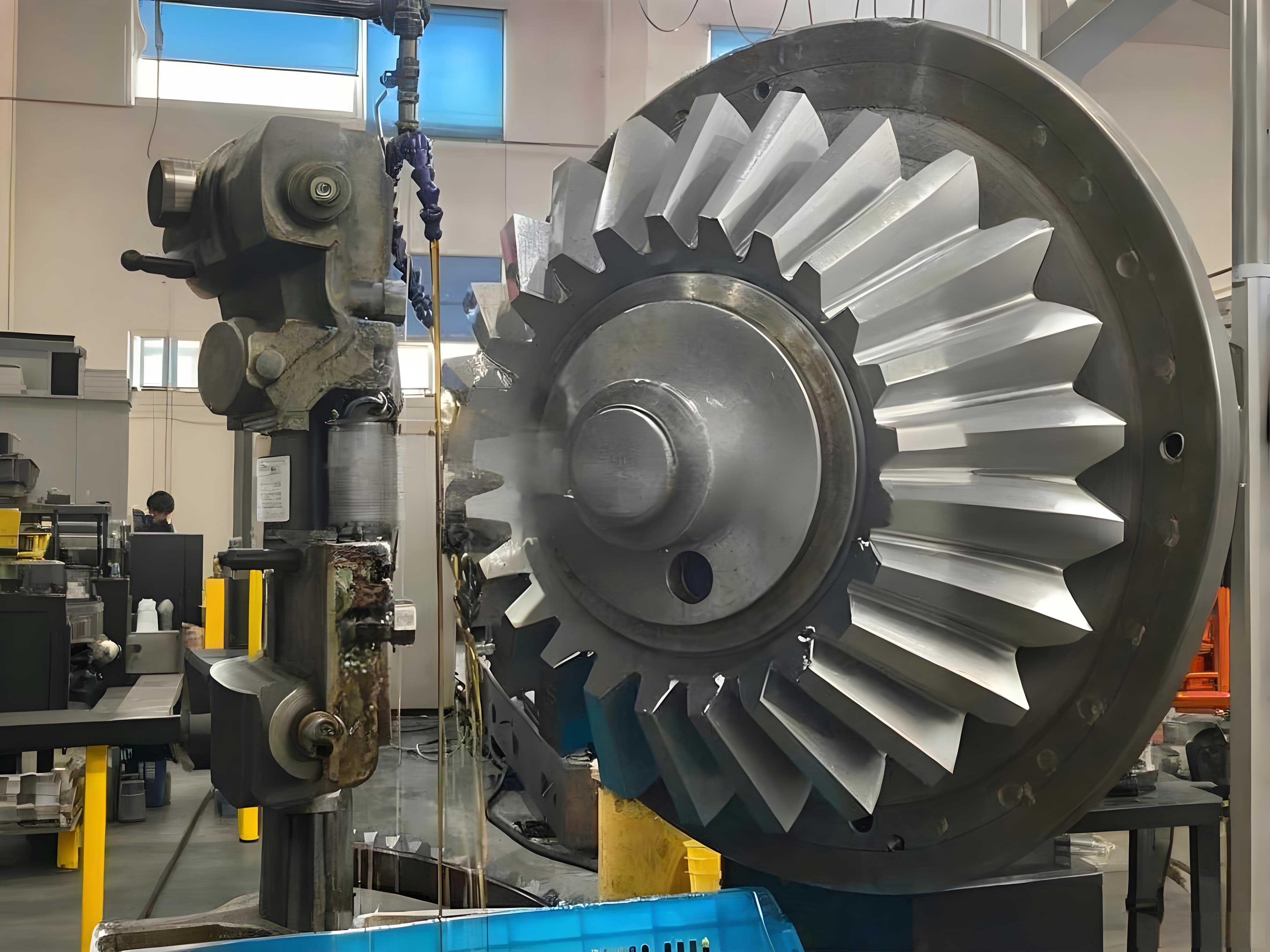
To address these issues, I proposed a non-standard pre-forging tooth profile design for miter gears. This approach is based on the functional requirements of miter gears in transmission systems. Typically, the mating region of miter gears is around the mid-height of the tooth, where high surface accuracy and strength are crucial. In contrast, the root region has less stringent surface requirements. Therefore, I optimized the design by increasing the finishing allowance on the tooth surface (especially at the mid-height) and decreasing it at the tooth root. This non-standard profile reduces constraints at the root, eliminating folding, while promoting more intense material flow on the surface to improve accuracy. The design principle can be visualized as modifying the offset distribution along the tooth profile. Mathematically, if \( f(x) \) represents the tooth profile curve, the optimized pre-forging profile \( g(x) \) is defined as:
$$ g(x) = f(x) + \Delta(x) $$
where \( \Delta(x) \) is a variable offset function: larger values on the tooth surface and smaller or negative values near the root. For practical application, I designed a specific non-standard profile and simulated it using Deform-3D under the same conditions. The results showed no folding defects, and the equivalent strain on the tooth surface was higher compared to the standard scheme with a 0.15 mm offset, indicating better material flow and surface refinement. Below is a table comparing key outcomes between standard and non-standard designs for miter gears:
| Design Type | Finishing Allowance Distribution | Folding Defect | Surface Quality | Maximum Load (kN) |
|---|---|---|---|---|
| Standard (0.15 mm offset) | Uniform | No | Low (pits present) | ~2700 |
| Non-standard | Variable: high on surface, low on root | No | High (smooth surface) | ~2800-3000 (estimated) |
Physical experiments were conducted to validate these findings. For the standard design (Scheme 4), the hot forging was performed on a 4000 kN friction press at 1100°C, with dies preheated to 200°C and lubricated using water-based graphite. Cold finishing was done on a 1200-ton metal extrusion hydraulic press. The resulting miter gears exhibited surface pits, confirming the simulation predictions. In contrast, with the non-standard pre-forging tooth profile, the cold-finished miter gears showed excellent surface quality without folds, meeting the required precision of IT8 grade. This demonstrates the effectiveness of the optimized design for producing high-quality miter gears.
The optimization process for miter gears also involves considering material behavior during deformation. The flow stress \( \sigma \) of the steel under cold forging conditions can be modeled using the Hollomon equation:
$$ \sigma = K \epsilon^n $$
where \( K \) is the strength coefficient, \( \epsilon \) is the true strain, and \( n \) is the strain-hardening exponent. For AISI-4120 steel, typical values are \( K \approx 1500 \) MPa and \( n \approx 0.2 \). This relationship influences the forming loads and material flow in miter gears. Additionally, the friction conditions play a vital role. The shear friction model used in simulations is defined as:
$$ \tau = m \cdot k $$
where \( \tau \) is the frictional shear stress, \( m \) is the friction factor (set to 0.1), and \( k \) is the shear yield strength of the material, approximately \( \sigma / \sqrt{3} \). Proper lubrication reduces \( m \), minimizing defects in miter gears.
Beyond the specific case, the principles of pre-forging tooth profile optimization can be extended to other types of miter gears with different sizes and applications. For instance, in heavy-duty miter gears used in industrial machinery, the finishing allowances might need adjustment based on load requirements. I developed a generalized formula to determine the optimal surface offset \( \Delta_s \) and root offset \( \Delta_r \) for miter gears:
$$ \Delta_s = C_1 \cdot m \cdot \sqrt{N} $$
$$ \Delta_r = C_2 \cdot m \cdot \log(1/N) $$
where \( m \) is the module, \( N \) is the number of teeth, and \( C_1 \) and \( C_2 \) are constants derived from experimental data (e.g., \( C_1 \approx 0.05 \), \( C_2 \approx -0.02 \) for steel miter gears). This helps in customizing designs for various miter gears.
In summary, the design of the pre-forging tooth profile is a decisive factor in the hot-cold compound forming of miter gears. Standard designs with uniform offsets often lead to a dilemma: folding at large allowances or poor surface finish at small allowances. Through numerical simulation and physical testing, I have shown that a non-standard approach—increasing the finishing allowance on the tooth surface while reducing it at the root—effectively eliminates folding and enhances surface accuracy. This optimized method ensures that miter gears meet stringent performance standards, making it a superior choice for industrial production. Future work could explore advanced materials or multi-stage forming processes for further improving miter gears. The integration of simulation tools like Deform-3D with experimental validation remains key to advancing forging technology for miter gears and other precision components.