
In my extensive experience with automotive drivetrain systems, the hypoid gear has consistently proven to be a superior choice for the final drive unit in vehicles such as passenger cars, SUVs, and light trucks. Its advantages over spiral bevel gears—including enhanced operational smoothness, greater bending and contact strength, and improved bearing stiffness—are well-documented. However, a significant challenge arises when a hypoid gear is employed for larger transmission ratios, typically where \( i \geq 4.5 \). This often leads to an increase in the gear’s overall dimensions, which can adversely affect the vehicle’s ground clearance and, consequently, its off-road capability or general passability. The traditional design process for these hypoid gears is heavily reliant on empirical knowledge and iterative calculations to determine basic structural parameters. This method is not only time-consuming but may also yield suboptimal designs due to the complex interdependencies among numerous parameters and the need for iterative solutions in dozens of governing equations. Therefore, I have focused on developing a systematic optimization approach. In this article, I will present a comprehensive methodology for the optimal design of hypoid gear structural parameters, with the primary objective of minimizing the combined volume of the gear pair under stringent constraints of strength, stress, and geometric compatibility. This approach aims to overcome the limitations of traditional design, offering a more rational and efficient path to compact, high-performance final drives.
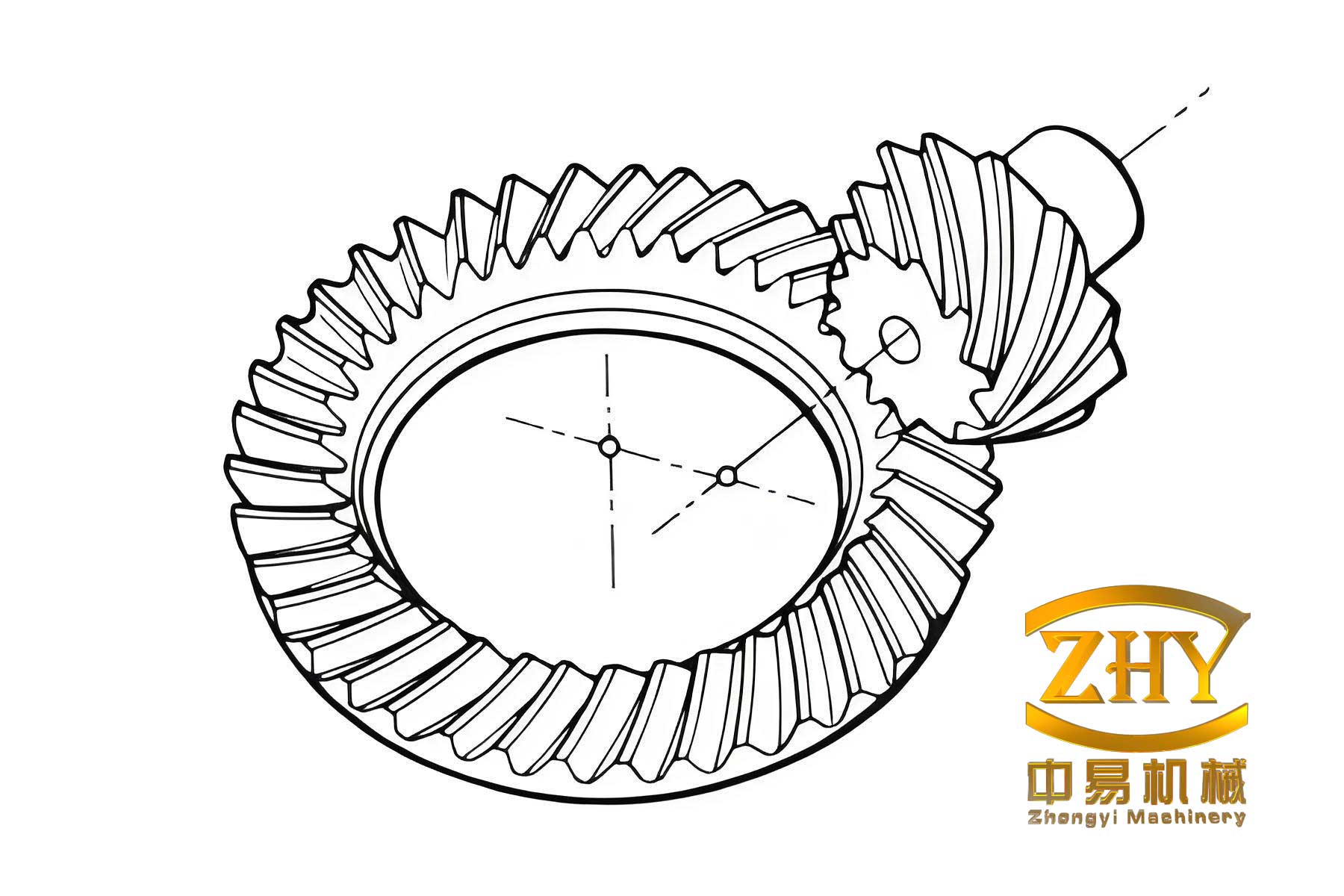
The core of my work lies in formulating and solving a constrained nonlinear optimization problem. For a given final drive ratio, the design variables, objective function, and constraints are defined mathematically. I will now delve into the detailed construction of this optimization model for the hypoid gear set.
Mathematical Model for Hypoid Gear Optimization
The selection of design variables is critical. After thorough analysis, I have identified seven key structural parameters that predominantly influence the total volume of the hypoid gear pair and are central to its performance. These are listed in the table below, along with their symbols and descriptions.
| Symbol | Description | Variable Notation |
|---|---|---|
| \( Z_1 \) | Number of teeth on the driving (pinion) hypoid gear | \( x_1 \) |
| \( Z_2 \) | Number of teeth on the driven (ring) hypoid gear | \( x_2 \) |
| \( d_2 \) | Pitch diameter of the driven hypoid gear (mm) | \( x_3 \) |
| \( m_1 \) | Transverse module at the driving hypoid gear (mm) | \( x_4 \) |
| \( F \) | Face width of the driven hypoid gear (mm) | \( x_5 \) |
| \( E \) | Hypoid offset or pinion offset distance (mm) | \( x_6 \) |
| \( \beta_1 \) | Mean spiral angle at the driving hypoid gear (degrees) | \( x_7 \) |
Thus, the design vector is:
$$\vec{X} = [Z_1, Z_2, d_2, m_1, F, E, \beta_1]^T = [x_1, x_2, x_3, x_4, x_5, x_6, x_7]^T$$
The primary goal is to minimize the total material volume of the hypoid gear pair to enhance compactness and vehicle ground clearance. While exact volume calculation requires detailed tooth geometry, a simplified but effective objective function can be formulated based on the fundamental gear dimensions. The combined volume \( V_{\text{total}} \) is approximated as the sum of the volumes of two cylindrical blanks representative of the gear bodies:
$$ V_1 \approx \frac{\pi}{4} (m_1 Z_1)^2 \cdot (1.1F) $$
$$ V_2 \approx \frac{\pi}{4} d_2^2 \cdot F $$
The factor 1.1 for the pinion face width is a common assumption, relating it to the ring gear face width. Therefore, the objective function to be minimized is:
$$ f(\vec{X}) = V_1 + V_2 = \frac{\pi}{4} \left[ (m_1 Z_1)^2 (1.1F) + d_2^2 F \right] $$
This function clearly depends on all seven design variables, either directly or indirectly through relationships that will be enforced by constraints.
Constraint Formulations for the Hypoid Gear Set
The optimization must satisfy a multitude of engineering constraints to ensure the hypoid gear’s functionality, strength, and manufacturability. I have categorized these constraints as follows.
Geometric and Assembly Constraints
1. Driven Gear Diameter for Ground Clearance: To maintain required vehicle ground clearance \( X \), the hypoid gear’s size must be limited.
$$ \frac{d_2}{2} \leq r_k – h – X $$
where \( r_k \) is the tire rolling radius and \( h \) is the sum of the housing clearance and thickness.
2. Driven Gear Diameter for Torque Capacity: The pitch diameter must be sufficient to transmit applied torques. It should be greater than or equal to the maximum value calculated from two critical driving conditions:
– When transmitting maximum engine torque in first gear:
$$ d_2 \geq 3.46 \sqrt[3]{M_{emax} \cdot i_{k1} \cdot i_0} $$
$$ d_2 \geq 3.46 \sqrt[3]{0.85 \cdot G_2 \cdot r_k} $$
– When transmitting maximum engine torque in direct drive:
$$ d_2 \geq 5.74 \sqrt[3]{M_{emax} \cdot i_0} $$
Here, \( M_{emax} \) is engine max torque, \( i_{k1} \) is first gear ratio, \( i_0 \) is final drive ratio, and \( G_2 \) is axle load.
3. Tooth Number Constraints: For optimal mesh smoothness and noise reduction in a hypoid gear set, the sum of teeth should be sufficiently large.
$$ Z_1 + Z_2 \geq 45 $$
The pinion teeth are typically constrained for strength and space:
$$ 7 \leq Z_1 \leq 12 $$
Furthermore, the teeth numbers must closely approximate the desired gear ratio:
$$ |Z_2 – i_0 \cdot Z_1| \leq \Delta Z $$
where \( \Delta Z \) is a small integer allowance, often 1 or 2.
4. Module Constraint: The pinion transverse module is bounded based on empirical relations with the driven gear diameter and ratio:
$$ 1.3 \cdot \frac{d_2}{Z_1 \cdot i_0} \leq m_1 \leq 1.5 \cdot \frac{d_2}{Z_1 \cdot i_0} $$
5. Face Width Constraint: Excessive face width on the hypoid ring gear does not proportionally increase strength and can lead to manufacturing and stress concentration issues. A common recommendation is:
$$ |F – 0.155 d_2| \leq k $$
where \( k \) is a small tolerance (e.g., 1-2 mm).
6. Hypoid Offset Constraint: The offset \( E \) is a defining feature of a hypoid gear. If too large, it increases sliding velocities and wear; if too small, the benefits over bevel gears diminish. It is typically limited to a percentage of the ring gear diameter:
$$ 0.12 \, d_2 \leq E \leq 0.20 \, d_2 $$
7. Spiral Angle Constraint: The mean spiral angle \( \beta_m \) affects overlap ratio and axial forces. For automotive hypoid gears, it usually falls within a specific range. The relationship between the pinion and gear spiral angles in a hypoid set is \( \beta_2 = \beta_1 – \epsilon \), where the offset angle \( \epsilon \) is approximated by \( \epsilon \approx \sin^{-1}(2E / (d_2 – F)) \). The constraint on the mean spiral angle \( \beta_m = (\beta_1 + \beta_2)/2 \) is:
$$ 35^\circ \leq \beta_1 – \frac{1}{2} \sin^{-1}\left( \frac{2E}{d_2 – F} \right) \leq 40^\circ $$
This directly constrains \( \beta_1 \), \( E \), \( d_2 \), and \( F \).
Strength Constraints for the Hypoid Gear
The hypoid gear must withstand operational loads without failure. Both contact (pitting) and bending (root) stress constraints are essential.
8. Contact Stress Constraint: The Hertzian contact stress \( \bar{\sigma}_H \) at the tooth interface must be below the allowable limit \( [\sigma_H] \). A simplified formula based on AGMA-type approaches is:
$$ \bar{\sigma}_H = C_p \sqrt{ \frac{2 M_{p,calc} \cdot k_0 \cdot k_s \cdot k_m \cdot k_f \cdot 10^3}{d_1 \cdot k_v \cdot F \cdot J} } $$
where:
- \( C_p \): Elastic coefficient of the material
- \( d_1 = m_1 Z_1 \): Pitch diameter of driving hypoid gear
- \( M_{p,calc} = M_{g,calc} / (i_0 \cdot \eta_m) \): Calculated torque on pinion
- \( M_{g,calc} = \min(M_{Ge}, M_{Gs}) \): Calculated torque on ring gear from engine max torque or wheel slip torque
- \( k_0, k_s, k_m, k_v, k_f \): Overload, size, load distribution, dynamic, and surface condition factors, respectively.
- \( J \): Geometry factor for contact stress calculation for hypoid gears.
The constraint is:
$$ \bar{\sigma}_H \leq [\sigma_H] $$
9. Bending Stress Constraints: The root bending stress must be safe for both the hypoid pinion and ring gear.
For the driving hypoid gear:
$$ \sigma_{w1} = \frac{2 M_{p,calc} \cdot k_0 \cdot k_s \cdot k_m \cdot 10^3}{k_v \cdot F’ \cdot Z_1 \cdot m_1^2 \cdot J_{w1}} $$
where \( F’ \approx 1.1 F \) is the pinion face width and \( J_{w1} \) is the pinion bending geometry factor.
For the driven hypoid gear:
$$ \sigma_{w2} = \frac{2 M_{g,calc} \cdot k_0 \cdot k_s \cdot k_m \cdot 10^3}{k_v \cdot F \cdot Z_2 \cdot m_2^2 \cdot J_{w2}} $$
where \( m_2 = d_2 / Z_2 \) is the ring gear transverse module and \( J_{w2} \) is its bending geometry factor.
The constraints are:
$$ \sigma_{w1} \leq [\sigma_w] $$
$$ \sigma_{w2} \leq [\sigma_w] $$
where \( [\sigma_w] \) is the allowable bending stress.
The complete nonlinear constrained optimization problem for the hypoid gear is therefore summarized as:
| Component | Mathematical Representation |
|---|---|
| Design Vector | $$ \vec{X} = [x_1, x_2, x_3, x_4, x_5, x_6, x_7]^T $$ |
| Objective Function | $$ \min f(\vec{X}) = \frac{\pi}{4} \left[ (x_4 x_1)^2 (1.1 x_5) + x_3^2 x_5 \right] $$ |
| Constraints | $$ g_u(\vec{X}) \geq 0 \quad \text{for } u = 1, 2, …, 18 $$ (Encompassing all inequality constraints derived above) |
Optimization Methodology and Solution Strategy
To solve this complex optimization problem for the hypoid gear parameters, I employed the Sequential Unconstrained Minimization Technique (SUMT) using a penalty function method. This method transforms the constrained problem into a series of unconstrained problems by adding a penalty term to the objective function for any constraint violation. The transformed function becomes:
$$ \Phi(\vec{X}, r^{(k)}) = f(\vec{X}) + r^{(k)} \sum_{u=1}^{18} \left[ \min(0, g_u(\vec{X})) \right]^2 $$
where \( r^{(k)} \) is a positive penalty parameter that increases sequentially (\( r^{(k+1)} > r^{(k)} \)) to force the solution towards the feasible region. An interior point method can be conceptualized by defining the constraints as \( g_u(\vec{X}) > 0 \) and using a logarithmic barrier function. For practical computation, I utilized a gradient-based search algorithm (like the Davidon-Fletcher-Powell method) to find the minimum of \( \Phi \) for each value of \( r^{(k)} \), iterating until convergence to a feasible optimum design for the hypoid gear set.
Detailed Computational Case Study and Results
To demonstrate the efficacy of this hypoid gear optimization model, I applied it to a concrete design case: the final drive of a 4×4越野 vehicle. The key input parameters are listed below.
| Parameter | Symbol | Value | Unit |
|---|---|---|---|
| Vehicle Gross Weight | \( G_a \cdot g \) | 20050 | N |
| Engine Max Torque | \( M_{emax} \) | 172 | N·m |
| Transmission 1st Gear Ratio | \( i_{k1} \) | 3.115 | – |
| Tire Rolling Radius | \( r_k \) | 0.375 | m |
| Final Drive Ratio | \( i_0 \) | 4.55 | – |
| Required Ground Clearance | \( X \) | Assumed 0.22 m | m |
| Material Allowable Contact Stress | \( [\sigma_H] \) | 2800 | MPa |
| Material Allowable Bending Stress | \( [\sigma_w] \) | 850 | MPa |
| Various Design Coefficients | \( k_0, k_s, etc. \) | As per standards | – |
First, a conventional design was established using handbook methods and empirical rules, yielding the following hypoid gear parameters:
$$ \vec{X}_{\text{conv}} = [Z_1=9, Z_2=41, d_2=223\text{mm}, m_1=8\text{mm}, F=32\text{mm}, E=40\text{mm}, \beta_1=50^\circ]^T $$
The corresponding approximate total volume calculated by our objective function was:
$$ f(\vec{X}_{\text{conv}}) = V_1 + V_2 \approx 1,111,544 \text{ mm}^3 $$
I then initiated the optimization algorithm with the penalty function method. The algorithm proceeded through a sequence of unconstrained minimizations. The final converged solution, before any manufacturing rounding, was reported by the optimizer as follows:
——————————————OPTIMUM SOLUTION——————————————
IRC=2 IQU=35 IXF=174
R= .200000E+00
FO= .844120E+06
X:
  .867783E+01 .389865E+02 .190008E+03 .625851E+01 .284592E+02
X:
  .228194E+02 .467533E+02
FX= .843885E+06
Interpreting this output:
– The final objective function value \( F_0 \) is approximately \( 0.844120 \times 10^6 \) mm³.
– The design variables are:
$$ x_1 \approx 8.67783 \Rightarrow Z_1 \approx 8.68 $$
$$ x_2 \approx 38.9865 \Rightarrow Z_2 \approx 38.99 $$
$$ x_3 \approx 190.008 \Rightarrow d_2 \approx 190.0 \text{ mm} $$
$$ x_4 \approx 6.25851 \Rightarrow m_1 \approx 6.26 \text{ mm} $$
$$ x_5 \approx 28.4592 \Rightarrow F \approx 28.46 \text{ mm} $$
$$ x_6 \approx 22.8194 \Rightarrow E \approx 22.82 \text{ mm} $$
$$ x_7 \approx 46.7533 \Rightarrow \beta_1 \approx 46.75^\circ $$
– \( FX \) is the final computed objective value after the last iteration.
For practical manufacturing, these values must be rationalized. Applying sensible rounding and respecting standard preferred numbers (e.g., integer teeth, standard modules), a feasible optimal design for the hypoid gear set is proposed:
$$ \vec{X}^{*} = [Z_1=9, Z_2=41, d_2=190\text{mm}, m_1=6.5\text{mm}, F=29\text{mm}, E=24\text{mm}, \beta_1=50^\circ]^T $$
Note that \( Z_1 \) and \( Z_2 \) were kept at 9 and 41 to exactly meet the gear ratio \( i_0 = 41/9 \approx 4.556 \), which is within the specified tolerance \( \Delta Z \). The other parameters are rounded close to their optimal values. Recalculating the volume with these rounded values:
$$ f(\vec{X}^{*}) = \frac{\pi}{4} \left[ (6.5 \times 9)^2 \times (1.1 \times 29) + (190)^2 \times 29 \right] \approx 861,575 \text{ mm}^3 $$
The performance improvement is significant. The volume reduction achieved by the optimized hypoid gear design compared to the conventional design is:
$$ \Delta f = \frac{f(\vec{X}_{\text{conv}}) – f(\vec{X}^{*})}{f(\vec{X}_{\text{conv}})} \times 100\% = \frac{1,111,544 – 861,575}{1,111,544} \times 100\% \approx 22.5\% $$
A detailed comparison between the conventional and optimized hypoid gear designs is presented in the following table.
| Parameter | Conventional Design | Optimized Design (Rounded) | Change / Implication |
|---|---|---|---|
| \( Z_1 \) | 9 | 9 | Unchanged, satisfies ratio |
| \( Z_2 \) | 41 | 41 | Unchanged, satisfies ratio |
| \( d_2 \) (mm) | 223 | 190 | ↓ 14.8%, major contributor to volume reduction |
| \( m_1 \) (mm) | 8.0 | 6.5 | ↓ 18.75%, reduces pinion size |
| \( F \) (mm) | 32 | 29 | ↓ 9.4% |
| \( E \) (mm) | 40 | 24 | ↓ 40%, more compact offset |
| \( \beta_1 \) (deg) | 50 | 50 | Unchanged in rounded set |
| Approx. Volume (mm³) | 1,111,544 | 861,575 | ↓ 22.5% |
Analysis and Discussion of Optimization Outcomes for Hypoid Gears
The results from this hypoid gear optimization study are compelling and highlight several key advantages of the systematic approach.
1. Significant Volume and Size Reduction: The 22.5% reduction in the approximate total volume of the hypoid gear pair is the most direct benefit. This translates directly into a more compact final drive assembly. A smaller ring gear diameter \( d_2 \) is primarily responsible for this saving. This compactness inherently improves the vehicle’s ground clearance, a critical factor for off-road vehicles like the one in this case study. The minimized hypoid gear package allows for greater underbody clearance without resorting to larger axle housings or alternative complex layouts.
2. Rationalization of Hypoid Offset: The optimized offset \( E \) decreased dramatically from 40 mm to 24 mm. In the conventional design, the offset was 17.9% of \( d_2 \) (40/223), while in the optimized design, it is 12.6% of \( d_2 \) (24/190), moving towards the lower bound of the recommended range. A smaller offset for a hypoid gear reduces the sliding velocity component at the tooth mesh, which can potentially lower friction losses, reduce operating temperatures, and mitigate risks of scoring or wear under severe conditions. It also leads to a more compact and potentially stiffer pinion shaft arrangement.
3. Balanced Parameter Interdependence: The optimization model successfully navigated the complex trade-offs between parameters. For instance, reducing \( d_2 \) and \( m_1 \) would generally increase contact and bending stresses. However, the algorithm simultaneously adjusted other parameters like face width \( F \) and spiral angle \( \beta_1 \) (within its constraint band in the continuous solution) and ensured that all strength constraints were strictly satisfied. The final design is not just smaller; it is a balanced, feasible hypoid gear design where all parameters are co-optimized.
4. Enhanced Design Quality and Efficiency: The traditional design process for a hypoid gear is iterative and requires substantial experience to guess initial values that may converge to a good solution. The proposed optimization method automates this search. By defining the objective and constraints mathematically, the algorithm efficiently explores the design space, finding a superior solution that might be missed by manual methods. This reduces design time, allows for the exploration of more alternatives, and leads to higher performance and potentially lighter drivetrain components.
It is important to note that the volume calculation used here is an approximation. A more precise volume objective could be integrated with detailed tooth geometry derived from hypoid gear generation algorithms (e.g., based on the Gleason method). Furthermore, other objectives like minimizing mass, maximizing efficiency, or minimizing noise could be formulated, potentially leading to multi-objective optimization studies for hypoid gears.
Conclusion
In this work, I have developed and demonstrated a structured optimization framework for determining the key structural parameters of an automotive hypoid gear pair in a final drive application. The model considers seven primary design variables, aims to minimize the combined gear volume, and is subjected to a comprehensive set of eighteen constraints encompassing geometric, assembly, and strength requirements. The application of the penalty function method to solve this nonlinear programming problem proved effective. The case study on a越野 vehicle final drive showed that the optimized hypoid gear design achieved a 22.5% reduction in approximate volume compared to a conventionally designed hypoid gear, while fully respecting all performance constraints. This results in a more compact final drive, contributing directly to improved vehicle ground clearance. The optimization also yielded a more rational hypoid offset, promoting efficiency and durability. This methodology overcomes the inherent drawbacks of experience-based, iterative traditional design for these complex gears. It provides a rational, efficient, and repeatable tool for engineers to design high-performance, compact hypoid gear drives, pushing the boundaries of drivetrain design in modern vehicles. Future work could involve integrating more precise hypoid gear geometry models, incorporating thermal and dynamic constraints, and exploring robust optimization techniques to account for manufacturing variances in hypoid gear production.