
In modern mechanical engineering, the design of bevel gear transmissions is critical due to their role in transmitting power between intersecting shafts, often in applications like automotive differentials, industrial machinery, and aerospace systems. However, the optimization process for bevel gear systems is inherently complex, involving multiple design variables, nonlinear constraints, and reliability considerations. Traditional methods often rely on iterative manual calculations or simplified models, which can be inefficient and may not achieve optimal results. To address these challenges, I have developed an optimization design system that integrates genetic algorithms (GAs) with the .NET platform, enabling efficient and reliable design of bevel gear transmissions. This system leverages the global search capabilities of genetic algorithms and the robust framework of .NET for web-based remote optimization, focusing on minimizing the volume of bevel gear pairs under fuzzy reliability constraints. The integration of MATLAB for algorithmic computations and C# for user interface development ensures a seamless workflow, making it a powerful tool for engineers and designers.
The core of this system is based on a B/S (Browser/Server) architecture, which allows users to access the optimization tools remotely via a web browser. This three-tier structure includes the presentation layer, the functional layer (or business logic layer), and the data access layer. In the presentation layer, users input design parameters such as gear geometry, material properties, and operational conditions through a user-friendly interface. The functional layer processes these requests, communicating with the web server to invoke optimization algorithms. The data access layer interacts with MATLAB, where the genetic algorithm is implemented to perform optimization calculations. Results are then transmitted back through the functional layer to the presentation layer for display. This framework enhances accessibility and facilitates collaborative design efforts, as multiple users can interact with the system simultaneously without installing specialized software. The use of AJAX technology enables asynchronous communication, providing real-time updates and interactive features, such as dynamic plotting of optimization trajectories. By adopting this B/S model, the system overcomes limitations of standalone applications, offering scalability and ease of maintenance.
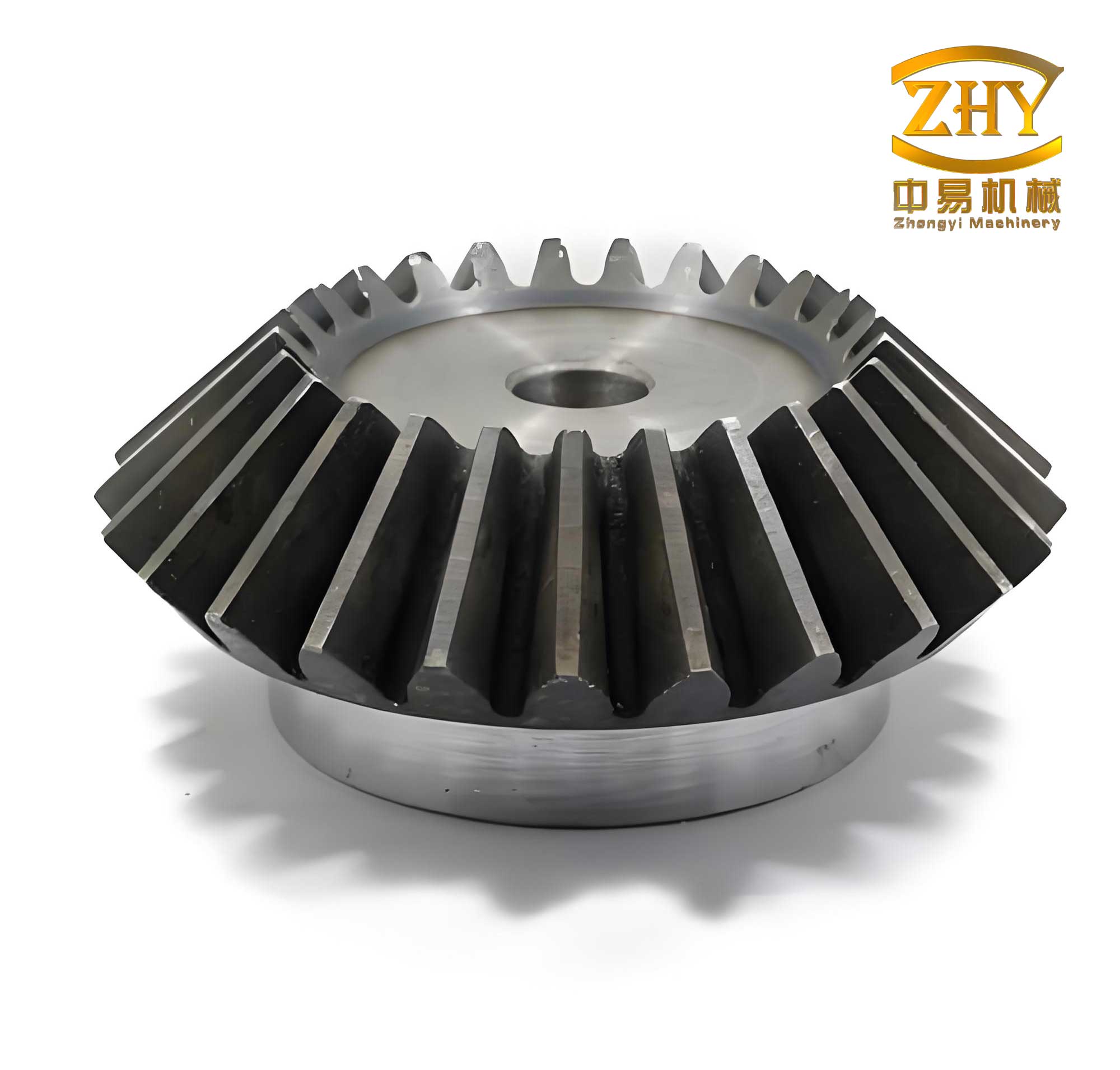
Genetic algorithms are employed in this system due to their ability to handle nonlinear, multi-modal optimization problems without requiring derivative information. For bevel gear transmission optimization, the objective is to minimize the total volume of the gear pair, which directly correlates with weight reduction and material savings—a key consideration in lightweight design. The fitness function is defined as the sum of the volumes of the two bevel gears, derived from their geometric parameters. Let \( z_1 \) and \( z_2 \) be the tooth numbers of the pinion and gear, respectively, \( m \) be the module at the large end, \( \psi_R \) be the face width coefficient, \( R \) be the cone distance, and \( b \) be the face width. The cone distance \( R \) is given by \( R = \frac{m z_1}{2 \sin \delta_1} = \frac{m}{2} \sqrt{z_1^2 + z_2^2} \), where \( \delta_1 \) and \( \delta_2 \) are the pitch cone angles, and \( u = z_2 / z_1 \) is the gear ratio. The face width is \( b = \psi_R R \). The volume of the pinion \( V_1 \) and gear \( V_2 \) are expressed as:
$$ V_1 = \frac{\pi}{3} b \cos \delta_1 \left[ \left( \frac{m z_1}{2} \right)^2 + \frac{m z_1}{2} \cdot \frac{R – b}{R} \cdot \frac{m z_1}{2} + \left( \frac{R – b}{R} \cdot \frac{m z_1}{2} \right)^2 \right] $$
$$ V_2 = \frac{\pi}{3} b \cos \delta_2 \left[ \left( \frac{m z_2}{2} \right)^2 + \frac{m z_2}{2} \cdot \frac{R – b}{R} \cdot \frac{m z_2}{2} + \left( \frac{R – b}{R} \cdot \frac{m z_2}{2} \right)^2 \right] $$
Thus, the fitness function for the genetic algorithm is \( \text{fitness} = V_1 + V_2 \). The design variables are \( x = (z_1, m, \psi_R)^T \), with bounds: \( z_1 \in [17 \cos \delta_1, z_{1 \max}] \), \( m \in [2, m_{\max}] \), and \( \psi_R \in [0.25, 0.30] \). These bounds ensure practical manufacturing and design limits for bevel gear systems.
To ensure reliability, the system incorporates fuzzy reliability constraints based on probabilistic models of contact stress and bending stress. Unlike traditional deterministic constraints, fuzzy reliability accounts for uncertainties in material properties and loading conditions, providing a more robust design. The contact stress \( \sigma_H \) and bending stress \( \sigma_F \) are treated as random variables following normal distributions, while the fatigue strength limits are modeled as fuzzy variables with normal membership functions. The fuzzy failure probability for contact strength \( P_H(A) \) and bending strength \( P_F(A) \) are derived using probability density functions and fuzzy set theory. For a target reliability \( R’ \), the nonlinear constraints are:
$$ \text{Nic1}: 1 – P_H(A) – R’ \geq 0 $$
$$ \text{Nic2}: 1 – P_F(A) – R’ \geq 0 $$
These constraints are integrated into the genetic algorithm as nonlinear conditions, ensuring that the optimized bevel gear design meets specified reliability thresholds. The genetic algorithm parameters, such as population size, crossover rate, and mutation rate, are configurable within the system to balance exploration and exploitation. The GA function in MATLAB, ga, is utilized with the following syntax: [xf, fval, output] = ga(@fitnessfun, nvars, Aeq, Beq, A, B, Lb, Ub, @Nic1, @Nic2), where xf is the optimal design vector, fval is the minimum fitness value, and output contains algorithm performance data.
The implementation of this optimization system involves seamless integration between the .NET platform and MATLAB. A project file is created to facilitate data exchange and function calls. In MATLAB, an m-file is developed for the genetic algorithm, including the fitness function and constraints. This m-file is then compiled into a .NET assembly using the MATLAB Compiler SDK, generating a DLL file that can be referenced in C# code. In Visual Studio, the DLL is added as a reference, enabling the C# application to invoke MATLAB functions directly. Data conversion between C# and MATLAB is handled through the MWNumericArray class, which translates .NET arrays into MATLAB-compatible formats. The web interface is built using ASP.NET with AJAX for responsive client-server communication. Users input parameters via HTML forms, which are processed by C# controllers that call the MATLAB optimization routines. Results, including optimization trajectories and final design parameters, are displayed dynamically using JavaScript and DOM manipulation. This hybrid programming approach leverages the mathematical prowess of MATLAB and the scalability of .NET, making the system efficient for real-world bevel gear design tasks.
To demonstrate the system’s capabilities, consider an optimization example for a bevel gear transmission with a shaft angle \( \Sigma = 90^\circ \). The goal is to minimize the volume under fuzzy reliability constraints with \( R’ = 0.995 \). Input parameters include power transmission, material properties, and operational speeds. The genetic algorithm is configured with a population size of 50, crossover probability of 0.8, and mutation probability of 0.05. The optimization process converges after 95 generations, yielding an optimal design. The results are summarized in the table below, comparing the optimized parameters with initial guesses and traditional constraint methods.
| Parameter | Initial Design | Optimized Design (Fuzzy Reliability) | Traditional Constraint Design |
|---|---|---|---|
| Pinion Tooth Number \( z_1 \) | 18 | 20 | 19 |
| Module \( m \) (mm) | 2.5 | 2.0 | 2.0 |
| Face Width Coefficient \( \psi_R \) | 0.28 | 0.25 | 0.25 |
| Total Volume \( V \) (mm³) | 75,230 | 58,119.2 | 49,830.6 |
| Fuzzy Reliability | 0.950 | >0.995 | 0.890 |
| Contact Strength Satisfied | Yes | Yes | Yes |
| Bending Strength Satisfied | Yes | Yes | Yes |
The table clearly shows that the bevel gear design optimized with fuzzy reliability constraints achieves a higher reliability level while maintaining a reasonable volume reduction. In contrast, the traditional constraint method yields a lower volume but fails to meet the target reliability, highlighting the importance of incorporating probabilistic models in bevel gear optimization. The genetic algorithm’s search trajectory can be visualized through plots generated by the system, showing convergence toward the optimum. For instance, the fitness value decreases monotonically over generations, indicating effective exploration of the design space. The optimal design variables are \( x^* = (20, 2.0, 0.25)^T \), resulting in a fitness value of \( f(x^*) = 58,119.2 \, \text{mm}^3 \). This represents a significant improvement over initial designs, demonstrating the system’s efficacy in achieving lightweight bevel gear configurations without compromising reliability.
Further analysis involves comparing the genetic algorithm approach with other optimization techniques, such as nonlinear programming methods like fmincon in MATLAB. While fmincon can also solve constrained optimization problems, it often requires gradient information and may get trapped in local minima for complex bevel gear design scenarios. The genetic algorithm, being a population-based method, excels in global search and is less sensitive to initial guesses. The table below summarizes a comparison between the two methods for the same bevel gear optimization problem.
| Aspect | Genetic Algorithm (GA) | Nonlinear Programming (fmincon) |
|---|---|---|
| Global Search Capability | High – explores multiple regions | Moderate – may converge locally |
| Derivative Requirement | No – derivative-free | Yes – requires gradients |
| Computational Load | Moderate – population evaluations | High – iterative gradient calculations |
| Convergence Speed | Slower but robust | Faster for smooth problems |
| Suitability for Bevel Gear Design | Excellent – handles nonlinearities | Good but may need tuning |
This comparison underscores why genetic algorithms are preferred in this system for bevel gear optimization, as they provide a balance between solution quality and computational efficiency. Additionally, the system’s web-based nature allows for distributed computing, where multiple optimization runs can be performed in parallel, further enhancing speed. The integration with .NET facilitates user management, data logging, and report generation, making it a comprehensive tool for industrial applications. For example, designers can save optimization histories, compare different bevel gear configurations, and export results to CAD software for further analysis.
The mathematical formulation of the fuzzy reliability constraints involves detailed probabilistic calculations. The contact stress \( \sigma_H \) and bending stress \( \sigma_F \) are assumed to follow normal distributions with means \( \mu_H, \mu_F \) and standard deviations \( \sigma_H, \sigma_F \), derived from load analysis and material data. The fatigue strength limits are modeled as fuzzy sets with membership functions based on experimental data. The fuzzy failure probability is computed using integrals of probability density functions over fuzzy regions. For contact strength, the probability \( P_H(A) \) is given by:
$$ P_H(A) = \sqrt{\frac{D}{2e_H^2 + D}} \cdot \exp\left(-\frac{(a – \mu_H)^2}{2e_H^2 + D}\right) \cdot [h(y_1) + h(y_2)] $$
where \( D \), \( a \), and \( e_H \) are parameters from the Gerber equation for fatigue, and \( h(y) \) is the standard normal cumulative distribution function with \( y_i \) defined as:
$$ y_i = \left( \frac{2e_H^2 + D}{D e_H^2} \right)^{1/2} \cdot \left( c_i – \frac{2a e_H + D \mu_H}{2e_H^2 + D} \right), \quad i = 1, 2 $$
Similar expressions apply for bending strength. These equations are embedded in the MATLAB code, ensuring that each candidate bevel gear design is evaluated for reliability. The genetic algorithm iteratively adjusts the design variables to minimize volume while satisfying these constraints. This approach is superior to deterministic methods, as it accounts for uncertainties inherent in bevel gear manufacturing and operation, such as variations in material hardness or load fluctuations.
In terms of system performance, the optimization process for a typical bevel gear design takes approximately 10-15 seconds on a standard web server, thanks to efficient coding and the use of compiled MATLAB functions. The user interface provides real-time feedback, including progress bars and intermediate results, enhancing the user experience. The system also includes help sections with reference data for bevel gear design, such as standard tooth profiles, material grades, and lubrication recommendations. This educational component aids less experienced designers in making informed decisions. Moreover, the system supports customization; for instance, users can define their own fitness functions or constraints for specialized bevel gear applications, such as aerospace or marine propulsion systems.
Looking ahead, there are several avenues for enhancing this optimization system. One direction is to incorporate multi-objective genetic algorithms (MOGAs) to handle conflicting design goals, such as minimizing volume while maximizing efficiency or durability of bevel gear transmissions. Another improvement is to integrate finite element analysis (FEA) for more accurate stress calculations, though this would increase computational demand. Cloud computing could be leveraged to scale up optimization tasks, allowing for high-fidelity simulations of bevel gear systems. Additionally, machine learning techniques could be employed to predict optimal design parameters based on historical data, reducing the need for exhaustive searches. The modular architecture of the .NET platform makes such extensions feasible, ensuring the system remains relevant as technology evolves.
In conclusion, the optimization design system for bevel gear transmission, based on genetic algorithms and the .NET platform, represents a significant advancement in mechanical design methodology. By combining the global optimization capabilities of genetic algorithms with the robustness of web-based frameworks, it addresses the complexities of bevel gear design in an efficient and user-friendly manner. The focus on fuzzy reliability ensures that designs are not only lightweight but also dependable under real-world conditions. The system’s ability to perform remote optimizations facilitates collaboration and knowledge sharing among engineering teams. As demonstrated through examples, it achieves substantial improvements in design metrics compared to traditional approaches. This work underscores the potential of integrating advanced algorithms with modern software platforms to solve challenging engineering problems, paving the way for smarter and more reliable bevel gear systems in various industries.
The continued evolution of bevel gear technology will benefit from such computational tools, enabling faster innovation and reduced development cycles. I am confident that this system will serve as a valuable resource for designers and researchers working on bevel gear transmissions, contributing to advancements in mechanical engineering and sustainable design practices.