
In the field of precision robotics and high-performance mechanical transmission systems, the RV reducer plays a critical role due to its exceptional fatigue strength, rigidity, longevity, and stable backlash accuracy. The RV reducer, a key component in many industrial applications, incorporates a cycloidal-pin gear transmission mechanism that offers compact size, wide transmission ratio range, high efficiency, reliability, and low noise. The performance of the RV reducer heavily relies on the design and manufacturing precision of its cycloidal gear, particularly the tooth profile. In practical applications, the standard tooth profile of the cycloidal gear must be modified to compensate for manufacturing errors, facilitate assembly, ensure proper lubrication, and achieve optimal meshing conditions. This article delves into the optimization modification of the cycloidal gear tooth profile and its parametric design, aiming to enhance the overall performance of the RV reducer. I will explore various modification methods, establish an optimization model to determine the best modification parameters, and demonstrate a parametric design approach using modern CAD tools and computational programming.
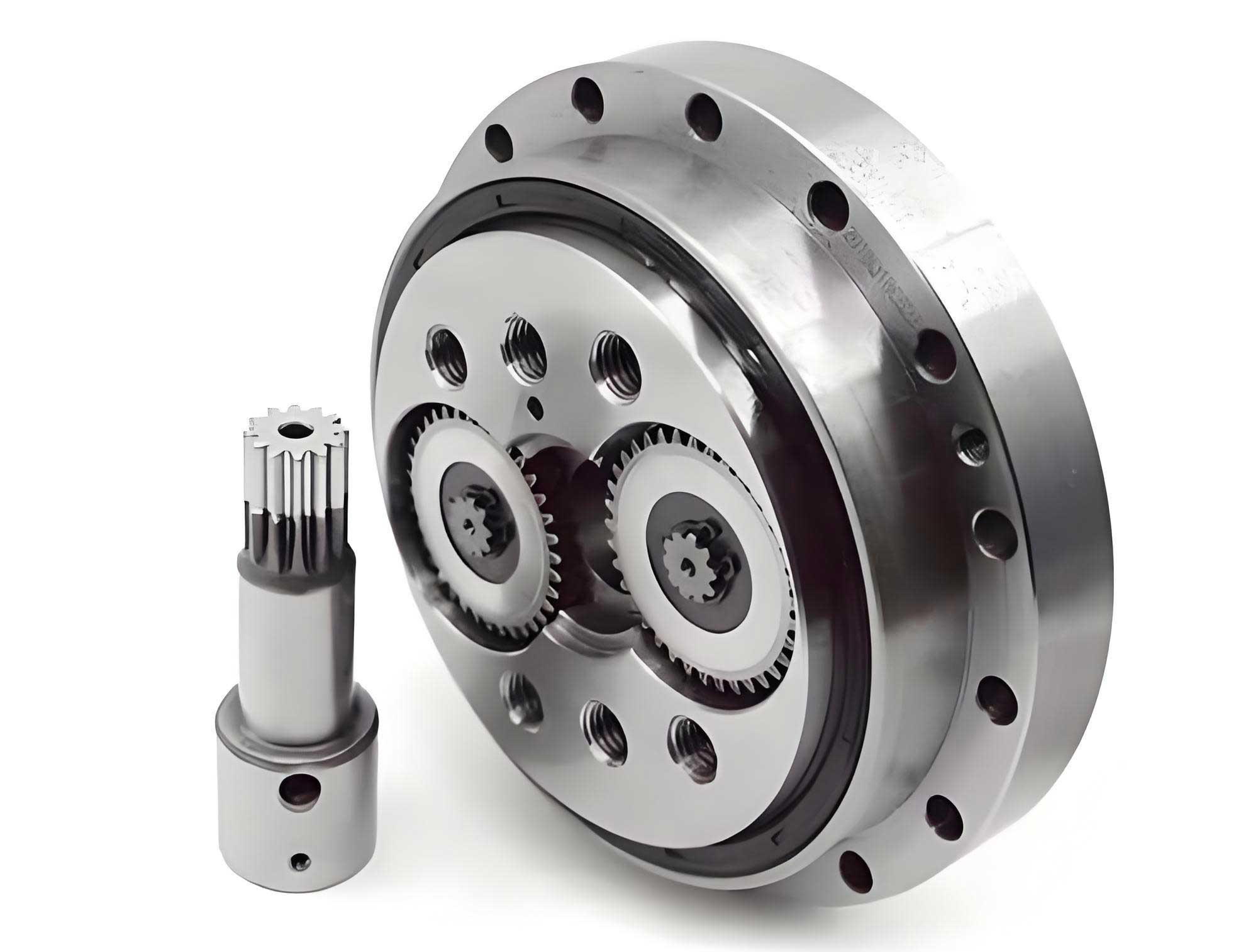
The RV reducer typically consists of a planet carrier, a sun gear, and cycloidal gears. The cycloidal gear meshes with a pin gear to achieve speed reduction and torque amplification. However, to accommodate necessary clearances such as side clearance Δc and radial clearance Δj, the ideal conjugate tooth profile must be altered. Without proper modification, issues like increased backlash, reduced transmission accuracy, and poor lubrication can arise, compromising the efficiency and durability of the RV reducer. Therefore, identifying an effective modification strategy is paramount for designing high-quality RV reducers. This study focuses on evaluating different modification techniques for the cycloidal gear, optimizing the modification parameters to minimize backlash while maintaining near-conjugate meshing, and implementing a parametric design workflow to streamline the manufacturing process, particularly for CNC machining.
Several modification methods are commonly employed for cycloidal gears: the shift distance modification, the equidistant modification, and the rotation angle modification. Each method has its advantages and limitations. The shift distance modification involves altering the center distance of the pin gear, while the equidistant modification adjusts the radius of the pin gear. The rotation angle modification changes the initial phase of the cycloidal gear. However, the rotation angle modification alone cannot be used independently because it leads to zero-clearance contact at the tooth root and tip, causing interference. Thus, a combined approach is often necessary. After thorough analysis, I determined that a combination of negative shift distance modification and positive equidistant modification yields the most favorable results for the RV reducer. This combination not only approximates a conjugate tooth profile in the working region but also ensures appropriate radial and side clearances, thereby minimizing comprehensive backlash and enhancing the transmission precision of the RV reducer.
To quantify the modification, I established a mathematical model for the cycloidal gear tooth profile. The standard tooth profile coordinates for a cycloidal gear are derived based on the generating principle. When modification is applied, the coordinates change accordingly. For the rotation angle modification, the tooth profile coordinates are given by:
$$ x_c = (r_p – r_{rp} S^{-\frac{1}{2}}) \cos[(1 – i_H) \phi – \delta] – \frac{a}{r_p} (r_p – z_p r_{rp} S^{-\frac{1}{2}}) \cos(i_H \phi + \delta) $$
$$ y_c = (r_p – r_{rp} S^{-\frac{1}{2}}) \sin[(1 – i_H) \phi – \delta] + \frac{a}{r_p} (r_p – z_p r_{rp} S^{-\frac{1}{2}}) \sin(i_H \phi + \delta) $$
where \( r_p \) is the radius of the pin gear center circle, \( r_{rp} \) is the radius of the pin gear sleeve, \( a \) is the eccentricity, \( z_p \) and \( z_c \) are the numbers of pin gear teeth and cycloidal gear teeth respectively, \( i_H = z_p / z_c \) is the transmission ratio, \( \phi \) is the rotation angle of the arm relative to a pin tooth center, \( \delta \) is the rotation angle modification amount, and \( S^{-\frac{1}{2}} = (1 + K_1^2 – 2K_1 \cos \phi)^{-\frac{1}{2}} \) with \( K_1 = a z_p / r_p \) being the standard shortening coefficient.
For the combined shift distance and equidistant modification, the modified tooth profile coordinates are:
$$ x’_c = (r_p + \Delta r_p – (r_{rp} + \Delta r_{rp}) S_r^{-\frac{1}{2}}) \cos[(1 – i_H) \phi] – \frac{a}{r_p + \Delta r_p} (r_p + \Delta r_p – z_p (r_{rp} + \Delta r_{rp}) S_r^{-\frac{1}{2}}) \cos(i_H \phi) $$
$$ y’_c = (r_p + \Delta r_p – (r_{rp} + \Delta r_{rp}) S_r^{-\frac{1}{2}}) \sin[(1 – i_H) \phi] + \frac{a}{r_p + \Delta r_p} (r_p + \Delta r_p – z_p (r_{rp} + \Delta r_{rp}) S_r^{-\frac{1}{2}}) \sin(i_H \phi) $$
where \( \Delta r_p \) is the shift distance modification amount (negative for negative shift), \( \Delta r_{rp} \) is the equidistant modification amount (positive for positive equidistant), \( S_r^{-\frac{1}{2}} = (1 + K’_1^2 – 2K’_1 \cos \phi)^{-\frac{1}{2}} \), and \( K’_1 = a z_p / (r_p + \Delta r_p) \) is the modified shortening coefficient. The relationship \( \Delta r_p + \Delta r_{rp} = \Delta j \) holds, where \( \Delta j \) is the required radial clearance.
The goal is to find the optimal modification amounts \( \Delta r_p^* \) and \( \Delta r_{rp}^* \) such that the modified tooth profile closely matches a conjugate profile derived from rotation angle modification within the working region. The working region of the cycloidal gear tooth profile is typically between \( \phi = 25^\circ \) and \( \phi = 100^\circ \). I define an objective function to minimize the deviation between the combined modification profile and the rotation angle modification profile over this region. Let \( \delta_c \) be the rotation angle modification amount determined from the required side clearance \( \Delta c \). Then, for \( m \) evenly spaced points in the working region, the objective function is:
$$ f(\Delta r_{rp}, \Delta r_p) = \frac{1}{m} \sum_{i=1}^{m} | x’_{c_i} – x_{c_i} | $$
subject to the constraints: \( \Delta r_{rp} > 0 \), \( \Delta r_p < 0 \), and \( \Delta r_p + \Delta r_{rp} = \Delta j > 0 \). The optimization problem is to minimize \( f(\Delta r_{rp}, \Delta r_p) \) with respect to these constraints.
To solve this optimization problem, I analyzed various numerical methods and selected the two-point extrapolation mixed penalty function method. This method combines the advantages of interior and exterior penalty functions, allowing arbitrary initial points and providing fast convergence to an approximate optimum. The mixed penalty function is constructed as:
$$ P(\mathbf{x}, c_k) = f(\mathbf{x}) + c_k \left( \sum_{i=1}^{p} \frac{1}{g_i(\mathbf{x})} + \sum_{j=1}^{q} [\max(0, h_j(\mathbf{x}))]^2 \right) $$
where \( \mathbf{x} = [\Delta r_{rp}, \Delta r_p]^T \), \( g_i(\mathbf{x}) \) are inequality constraints (e.g., \( \Delta r_{rp} > 0 \)), \( h_j(\mathbf{x}) \) are equality constraints (e.g., \( \Delta r_p + \Delta r_{rp} – \Delta j = 0 \)), and \( c_k \) is a sequence of penalty parameters decreasing with iterations. The two-point extrapolation technique accelerates convergence by predicting the optimum based on previous iterations. I implemented this algorithm using MATLAB, ensuring robust and efficient computation of the optimal modification amounts for the RV reducer’s cycloidal gear.
To validate the modification approach, I developed a drawing program in VC++ 6.0. This program allows interactive input of cycloidal gear parameters and modification amounts, and it plots both the standard and modified tooth profiles. The graphical comparison provides a clear visual assessment of the modification effect, confirming that the combined negative shift and positive equidistant modification produces a tooth profile with near-conjugate meshing in the working region and adequate clearances at the root and tip. This tool is invaluable for designers working on RV reducers, as it enables quick verification of different modification scenarios without physical prototyping.
Consider a practical example of an RV reducer with a single tooth difference. The parameters are: pin gear center circle radius \( r_p = 52.5 \, \text{mm} \), pin gear sleeve radius \( r_{rp} = 2.25 \, \text{mm} \), number of pin gear teeth \( z_p = 40 \), number of cycloidal gear teeth \( z_c = 39 \), eccentricity \( a = 1 \, \text{mm} \), required radial clearance \( \Delta j = 0.2 \, \text{mm} \), and required side clearance \( \Delta c = 0.05 \, \text{mm} \). First, the rotation angle modification amount \( \delta_c \) corresponding to \( \Delta c \) is calculated. Then, using the optimization model and the mixed penalty function method, the optimal modification amounts are found. The results are summarized in the table below:
| Parameter | Value | Unit |
|---|---|---|
| Shift Distance Modification \( \Delta r_p \) | -0.368 | mm |
| Equidistant Modification \( \Delta r_{rp} \) | 0.569 | mm |
| Radial Clearance \( \Delta j \) | 0.201 | mm |
| Objective Function Value \( f \) | 0.0023 | mm |
The VC++ drawing program was used to plot the tooth profiles. The output shows that the modified profile closely matches the rotation angle modification profile in the working region (approximately 25° to 100°), while maintaining clearances elsewhere. This confirms the effectiveness of the combined modification for this RV reducer configuration. The ability to graphically verify modifications streamlines the design process and reduces the need for trial-and-error in manufacturing.
Beyond modification, parametric design of the cycloidal gear is crucial for modern manufacturing, especially CNC machining. I utilized Pro/ENGINEER 4.0 (Pro/E) to create a parametric model of the cycloidal gear. The process involves defining key parameters such as \( r_p \), \( r_{rp} \), \( a \), \( z_p \), \( z_c \), \( \Delta r_{rp} \), and \( \Delta r_p \). These parameters are declared in Pro/E’s parameter table. Then, a datum curve is created using the equation-driven method, where the modified tooth profile equations are input in Cartesian coordinates. The curve is generated by sweeping the angle \( \phi \) from 0 to 2π. Subsequently, a single tooth solid is extruded from this curve, and a pattern feature is applied to replicate the tooth around the gear circumference. Finally, holes and other features are added to complete the cycloidal gear model. This parametric approach allows rapid regeneration of the gear model for different RV reducer specifications, significantly reducing design time and ensuring consistency.
For CNC machining, the tool path must account for the varying curvature of the cycloidal tooth profile to maintain high accuracy. Instead of evenly distributing points along the curve, I derived a formula to distribute points based on curvature, ensuring denser points in high-curvature regions and sparser points in low-curvature regions. The curvature \( \kappa(\phi) \) of the modified cycloidal tooth profile is given by:
$$ \kappa(\phi) = \frac{r_p S_r^{\frac{1}{2}}}{K’_1 (z_p + 1) \cos \phi – (1 – z_p K’_1)} + r_{rp} $$
where \( S_r^{\frac{1}{2}} = (1 + K’_1^2 – 2K’_1 \cos \phi)^{\frac{1}{2}} \). The arc length differential is \( ds = \sqrt{(x’_c)^2 + (y’_c)^2} \, d\phi \). To distribute \( N \) points along a single tooth profile proportionally to curvature, the number of points \( n \) over an interval from 0 to \( \phi \) is:
$$ n = C \int_0^\phi \kappa(\phi) \sqrt{(x’_c)^2 + (y’_c)^2} \, d\phi $$
where \( C \) is a proportionality constant determined by \( C = N / \int_0^{2\pi} \kappa(\phi) \sqrt{(x’_c)^2 + (y’_c)^2} \, d\phi \). This ensures that points are clustered where the curvature is high, improving machining accuracy. I implemented this in a VC++ program to compute the coordinates of distributed points along the tooth profile. The program calculates the coordinates for both left and right flanks of the cycloidal gear, outputting a list of points suitable for CNC programming. For the example RV reducer, with \( N = 100 \) points per tooth, the distribution is non-uniform, as shown in the computed data, leading to more precise tool movements and better surface finish.
The parametric design and point distribution calculation are integral to advancing the manufacturing of RV reducers. By integrating these methods, designers can quickly generate accurate CAD models and CNC instructions, reducing errors and enhancing the performance of the final product. The RV reducer benefits greatly from such precision engineering, as it directly impacts the efficiency and reliability of robotic systems and other high-precision machinery.
In conclusion, this study presents a comprehensive approach to optimizing the tooth profile modification of cycloidal gears in RV reducers. The combination of negative shift distance and positive equidistant modification is identified as the most effective method, balancing conjugate meshing with necessary clearances. The optimization model, solved using a mixed penalty function method, yields precise modification amounts that minimize backlash. Validation through a VC++ drawing program provides visual confirmation of the tooth profile improvements. Furthermore, parametric design in Pro/E and curvature-based point distribution for CNC machining streamline the design and manufacturing processes. These contributions enhance the design accuracy, manufacturing efficiency, and overall performance of RV reducers, supporting their critical role in modern automation and robotics. Future work may explore dynamic analysis of modified profiles or integration with real-time monitoring systems for adaptive manufacturing of RV reducer components.
The RV reducer continues to be a focal point in precision transmission, and advancements in cycloidal gear design directly contribute to its evolution. By leveraging optimization algorithms and parametric tools, engineers can push the boundaries of RV reducer performance, meeting the growing demands for high accuracy and durability in industrial applications. The methodologies outlined here serve as a foundation for further innovation in the field of gear design and manufacturing.