
In modern precision engineering, strain wave gear transmission systems have become indispensable in applications ranging from aerospace and robotics to CNC machine tools and automated control systems. The unique working principle of strain wave gear, which relies on elastic deformation to achieve high reduction ratios and compact design, offers significant advantages. However, in configurations without flexible bearings, the cam wave generator is subjected to severe surface wear, leading to reduced efficiency and lifespan. To address this, I investigate a novel design approach inspired by bionic surface textures, focusing on the optimization of micro-dimple parameters on the cam surface to enhance lubrication performance. This study builds upon prior computational fluid dynamics (CFD) analyses that identified an optimal elliptical clearance ratio for lubrication, extending the research to the parametric design of bionic textures. The integration of such textures in strain wave gear components can potentially revolutionize their durability and operational smoothness.
Nature has long served as a source of inspiration for engineering solutions, with numerous organisms evolving surface micro-textures to adapt to challenging environments. Examples include the self-cleaning properties of lotus leaves, the adhesive capabilities of tree frog toe pads, the drag-reducing shark skin, and the remarkable climbing ability of geckos. These biological surfaces exhibit non-smooth textures that optimize friction, wear, and fluid dynamics. In tribology, surface texturing has been widely adopted to improve the frictional performance of materials, finding applications in bearings, cylinder liners, seals, mechanical hard disks, artificial joints, and road surfaces. By emulating these natural designs, I aim to enhance the lubrication characteristics of the cam wave generator in strain wave gear systems, thereby mitigating wear and improving overall efficiency.
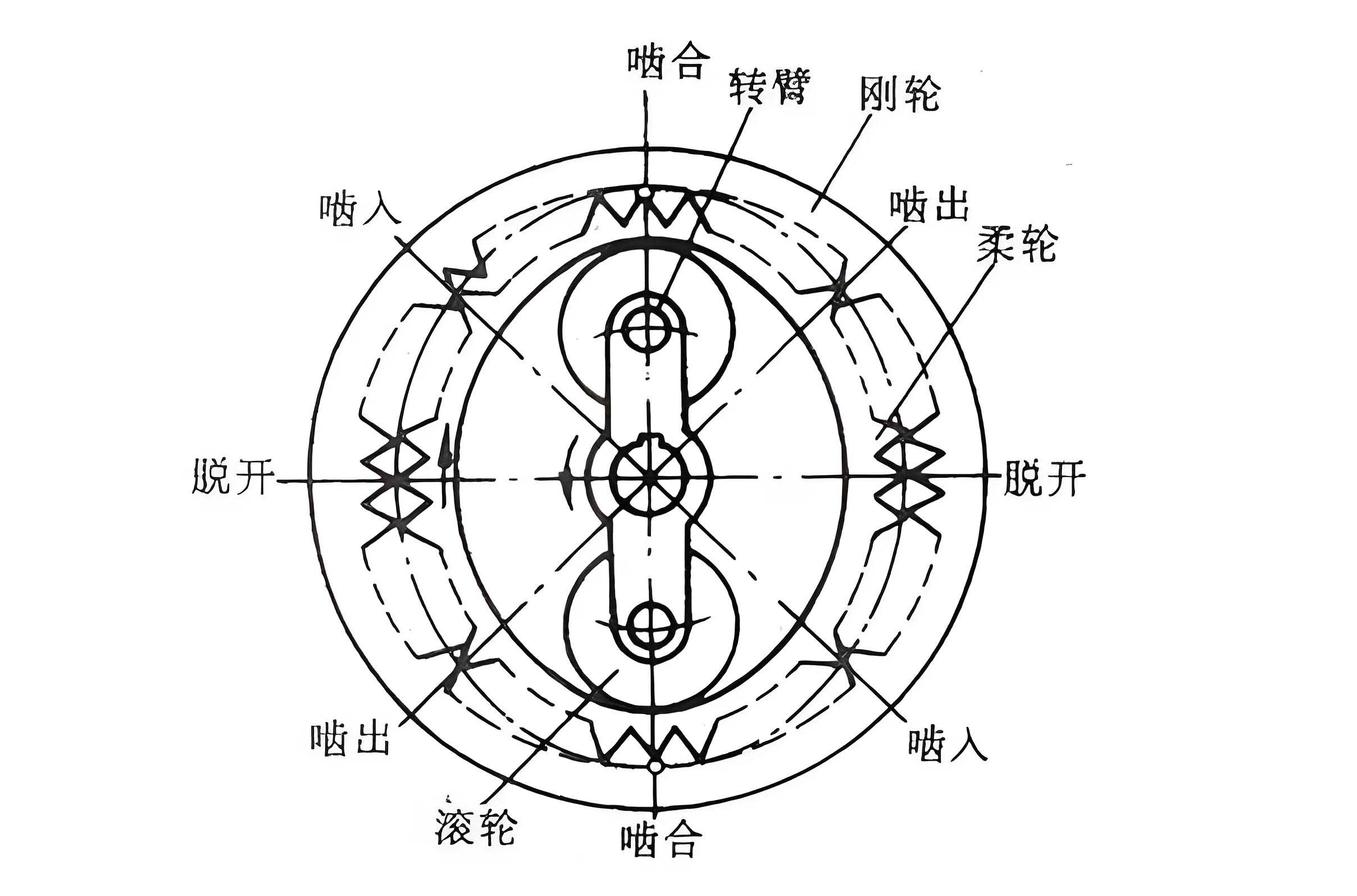
The analytical model for this study centers on the fluid domain between the cam wave generator and the flexspline in a strain wave gear assembly. As illustrated, the cam rotates counterclockwise at a speed $n_1$, while the flexspline rotates in the opposite direction. The boundaries of the oil film are defined by the outer wall of the cam and the inner wall of the flexspline. The oil film thickness $h(\theta)$ varies from a maximum $h_{\text{max}}$ at a rotational angle $\theta = 0$ to a minimum $h_{\text{min}}$ at $\theta = 90^\circ$. Along the width direction (z-axis) of the cam, the outer surface is textured with spherical-cap micro-dimples. The texture parameters include distribution location, depth, shape, and density, which are critical for optimizing lubrication. The elliptical clearance between the cam and flexspline is characterized by parameters $B$ and $L$, and the texture distribution is described by the ratio $B_p/B$, where $B_p$ relates to the position. The depth $h_p$ and the ratio $r_p/h_p$ define the shape, with smaller ratios indicating gentler curvature changes. The density is represented by the ratio $\frac{N\pi r_p^2}{BL}$, where $N$ is the number of dimples. This model forms the basis for simulating the effects of texture parameters on the lubrication performance of the strain wave gear.
To systematically evaluate the impact of micro-dimple textures, I employ computational fluid dynamics methods to analyze the oil film pressure distribution, load-carrying capacity, and frictional forces. The governing equations for fluid flow in the thin film region are derived from the Reynolds equation, which for an incompressible, isoviscous lubricant can be expressed as:
$$ \frac{\partial}{\partial x} \left( \frac{h^3}{\mu} \frac{\partial p}{\partial x} \right) + \frac{\partial}{\partial z} \left( \frac{h^3}{\mu} \frac{\partial p}{\partial z} \right) = 6U \frac{\partial h}{\partial x} $$
where $p$ is the pressure, $h$ is the film thickness, $\mu$ is the dynamic viscosity, and $U$ is the relative surface velocity. For the textured surface, the film thickness function $h(x,z)$ incorporates the micro-dimple geometry, leading to localized variations that influence the hydrodynamic pressure generation. The load-carrying capacity $W$ and friction force $F$ are calculated by integrating the pressure and shear stress over the surface area:
$$ W = \iint_A p \, dA, \quad F = \iint_A \tau \, dA $$
where $\tau$ is the shear stress. These metrics are used to assess the lubrication performance under different texture parameters, ensuring that the strain wave gear operates with minimal wear and energy loss.
Influence of Texture Distribution Location
The distribution of micro-dimples on the cam surface is categorized into three configurations: full-area distribution (uniform across the entire surface), convergent-area distribution (only in regions where the gap between cam and flexspline is converging), and divergent-area distribution (only in regions where the gap is diverging). Under conditions of $z=0$, $\delta=3$, $h_{\text{min}}=0.1\,\text{mm}$, $\omega=2000\,\text{rpm}$, and $h_p = r_p = 1\,\text{mm}$, the oil film pressure on the flexspline inner wall is simulated. The results show that divergent-area distribution yields a smoother pressure profile compared to convergent-area distribution, while full-area distribution produces pressure curves with small突起 corresponding to dimple locations, indicating local hydrodynamic effects. A comparative analysis of load capacity and friction force is summarized in Table 1.
| Distribution Location | Load Capacity (Relative) | Friction Force (Relative) | Lubrication Performance |
|---|---|---|---|
| Full-Area | High | Low | Optimal |
| Convergent-Area | Medium | High | Moderate |
| Divergent-Area | Highest | Medium | Good |
From this, I conclude that full-area distribution offers the best balance, enhancing load capacity while minimizing friction, which is crucial for the longevity of strain wave gear systems. The divergent-area distribution, although providing the highest load, incurs increased friction, reducing overall lubrication efficiency.
Influence of Texture Depth
The depth of micro-dimples $h_p$ is a critical parameter, as it directly affects the film thickness and pressure generation. I analyze depths ranging from 0.05 mm to 0.5 mm, keeping other parameters constant. The results indicate that when $h_p$ is comparable to the minimum film thickness $h_{\text{min}}$, the lubrication performance peaks. Specifically, at $h_p = 0.1\,\text{mm}$, the maximum oil film pressure and the ratio of pressure integral are highest, corresponding to optimal load capacity and minimal friction. This relationship can be expressed by the following empirical formula derived from simulations:
$$ W \propto \frac{1}{1 + \left( \frac{h_p}{h_{\text{min}}} \right)^2}, \quad F \propto \frac{h_p}{h_{\text{min}}} $$
For depths exceeding the gap scale, the load capacity drops sharply due to disruption of the continuous film. Figure 5 (conceptual) illustrates the variation of load and friction with depth, confirming that $h_p = 0.1\,\text{mm}$ is optimal for this strain wave gear configuration. This depth ensures that the dimples act as micro-reservoirs and pressure generators without causing excessive leakage or cavitation.
Influence of Texture Shape
The shape of micro-dimples is characterized by the ratio $r_p/h_p$, where $r_p$ is the radius and $h_p$ is the depth. A smaller ratio indicates a flatter, more gradual dimple, while a larger ratio denotes a steeper, deeper dimple. I vary $r_p$ from 0.5 mm to 10 mm while maintaining $h_p = 0.1\,\text{mm}$. The load capacity and friction force as functions of $r_p$ are plotted in Figure 6, showing that both metrics increase with $r_p$ until stabilizing at $r_p \geq 6\,\text{mm}$. The stabilization suggests that beyond this point, the local hydrodynamic effects reach a plateau, and further increases do not enhance performance. The optimal value is identified as $r_p = 6\,\text{mm}$, where the shape provides sufficient curvature to generate pressure without introducing turbulence or stress concentrations. This can be modeled by the shape factor $S$:
$$ S = \frac{r_p}{h_p} $$
and the load capacity correlates with $S$ as:
$$ W \sim \frac{S}{1 + S^2} $$
Thus, for the strain wave gear application, a dimple with $r_p = 6\,\text{mm}$ and $h_p = 0.1\,\text{mm}$ yields the best lubrication characteristics.
Influence of Texture Density
Texture density, defined as the area fraction $\frac{N\pi r_p^2}{BL}$, influences the cumulative hydrodynamic effect. Higher density means more dimples per unit area, which can enhance pressure build-up but also increase surface roughness. I simulate densities from 5% to 40% while keeping $r_p = 6\,\text{mm}$ and $h_p = 0.1\,\text{mm}$. The results, summarized in Table 2, demonstrate that load capacity increases monotonically with density, while friction force decreases, leading to improved lubrication performance. This is attributed to the stronger local fluid dynamic pressure accumulation and better oil retention. The relationship can be approximated by:
$$ W \propto \left( \frac{N\pi r_p^2}{BL} \right)^{0.5}, \quad F \propto \left( \frac{N\pi r_p^2}{BL} \right)^{-0.2} $$
| Density (%) | Load Capacity (Normalized) | Friction Force (Normalized) | Lubrication Index |
|---|---|---|---|
| 5 | 0.8 | 1.0 | 0.8 |
| 10 | 0.9 | 0.9 | 1.0 |
| 20 | 1.0 | 0.8 | 1.25 |
| 30 | 1.1 | 0.7 | 1.57 |
| 40 | 1.2 | 0.6 | 2.0 |
Therefore, maximizing texture density within practical manufacturing limits is beneficial for strain wave gear applications. However, extremely high densities may lead to inter-dimple interference or surface weakening, so an optimal range of 20-40% is recommended.
Conclusion
Through comprehensive CFD simulations and parametric analysis, I have elucidated the effects of bionic micro-dimple textures on the lubrication performance of cam wave generators in strain wave gear transmissions without flexible bearings. The key findings are:
- Full-area distribution of textures provides the best lubrication and load-carrying characteristics, outperforming convergent or divergent distributions.
- Texture depth should be on the order of the minimum film thickness, with an optimal value of $h_p = 0.1\,\text{mm}$ for the studied strain wave gear configuration.
- Texture shape, characterized by $r_p/h_p$, has an optimal radius of $r_p = 6\,\text{mm}$, ensuring effective pressure generation without adverse effects.
- Higher texture density enhances load capacity and reduces friction, with recommendations for densities above 20% for superior performance.
These insights provide a foundation for designing and optimizing surface textures in strain wave gear components, potentially extending their service life and efficiency. The integration of bionic principles into strain wave gear technology represents a promising avenue for advancing precision mechanical systems. Future work could explore dynamic conditions, multi-scale textures, and material interactions to further refine the design. As strain wave gear continues to evolve, such innovations will be crucial for meeting the demands of high-performance applications in robotics, aerospace, and beyond.