
In my experience working with heavy machinery components, the spiral bevel gear, particularly the driven spiral bevel gear used in drive axles, presents a significant challenge in heat treatment. Traditionally, our company employed pit furnaces with drip-fed kerosene for carburizing. After carburizing, the spiral bevel gears were slow-cooled and then subjected to a secondary heating process for press-quenching to maintain shape. This method, while functional, was labor-intensive, energy-inefficient, and prone to issues like oxidation and decarburization during cooling and reheating. These defects often led to subpar surface hardness, reduced wear resistance, and diminished fatigue strength in the spiral bevel gear. To address these challenges, we integrated a Japanese Unicase multi-purpose box furnace production line. This allowed us to explore and implement a direct quenching process after carburizing for the spiral bevel gear, eliminating the need for secondary press-quenching. This article details my first-hand account of developing this optimized process, which not only enhanced the quality of the spiral bevel gear but also streamlined production and reduced costs substantially.
The driven spiral bevel gear in question is a large, thin-disc component with a significant central bore, making it highly susceptible to distortion during heat treatment. The material is 20CrMnTi, a chromium-manganese-titanium steel commonly used for carburized gears. The chemical composition is critical for achieving the desired core toughness and case hardness after carburizing. The technical specifications for the finished spiral bevel gear are stringent: a surface hardness of 58–63 HRC, an effective case depth of 1.5–2.0 mm, controlled carbide and retained austenite levels (both ≤ Grade 5), and strict limits on distortion (roundness of the inner bore ≤ 0.15 mm, parallelism at specific locations ≤ 0.2 mm and ≤ 0.1 mm).
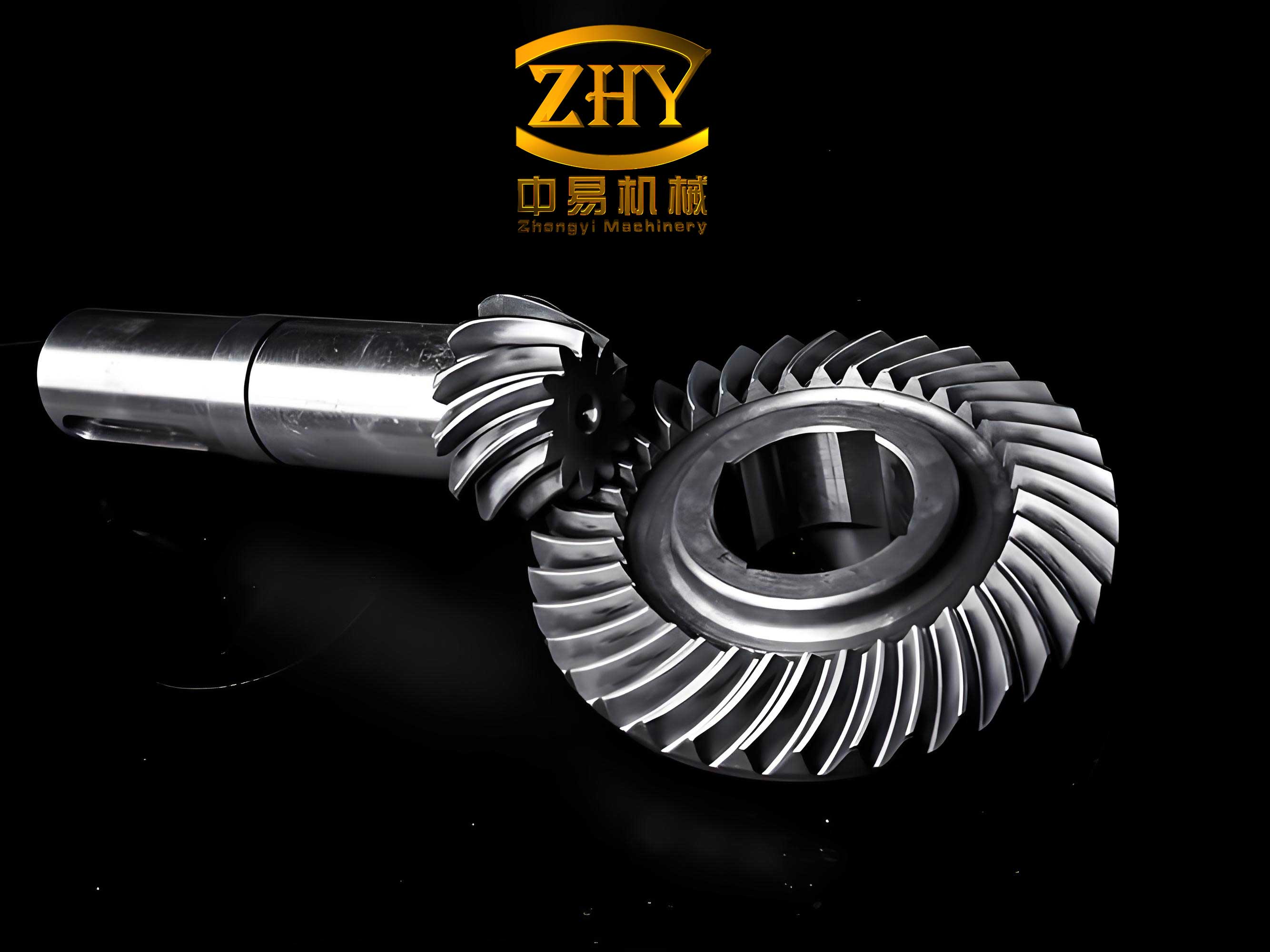
The cornerstone of our new process was the precise determination of thermal and atmospheric parameters within the Unicase furnace. For the spiral bevel gear, temperature control is paramount. Through numerous experimental runs, we established that a carburizing temperature of 920°C and a subsequent quenching temperature of 810°C yielded the optimal balance between case depth development and minimal distortion for this large, thin-section spiral bevel gear. The carbon potential of the furnace atmosphere directly governs the surface carbon concentration. For a spiral bevel gear, a surface carbon content between 0.8% and 1.05% is ideal. A concentration above 1.05% promotes excessive and potentially networked carbides, increasing brittleness and the risk of spalling, which severely compromises the fatigue life of the spiral bevel gear. Conversely, a concentration below 0.8% results in insufficient hardness and wear resistance. Therefore, we set the boost diffusion parameters as follows: a boost phase carbon potential of 1.05% to rapidly build up carbon at the surface, followed by a diffusion phase at 0.80% to smooth the carbon gradient and achieve the target surface concentration.
The duration of the boost and diffusion phases is calculated based on the desired case depth and the principles of diffusion. The relationship between case depth (d, in mm) and carburizing time (τ, in hours) at a constant temperature can be approximated by a parabolic law:
$$d = K \sqrt{\tau}$$
where K is a constant dependent on temperature and steel composition. For a target case depth of 1.5–2.0 mm at 920°C, the total carburizing time (T) was estimated from standard diffusion charts. The allocation between boost time (τ_boost) and diffusion time (τ_diff) is crucial for achieving the correct carbon profile. The ratio can be derived from the desired surface carbon concentration (C_s), the core carbon content of the steel (C_0), and the saturation limit of austenite at the carburizing temperature (C_max):
$$ \tau_{\text{boost}} = T \left( \frac{C_s – C_0}{C_{\text{max}} – C_0} \right)^2 $$
For our spiral bevel gear made of 20CrMnTi, C_0 ≈ 0.21%, C_s = 0.80%, and C_max ≈ 1.05% at 920°C. Plugging in the values:
$$ \tau_{\text{boost}} = T \left( \frac{0.80 – 0.21}{1.05 – 0.21} \right)^2 = T \left( \frac{0.59}{0.84} \right)^2 \approx T \times (0.702)^2 \approx 0.49T $$
Thus, the boost phase should constitute approximately 49% of the total carburizing time, with diffusion taking the remaining 51%. This ensures a proper carbon gradient without excessive surface carbon for the spiral bevel gear.
Perhaps the most critical factor for a large spiral bevel gear is controlling distortion during quenching. The quenching medium and its agitation are vital. We selected an isothermal/mar-tempering oil for its ability to provide a rapid cooling rate through the pearlite transformation zone but a slower rate through the martensite transformation zone, thereby reducing thermal stress and distortion. We experimented with three variations of this oil, adjusting their cooling curves by additive treatments. The key parameters were oil temperature and agitation speed. For the final process, we used Oil-3 at a temperature of 110°C with a low agitation speed of 126 rpm. This combination provided sufficient hardenability to achieve the required 58-63 HRC on the spiral bevel gear’s teeth while minimizing the distortion forces on the thin disc.
However, even the best quenching medium cannot compensate for poor part orientation during heating and quenching. The fixturing and loading method for the spiral bevel gear are equally crucial. We tested various loading configurations and found that vertical hanging produced the least distortion compared to horizontal stacking or bolting arrangements. To implement this practically, I designed a trapezoidal hanging fixture. This fixture supports the spiral bevel gear at two points corresponding to quarter-points on the inner bore’s circumference, ensuring even stress distribution during the process. The table below summarizes the dramatic improvement in distortion control achieved with the vertical hanging method using the trapezoidal fixture compared to other methods.
| Loading Method | Number of Spiral Bevel Gears | Parts Exceeding Parallelism Spec (Location B) | Parts Exceeding Parallelism Spec (Location C) | Parts Exceeding Roundness Spec | Overall Distortion Pass Rate |
|---|---|---|---|---|---|
| Vertical Hanging (with Fixture) | 60 | 0 | 0 | 0 | 100% |
| Horizontal Stacking | 8 | 7 | 0 | 0 | ~13% |
| Bolted Connection | 8 | 0 | 0 | 5 | ~38% |
The development of the quenching oil was an iterative process. The initial oil (Oil-1) provided adequate hardness but resulted in unacceptable distortion for the spiral bevel gear. Oil-2, a modified version, solved the distortion problem for the spiral bevel gear but proved insufficient for hardening larger-diameter shafts that were processed in the same furnace. The final formulation, Oil-3, offered a balanced cooling curve that met the requirements for both thin-section spiral bevel gears and thicker shaft components. The following table illustrates the performance of the different oils on batches of spiral bevel gears, highlighting the success of Oil-3.
| Batch | Quench Oil Used | Number of Spiral Bevel Gears | Average Surface Hardness (HRC) | Number of Gears Failing Distortion Specs | Key Observation |
|---|---|---|---|---|---|
| 1 | Oil-1 | 9 | >60 | 7 | High distortion, pass rate 22% |
| 2 | Oil-2 | 9 | 58-62 | 0 | Good for spiral bevel gear only |
| 3 | Oil-3 | 60 | >60 | 0 | Excellent for spiral bevel gear and other parts |
The complete, optimized thermal cycle for the spiral bevel gear in the Unicase furnace can be summarized by the following sequence of events and parameters. The entire process is controlled by the furnace’s integral carbon and temperature probes, ensuring reproducibility.
- Heating: The spiral bevel gears, loaded vertically on the trapezoidal fixtures, are heated to the carburizing temperature of 920°C under a neutral atmosphere.
- Boost Carburizing: At 920°C, the carbon potential is raised to 1.05% for a duration calculated as 0.49T, where T is the total time needed for the target case depth. This builds a high carbon layer.
- Diffusion: The carbon potential is lowered to 0.80% for the remaining 0.51T. This allows carbon to diffuse inwards, lowering the surface concentration and creating a smooth gradient.
- Temperature Ramping for Quench: After diffusion, the furnace temperature is lowered to the quench temperature of 810°C. This step is performed under a protective atmosphere to prevent decarburization.
- Direct Quenching: Once stabilized at 810°C, the spiral bevel gears are rapidly transferred to the integral quench tank containing Oil-3 at 110°C with low-speed agitation.
- Tempering: Although not detailed in the initial scope, a low-temperature temper (typically 160-180°C for 2-3 hours) is subsequently performed to relieve quenching stresses and stabilize the microstructure.
The metallurgical results on the spiral bevel gear were consistently excellent. The case microstructure showed fine, dispersed carbides and controlled retained austenite, well within the specified Grade 5 limits. The hardness profile from the surface to the core was optimal, meeting the demanding service requirements of a drive axle spiral bevel gear. The elimination of the secondary heating and press-quenching step not only saved energy but also removed opportunities for oxidation and decarburization, resulting in a cleaner, higher-quality surface on every spiral bevel gear.
The success of this process hinges on the synergistic control of all variables. To encapsulate the interrelationships, we can model the key output—case depth and distortion—as functions of the primary inputs. While simplified, these relationships guide process design.
The effective case depth (ECD) to a specified hardness (e.g., 550 HV) is primarily a function of temperature (T), time (τ), and carbon potential (Cp). A more comprehensive form of the diffusion equation considers the carbon gradient:
$$ \text{ECD} \propto \sqrt{D(T) \cdot \tau} $$
where D(T) is the temperature-dependent diffusion coefficient of carbon in austenite, which increases exponentially with temperature:
$$ D(T) = D_0 \exp\left(-\frac{Q}{RT}\right) $$
Here, $D_0$ is a pre-exponential factor, $Q$ is the activation energy for diffusion, and $R$ is the gas constant. For the spiral bevel gear, operating at 920°C provided a sufficiently high D(T) to achieve the 1.5-2.0 mm depth within a practical time frame without excessive grain growth.
Distortion (Δ) in the spiral bevel gear is a more complex function, influenced by thermal gradients (ΔT), phase transformation stresses (σ_phase), and fixturing constraints (F). It can be conceptually represented as:
$$ \Delta \approx f(\alpha \cdot \Delta T, \beta \cdot \Delta V_{\text{transformation}}, \gamma \cdot F) $$
where α is the coefficient of thermal expansion, β is a factor related to the volume change during austenite-to-martensite transformation, and γ is a geometric compliance factor. Our process minimizes Δ by:
- Reducing ΔT during quenching through the use of hot oil (110°C).
- Mitigating σ_phase by using an oil that slows the martensitic transformation (Mar-tempering effect).
- Optimizing F through the vertical hanging fixture that allows uniform contraction.
The economic and qualitative benefits of this optimized carburizing and direct quenching process for the spiral bevel gear have been substantial. Over a year of production, we have processed hundreds of spiral bevel gears using this methodology. The consistency is remarkable, as shown in the final quality audit data from a representative batch of 15 spiral bevel gears processed in a single run with the optimized parameters.
| Spiral Bevel Gear Serial # | Parallelism at Location C (mm) | Parallelism at Location B (mm) | Inner Bore Roundness (mm) | Surface Hardness (HRC) |
|---|---|---|---|---|
| 1 | 0.05 | 0.05 | 0.05 | 60 |
| 2 | 0.05 | 0.05 | 0.03 | 60 |
| 3 | 0.05 | 0.05 | 0.04 | 61 |
| 4 | 0.05 | 0.05 | 0.03 | 59 |
| 5 | 0.12 | 0.02 | 0.03 | 60 |
| 6 | 0.02 | 0.07 | 0.05 | 60 |
| 7 | 0.10 | 0.05 | 0.05 | 61 |
| 8 | 0.05 | 0.10 | 0.03 | 62 |
| 9 | 0.05 | 0.07 | 0.09 | 60 |
| 10 | 0.05 | 0.05 | 0.05 | 59 |
| 11 | 0.12 | 0.05 | 0.03 | 62 |
| 12 | 0.05 | 0.05 | 0.03 | 60 |
| 13 | 0.07 | 0.05 | 0.04 | 60 |
| 14 | 0.03 | 0.05 | 0.10 | 61 |
| 15 | 0.10 | 0.05 | 0.05 | 60 |
All measured values for the spiral bevel gear in this batch are within the strict specifications, demonstrating the process capability. The direct financial savings from eliminating the press-quenching operation, reducing scrap and rework, and improving energy efficiency are significant. More importantly, the enhanced and consistent quality of the spiral bevel gear contributes to greater reliability and longevity of the final drive axle assembly. The fatigue performance, in particular, is expected to see a marked improvement due to the absence of surface defects and the optimal compressive residual stress profile imparted by direct quenching.
In conclusion, the journey to optimize the heat treatment for the driven spiral bevel gear was a comprehensive exercise in applying metallurgical principles to a complex manufacturing challenge. By systematically addressing temperature, atmosphere, time, fixturing, and quenching medium, we developed a robust carburizing and direct quenching process. This process ensures that every spiral bevel gear meets the highest standards for hardness, case depth, microstructure, and most critically, dimensional stability. The spiral bevel gear is no longer a bottleneck prone to distortion; it is now a model of consistent quality produced through a streamlined, efficient, and controlled thermal cycle. The lessons learned and the methodologies developed, especially concerning fixture design and quenchant customization, have been successfully applied to other challenging carburized components, further validating the approach taken for the spiral bevel gear.