
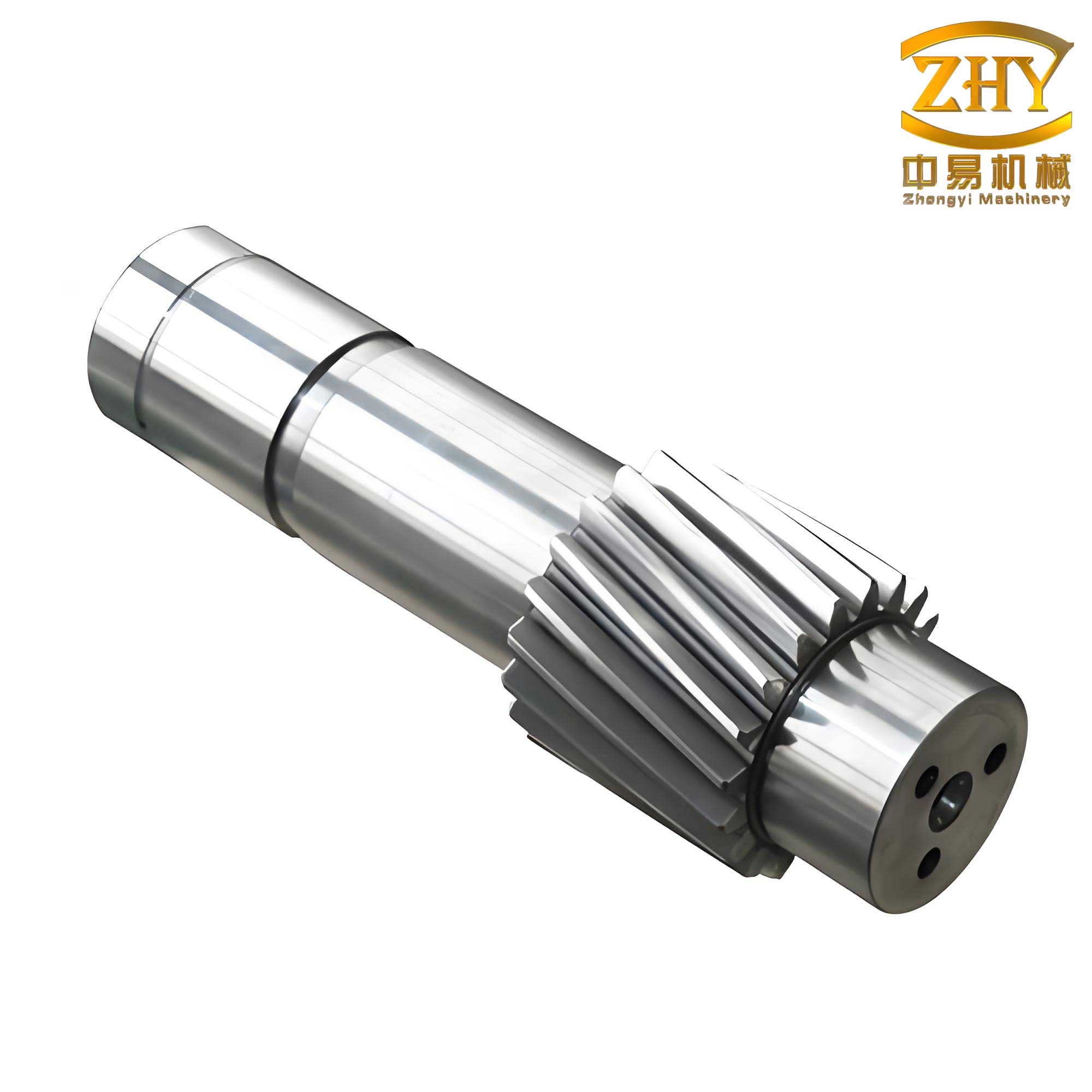
In our production of mining equipment such as conveyor systems, crushers, and gearboxes, bevel gear shafts manufactured from 18CrNiMo7-6 steel are critical components. Field performance analysis and failure investigations of warranty returns consistently indicated that fractures occurred during service, primarily due to the release of residual stresses. We concluded that our existing heat treatment process was not effectively minimizing the quenching stresses induced after carburizing. To address this, we initiated a comprehensive process optimization project. The core objective was to achieve the target surface hardness of 58–62 HRC while ensuring the core hardness remained at or below 35 HRC, thereby reducing the risk of stress-induced failure. The optimization was systematically carried out through three distinct phases of experimentation, focusing on modifying post-carburizing quenching parameters.
The material 18CrNiMo7-6 is a case-hardening steel widely used for high-performance gear shafts due to its excellent hardenability, toughness, and core strength. The standard process involves carburizing to create a high-carbon case, followed by direct quenching and tempering. However, the high hardenability of this steel means that during quenching of large-section gear shafts, the entire cross-section, including the core, can transform to martensite. While this provides high strength, it also generates significant internal (residual) stresses due to the volumetric expansion associated with the martensitic transformation, especially when the temperature gradient between the surface and core is severe. Our goal was to modulate the quenching process to achieve a favorable stress distribution—maintaining high surface hardness for wear resistance while allowing the core to transform to a lower-hardness, lower-stress microstructure like bainite or fine pearlite.
The initial, or baseline, process was defined as follows: Quenching from 840°C after a 30-minute equalization soak, followed by a 10-minute intense oil agitation (“strong cooling”) and 20 minutes of slow oil agitation (“gentle cooling”), with an oil temperature of 50°C. The metallographic results for this baseline were excellent: Martensite & Retained Austenite (M/RA) at level 1, Carbides at level 1, and Core microstructure at level 1, according to the relevant heavy-duty gear inspection standard. Despite this, field failures persisted, indicating that perfect microstructure at the specimen level did not guarantee low stress in actual, complex-shaped gear shafts.
Phase 1: Initial Adjustments to Quenching Temperature and Cooling Cycle
The first experimental phase aimed to reduce the quenching severity. The strategy involved lowering the austenitizing temperature before quenching to reduce the thermal gradient, adding a pre-cooling (air) step, and reducing the cooling intensity by adjusting oil temperature and agitation times. Four separate furnace batches were processed with varying parameters, as detailed in Table 1.
| Batch | Quenching Parameters | M/RA (Level) | Carbides (Level) | Core (Level) | Notes |
|---|---|---|---|---|---|
| Baseline | 840°C, 30min soak, 10min strong cool, 20min gentle cool, Oil 50°C | 1 | 1 | 1 | Original Process |
| Batch 1 | 820°C, 30min soak, 3min pre-cool, 30min gentle cool, Oil 50°C | 4 | 1 | 2 | 15 gear shafts of 2 types |
| Batch 2 | 840°C, 30min soak, 3min pre-cool, 40min gentle cool, Oil 60°C | 1 | 2 | 2 | 2 gear shafts of 1 type |
| Batch 3 | 840°C, 60min soak, 3min pre-cool, 20min gentle cool, Oil 70°C | 4 | 1 | 2 | 6 gear shafts of 1 type |
| Batch 4 | 840°C, 30min soak, 0min pre-cool, 25min gentle cool, Oil 60°C | 4 | None | 2 | 5 gear shafts of 2 types |
Analysis: Only Batch 2 yielded ideal microstructure (M/RA Level 1). This batch had the smallest load mass, meaning the pre-cool and extended gentle cooling were sufficient. However, a critical flaw was identified: pre-cooling significantly reduces the temperature of the gear teeth, lowering their undercooling and potentially leading to insufficient cooling and soft teeth. For the shaft section, pre-cooling only slightly lowers the surface temperature, while the sub-surface and core remain hotter, potentially creating an unfavorable stress distribution upon final quenching. Batches 1, 3, and 4 all resulted in M/RA Level 4, which, while acceptable per standard (≤4), was not optimal and indicated a process window that was too narrow. This phase demonstrated that simply adding pre-cool was not a robust solution for our range of gear shafts.
Phase 2: Refining the Cooling Strategy
Based on Phase 1 learnings, Phase 2 focused on a more controlled cooling sequence: a lower, fixed austenitizing temperature of 820°C, elimination of the unpredictable pre-cool step, introduction of a short, intense agitation period, and a calculated reduction in gentle cooling time. Two batches were processed, with Batch 5 undergoing a double heat treatment (quench + temper + reheat & quench).
| Batch | Quenching Parameters | M/RA (Level) | Carbides (Level) | Core (Level) | Notes |
|---|---|---|---|---|---|
| Baseline | 840°C, 30min soak, 10min strong cool, 20min gentle cool, Oil 50°C | 1 | 1 | 1 | Original Process |
| Batch 5 | 820°C, 4h soak, 3min strong cool, 20min gentle cool, Oil 60°C | 1 | 2 | 1 | 8 gear shafts + 2 test pieces (Double Quench) |
| Batch 6 | 820°C, 60min soak, 3min strong cool, 20min gentle cool, Oil 60°C | 2 | 1 | 1 | 16 gear shafts (1 cracked in keyway) |
Full-section test pieces from Batch 5 were analyzed. Hardness traverses on a Ø120mm shaft section revealed that the core was not fully hardened. The hardness within 5 mm of the surface was 37-38 HRC, while the core ranged from 32 to 35.1 HRC, indicating a gradient. This was a positive sign regarding stress reduction but showed the 820°C quench lowered hardenability.
Analysis: The metallography improved significantly from Phase 1. However, Batch 6 resulted in a cracked gear shaft at the keyway after finish machining, a clear indicator of excessively high residual tensile stresses in the core. Although the microstructure was good (M/RA Level 2), the stress state was unacceptable. This highlighted the delicate balance: achieving the correct microstructure does not automatically guarantee low stress in critical areas like stress concentrators (keyways). The need for a more precise calculation of cooling time based on final part temperature became evident.
Phase 3: Final Optimization and Parameter Definition
The final phase established definitive parameters. The quenching temperature was fixed at 820°C. The equalization (soak) time was significantly extended to 3-4 hours to ensure the core of large gear shafts reached the austenitizing temperature uniformly. The strong cooling time was strictly limited to 3 minutes to prevent excessive cooling of the core. The gentle cooling time was now determined dynamically, based on achieving a target oil-out temperature, measured directly on the part. Two final validation batches were run.
| Batch | Quenching Parameters | M/RA (Level) | Carbides (Level) | Core (Level) | Notes |
|---|---|---|---|---|---|
| Baseline | 840°C, 30min soak, 10min strong cool, 20min gentle cool, Oil 50°C | 1 | 1 | 1 | Original Process |
| Batch 7 | 820°C, 3h soak, 3min strong cool, 15min gentle cool, Oil 60°C | 4 (3 after CT)* | 2 | 1 (Test block: Level 2) | 14 gear shafts. Final temp: 100-140°C. |
| Batch 8 | 820°C, 4h soak, 3min strong cool, 22min gentle cool, Oil 60°C | 4 (3 after CT)* | 2 | 1 (Test block: Level 3) | 5 gear shafts. Final temp: 100-150°C. |
*CT: Cold Treatment
Hardness traverses on sectioned gear shafts from Batch 7 (Ø120mm) and Batch 8 (Ø160mm) provided conclusive data, shown in Table 5 and Table 6.
| Distance from Surface (mm) | 5 | 10 | 15 | 20 | 25 | 30 | 35 | 40 | 45 | 50 | 55 | 60 (Core) |
|---|---|---|---|---|---|---|---|---|---|---|---|---|
| Hardness (HRC) | ~35 | ~33 | ~31.5 | ~30.5 | ~30 | ~30 | ~31 | ~32 | ~32.5 | ~33 | ~33 | ~33 |
| Distance from Surface (mm) | 5-6 | 15-20 | 30-35 | 45-55 | 70-80 (Core) |
|---|---|---|---|---|---|
| Hardness (HRC) | 32-33 | 27-29 | 28-29.5 | 30-32 | 30-32 |
Analysis: The core hardness for both shaft sizes was consistently between 30 and 33.6 HRC, successfully meeting the ≤35 HRC target. This confirmed a significant reduction in core martensite content and, by extension, lower quenching stresses. The measured final part temperatures (100-150°C) validated the cooling time calculation method. The case microstructure (M/RA Level 4 before cold treatment) indicated that for this lower-intensity quenching process, a subsequent cold treatment cycle is essential to transform retained austenite and achieve the required surface hardness of 58-62 HRC. The core microstructure on actual shaft sections was a mixture of low-carbon martensite and a small amount of free ferrite (Level 2-3), which is acceptable and contributes to good toughness and lower stress.
Theoretical Foundation and Process Design Equations
The optimization can be framed using fundamental heat treatment principles. The goal was to engineer a cooling curve that avoids the nose of the Continuous Cooling Transformation (CCT) diagram for the core composition, while still cooling the case rapidly enough to form martensite.
1. Core Hardness Target: To ensure core hardness ≤ 35 HRC, the cooling rate at the core must be below the critical cooling rate for martensite formation for the 18CrNiMo7-6 steel with its base carbon content (~0.17%). This can be approximated by ensuring the cooling time between 800°C and 500°C (t8/5) is long enough to permit diffusion-controlled transformations like bainite or fine pearlite. The final hardness can be correlated to the transformed microstructure. A simplified model for core hardness (HRCcore) based on cooling rate (Vcool) could be expressed as a piecewise function:
$$ HRC_{core} \approx \begin{cases}
40 + f(C, alloy) & V_{cool} > V_{critical} \\
A \cdot \log(t_{8/5}) + B & V_{cool} < V_{critical}
\end{cases} $$
Where A and B are material constants, and Vcritical is the critical cooling rate for martensite.
2. Cooling Time Calculation: The gentle cooling time (tgentle) was determined to achieve a target oil-out temperature (Tfinal). This can be modeled using a lumped capacitance approximation for the shaft section, considering Newtonian cooling:
$$ \frac{T(t) – T_{oil}}{T_{initial} – T_{oil}} = \exp\left(-\frac{h A}{\rho V c_p} t \right) $$
Where:
– T(t) is the part temperature at time t (targeting Tfinal ~ 120°C),
– Toil is the oil temperature (60°C),
– Tinitial is the part temperature after strong cooling (~600-650°C estimated),
– h is the effective heat transfer coefficient during gentle agitation,
– A/V is the surface area to volume ratio of the shaft section,
– ρ is density, cp is specific heat.
Solving for t gives the basis for the gentle cooling time. In practice, we calibrated this model empirically: for a shaft diameter D (in mm), a rule-of-thumb was tgentle ≈ k * D, where k is an empirically derived constant (approximately 0.25-0.35 min/mm for our oil and agitation setup).
3. Stress Reduction Rationale: The reduction in quenching stress (σq) is proportional to the difference in volumetric strain between the case and core. By promoting a non-martensitic, lower-expansion transformation in the core, the strain difference (Δε) is minimized:
$$ \sigma_q \propto E \cdot \Delta \varepsilon \approx E \cdot (\alpha_M \cdot \Delta V_M^{case} – \alpha_{B/P} \cdot \Delta V_{B/P}^{core}) $$
Where E is Young’s modulus, α is a transformation coefficient, and ΔV is the volumetric change associated with martensitic (M) or bainitic/pearlitic (B/P) transformation. Lowering the quench temperature to 820°C also reduces the initial thermal gradient (ΔT), further reducing thermal stress contributions.
Conclusion and Final Process Recommendations
Through systematic three-phase experimentation, we successfully optimized the carburizing and quenching process for 18CrNiMo7-6 bevel gear shafts to minimize residual stress.
1. Achieved Objectives: The core hardness was reliably reduced to 30-34 HRC, meeting the ≤35 HRC target. This confirms a significant reduction in quenching stress, addressing the root cause of field failures. The case microstructure meets specification requirements after the inclusion of cold treatment.
2. Key Optimized Parameters:
– Quenching Temperature: Fixed at 820°C.
– Equalization Time: Extended significantly to 3-4 hours based on part cross-section to ensure thermal uniformity.
– Cooling Cycle: A short, intense agitation (≤3 minutes) followed by a calculated gentle cooling period to achieve a final part temperature of 100-150°C. The gentle cooling time is a function of the smallest shaft diameter in the load.
– Subsequent Treatment: Cold treatment is necessary to achieve final surface hardness specifications due to the higher retained austenite from the moderated quench. The secondary tempering temperature should not be increased, to maintain core strength and toughness.
3. Process Window Definition:
– For gear shafts with module ≥14 and/or shaft diameter ≥160mm, the strong cooling time can be cautiously extended to 4-5 minutes to ensure adequate cooling of the gear tooth roots, provided the core hardness and final temperature are monitored.
– The relationship between shaft section hardness and case microstructure is one of compromise. The optimized process finds the balance where both stress (<35 HRC core) and microstructure (M/RA ≤4 after CT) are within acceptable limits for long-term performance.
This optimized process has been implemented in production, providing a robust and reliable heat treatment for critical 18CrNiMo7-6 bevel gear shafts, directly contributing to enhanced product service life and reliability in demanding mining applications.