
The pursuit of enhanced performance, durability, and reliability in power transmission systems has consistently placed spiral bevel gears at the forefront of engineering design for aerospace, automotive, marine, and heavy machinery applications. Their defining characteristics—high load-bearing capacity, smooth and quiet operation due to gradual tooth engagement, and compact structural design—make them indispensable components. The realization of these inherent advantages, however, is critically dependent on their final mechanical properties, which are predominantly determined by heat treatment processes. Among these, carburizing and quenching remains a cornerstone technique for manufacturing high-performance spiral bevel gears. This process enriches the surface layer of a low-carbon alloy steel gear with carbon, creating a hard, wear-resistant case while maintaining a tough and ductile core, perfectly aligning with the demanding service conditions of spiral bevel gears.
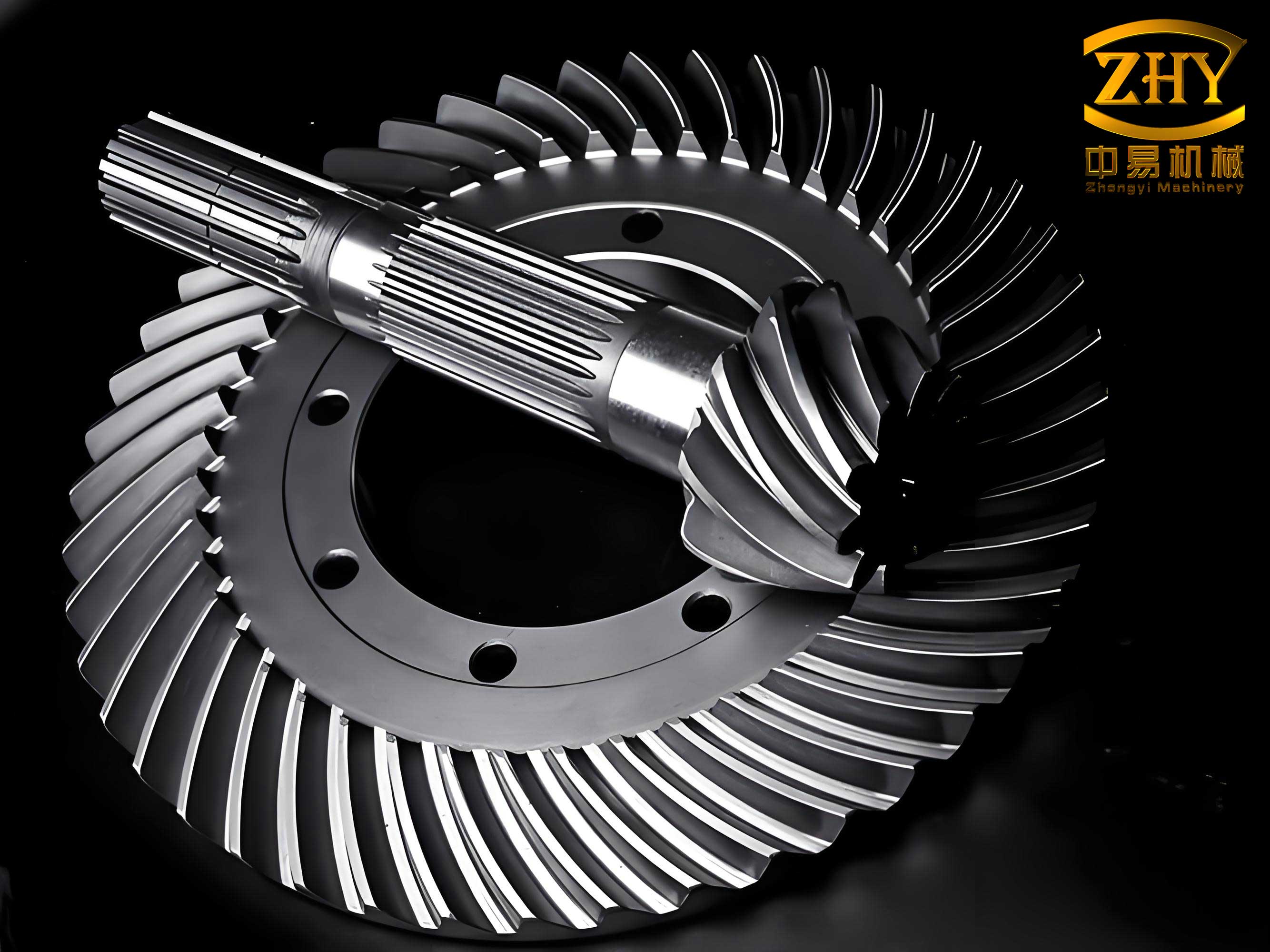
Despite its benefits, the carburizing and quenching process introduces significant challenges, primarily related to dimensional distortion. The complex thermal gradients, phase transformations, and associated transformation stresses that occur during heating and rapid cooling can lead to unpredictable changes in the geometry of spiral bevel gears. Such distortions can adversely affect gear meshing accuracy, increase noise and vibration, accelerate wear, and ultimately lead to premature failure. Therefore, controlling and minimizing distortion is as crucial as achieving the desired hardness profile. The traditional approach to process parameter selection often relies heavily on empirical knowledge and trial-and-error, which is time-consuming, costly, and may not yield globally optimal solutions, especially for complex components like spiral bevel gears.
This article presents a systematic, simulation-driven methodology to investigate and optimize the carburizing and quenching process for spiral bevel gears. The core of this study utilizes finite element analysis (FEA) software, Deform, to simulate the coupled thermal, diffusion, and mechanical phenomena during the heat treatment of gears made from 18Cr2Ni4WA steel. To efficiently explore the multi-dimensional parameter space and understand complex interactions, Response Surface Methodology (RSM) is employed. The primary objectives are to quantitatively analyze the influence of key process parameters—carburizing temperature, strong carburizing time, diffusion time, and quenching temperature—on two critical response variables: the magnitude of gear distortion and the resulting surface hardness. Subsequently, a multi-objective optimization is performed to identify the parameter set that minimizes distortion while maximizing surface hardness, thereby providing a scientifically grounded guideline for the heat treatment of spiral bevel gears.
1. Numerical Simulation of Gear Carburizing and Quenching
The first step in this optimization study involves creating a accurate digital twin of the physical heat treatment process. This is accomplished through numerical simulation, which allows for a detailed investigation of transient temperature fields, carbon concentration profiles, phase transformations, stress evolution, and final distortion without the need for numerous physical experiments.
1.1 Gear Model and Material Properties
A three-dimensional model of a spiral bevel gear was created for analysis. The key geometrical parameters defining the gear are summarized in the table below. This specific geometry represents a typical medium-sized gear used in demanding transmissions.
| Parameter | Value | Parameter | Value |
|---|---|---|---|
| Module | 3 mm | Number of Teeth | 44 |
| Pressure Angle | 20° | Shaft Angle | 90° |
| Mean Spiral Angle | 35° | Face Width | 20.2 mm |
| Addendum Coefficient | 0.85 | Outer Cone Distance | 69.73 mm |
| Pitch Diameter | 132 mm | Hand of Spiral | Left |
The material selected for the spiral bevel gear is 18Cr2Ni4WA, a high-strength, high-toughness, case-hardening alloy steel renowned for its excellent hardenability. Its chemical composition and critical transformation temperatures are fundamental inputs for the simulation and are listed below.
| Element | C | Si | Mn | Cr | Ni | W |
|---|---|---|---|---|---|---|
| Wt. % | 0.18 | 0.27 | 0.45 | 1.65 | 4.00 | 1.00 |
| Critical Point | Ac1 | Ac3 | Ms | Mf |
|---|---|---|---|---|
| Temperature (°C) | 695 | 800 | 310 | 250 |
The material database within the Deform software (specifically, material code BS655M13, which corresponds to 18Cr2Ni4WA steel) provides the necessary temperature-dependent thermophysical properties (conductivity, specific heat), mechanical properties, and most importantly, the kinetics data for carbon diffusion and phase transformation (TTT/CCT diagrams).
1.2 Process Route and Simulation Setup
The simulated heat treatment cycle for the spiral bevel gears consists of three main stages: Normalizing, Carburizing, and Quenching. The carburizing stage is further divided into a boost (strong carburizing) phase and a diffusion phase.
- Normalizing: This initial step refines the microstructure and prepares the gear for subsequent carburizing.
- Carburizing: The gear is heated in a carbon-rich atmosphere.
- Boost Phase: High carbon potential (1.2%) is maintained to rapidly increase surface carbon content.
- Diffusion Phase: Carbon potential is reduced (0.85%) to allow carbon to diffuse deeper into the material, creating a more gradual carbon gradient.
- Quenching: The gear is rapidly cooled in oil to transform the high-carbon austenite case into hard martensite.
The quenching oil’s cooling intensity is defined by a temperature-dependent heat transfer coefficient (h), a critical boundary condition for an accurate thermal simulation. The values used are standard for industrial quenching oils.
| Temperature (°C) | 100 | 200 | 300 | 350 | 400 | 470 | 500 | 600 | 700 | 800 | 850 |
|---|---|---|---|---|---|---|---|---|---|---|---|
| h (W/m²·°C) | 140 | 210 | 495 | 1000 | 1875 | 3375 | 3200 | 1525 | 950 | 700 | 560 |
The gear model was discretized into a finite element mesh consisting of 77,031 tetrahedral elements with 18,218 nodes. To simulate a realistic furnace loading condition, the bottom face of the gear blank was constrained, representing a gear lying flat on a tray or fixture during heat treatment.
2. Response Surface Methodology for Process Analysis
To systematically study the effects of process parameters and their interactions, a Design of Experiments (DoE) approach was implemented using Response Surface Methodology (RSM). RSM is a collection of statistical and mathematical techniques useful for developing, improving, and optimizing processes where the response of interest is influenced by several variables.
2.1 Experimental Design and Main Effects Analysis
Four key controllable process parameters were selected as input factors (design variables):
- X1: Carburizing Temperature (°C)
- X2: Strong Carburizing Time (h)
- X3: Diffusion Time (h)
- X4: Quenching Temperature (°C)
The target response variables (outputs) are:
- Y1: Maximum Distortion, D (µm)
- Y2: Surface Hardness, H (HRC)
A Box-Behnken Design (BBD), a type of RSM design efficient for fitting quadratic models, was chosen. The factors were varied across three levels (low, medium, high) as defined below, resulting in a total of 27 simulation runs.
| Factor | Symbol | Low (-1) | Medium (0) | High (+1) |
|---|---|---|---|---|
| Carburizing Temp. | X1 | 900 °C | 915 °C | 930 °C |
| Strong Carb. Time | X2 | 5.00 h | 6.50 h | 8.00 h |
| Diffusion Time | X3 | 1.00 h | 1.75 h | 2.50 h |
| Quenching Temp. | X4 | 820 °C | 850 °C | 880 °C |
The Deform software was used to run all 27 simulations, and the resulting maximum distortion and surface hardness values were extracted. A subset of the simulation results is shown for illustration.
| Run | X1 (°C) | X2 (h) | X3 (h) | X4 (°C) | D (µm) | H (HRC) |
|---|---|---|---|---|---|---|
| 1 | 900 | 6.50 | 2.50 | 850 | 139 | 63.0 |
| 2 | 915 | 5.00 | 1.00 | 850 | 125 | 62.0 |
| 3 | 915 | 6.50 | 1.75 | 850 | 135 | 62.7 |
| … | … | … | … | … | … | … |
| 25 | 915 | 8.00 | 2.50 | 850 | 143 | 63.0 |
| 26 | 915 | 6.50 | 1.00 | 880 | 141 | 61.9 |
| 27 | 900 | 6.50 | 1.00 | 850 | 132 | 61.8 |
Analyzing the main effects helps to understand the individual impact of each factor on the responses. For distortion (D), the quenching temperature (X4) exhibits the steepest slope, indicating it is the most influential parameter. Distortion increases significantly with higher quenching temperatures. Strong carburizing time (X2) and diffusion time (X3) also show positive effects on distortion, while carburizing temperature (X1) has a relatively minor and slightly negative influence.
For surface hardness (H), the diffusion time (X3) is the dominant factor, with hardness increasing as diffusion time increases. Quenching temperature (X4) has a secondary positive effect. The carburizing temperature (X1) and strong carburizing time (X2) have negligible to very small negative effects on the final hardness within the studied range.
2.2 Development of Predictive Regression Models
Based on the simulation data, second-order polynomial regression models were developed to mathematically describe the relationship between the process parameters and the response variables. The general form of the quadratic model is:
$$ \hat{y} = \beta_0 + \sum_{i=1}^{4}\beta_i x_i + \sum_{i=1}^{4}\sum_{j=1}^{4}\beta_{ij} x_i x_j + \sum_{i=1}^{4}\beta_{ii} x_i^2 + \epsilon $$
where $\hat{y}$ is the predicted response (distortion or hardness), $x_i$ are the coded or actual factor levels, $\beta_0$ is the constant term, $\beta_i$ are the linear coefficients, $\beta_{ij}$ are the interaction coefficients, $\beta_{ii}$ are the quadratic coefficients, and $\epsilon$ is the random error.
Using least squares regression, the following predictive equations were obtained for the spiral bevel gear responses (in terms of actual factors):
Distortion Model (D):
$$ D = -1434 + 2.783X_1 + 7.30X_2 + 10.75X_3 + 0.321X_4 – 0.284X_2^2 – 1.580X_3^2 + 0.001790X_4^2 – 0.003333X_1X_4 $$
Hardness Model (H):
$$ H = 58.22 – 0.00111X_1 – 0.1222X_2 + 1.919X_3 + 0.004167X_4 – 0.4563X_3^2 + 0.0667X_2X_3 $$
2.3 Model Adequacy and Significance Testing
The accuracy and statistical significance of the developed models were rigorously checked using Analysis of Variance (ANOVA). Key metrics such as the coefficient of determination (R²), adjusted R², F-value, and p-value were examined.
| Response | R-Sq | R-Sq(adj) | F-Value | P-Value |
|---|---|---|---|---|
| Distortion (D) | 99.65% | 99.50% | 646.30 | < 0.0001 |
| Hardness (H) | 98.72% | 98.33% | 256.79 | < 0.0001 |
The high R² and adjusted R² values (very close to 100%) indicate that the models explain almost all the variability in the response data. The exceptionally high F-values and extremely low p-values (<< 0.05) confirm that the regression models are highly significant and that the included terms have a substantial effect on the responses. The residual plots for both models showed random scatter around zero, further validating the assumptions of the regression analysis. Therefore, these models are deemed highly reliable for prediction and optimization within the defined factor space.
3. Multi-Objective Process Parameter Optimization
With validated predictive models in hand, the next step is to find the optimal set of process parameters that simultaneously minimize distortion and maximize surface hardness for the spiral bevel gear. This constitutes a multi-objective optimization problem.
3.1 Optimization Problem Formulation
The optimization goal is formally stated as:
$$
\text{Find } \mathbf{X} = [X_1, X_2, X_3, X_4] \text{ to:}
$$
$$
\begin{aligned}
& \text{Minimize} & & D(\mathbf{X}) \\
& \text{Maximize} & & H(\mathbf{X}) \\
& \text{Subject to} & & 900 \leq X_1 \leq 930 \\
& & & 5.00 \leq X_2 \leq 8.00 \\
& & & 1.00 \leq X_3 \leq 2.50 \\
& & & 820 \leq X_4 \leq 880
\end{aligned}
$$
where $D(\mathbf{X})$ and $H(\mathbf{X})$ are the prediction model equations defined earlier.
3.2 Optimization Results and Verification
The multi-objective optimization was performed using the desirability function approach within the RSM framework. This method combines the individual desirability of each response into a single composite desirability (D’) ranging from 0 (unacceptable) to 1 (ideal). The optimization solver searched the design space to maximize this composite desirability.
The optimal process parameters identified for the carburizing and quenching of the 18Cr2Ni4WA spiral bevel gear are:
| Optimal Parameter | Symbol | Optimal Value |
|---|---|---|
| Carburizing Temperature | X1 | 915 °C |
| Strong Carburizing Time | X2 | 5.00 h |
| Diffusion Time | X3 | 2.27 h (≈ 136 min) |
| Quenching Temperature | X4 | 820 °C |
At this optimum point, the predicted responses are a distortion (D) of 123 µm and a surface hardness (H) of 62.7 HRC. The composite desirability was 0.8155, with individual desirabilities of 0.91323 for distortion and 0.72824 for hardness, indicating a well-balanced compromise between the two conflicting objectives.
To verify the optimization result, a final simulation was conducted using the optimal parameter set. The results were in excellent agreement with the model predictions. The simulation confirmed a maximum distortion of 123 µm at the gear’s large end and a surface hardness of 62.7 HRC. Furthermore, a series of control simulations were run by slightly varying one optimal parameter at a time. The results, summarized below, demonstrate that any deviation from the optimal set leads to an increase in distortion, a decrease in hardness, or both, confirming the robustness of the identified optimum.
| Test Case | X1 (°C) | X2 (h) | X3 (h) | X4 (°C) | D (µm) | H (HRC) |
|---|---|---|---|---|---|---|
| Control 1 | 930 | 5.00 | 2.27 | 820 | 126 | 62.6 |
| Control 2 | 915 | 6.50 | 2.27 | 820 | 130 | 62.7 |
| Control 3 | 915 | 5.00 | 2.50 | 820 | 125 | 62.7 |
| Control 4 | 915 | 5.00 | 2.27 | 850 | 132 | 62.8 |
| Control 5 | 915 | 5.00 | 2.27 | 880 | 143 | 62.9 |
| Optimal | 915 | 5.00 | 2.27 | 820 | 123 | 62.7 |
4. Discussion on Mechanisms and Practical Implications
The findings of this study reveal the complex interplay between process parameters and the final state of spiral bevel gears. The dominance of quenching temperature on distortion is physically rooted in its control over thermal stresses. A higher initial temperature before quenching creates a steeper temperature gradient between the surface and core during cooling. This leads to greater differential thermal contraction, generating higher thermal stresses that drive plastic deformation (distortion). Furthermore, a higher quenching temperature promotes a more complete austenitization and dissolution of carbides, leading to a greater volume fraction of martensite upon quenching. Since martensite has a larger specific volume than austenite, this transformation-induced volume expansion contributes further to the overall distortion of the spiral bevel gear.
The primary influence of diffusion time on hardness is directly related to carbon profile development. While the boost phase establishes a high surface carbon concentration, the diffusion phase is responsible for transporting carbon atoms deeper into the material, creating a thicker and more uniform case depth. A longer diffusion time allows for a greater total amount of carbon to be incorporated into the austenitic structure within the effective case depth. Since carbon is the primary hardening element in martensite, a higher carbon content in the case translates directly to higher hardness after quenching. The quenching temperature also affects hardness, as a lower temperature may not fully austenitize the material or may lead to the formation of non-martensitic products, but its effect is secondary to the carbon content established during diffusion.
The practical implication of this work is a clear, optimized recipe for heat treating this specific grade of spiral bevel gear. The recommended parameters (915°C carburizing, 5h boost, 2.27h diffusion, 820°C quench) provide a targeted solution to achieve the best possible balance between dimensional accuracy (minimal distortion) and functional performance (high surface hardness). This data-driven approach moves beyond trial-and-error, potentially reducing scrap rates, improving gear quality consistency, and shortening development cycles for new spiral bevel gear applications.
5. Conclusions
This study successfully demonstrates an integrated simulation and optimization framework for the carburizing and quenching process of spiral bevel gears. The combination of finite element analysis using Deform software and Response Surface Methodology proved to be a powerful tool for understanding and controlling this complex thermo-chemical-mechanical process. The key conclusions are as follows:
- Parameter Influence Ranking: For the 18Cr2Ni4WA spiral bevel gear, the influence of process parameters on distortion follows the order: Quenching Temperature > Strong Carburizing Time > Diffusion Time > Carburizing Temperature. For surface hardness, the order is: Diffusion Time > Quenching Temperature > Strong Carburizing Time ≈ Carburizing Temperature.
- Predictive Modeling: Highly accurate second-order polynomial models were developed to predict distortion and hardness as functions of the four key process parameters. The models exhibited excellent statistical significance (R² > 98.7%, p < 0.0001) and were validated through simulation data.
- Optimal Process Parameters: Through multi-objective optimization, the optimal parameter set for minimizing distortion while maximizing hardness was identified as: Carburizing Temperature = 915 °C, Strong Carburizing Time = 5.00 h, Diffusion Time = 2.27 h, and Quenching Temperature = 820 °C. This combination is predicted and verified to yield a distortion of 123 µm and a surface hardness of 62.7 HRC.
- Methodology Validation: Control simulations confirmed that deviations from the optimal parameter set lead to inferior results, underscoring the effectiveness and robustness of the RSM-based optimization approach for spiral bevel gears.
This work provides a systematic, quantitative foundation for setting heat treatment parameters for high-performance spiral bevel gears, contributing to improved manufacturing quality and gear system reliability. The methodology is generalizable and can be adapted to other gear geometries, materials, and heat treatment processes.