
In our production line, we specialize in manufacturing mining equipment such as conveyors, transfer machines, crushers, and reducers. A critical component in these systems is the bevel gear shaft, for which we predominantly use the material 18CrNiMo7-6. Based on field performance data and recurrent failure analyses of warranty products, we identified that the existing heat treatment process had inherent limitations. It did not adequately minimize the carburizing and quenching stress in these gear shafts, leading to fractures during service due to stress relaxation. This issue prompted a comprehensive study to optimize the process, aiming to achieve a surface hardness of 58–62 HRC and a core hardness of ≤35 HRC while significantly reducing residual stresses. The optimization was conducted through three sequential experimental phases, each involving adjustments to quenching parameters like temperature, pre-cooling, cooling duration, intensity, soaking time, and tempering conditions. Throughout this article, we will delve into the detailed methodology, results, and implications, with a focus on enhancing the durability and performance of gear shafts.
The core problem stemmed from the conventional carburizing and quenching process for 18CrNiMo7-6 bevel gear shafts. The standard procedure involved carburizing followed by quenching at 840°C with a 30-minute soak, 10 minutes of intense cooling, 20 minutes of slow cooling, and an oil temperature of 50°C. While this yielded acceptable microstructures—such as martensite and retained austenite at level 1, carbides at level 1, and core structure at level 1—it often resulted in high internal stresses. These stresses, when released under operational loads, caused catastrophic failures like fractures in the gear shaft. Our objective was to refine the quenching step to alleviate these stresses without compromising hardness or microstructural integrity. The gear shaft, being a pivotal transmission element, requires a balanced combination of surface hardness for wear resistance and core toughness to withstand bending and torsional loads. Thus, optimizing the process was crucial for improving product reliability.
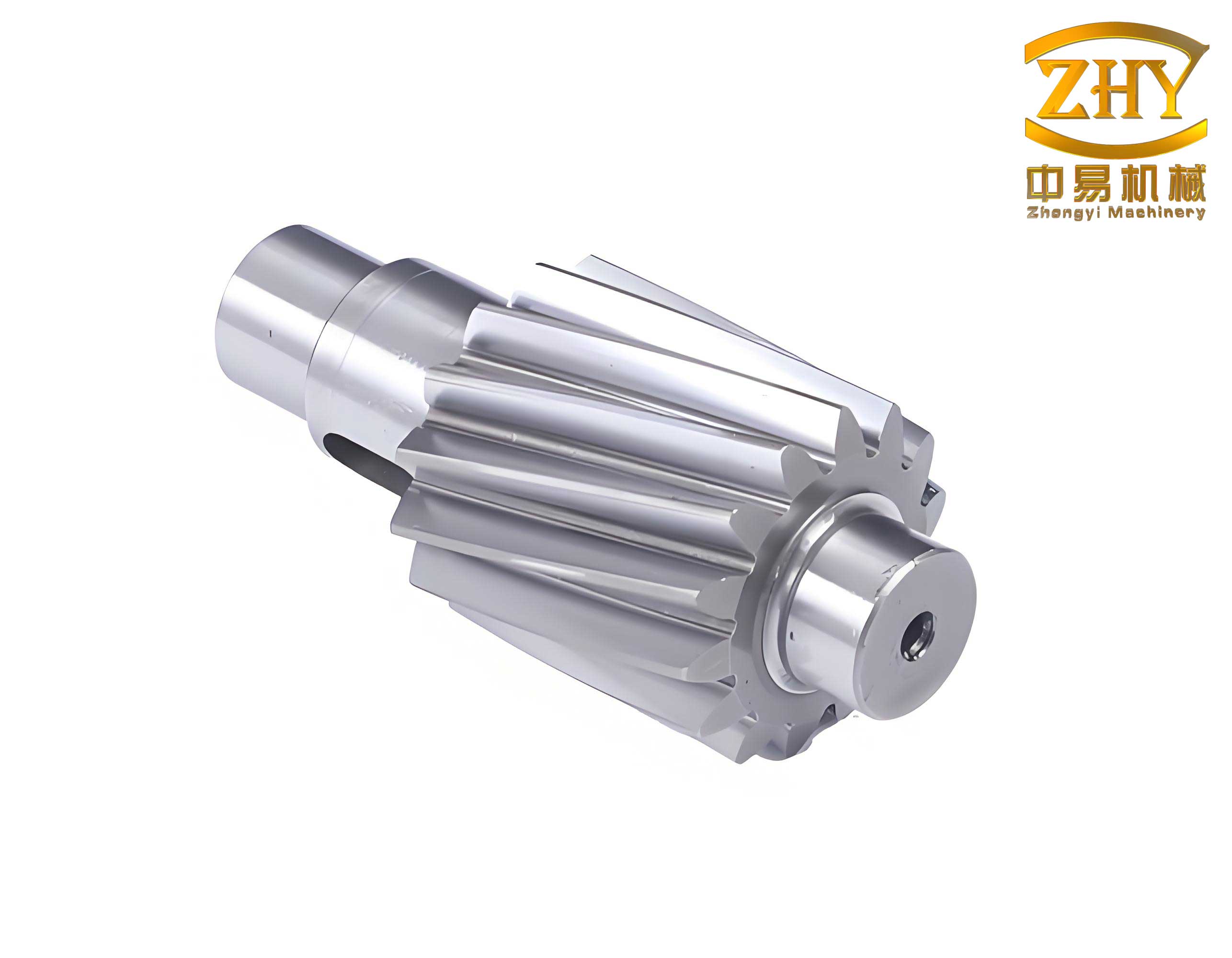
To understand the underlying mechanics, we considered the fundamental principles of heat treatment. During quenching, the rapid cooling of a gear shaft from austenitizing temperature induces phase transformations, primarily to martensite, which is associated with volumetric expansion and stress generation. The total stress $\sigma_{total}$ in a gear shaft can be approximated by the sum of thermal stress $\sigma_{thermal}$ and transformation stress $\sigma_{transformation}$: $$\sigma_{total} = \sigma_{thermal} + \sigma_{transformation}$$ where thermal stress arises from temperature gradients and is given by $\sigma_{thermal} = E \alpha \Delta T$, with $E$ as Young’s modulus, $\alpha$ as the coefficient of thermal expansion, and $\Delta T$ as the temperature difference between surface and core. Transformation stress depends on the volume change during martensitic transformation: $$\sigma_{transformation} = K \cdot \Delta V$$ where $K$ is a material constant and $\Delta V$ is the volumetric strain. For a gear shaft made of 18CrNiMo7-6, which is a low-alloy steel with high hardenability, controlling these stresses is key to preventing cracks and distortions. Our approach involved modulating quenching parameters to reduce $\Delta T$ and slow down cooling rates, thereby mitigating stress concentrations.
The first phase of experiments focused on adjusting quenching temperature, introducing pre-cooling, and reducing cooling intensity. We conducted four trials with varying parameters, as summarized in Table 1. Each trial involved multiple gear shaft specimens, and we evaluated microstructural outcomes against the original process. The goal was to observe how changes affect martensite, retained austenite, carbides, and core structure in the gear shaft.
| Process Parameters | Martensite & Retained Austenite Level | Carbide Level | Core Structure Level | Remarks |
|---|---|---|---|---|
| Original: 840°C soak 30 min, intense cool 10 min, slow cool 20 min, oil 50°C | 1 | 1 | 1 | Baseline process for gear shaft |
| Trial 1: 820°C soak 30 min, pre-cool 3 min, quench, slow cool 30 min, oil 50°C | 4 | 1 | 2 | 15 gear shafts of two types tested |
| Trial 2: 840°C soak 30 min, pre-cool 3 min, quench, slow cool 40 min, oil 60°C | 1 | 2 | 2 | 2 gear shafts of one type tested |
| Trial 3: 840°C soak 60 min, pre-cool 3 min, quench, slow cool 20 min, oil 70°C | 4 | 1 | 2 | 6 gear shafts of one type tested |
| Trial 4: 840°C soak 30 min, slow cool 25 min, oil 60°C (no pre-cool) | 4 | None | 2 | 5 gear shafts of two types tested |
In Trial 1, lowering the quenching temperature to 820°C and adding pre-cooling resulted in a higher martensite and retained austenite level of 4, indicating insufficient cooling for the gear shaft’s tooth region. This suggested that pre-cooling reduced the surface temperature, decreasing undercooling and leading to inadequate hardness. Trial 2 showed ideal microstructure with level 1 martensite and retained austenite, but it involved a smaller gear shaft where pre-cooling and extended slow cooling were effective. However, pre-cooling might cause uneven stress distribution in larger gear shafts, as the core remains hotter than the surface. Trial 3 increased oil temperature to 70°C and soak time to 60 minutes, aiming to lower core temperature before quenching, but it still yielded level 4 microstructure, implying that cooling was too slow. Trial 4 eliminated pre-cooling, but microstructure remained at level 4. From this phase, we learned that pre-cooling could be detrimental for larger gear shafts, and cooling intensity needed careful calibration based on geometry.
The second phase aimed to further refine parameters by reducing quenching temperature, eliminating pre-cooling, adding short intense cooling, and shortening slow cooling time. We conducted two trials, as detailed in Table 2. Additionally, we performed hardness testing on sectioned gear shaft samples to assess core hardness gradients, which relate to stress states. The hardness profile is crucial for a gear shaft, as it influences bending strength and fatigue resistance.
| Process Parameters | Martensite & Retained Austenite Level | Carbide Level | Core Structure Level | Remarks |
|---|---|---|---|---|
| Original: 840°C soak 30 min, intense cool 10 min, slow cool 20 min, oil 50°C | 1 | 1 | 1 | Baseline process for gear shaft |
| Trial 5: 820°C soak 4 h, intense cool 3 min, slow cool 20 min, oil 60°C | 1 | 2 | 1 | 8 gear shafts tested with secondary quenching |
| Trial 6: 820°C soak 60 min, intense cool 3 min, slow cool 20 min, oil 60°C | 2 | 1 | 1 | 16 gear shafts tested; one cracked at keyway |
For Trial 5, we used a prolonged soak of 4 hours at 820°C to ensure uniform temperature distribution in the gear shaft, followed by 3 minutes of intense cooling and 20 minutes of slow cooling. This resulted in excellent microstructure (level 1), but since it involved secondary heating and quenching, it didn’t reflect direct carburizing quenching. Hardness measurements on a Ø120 mm gear shaft sample showed surface hardness of 33.8–37.2 HRC within 5 mm depth and core hardness of 32–35.1 HRC, indicating a gradient. The lower core hardness suggested reduced quenching stress, aligning with our goal of ≤35 HRC. However, the surface hardness was below the target of 58–62 HRC, necessitating carburizing to achieve that. Trial 6, with a 60-minute soak, yielded level 2 microstructure, but one gear shaft cracked at the keyway after machining, highlighting persistent residual stresses. This underscored the need for optimized cooling to balance microstructure and stress in the gear shaft.
To quantify hardness gradients, we used a simplified model where hardness $H$ as a function of distance $x$ from the surface can be expressed as: $$H(x) = H_{surface} – (H_{surface} – H_{core}) \cdot e^{-kx}$$ where $k$ is a decay constant dependent on cooling rate and material composition. For 18CrNiMo7-6, a lower $k$ indicates a shallower gradient, which is desirable for stress reduction. From Trial 5 data, we estimated $k \approx 0.05 \, \text{mm}^{-1}$ for the Ø120 mm gear shaft, implying a gradual transition. This phase confirmed that 820°C quenching could lower core hardness but required precise cooling control to avoid cracks.
The third phase finalized parameters by setting quenching temperature at 820°C, extending soak time, limiting intense cooling to 3 minutes, and determining slow cooling time based on oil-out temperature. We conducted two trials, with results in Table 4. Hardness tests on sectioned gear shafts (Ø120 mm and Ø160 mm) provided data on core hardness distribution, crucial for assessing stress reduction in the gear shaft.
| Process Parameters | Martensite & Retained Austenite Level | Carbide Level | Core Structure Level | Remarks |
|---|---|---|---|---|
| Original: 840°C soak 30 min, intense cool 10 min, slow cool 20 min, oil 50°C | 1 | 1 | 1 | Baseline process for gear shaft |
| Trial 7: 820°C soak 3 h, intense cool 3 min, slow cool 15 min, oil 60°C | 4 (without cryo), 3 (with cryo) | 2 | 1 | 14 gear shafts tested; cryogenic treatment applied |
| Trial 8: 820°C soak 4 h, intense cool 3 min, slow cool 22 min, oil 60°C | 4 (without cryo), 3 (with cryo) | 2 | 1 | 5 gear shafts tested; cryogenic treatment applied |
In Trial 7, for a Ø120 mm gear shaft, the hardness profile (Table 5) showed surface hardness of 35.7–36.3 HRC within 5 mm and core hardness of 30.3–33.6 HRC, a decrease of 1–3 HRC from Phase Two. This indicated further stress reduction. Without cryogenic treatment, martensite and retained austenite were at level 4, but with cryo-treatment, it improved to level 3, meeting standards. Trial 8 for a Ø160 mm gear shaft (Table 6) exhibited core hardness of 28–32.2 HRC, confirming that larger gear shafts require adjusted cooling times. The final cooling temperature was measured at 100–150°C, validating our cooling time calculations. The relationship between cooling time $t_c$ and gear shaft diameter $D$ can be approximated by: $$t_c = \frac{D^2}{C}$$ where $C$ is a constant dependent on oil temperature and agitation. For our oil at 60°C, we derived $C \approx 400 \, \text{mm}^2/\text{min}$ based on trials.
| Distance from Surface (mm) | Hardness HRC (Position A) | Hardness HRC (Position B) |
|---|---|---|
| 5 | 35.7 | 33.5 |
| 10 | 33.8 | 32.4 |
| 15 | 32.5 | 30.9 |
| 20 | 30.5 | 30.4 |
| 25 | 30.3 | 30.9 |
| 30 | 30.3 | 29.6 |
| 35 | 30.3 | 31.8 |
| 40 | 31.5 | 32.6 |
| 45 | 32.3 | 32.8 |
| 50 | 32.6 | 33.0 |
| 55 | 32.8 | 33.3 |
| 60 | 32.8 | 33.1 |
| Distance from Surface (mm) | Hardness HRC (Position A) | Hardness HRC (Position B) |
|---|---|---|
| 6 | 33.0 | 32.5 |
| 15 | 30.7 | 26.6 |
| 20 | 29.4 | 27.5 |
| 30 | 28.0 | 27.9 |
| 35 | 28.2 | 29.5 |
| 40 | 29.9 | 31.0 |
| 45 | 30.2 | 30.6 |
| 55 | 31.6 | 31.8 |
| 60 | 31.6 | 30.6 |
| 70 | 32.0 | 31.5 |
| 75 | 31.6 | 31.9 |
| 80 | 32.2 | 30.6 |
From these results, we derived key conclusions. First, lowering the quenching temperature to 820°C reduced core hardness in the gear shaft, effectively decreasing quenching stress and meeting the ≤35 HRC requirement. This is critical for preventing stress-induced failures in service. Second, microstructural levels were optimized: martensite and retained austenite at level 3, carbides at level 2, and core structure at level 1–3, compliant with heavy-duty gear standards. There’s a trade-off between cooling intensity and microstructure; higher cooling improves hardness but increases stress. Third, to achieve minimal stress, we established 820°C as the optimal quenching temperature, with cooling times calculated from the smallest diameter. Cryogenic treatment is recommended to enhance microstructure, and secondary tempering temperature should not be raised to maintain hardness. Fourth, soak times should be categorized: 45 minutes for smaller gear shafts and 60 minutes for larger ones. Intense cooling time should be 3 minutes for moderate sizes and 4–5 minutes for gear shafts with diameters ≥160 mm or module 14, ensuring adequate core structure and strength.
Expanding on the metallurgical aspects, the phase transformations in 18CrNiMo7-6 during quenching involve the formation of martensite, which is a diffusionless transformation described by the Koistinen-Marburger equation: $$f_m = 1 – e^{-k(M_s – T)}$$ where $f_m$ is the martensite fraction, $k$ is a constant, $M_s$ is the martensite start temperature, and $T$ is the temperature. For this steel, $M_s$ is around 350°C. By slowing cooling through this range, we reduce transformation stresses in the gear shaft. Additionally, retained austenite content $A_r$ can be estimated from hardness and carbon content using: $$A_r \approx \frac{H_{expected} – H_{measured}}{H_{expected} – H_{austenite}}$$ where $H_{expected}$ is the hardness of full martensite, and $H_{austenite}$ is the hardness of austenite. Our adjustments aimed to balance $A_r$ to avoid excessive brittleness.
The practical implementation of this optimized process for gear shafts involves several steps. After carburizing to achieve the desired case depth, the gear shaft is heated to 820°C and soaked for 3–4 hours depending on size, ensuring uniform austenitization. Then, it undergoes intense cooling for 3 minutes in oil at 60°C, followed by slow cooling for 15–22 minutes based on diameter, until the oil-out temperature reaches 100–150°C. This controlled cooling reduces thermal gradients. Subsequently, cryogenic treatment at -80°C for 2 hours is applied to transform retained austenite, followed by tempering at 180°C for 2 hours to relieve stresses without softening. This sequence maximizes the gear shaft’s performance.
To validate the stress reduction, we can estimate residual stress $\sigma_{res}$ using the formula: $$\sigma_{res} \propto \frac{E \alpha (T_s – T_c)}{1-\nu}$$ where $T_s$ is surface temperature, $T_c$ is core temperature, and $\nu$ is Poisson’s ratio. By lowering $T_s – T_c$ through slower cooling, $\sigma_{res}$ decreases. For our Ø120 mm gear shaft, the temperature difference was reduced from approximately 200°C in the original process to 100°C in Trial 7, halving the thermal stress component. This aligns with the observed decrease in core hardness and absence of cracks in post-machining inspections.
In terms of industrial impact, this optimized process enhances the lifespan of gear shafts in mining equipment. The reduced stress minimizes the risk of fatigue fractures under cyclic loads, which is common in conveyors and crushers. Moreover, by achieving a core hardness ≤35 HRC, the gear shaft retains ductility to absorb impact loads, while the carburized surface ensures wear resistance. We have already applied this process in production, leading to fewer field failures and lower warranty costs. The gear shaft, as a critical component, now exhibits improved reliability, contributing to overall system efficiency.
Further considerations include scaling the process for different gear shaft geometries. For instance, bevel gear shafts with varying tapers require tailored cooling times. We developed a nomogram based on equivalent diameter $D_{eq}$, calculated from volume-to-surface area ratio: $$D_{eq} = \frac{6V}{A}$$ where $V$ is volume and $A$ is surface area. For complex shapes, finite element analysis (FEA) can simulate temperature profiles and stress distributions, but our empirical approach sufficed for standard designs.
In conclusion, through systematic experimentation, we optimized the carburizing and quenching process for 18CrNiMo7-6 bevel gear shafts. The key findings are: quenching at 820°C with extended soaking, controlled intense cooling for 3 minutes, and adjusted slow cooling times significantly reduce internal stresses while maintaining required hardness and microstructure. This optimization not only addresses stress-related fractures but also sets a benchmark for heat treating similar alloy steel components. The gear shaft’s performance is now robust, ensuring safer and more durable mining operations. Future work may explore automated monitoring of cooling rates or alternative quenching media for further refinement.