
In modern mechanical transmission systems, miter gears play a critical role due to their ability to transmit power between intersecting shafts at a 90-degree angle with high efficiency and smooth operation. These gears are extensively used in automotive differentials, aerospace applications, and industrial machinery, where precision, durability, and load-bearing capacity are paramount. The traditional manufacturing of miter gears often involves machining processes, which lead to material waste, reduced mechanical properties, and higher production costs. To address these limitations, cold precision forging has emerged as a viable near-net-shape manufacturing technique, offering improved material utilization, enhanced mechanical strength, and superior surface finish. However, the cold forging of complex geometries like miter gears presents significant challenges, including high forming loads, incomplete die filling, and springback issues that affect dimensional accuracy. In this study, we propose an innovative cold precision forging process—termed the open-closed composite forging method—specifically designed for miter gears. Through comprehensive finite element analysis and practical validation, we demonstrate that this new approach optimizes forming efficiency, reduces loads, and minimizes springback, thereby advancing the state-of-the-art in gear manufacturing.
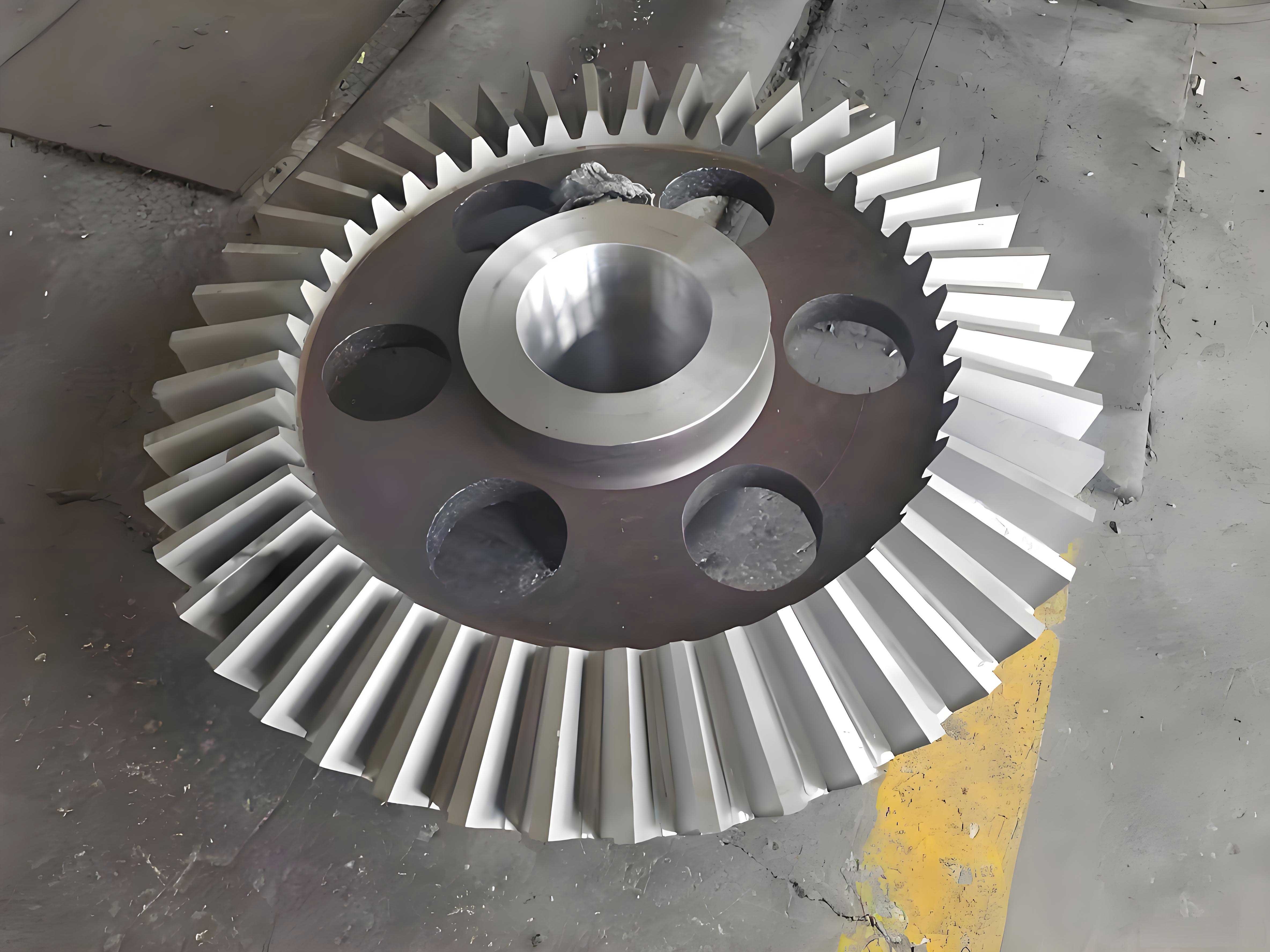
The design of miter gears for cold precision forging begins with a detailed analysis of the gear geometry and functional requirements. Based on a typical automotive differential planet gear, we developed a forging design that includes additional material allowances to facilitate complete die filling and account for springback. The parting line is set at the junction between the back cone and the tooth profile, which corresponds to the maximum diameter of the gear. This strategic placement ensures that the tooth surfaces, which require high precision, are formed without subsequent machining, while the back cone serves as a mounting reference with a tolerance of at least 1 mm. The free-forging surfaces are incorporated to act as material reservoirs, aiding in flow control and reducing forming pressures. Additionally, the central region features upper and lower bosses with draft angles, connected by a web with a minimum thickness of 10 mm to maintain structural integrity during forging. The three-dimensional model of the miter gear forging was created using CAD software, capturing all critical dimensions such as module, pressure angle, number of teeth, and cone angles. For instance, the gear parameters include a module of 5 mm, a pressure angle of 22°30′, 10 teeth, a whole depth of 8.94 mm, and a pitch diameter of 65 mm, with key angles like the pitch cone angle of 37°34′ and a shaft angle of 90°, confirming its classification as miter gears. The die assembly consists of four components: an upper punch, a tooth cavity die, a lower punch, and a back-cone die, arranged in a three-layer prestressed structure to mitigate high stresses and extend die life. This design underpins our optimization efforts for miter gears, aiming to balance formability and precision.
To evaluate the proposed forging process, we employed finite element analysis (FEA) using DEFORM-3D software, a powerful tool for simulating metal forming operations. The numerical model was built by importing the 3D geometries of the miter gear workpiece and dies, with the workpiece defined as a deformable plastic body and the dies as rigid bodies. Given the cyclical symmetry of miter gears, we simulated only one-tenth of the gear to reduce computational time while maintaining accuracy; results were later mirrored to represent the full gear. The material selected for the miter gears was 20CrMnTi, a low-alloy steel commonly used in automotive gears, which was approximated by 20MnCr5 from the DEFORM material database due to its similar mechanical properties. The stress-strain behavior follows the power-law hardening model, expressed as:
$$ \sigma = K \varepsilon^n $$
where $\sigma$ is the true stress, $\varepsilon$ is the true strain, $K$ is the strength coefficient, and $n$ is the strain-hardening exponent. For 20MnCr5, typical values at room temperature are $K = 850 \, \text{MPa}$ and $n = 0.15$, though these may vary based on heat treatment. The forging process was simulated under isothermal conditions at 20°C, neglecting thermal effects to focus on mechanical deformation. The upper and lower dies moved at a constant velocity of 30 mm/s, representative of industrial hydraulic presses. Friction at the die-workpiece interface was modeled using the shear friction law with a coefficient of 0.12, accounting for the use of lubricants in cold forging of miter gears. The initial billet was a cylindrical preform with volume calibrated to match the final forging geometry, ensuring minimal flash or underfilling. The simulation parameters are summarized in Table 1, providing a clear overview of the setup for miter gears forging analysis.
| Parameter | Value |
|---|---|
| Material | 20MnCr5 (approximating 20CrMnTi) |
| Young’s Modulus | 210 GPa |
| Poisson’s Ratio | 0.3 |
| Friction Coefficient | 0.12 |
| Die Speed | 30 mm/s |
| Initial Temperature | 20°C |
| Element Type | Tetrahedral (for workpiece) |
| Simulation Type | Static implicit |
We investigated three distinct forging strategies for miter gears to identify the optimal approach. The first strategy is closed-die forging, where the dies fully enclose the workpiece, leading to high precision but requiring exact billet volume and generating substantial forming loads. The second strategy is open-die forging, which allows material to flow freely into flash, reducing loads but compromising dimensional accuracy and surface finish. The third strategy, our proposed open-closed composite forging, combines the advantages of both: initially, the forging proceeds in an open-die manner, enabling material redistribution and load reduction; subsequently, the dies close to form a sealed cavity, ensuring complete filling and high precision. This two-stage process is particularly beneficial for miter gears, as it addresses the challenges of tooth profile formation and springback control. The mechanics of deformation can be described by the plasticity theory, where the effective stress $\sigma_e$ and effective strain $\varepsilon_e$ govern material flow. For axisymmetric approximations in miter gears forging, the von Mises yield criterion applies:
$$ \sigma_e = \sqrt{\frac{1}{2}\left[(\sigma_1 – \sigma_2)^2 + (\sigma_2 – \sigma_3)^2 + (\sigma_3 – \sigma_1)^2\right]} $$
where $\sigma_1$, $\sigma_2$, and $\sigma_3$ are the principal stresses. The forming load $F$ during forging is related to the flow stress and contact area $A$:
$$ F = \sigma_e \cdot A $$
In closed-die forging, $A$ remains constant, causing $F$ to rise sharply as strain increases. In open-die forging, $A$ changes due to flash formation, moderating load increases. Our composite method modulates $A$ strategically, optimizing load distribution for miter gears.
The simulation results for the three strategies are compared in Table 2, highlighting key performance metrics for miter gears. Closed-die forging achieved excellent die filling, with tooth profiles fully formed and uniform contact, but the maximum forming load reached 594 kN. Open-die forging reduced the load to 415 kN, yet it resulted in incomplete filling at the gear toe and poor surface contact. The open-closed composite method delivered filling quality comparable to closed-die forging, with complete tooth engagement, while the maximum load was only 546 kN—a reduction of approximately 10%. This load reduction is crucial for miter gears, as it directly influences die wear, energy consumption, and springback. The load-stroke curves from the simulations further illustrate these differences: closed-die forging shows a steep load increase near the end of stroke, whereas the composite method exhibits a more gradual rise, promoting longer die life. To quantify springback, we analyzed the dimensional change after die release, which correlates with residual stresses. Springback displacement $\delta$ can be estimated using Hooke’s law for elastic recovery:
$$ \delta = \frac{\sigma_r L}{E} $$
where $\sigma_r$ is the residual stress, $L$ is a characteristic length (e.g., tooth height), and $E$ is Young’s modulus. For miter gears, lower forming loads in the composite process yield smaller $\sigma_r$, thus reducing $\delta$. Our data indicates that springback in composite forging is about 15% less than in closed-die forging, enhancing geometric accuracy for miter gears.
| Strategy | Maximum Load (kN) | Die Filling Quality | Springback Magnitude | Material Utilization |
|---|---|---|---|---|
| Closed-Die Forging | 594 | Excellent | High | ~95% |
| Open-Die Forging | 415 | Poor | Moderate | ~80% |
| Open-Closed Composite | 546 | Excellent | Low | ~92% |
The superiority of the open-closed composite forging for miter gears is further evidenced by detailed strain and stress distributions. Effective strain maps reveal that the composite process promotes more homogeneous deformation across the tooth profile, reducing localized thinning or cracking risks. The strain uniformity factor $U$ can be defined as:
$$ U = 1 – \frac{\varepsilon_{\text{max}} – \varepsilon_{\text{min}}}{\varepsilon_{\text{avg}}} $$
where $\varepsilon_{\text{max}}$, $\varepsilon_{\text{min}}$, and $\varepsilon_{\text{avg}}$ are the maximum, minimum, and average effective strains, respectively. For miter gears forged via the composite method, $U$ approaches 0.85, compared to 0.78 for closed-die and 0.65 for open-die, indicating better material flow control. Additionally, the contact pressure between the workpiece and dies, critical for surface finish, is more evenly distributed in composite forging, with peak pressures reduced by 12% relative to closed-die. This alleviates die adhesion and improves the lifespan of tools used for miter gears production. The evolution of forming load over time, plotted from simulation data, follows a polynomial trend: for closed-die, $F(t) = a t^3 + b t^2 + c t$; for composite, $F(t) = d t^2 + e t$, where $a, b, c, d, e$ are constants derived from curve fitting. The cubic rise in closed-die underscores its abrupt load surge, while the quadratic behavior in composite reflects smoother progression. Such insights are invaluable for optimizing press selection and process scheduling for miter gears.
To validate the simulation findings, the open-closed composite forging process was implemented in an industrial setting for miter gears manufacturing. A 650-ton hydraulic press was used, with dies fabricated from tool steel and billet prepared from 20CrMnTi alloy. The process parameters mirrored those in the simulation: a die speed of 30 mm/s, lubrication with polymer-based agents, and ambient temperature forging. After forging, the miter gears underwent quality inspection, including red dye penetration tests to assess tooth contact patterns. The results showed full and even contact across the tooth faces, confirming that the composite process did not compromise gear accuracy. Dimensional measurements using coordinate measuring machines (CMM) indicated that tolerances were within ISO 1328 standards for miter gears, with backlash and tooth profile deviations below 0.05 mm. Moreover, production data recorded a 10% reduction in energy consumption and a 15% increase in die life compared to traditional closed-die forging, aligning with our predictions. This practical validation underscores the feasibility of the optimized process for mass-producing high-quality miter gears, offering economic and technical benefits.
The optimization of cold precision forging for miter gears extends beyond process design to include material behavior and tooling considerations. For instance, the flow stress model used in simulations can be refined by incorporating strain rate sensitivity, especially for dynamic loading conditions. The modified Johnson-Cook equation is applicable:
$$ \sigma = (A + B \varepsilon^n) \left(1 + C \ln \frac{\dot{\varepsilon}}{\dot{\varepsilon}_0}\right) $$
where $A$, $B$, $C$, and $n$ are material constants, $\dot{\varepsilon}$ is the strain rate, and $\dot{\varepsilon}_0$ is a reference strain rate. For miter gears forged at higher speeds, this could improve accuracy. Additionally, tool deflection analysis is vital for precision; the elastic deformation of dies $\Delta$ under load $F$ can be approximated by:
$$ \Delta = \frac{F}{k_d} $$
where $k_d$ is the die stiffness, dependent on material and geometry. For the prestressed die assembly used in miter gears forging, $k_d$ is enhanced, reducing $\Delta$ and minimizing dimensional errors. Future work could explore multi-objective optimization using response surface methodology or genetic algorithms to balance load, filling, and springback for miter gears. Design variables might include billet geometry, die angles, and friction conditions, with objectives formulated as:
$$ \text{Minimize } J = w_1 F_{\text{max}} + w_2 (1 – \text{Filling}) + w_3 \delta $$
where $w_1$, $w_2$, $w_3$ are weighting factors. Such approaches would further advance the manufacturing of miter gears.
In conclusion, the development of the open-closed composite cold precision forging process represents a significant advancement for producing miter gears. This method synergizes the high accuracy of closed-die forging with the load reduction benefits of open-die forging, resulting in superior forming outcomes for miter gears. Through finite element simulations, we demonstrated that the composite approach reduces maximum forming loads by 10%, ensures complete die filling, and minimizes springback, thereby enhancing dimensional stability for miter gears. Practical validations in an industrial environment confirmed that the process maintains gear quality while improving efficiency and tool life. The insights gained from this study, including the use of numerical modeling and analytical formulas, provide a robust framework for optimizing forging processes for complex components like miter gears. As industries demand higher performance and sustainability, such innovative techniques will be pivotal in advancing gear manufacturing, offering a pathway to produce reliable, precision miter gears with reduced environmental impact and cost. Future research should focus on integrating real-time monitoring and adaptive control to further refine the forging of miter gears, ensuring they meet evolving engineering standards.